

Global Healthcare Decision Support System Market Is Expected To Reach At A CAGR Of 9.2% Between 2025 And 2034
02-Oct-2026 | Zion Market Research
Healthcare Decision Support System Market Analysis
According to the report, the global healthcare decision support system market size was valued at approximately USD 2.58 billion in 2024 and is projected to reach around USD 5.69 billion by the end of 2034, expanding at a CAGR of approximately 9.2% from 2025 to 2034.
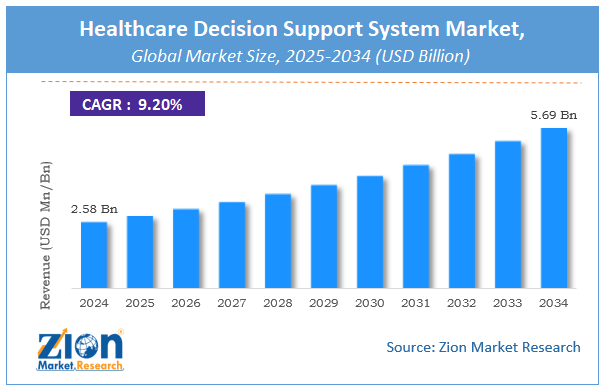
A healthcare decision support system is a computer-based tool that assists healthcare professionals in making clinical decisions by combining clinical expertise, patient information, and other health data. It provides evidence-based recommendations, patient-specific analysis, and alerts to support safer and more effective care.
The factors driving growth in the healthcare decision support system market include the increasing need to reduce medical errors and the growing need to improve clinical outcomes and quality of care. The aging population and the rising number of people affected by chronic diseases have also contributed to growth in the healthcare decision support system market. The rise in government initiatives has also boosted market growth.
Concerns about data security for cloud-based HDSS, higher initial costs of private cloud options, and institutional preference for on-premise solutions can limit adoption of certain delivery models and moderate growth in cloud deployments.

Healthcare Decision Support System Market: Report Scope
| Report Attributes | Report Details |
|---|---|
| Report Name | Healthcare Decision Support System Market |
| Market Size in 2024 | USD 2.58 Billion |
| Market Forecast in 2034 | USD 5.69 Billion |
| Growth Rate | CAGR of 9.2% |
| Number of Pages | 247 |
| Key Companies Covered | Cerner, Epic, MEDITECH, Wolters Kluwer Health, Zynx Health, Elsevier B.V., IBM Watson Health, Allscripts Healthcare Solutions, NextGen Healthcare, Siemens Healthineers, and others. |
| Segments Covered |
By Product, By Delivery Mode, By Model, By Type, By Component, By Application, By Level of Interactivity, By Setting, and By Region |
| Regions Covered | North America, Europe, Asia Pacific (APAC), Latin America, The Middle East and Africa (MEA) |
| Base Year | 2024 |
| Historical Year | 2020 to 2024 |
| Forecast Year | 2025 to 2034 |
| Customization Scope | Avail customized purchase options to meet your exact research needs. Request For Customization |
The healthcare decision support system market is segmented based on product, delivery mode, model, type, component, application, level of interactivity, settings, and region.
Based on Product Segment, the healthcare decision support system market is divided into integrated CDSS and standalone CDSS. The integrated CDSS category represents the most dominant division, accounting for superior market share because embedding algorithmic intelligence directly into electronic health record workflows allows clinicians to receive immediate point-of-care guidance without leaving their core documentation screens. This unified workflow eliminates data re-entry, accelerates clinical charting, and maximizes user adoption across major health systems. Standalone CDSS represents the second most dominant division, maintaining steady demand in specialized clinical domains where deep reference databases for oncology or rare genetics are required without altering core enterprise software architecture.
Based on Delivery Mode Segment, the healthcare decision support system market is divided into on-premise and cloud-based. The cloud-based category represents the most dominant division, capturing high market volume driven by its scalable software-as-a-service model, reduced upfront hardware expenditures, and automatic clinical rule updates. Cloud architectures allow health systems to deploy standardized decision support across distributed outpatient and telehealth environments effortlessly. The on-premise category stands as the second most dominant division, sustaining high commercial value among major academic medical centers and public healthcare institutions requiring local server control to comply with strict patient data sovereignty protocols.
Based on Model Segment, the healthcare decision support system market is divided into knowledge-based and non-knowledge based. The knowledge-based category represents the most dominant division, commanding substantial market revenue through its transparent, rule-based inference engines that cross-reference patient data against verified medical literature, clinical guidelines, and drug interaction compendia. Its clear, explainable logic provides clinicians with dependable, legally defensible recommendations. Non-knowledge-based models represent the second-largest segment, with rapid adoption as healthcare providers embrace machine learning and neural networks to uncover complex clinical patterns in unstructured patient records.
Based on Type Segment, the healthcare decision support system market is divided into therapeutic and diagnostic. The therapeutic category represents the most dominant division, supported by extensive clinical utilization in managing high-volume, high-risk medication orders, verifying proper dosing, and flagging adverse drug interactions. By directly intercepting pharmaceutical errors, therapeutic platforms protect health networks from costly malpractice claims and improve patient safety. Diagnostic decision support is the second-largest division, growing rapidly as medical practitioners use AI-assisted differential diagnosis algorithms to interpret complex medical imaging and laboratory results.
Based on Component Segment, the healthcare decision support system market is divided into services, software, and hardware. The services category represents the most dominant division, generating high recurring revenues from complex systems integration, workflow customization, clinical rule updates, and ongoing staff training required for successful implementation. The software category follows as the second most dominant division, capturing significant commercial value through proprietary decision algorithms, clinical intelligence licenses, and continuous evidence database subscriptions.
Based on Application Segment, the healthcare decision support system market is divided into advanced CDSS and conventional CDSS. The conventional CDSS category represents the most dominant division, accounting for the largest global deployment volume through foundational electronic order sets, standard medication contraindication warnings, and clinical reminders universally adopted in modern hospital facilities. Advanced CDSS stands as the second most dominant division, expanding rapidly as healthcare systems deploy predictive analytics and natural language processing to identify early physiological decompensation in high-risk patients.
Based on Level of Interactivity Segment, the healthcare decision support system market is divided into active CDSS and passive CDSS. The active CDSS category is the most dominant division, commanding a larger market share because real-time automated pop-ups and mandatory order-interception alerts effectively prevent critical medication errors before clinical orders are finalized. Passive CDSS represents the second-largest division, fulfilling a vital informational role by providing searchable medical references and digital dosage calculators that clinicians consult on demand.
Based on Settings Segment, the healthcare decision support system market is divided into in patient and ambulatory care settings. The in patient category represents the most dominant division, driven by high clinical acuity, intensive care monitoring needs, and continuous medication regimens that require round-the-clock decision support oversight in acute hospital wards. Ambulatory care settings represent the second-largest division, growing rapidly as global healthcare delivery shifts toward outpatient clinics, urgent care centers, and primary care networks focused on chronic illness monitoring and preventive healthcare.
North America is predicted to dominate the global market due to high adoption of clinical decision systems by healthcare institutions and the introduction of technologies that link EHRs with decision support to improve patient experience and treatment. This leadership sustains strong demand and influences global product and integration standards.
Recent Development
-
In March 2025, Elsevier enhanced its ClinicalKey platform by integrating AI-powered decision support directly with Epic Systems EHR and DrFirst's iPrescribe, streamlining clinician documentation workflows and delivering actionable therapeutic insights at the bedside.
Browse the full "Healthcare Decision Support System Market By Product (Integrated CDSS, and Standalone CDSS), By Delivery Mode (On-Premise, and Cloud-based), By Model (Knowledge-based, and Non-Knowledge based), By Type (Therapeutic, and Diagnostic), By Component (Services, Software, and Hardware), By Application (Advanced CDSS, and Conventional CDSS), By Level of Interactivity (Active CDSS, and Passive CDSS), By Settings (In Patient, and Ambulatory Care Settings), and By Region - Global and Regional Industry Overview, Market Intelligence, Comprehensive Analysis, Historical Data, and Forecasts 2025 - 2034" report at https://www.zionmarketresearch.com/report/healthcare-decision-support-system-market
Healthcare Decision Support System Market: Competitive Landscape
The global healthcare decision support system market is dominated by players:
- Cerner
- Epic
- MEDITECH
- Wolters Kluwer Health
- Zynx Health
- Elsevier B.V.
- IBM Watson Health
- Allscripts Healthcare Solutions
- NextGen Healthcare
- Siemens Healthineers
Segments Covered
The global healthcare decision support system market is dominated by players:
By Product
- Integrated CDSS
- Standalone CDSS
By Delivery Mode
- On-Premise
- Cloud-based
By Model
- Knowledge-based
- Non-knowledge-based
By Type
- Therapeutic
- Diagnostic
By Component
- Services
- Software
- Hardware
By Application
- Advanced CDSS
- Conventional CDSS
By Level of Interactivity
- Active CDSS
- Passive CDSS
By Setting
- In Patient
- Ambulatory care settings
By Region
- North America
- The U.S.
- Canada
- Mexico
- Europe
- France
- The UK
- Spain
- Germany
- Italy
- Rest of Europe
- Asia Pacific
- China
- Japan
- India
- Australia
- South Korea
- Rest of Asia Pacific
- The Middle East & Africa
- Saudi Arabia
- UAE
- Egypt
- Kuwait
- South Africa
- Rest of the Middle East & Africa
- Latin America
- Brazil
- Argentina
- Rest of Latin America
About Us:
Zion Market Research is an obligated company. We create futuristic, cutting-edge, informative reports ranging from industry reports, the company reports to country reports. We provide our clients not only with market statistics unveiled by avowed private publishers and public organizations but also with vogue and newest industry reports along with pre-eminent and niche company profiles. Our database of market research reports comprises a wide variety of reports from cardinal industries. Our database is been updated constantly in order to fulfill our clients with prompt and direct online access to our database. Keeping in mind the client's needs, we have included expert insights on global industries, products, and market trends in this database. Last but not the least, we make it our duty to ensure the success of clients connected to us-after all-if you do well, a little of the light shines on us.
Contact Us:
Zion Market Research
244 Fifth Avenue, Suite N202
New York, 10001, United States
US OFFICE NO: +1 (302) 444-0166
USA/Canada Toll-Free No: 1-855-465-4651
APAC: +91 7768 006 007, +91 7768 006 008
Email: sales@zionmarketresearch.com
Website: https://www.zionmarketresearch.com