
Global Wave Energy Converter Market Trend, Growth, Size and Forecast 2032

Wave Energy Converter Market By Type (Oscillating Water Column (OWC), Point Absorber, Attenuator, Overtopping Device, Oscillating Wave Surge Converter (OWSC), and Submerged Pressure Differential Device), By Application (Utility-Scale Power Generation, Island & Remote Community Electrification, Desalination Plants, Offshore Oil & Gas Platforms, Defense & Marine Surveillance, and Research & Demonstration Projects), By End User (Utilities, Government & Public Sector, Industrial, Commercial, and Research Institutes), By Technology (Overtopping Devices, Oscillating Body Converters, Rotating Mass Converters, and Oscillating Water Columns), By Installation Location (Nearshore, Offshore, and Shoreline), By Power Output (Up to 100 kW, 100–500 kW, and Above 500 kW), By Component (Power Take-Off (PTO) Systems, Generators, Turbines, Floaters & Buoys, Mooring Systems, Control & Monitoring Systems, and Electrical Infrastructure), and By Region: Global and Regional Industry Overview, Market Intelligence, Comprehensive Analysis, Historical Data, and Forecasts 2024 - 2032-
| Market Size in 2023 | Market Forecast in 2032 | CAGR (in %) | Base Year |
|---|---|---|---|
| USD 18.52 Billion | USD 29.48 Billion | 5.3% | 2023 |
What is the Market size of the Wave Energy Converter Market?
What will be the global wave energy converter market size during the forecast period?
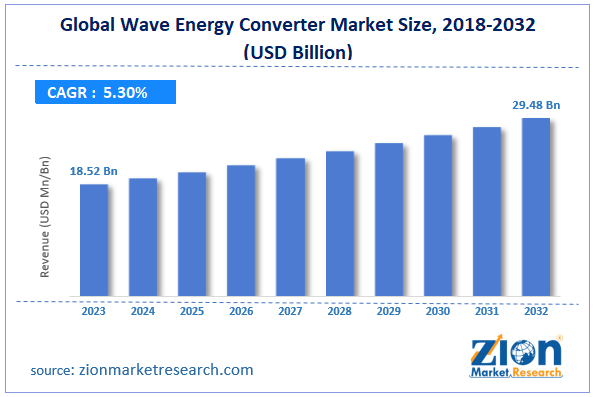
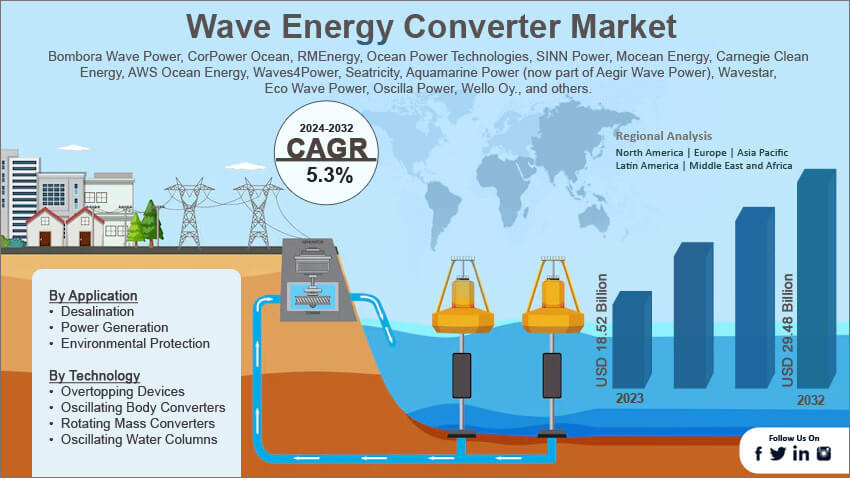
The global wave energy converter market size was worth around USD 18.52 billion in 2023 and is predicted to grow to around USD 29.48 billion by 2032, with a compound annual growth rate (CAGR) of roughly 5.30% between 2024 and 2032.
This report provides a comprehensive analysis of the growth drivers, restraints, and challenges shaping demand across the global wave energy converter market throughout the forecast period, while highlighting high-potential emerging opportunities within the industry.
Key Insights
- As per the analysis shared by our research analyst, the global wave energy converter market is estimated to grow annually at a CAGR of around 5.30% over the forecast period (2024-2032)
- In terms of revenue, the global wave energy converter market size was valued at around USD 18.52 billion in 2023 and is projected to reach USD 29.48 billion by 2032.
- The market is projected to grow at a significant rate due to the rising demand for renewable energy
- Based on application segmentation, power generation was predicted to show maximum market share in the year 2023
- Based on location segmentation, offshore was the leading segment in 2023, supported by growing investments in offshore projects.
- On the basis of region, Europe was the leading revenue generator in 2023, supported by strong renewable energy targets, substantial funding for pilot demonstrations, and active research and development of efficient wave energy solutions.
Wave Energy Converter Market: Overview
Wave energy converters (WECs) are equipment used for converting the potential and kinetic energy of waves into more usable energy forms such as electrical or mechanical power. These converters are beneficial for generating clean energy that can be further used for powering the electrical grid, pumping for seawater desalination, and ocean vehicle propulsion. The most common forms of wave energy converters used are terminators, point absorbers, oscillating wave surge, attenuators, submerged pressure differential, oscillating water column, and rotating mass.
Currently, the industry offers several types of wave energy converters since the device application continues to differ based on wave conditions or ocean environment. The presence of a number of WECs is one of the leading causes of limited growth in the industry since there is a significant lack of standardization. While the application of wave energy converters offers several benefits, the industry is currently facing a low rate of investment. The projection period may generate high growth opportunities for the market players.
Wave Energy Converter Market: Growth Drivers
Rising demand for renewable energy will drive market demand
The global wave energy converter market is expected to witness high growth due to the increasing demand for renewable energy across the globe. One of the more pressing concerns of the modern global world is the negative environmental impact of excessive dependence on nonrenewable energy. The excessive exploitation of natural gas and fossil fuels has a comprehensive impact on the ecosystem. For instance, natural gas extraction is a leading cause of methane release. It is an extremely harmful greenhouse gas. Moreover, natural gas burning also leads to the emission of other intense gases such as sulfur dioxide (SO2), nitrogen oxides (NOx), and carbon monoxide. These power sources are depleting rapidly as the consumption rate is surging exponentially with the rise in industrialization, commercialization, and urbanization. Consumer awareness is also rising steadily as the impact of the overconsumption of non-renewable energy is evident in the constantly changing price of energy units such as petrol and diesel.
Additionally, the supply chain disruptions in the energy sector are directly associated with the growing inflation rate across the globe. Hence, there is a greater need to deploy and harvest renewable energy sources such as solar and wave power. While the former energy type has already gained heavy momentum in the last 5 years, wind energy is witnessing a steady rise in terms of interest and investment from governments and environmental agencies. In 2023, the European Union built around 17 wind power farms following the region’s vision focusing on energy transition by 2030. In March 2024, the Climate Fund Manager, investment advisers, and the Southern African Power Pool (SAPP) announced a new target fund worth USD 1.3 billion, which will be used for the construction of high-voltage transmission lines linking several regions in the South African nation.
Rising investments in offshore activities and deep-sea exploration could fuel the market growth rate
Wave energy converters are expected to generate high demand due to the rising investments in offshore activities across the globe. Offshore projects require extensive sea or ocean-appropriate infrastructure that can support all forms of offshore research and development activities. These infrastructure settings have high energy demands that can be met by harnessing the abundantly available wind energy. Additionally, deep-sea exploration projects are on the rise, which could further impact the global wave energy converter market.
Wave Energy Converter Market: Restraints
High cost of investments and maintenance could restrict the market expansion rate
The global wave energy converter market is expected to be restricted due to the high cost of investment associated with the construction of WECs. When compared to solar or wind energy, harnessing wave power is more expensive due to several challenges concerning the construction of large-scale equipment and its maintenance in harsh and unpredictable waters for multiple years. Additionally, the regulatory framework surrounding permission to use WECs in international waters further deflects potential investment to other areas.
Wave Energy Converter Market: Opportunities
Rising development of novel converters will aid in the market expansion trend
The global wave energy converter market is expected to generate growth opportunities due to the rising development of new and improved converters with higher performance.
In February 2024, a Sweden-based company operating in the wave energy converter sector, CorPower Ocean, announced that its device, C4 WEC, had made a major breakthrough after completing the first cycle of the ocean commissioning program held in Northern Portugal. The new wave energy converter managed to overcome some of the key challenges the device was facing initially in the form of efficient power generation and storm survivability.
In December 2022, researchers at the Indian Institute of Technology (IIT) - Madras developed a new wave energy converter. The electricity-generating tool leverages the power output of the ocean waves and is expected to generate 1 MW of power in the coming three years. The growing focus on the development of WECs that offer all-round services has high growth potential. Since the cost of manufacturing wave energy converters is high, manufacturers are targeting solutions that can be integrated with other energy-generating sources to improve the cost-efficiency of the device.
In October 2023, Hawaii-based startup Wavr LLC announced that it was working on developing a wave energy converter that can be integrated into other renewable energy sources and also offers scalability services. As per the company's plans, once the design can be made commercially available, it will be sold at a price of USD 2300 consisting of five 40 W solar panels.
Rising partnerships and collaborations domestically and internationally will help in further market expansion
The globalization of the renewable energy industry has led to increased investments in international partnerships, which is expected to create a higher growth scope for the global wave energy converter market.
For instance, in August 2023, the Ministry of New and Renewable Energy (MNRE) from India and the U.S. Department of Energy (DOE) announced the launch of the U.S. - India Renewable Energy Technology Action Platform (RETAP) as part of the Strategic Clean Energy Partnership.
Wave Energy Converter Market: Challenges
Achieving optimum efficiency in WECs could be challenging for the industry players
The global industry for wave energy converters faces challenges when trying to optimize the power efficiency of wave energy converters. The current WECs have conversion efficiency below 50%, and to maximize energy collection, they must be tuned to the specific wave frequency, which can be challenging to achieve in harsh weather conditions. The intense environment of the ocean and the seas can further complicate product performance.
Wave Energy Converter Market: Report Scope
| Report Attributes | Report Details |
|---|---|
| Report Name | Wave Energy Converter Market |
| Market Size in 2023 | USD 18.52 Billion |
| Market Forecast in 2032 | USD 29.48 Billion |
| Growth Rate | CAGR of 5.30% |
| Number of Pages | 255 |
| Key Companies Covered | Bombora Wave Power, CorPower Ocean, RMEnergy, Ocean Power Technologies, SINN Power, Mocean Energy, Carnegie Clean Energy, AWS Ocean Energy, Waves4Power, Seatricity, Aquamarine Power (now part of Aegir Wave Power), Wavestar, Eco Wave Power, Oscilla Power, Wello Oy, and others. |
| Segments Covered | By Type, By Application, By End User, By Technology, By Installation Location, By Power Output, By Component, and By Region |
| Regions Covered | North America, Europe, Asia Pacific (APAC), Latin America, Middle East, and Africa (MEA) |
| Base Year | 2023 |
| Historical Year | 2018 - 2022 |
| Forecast Year | 2024 - 2032 |
| Customization Scope | Avail customized purchase options to meet your exact research needs. Request For Customization |
Wave Energy Converter Market: Segmentation
The wave energy converter market is segmented by type, application, end user, technology, installation location, power output, component, and region. All the segments of the wave energy converter market have been analyzed based on present and future trends and the market is estimated from 2024 to 2032.
Based on Type Segment, the wave energy converter market is divided into oscillating water column (OWC), point absorber, attenuator, overtopping device, oscillating wave surge converter (OWSC), and submerged pressure differential device. Multiple converter types exist because device applications continue to differ based on wave conditions or ocean environment. Ongoing development focuses on improving power generation efficiency and storm survivability, which supports broader market adoption. Point absorbers, oscillating water columns, and attenuators remain among the more actively developed designs that help drive technology progress and project deployment.
Based on application, the global market divisions are utility-scale power generation, island and remote community electrification, desalination plants, offshore oil and gas platforms, defense and marine surveillance, and research and demonstration projects. In 2023, the highest demand was witnessed in the power generation segment. The growing energy needs across industries and increased focus on generating clean energy are fueling the segmental growth rate. In 2022, the global renewable energy market was valued at over USD 900 billion and is expected to emerge as one of the fastest-growing industries during the forecast period.
Based on end user, the wave energy converter market is divided into utilities, government and public sector, industrial, commercial, and research institutes. Utilities and government and public sector users anchor primary demand through renewable energy targets and clean power procurement. Research institutes support secondary but critical activity through demonstration projects and technology validation that underpin long-term market growth.
Based on technology, the global wave energy converter industry is segmented into overtopping devices, oscillating body converters, rotating mass converters, and oscillating water columns. Oscillating body converters and oscillating water columns are among the more established approaches, while overtopping and rotating mass designs continue to be refined for specific site conditions. Technology progress that improves conversion efficiency and survivability supports overall market development.
Based on installation location, the global market segments are nearshore, offshore, and shoreline. In 2023, the highest demand was observed in the offshore segment. The growing investments in offshore projects are expected to drive the segmental demand. However, this equipment has to be extremely advanced in terms of technology. Additionally, wave energy converters can also be placed nearshore in areas with strong waves. As per market research, wave energy, if harnessed efficiently, can create up to 2 terawatts (TW) per year globally.
Wave Energy Converter Market: Regional Analysis
Why will Europe continue to dominate the global market during the projection period?
The global wave energy converter market is expected to witness the highest growth in Europe during the forecast period. The region is one of the largest markets for clean and renewable energy. It has registered massive investments in the renewable sector in the last decade. As per official reports, the European Union has revised its renewable energy vision in the form of the Renewable Energy Directive EU/2023/2413. As per the new set of targets, the region has set a minimum target of 42.5% for renewable energy. Countries such as Spain and Scotland are at the forefront of wave energy generation. Around USD 82 million has been allotted from the Horizon Europe 2023-24 funding for the pilot farm demonstrations.
In addition to this, the regional players are extensively working on researching and developing the most efficient ways to harness wave energy. They are leading the development trajectory with the successful launch of a new wave energy converter. North America is expected to generate significant growth in the coming years. The US is projected to lead the regional market growth rate. In March 2022, CalWave Power Technologies launched California’s first long-term WEC for harnessing the power of wave energy.
Wave Energy Converter Market: Competitive Analysis
The global wave energy converter market is led by players like:
- Bombora Wave Power
- CorPower Ocean
- RMEnergy
- Ocean Power Technologies
- SINN Power
- Mocean Energy
- Carnegie Clean Energy
- AWS Ocean Energy
- Waves4Power
- Seatricity
- Aquamarine Power (now part of Aegir Wave Power)
- Wavestar
- Eco Wave Power
- Oscilla Power
- Wello Oy.
Segments Covered
The global wave energy converter market is segmented as follows:
By Type
- Oscillating Water Column (OWC)
- Point Absorber
- Attenuator
- Overtopping Device
- Oscillating Wave Surge Converter (OWSC)
- Submerged Pressure Differential Device
By Application
- Utility-Scale Power Generation
- Island & Remote Community Electrification
- Desalination Plants
- Offshore Oil & Gas Platforms
- Defense & Marine Surveillance
- Research & Demonstration Projects
By End User
- Utilities
- Government & Public Sector
- Industrial
- Commercial
- Research Institutes
By Technology
- Overtopping Devices
- Oscillating Body Converters
- Rotating Mass Converters
- Oscillating Water Columns
By Installation Location
- Nearshore
- Offshore
- Shoreline
By Power Output
- Up to 100 kW
- 100–500 kW
- Above 500 kW
By Component
- Power Take-Off (PTO) Systems
- Generators
- Turbines
- Floaters & Buoys
- Mooring Systems
- Control & Monitoring Systems
- Electrical Infrastructure
By Region
- North America
- The U.S.
- Canada
- Mexico
- Europe
- France
- The UK
- Spain
- Germany
- Italy
- Rest of Europe
- Asia Pacific
- China
- Japan
- India
- Australia
- South Korea
- Rest of Asia Pacific
- The Middle East & Africa
- Saudi Arabia
- UAE
- Egypt
- Kuwait
- South Africa
- Rest of the Middle East & Africa
- Latin America
- Brazil
- Argentina
- Rest of Latin America
Table Of Content
Methodology
FrequentlyAsked Questions
Wave energy converters (WECs) are equipment used for converting the potential and kinetic energy of waves into more usable energy forms such as electrical or mechanical power.
Key growth drivers include the rising demand for renewable energy, the environmental impact of fossil fuels, the need to diversify energy sources amid supply and price pressures, and growing investments in offshore activities and deep-sea exploration.
According to study, the global wave energy converter market size was worth around USD 18.52 billion in 2023 and is predicted to grow to around USD 29.48 billion by 2032.
The global wave energy converter market is expected to grow at a compound annual growth rate (CAGR) of approximately 5.3% during the forecast period from 2024 to 2032.
Europe was the leading revenue generator in 2023 and is expected to remain a primary market, supported by strong renewable energy targets, funding for pilot demonstrations, and active technology development.
The global wave energy converter market is led by players like Bombora Wave Power, CorPower Ocean, RMEnergy, Ocean Power Technologies, SINN Power, Mocean Energy, Carnegie Clean Energy, AWS Ocean Energy, Waves4Power, Seatricity, Aquamarine Power (now part of Aegir Wave Power), Wavestar, Eco Wave Power, Oscilla Power and Wello Oy.
The report explores crucial aspects of the wave energy converter market including detailed discussion of existing growth factors and restraints while also browsing future growth opportunities and challenges that impact the market.

HappyClients

