
Tissue Nanotransfection Market Size, Share, Value and Forecast 2034

Tissue Nanotransfection Market By Product Type (Nanochip Devices, Delivery Cartridges, Software and Control Systems, Accessories and Consumables), By Application (Wound Healing, Tissue Regeneration, Cell Reprogramming, Vascular Repair, Neurological Repair), By End-User (Hospitals, Research and Academic Institutes, Biotechnology Companies, Specialty Clinics), By Distribution Channel (Direct Institutional Sales, Distributor Partnerships, Online Medical Equipment Platforms, Government and Tender Procurement), and By Region - Global and Regional Industry Overview, Market Intelligence, Comprehensive Analysis, Historical Data, and Forecasts 2026 - 2034
| Market Size in 2025 | Market Forecast in 2034 | CAGR (in %) | Base Year |
|---|---|---|---|
| USD 82.63 Million | USD 468.27 Million | 20.89% | 2025 |
Tissue Nanotransfection Industry Perspective:
What will be the size of the tissue nanotransfection market during the forecast period?
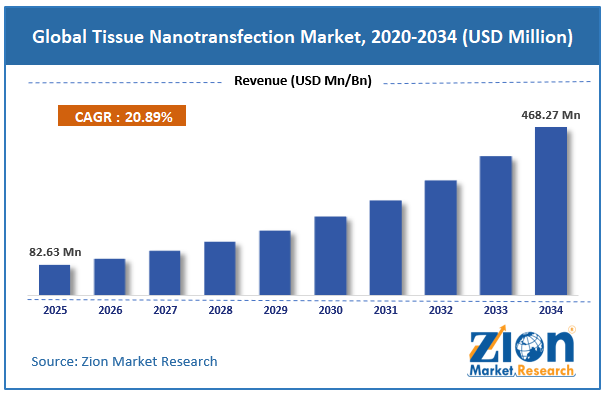
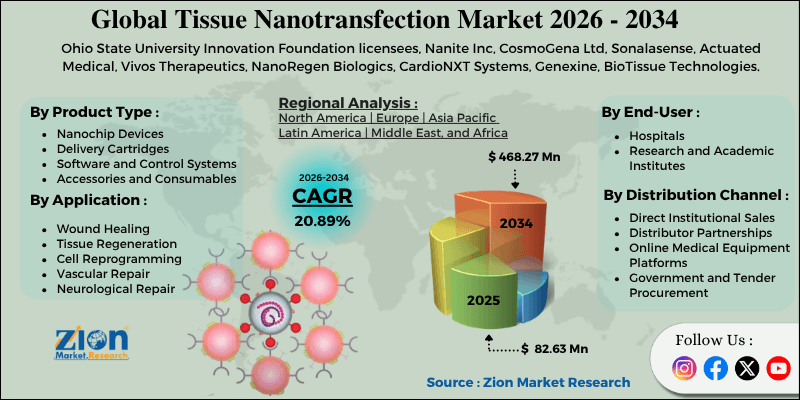
The global tissue nanotransfection market size was approximately USD 82.63 million in 2025 and is projected to reach USD 468.27 million by 2034, growing at a compound annual growth rate of approximately 20.89% between 2026 and 2034.
Key Insights
- According to our research team's analysis, the global tissue nanotransfection market is expected to grow at a compound annual growth rate of approximately 20.89% over the forecast period from 2025 to 2034.
- In terms of revenue, the global tissue nanotransfection market was valued at approximately USD 82.63 million in 2025 and is projected to reach USD 468.27 million by 2034.
- The tissue nanotransfection market is expected to grow steadily due to rising demand for non-surgical regenerative treatments, increasing cases of chronic wounds and vascular diseases, and increasing research funding from both government and private organizations.
- Based on product type, nanochip devices hold the largest market share, as they form the core technology for every procedure, while software and control systems are growing the fastest due to rising demand for precision dosing and treatment personalization.
- Based on application, tissue regeneration leads the market as hospitals adopt the technology for faster healing outcomes, while vascular repair applications are growing steadily as awareness of non-invasive blood flow restoration increases.
- Based on end user, hospitals hold the largest market share due to high patient volumes needing wound and tissue care, while research and academic institutes are growing rapidly as more studies explore new treatment possibilities.
- Based on distribution channel, direct institutional sales lead the market because hospitals and research centers prefer working closely with manufacturers, while distributor partnerships are expanding steadily to reach smaller clinics and international markets.
- Based on region, North America leads the global tissue nanotransfection market due to a strong research infrastructure and early technology adoption, followed by Europe, where growing healthcare investment and supportive regulatory pathways are driving further growth.
Tissue Nanotransfection Market: Overview
Tissue nanotransfection is a regenerative medicine technology that uses a small nanochip and a gentle electrical pulse to deliver genetic material into skin cells, helping them differentiate into other cell types that can repair damaged tissues. This technology allows doctors and researchers to reprogram cells directly on the body without surgery, viral gene delivery, or complex laboratory procedures. By turning a patient's own skin cells into healing cells, tissue nanotransfection can help restore blood flow, repair damaged nerves, heal chronic wounds, and support faster tissue recovery. Because the treatment is minimally invasive and uses the body's natural cells, it has the potential to be safer, faster, and more affordable than many traditional cell therapies. Hospitals, research institutes, and biotechnology companies are actively studying this technology for a wide range of medical conditions. Growing investment in regenerative medicine, increasing cases of chronic wounds and vascular diseases, and continuous advances in nanochip technology are driving the tissue nanotransfection market. Ongoing research, clinical studies, and funding from governments and private organizations are expected to support worldwide market growth further.
The tissue nanotransfection industry is expanding steadily as hospitals, researchers, and biotechnology firms recognize its potential to transform the delivery of tissue repair and regeneration to patients worldwide.
Impact of the USA-Israel War on Iran on the Tissue Nanotransfection Market
Rising tensions among the United States, Israel, and Iran could disrupt the global supply chain of specialized electronic components and semiconductor materials used in nanochip manufacturing and delay some international research collaborations. However, hospitals, universities, and biotechnology firms continue to prioritize regenerative medicine research because the long-term medical benefits are considered essential regardless of short-term geopolitical disruptions. As demand for advanced wound care and tissue repair solutions continues to rise, the tissue nanotransfection market is expected to maintain its growth trajectory despite temporary setbacks.
Tissue Nanotransfection Market: Technology Roadmap 2026–2034
What is the projected development roadmap of the tissue nanotransfection market over the forecast period?
The tissue nanotransfection market is advancing through smaller, more precise nanochips, improved genetic delivery methods, better software for personalized treatment, and the growing use of artificial intelligence to guide dosing and monitor healing progress. The market is expected to grow at a compound annual growth rate of approximately 20.89% during the forecast period, driven by increasing clinical validation, growing hospital adoption, and continuous innovation in chip design and delivery techniques.
The following roadmap outlines key development phases expected through 2034.
2026–2028: Clinical Validation and Early Adoption Phase
- More refined nanochip designs are expected to see wider testing in hospitals and specialty wound care clinics as clinical evidence continues to build.
- Improved cartridge and delivery systems are expected to make treatments more consistent and easier for medical staff to administer.
- Expanding distributor partnerships are expected to help bring this technology to more hospitals and clinics across different regions.
2029–2032: Precision Treatment and Integration Phase
- Artificial intelligence-powered software is expected to help doctors personalize treatment settings based on each patient's specific tissue condition.
- Connected devices with real-time monitoring are expected to allow doctors to track healing progress remotely and adjust treatment as needed.
- Combination therapies that pair tissue nanotransfection with other regenerative techniques are expected to offer more complete healing solutions.
2033–2034: Widespread Clinical Integration Phase
- Advanced chip technology is expected to help treat a broader range of conditions beyond wound healing and vascular repair, including neurological tissue damage.
- Next-generation devices with longer shelf life and simpler operation are expected to make the technology accessible to smaller clinics and rural healthcare centers.
- Stronger training programs and standardized treatment protocols are expected to support consistent and reliable use across the healthcare industry.
Tissue Nanotransfection Market: Dynamics
Growth Drivers
The tissue nanotransfection market is growing, driven by rising demand for faster and safer tissue repair solutions.
The tissue nanotransfection industry is growing as hospitals, researchers, and healthcare providers seek faster, less invasive ways to treat damaged tissues. This advanced technology helps reprogram a patient's skin cells directly on the body without surgery or lengthy laboratory procedures, making treatment quicker and more convenient. The rising number of people with chronic wounds, diabetic ulcers, nerve damage, and blood vessel injuries is increasing the demand for effective regenerative therapies. Governments, research organizations, and private investors are providing more funding for regenerative medicine because it has the potential to improve healing, reduce healthcare costs, and lower the need for repeated treatments.
Hospitals are also exploring tissue nanotransfection to improve patient recovery, shorten hospital stays, and reduce the burden on surgical departments. Growing awareness of regenerative medicine is encouraging more clinical research and medical studies worldwide. At the same time, continuous improvements in nanochip technology, gene delivery methods, and treatment precision are making this technology safer, more reliable, and easier to use. These advancements are driving the growth of the tissue nanotransfection market and supporting its future adoption across a wide range of medical applications.
How is the growing focus on non-invasive regenerative medicine driving the tissue nanotransfection market?
The tissue nanotransfection market is growing as more hospitals and patients seek treatments that do not require surgery, viral gene delivery, or lengthy laboratory procedures. This innovative technology helps repair damaged tissues, restore blood flow, and support nerve healing by using a small device placed on the skin, making treatment less invasive and more convenient. It is especially beneficial for elderly patients and people with chronic health conditions who may not be suitable for surgery. Rising healthcare costs and the growing demand for faster recovery are encouraging healthcare providers to adopt regenerative medicine technologies like tissue nanotransfection.
More hospitals, specialty clinics, and research centers are investing in this technology as awareness of its potential benefits continues to increase. Equipment financing and leasing programs are also making it easier for smaller healthcare providers to access advanced treatment devices. At the same time, ongoing research is improving nanochip design, gene delivery methods, and treatment accuracy, leading to better patient outcomes. These advancements are supporting the steady growth of the tissue nanotransfection market and creating new opportunities for healthcare providers and medical device companies worldwide.
Restraints
How are high development costs and limited clinical data affecting the tissue nanotransfection market?
The tissue nanotransfection industry faces several challenges that may slow its growth. One of the biggest challenges is the high cost of developing and manufacturing advanced nanochips and the software needed to control them. This makes the technology expensive for many small hospitals and clinics. Since tissue nanotransfection is still a new treatment, there is limited long-term clinical evidence, making some doctors and healthcare providers cautious about using it in routine medical care. The approval process for new medical devices is also strict and time-consuming, which can delay product launches.
In addition, many healthcare professionals and patients remain unaware of this technology and its benefits, which limits its adoption. Reimbursement policies for tissue nanotransfection treatments are also not fully established in many countries, creating financial uncertainty for hospitals and patients. Despite these challenges, ongoing clinical trials, technological improvements, lower manufacturing costs, and expanding physician training programs are expected to support the long-term growth of the tissue nanotransfection market.
Opportunities
Emerging applications, the integration of artificial intelligence, and expanding healthcare access are driving opportunities in the tissue nanotransfection market.
The tissue nanotransfection market offers strong growth opportunities as more countries invest in regenerative medicine and modern healthcare infrastructure. Developing regions across Asia Pacific, Latin America, the Middle East, and Africa are expanding hospitals and healthcare facilities, creating greater demand for advanced and affordable regenerative treatments. Tissue nanotransfection has the potential to improve healing without surgery, making it an attractive option for healthcare providers and patients. The growing use of artificial intelligence in healthcare is also helping doctors plan personalized treatments and creating opportunities for manufacturers to develop smarter, more precise medical devices.
Partnerships between hospitals, biotechnology companies, and research institutions are supporting the development of new applications, including nerve repair, blood vessel regeneration, and organ tissue healing. Flexible financing options are making these advanced technologies more accessible to healthcare providers. Governments are increasing funding for regenerative medicine research and introducing policies that encourage medical innovation. Investments in specialty wound care centers, research facilities, and advanced hospitals are further supporting market growth. These trends are expected to expand the tissue nanotransfection industry, improve patient access to innovative treatments, and create long-term opportunities across developed and emerging economies.
Challenges
What challenges does the tissue nanotransfection market face in achieving broad adoption and delivering long-term value?
The tissue nanotransfection market faces several challenges that may affect its growth. One of the biggest challenges is ensuring that the treatment delivers consistent results for different patients, as factors such as age, skin type, and existing health conditions can influence its effectiveness. Another concern is maintaining a reliable supply of specialized materials and components required to manufacture nanochips, especially amid global supply chain disruptions.
Many hospitals, doctors, and patients also need better awareness and understanding of how tissue nanotransfection works and what benefits it can provide. In addition, manufacturers must comply with evolving medical device regulations and safety standards, which can increase development time and costs. Growing competition among regenerative medicine companies is also encouraging manufacturers to develop safer, more effective, and affordable devices. Despite these challenges, continued clinical research, increasing demand for non-invasive regenerative treatments, and growing government support for medical innovation are expected to drive the long-term growth of the tissue nanotransfection market.
Tissue Nanotransfection Market: Report Scope
| Report Attributes | Report Details |
|---|---|
| Report Name | Tissue Nanotransfection Market |
| Market Size in 2025 | USD 82.63 Million |
| Market Forecast in 2034 | USD 468.27 Million |
| Growth Rate | CAGR of 20.89% |
| Number of Pages | 227 |
| Key Companies Covered | Ohio State University Innovation Foundation licensees, Nanite Inc, CosmoGena Ltd, Sonalasense, Actuated Medical, Vivos Therapeutics, NanoRegen Biologics, CardioNXT Systems, Genexine, BioTissue Technologies, and others. |
| Segments Covered | By Product Type, By Application, By End-User, By Distribution Channel, and By Region |
| Regions Covered | North America, Europe, Asia Pacific (APAC), Latin America, Middle East, and Africa (MEA) |
| Base Year | 2025 |
| Historical Year | 2020 - 2024 |
| Forecast Year | 2026 - 2034 |
| Customization Scope | Avail customized purchase options to meet your exact research needs. Request For Customization |
Tissue Nanotransfection Market: Segmentation
The global tissue nanotransfection market is segmented by product type, application, end user, distribution channel, and region.
What makes nanochip devices the dominant product type in the tissue nanotransfection market?
Based on product type, the global tissue nanotransfection industry is divided into nanochip devices, delivery cartridges, software and control systems, and accessories and consumables. Nanochip devices lead with about a 52% share because they are the essential core technology required for every single treatment procedure. The software and control systems segment holds around 24% of the market share. It is growing rapidly due to increasing demand for precise, personalized treatment settings.
How does tissue regeneration maintain its leading position in the tissue nanotransfection market?
Based on application, the tissue nanotransfection market is segregated into wound healing, tissue regeneration, cell reprogramming, vascular repair, and neurological repair. Tissue regeneration accounts for about 38% of the market share, as hospitals continue to adopt the technology to help patients heal faster from injuries and chronic conditions. The vascular repair segment holds around 26% share. It is growing steadily as more doctors use the technology to help restore healthy blood flow in damaged tissue.
Which healthcare facilities are the primary users of tissue nanotransfection technology?
Based on end-user, the market is classified into hospitals, research and academic institutes, biotechnology companies, and specialty clinics. Hospitals hold around a 47% share because they treat the largest number of patients needing wound care and tissue repair. The research and academic institutes segment accounts for about 28% of the market share. It is growing rapidly due to an increasing number of studies exploring new treatment applications and improved chip designs.
Which distribution channel holds the largest share of the tissue nanotransfection market?
Based on distribution channel, the tissue nanotransfection market is categorized into direct institutional sales, distributor partnerships, online medical equipment platforms, and government and tender procurement. Direct institutional sales account for about 49% of market share because hospitals and large research centers prefer to purchase directly from manufacturers to ensure proper training and support. The distributor partnerships segment holds around 27% share. It continues expanding by helping smaller clinics and international markets access the technology.
Tissue Nanotransfection Market: Regional Analysis
What factors are driving the growth of the tissue nanotransfection market in North America?
The North America tissue nanotransfection market is the largest regional market and is expected to grow at a CAGR of around 11.2% during the forecast period. The region leads because of its advanced healthcare system, strong medical research capabilities, and early adoption of innovative treatment technologies. The United States holds the largest market share due to the presence of leading research universities, biotechnology companies, and hospitals that actively invest in regenerative medicine. Many healthcare organizations are working with research institutes and medical device companies to conduct clinical trials and develop new tissue nanotransfection treatments.
Companies are also investing in improving nanochip technology, gene delivery methods, and software systems to make treatments safer and more effective. Canada is contributing to market growth through government-funded medical research, the expansion of healthcare infrastructure, and partnerships between hospitals and academic institutions. Mexico is emerging as a growing market as healthcare providers explore affordable regenerative medicine solutions for wound healing and tissue repair. The region also benefits from advanced manufacturing, strong research networks, and continuous technological innovation. Rising cases of chronic wounds, vascular diseases, and nerve injuries, along with increasing investments in regenerative medicine, expanding hospital infrastructure, and supportive government funding, continue to strengthen the North America tissue nanotransfection market and drive its long-term growth.
Why are healthcare investments accelerating the European tissue nanotransfection market?
The European tissue nanotransfection market is the second-largest regional market and is expected to grow at a CAGR of around 11.8% during the forecast period. The region is growing as hospitals, research institutes, and healthcare providers invest more in regenerative medicine to improve patient care and reduce the need for traditional surgery. Germany, the United Kingdom, France, the Netherlands, and the Nordic countries are making significant investments in medical research, modern hospitals, and advanced regenerative treatment programs. Germany and the United Kingdom lead the regional market due to their strong healthcare systems, active medical research, and growing demand for advanced wound-healing and tissue-repair solutions.
Many hospitals are exploring tissue nanotransfection as a less invasive treatment that can improve recovery and reduce hospital stays. Governments across Europe are supporting medical innovation through research funding, healthcare modernization, and policies that encourage the development of advanced therapies. Medical technology companies are also improving nanochip design, treatment accuracy, and gene delivery systems to make the technology safer and more effective. Growing awareness of regenerative medicine, expanding specialty wound care centers, rising healthcare investments, and continuous technological advancements are expected to support the long-term growth of the European tissue nanotransfection market.
Recent Market Developments
- In July 2026, Auxilium Biotechnologies announced a major milestone in regenerative medicine by successfully bioprinting human liver, kidney, and cartilage tissue aboard the International Space Station, advancing research into next-generation tissue repair and regenerative therapies.
- In March 2026, the American Diabetes Association recognized Dr. Chandan K. Sen, co-inventor of tissue nanotransfection, with the 2026 Roger E. Pecoraro Award for his contributions to regenerative medicine and advanced wound healing research.
Tissue Nanotransfection Market: Competitive Analysis
The leading players in the global tissue nanotransfection market are:
- Ohio State University Innovation Foundation licensees
- Nanite Inc
- CosmoGena Ltd
- Sonalasense
- Actuated Medical
- Vivos Therapeutics
- NanoRegen Biologics
- CardioNXT Systems
- Genexine
- BioTissue Technologies
The global tissue nanotransfection market is segmented as follows:
By Product Type
- Nanochip Devices
- Delivery Cartridges
- Software and Control Systems
- Accessories and Consumables
By Application
- Wound Healing
- Tissue Regeneration
- Cell Reprogramming
- Vascular Repair
- Neurological Repair
By End-User
- Hospitals
- Research and Academic Institutes
- Biotechnology Companies
- Specialty Clinics
By Distribution Channel
- Direct Institutional Sales
- Distributor Partnerships
- Online Medical Equipment Platforms
- Government and Tender Procurement
By Region
- North America
- The U.S.
- Canada
- Mexico
- Europe
- France
- The UK
- Spain
- Germany
- Italy
- Rest of Europe
- Asia Pacific
- China
- Japan
- India
- Australia
- South Korea
- Rest of Asia Pacific
- The Middle East & Africa
- Saudi Arabia
- UAE
- Egypt
- Kuwait
- South Africa
- Rest of the Middle East & Africa
- Latin America
- Brazil
- Argentina
- Rest of Latin America
Table Of Content
Methodology
FrequentlyAsked Questions
Tissue nanotransfection is a regenerative medicine technology that uses a small nanochip and a gentle electrical pulse to deliver genetic material into skin cells, helping them differentiate into other cell types that can repair damaged tissues. This technology allows doctors and researchers to reprogram cells directly on the body without surgery, viral gene delivery, or complex laboratory procedures.
The global tissue nanotransfection market is expected to grow, driven by rising demand for non-invasive regenerative treatments, increasing cases of chronic wounds and vascular diseases, increasing government and private research funding, and continuous improvements in nanochip and software technologies.
According to research, the global tissue nanotransfection market was valued at approximately USD 82.63 million in 2025 and is projected to reach approximately USD 468.27 million by 2034.
The compound annual growth rate of the tissue nanotransfection market is expected to be approximately 20.89% from 2026 to 2034.
North America is expected to lead the global tissue nanotransfection market throughout the forecast period, driven by strong research infrastructure, early technology adoption, and supportive government funding for medical innovation.
The major players in the global tissue nanotransfection market include Nanite Inc, CosmoGena Ltd, Sonalasense, Actuated Medical, Vivos Therapeutics, NanoRegen Biologics, CardioNXT Systems, Genexine, and BioTissue Technologies.
The report examines key aspects of the tissue nanotransfection market, including growth drivers, adoption barriers, emerging opportunities, competitive dynamics, detailed regional performance, and a forward-looking outlook across all major product types, applications, end-user segments, and geographic regions through 2034.
The tissue nanotransfection market offers opportunities in regenerative medicine research, nanochip development, clinical trials, and partnerships among biotechnology companies, hospitals, research institutions, and medical device manufacturers to accelerate innovation and commercialization.
The tissue nanotransfection market value chain includes research and development, nanochip design, material sourcing, device manufacturing, regulatory approval, clinical testing, distribution, hospital adoption, treatment delivery, and post-treatment monitoring.
The tissue nanotransfection market is being transformed by advancements in nanochip precision, gene delivery technologies, artificial intelligence-powered treatment planning, and real-time monitoring systems, enabling more accurate treatments, improved healing outcomes, personalized therapies, and reduced treatment-related complications.

HappyClients

