
Solar Shading Systems Market Size, Share, Growth, Opportunities 2034

Solar Shading Systems Market By Product Type (External Shading Systems, Internal Shading Systems, Fixed Shading Systems, Dynamic Solutions, and Others), By Geometry (Egg-Crate, Vertical, and Horizontal), By Material (Metal, Glass, Wood, and Others), By Application (Residential and Non-Residential), and By Region - Global and Regional Industry Overview, Market Intelligence, Comprehensive Analysis, Historical Data, and Forecasts 2025 - 2034
| Market Size in 2024 | Market Forecast in 2034 | CAGR (in %) | Base Year |
|---|---|---|---|
| USD 13.03 Billion | USD 17.07 Billion | 3.05% | 2024 |
Solar Shading Systems Industry Perspective:
What is the anticipated size of the global solar shading systems market during the projection period?
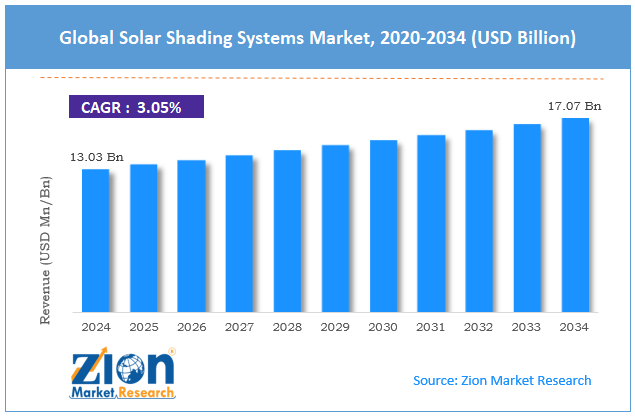
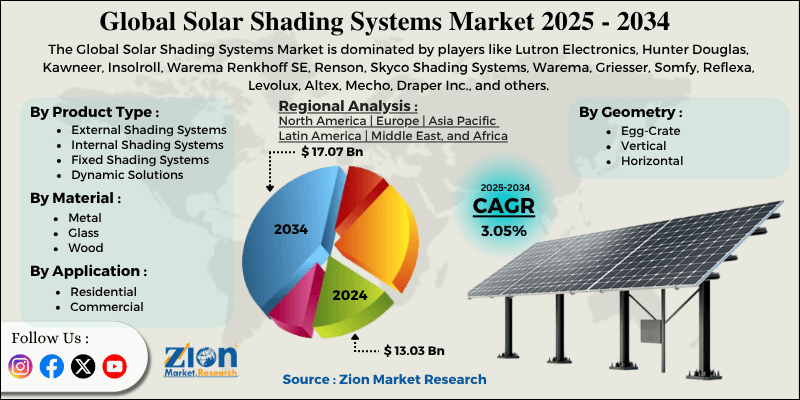
The global solar shading systems market size was worth around USD 13.03 billion in 2024 and is predicted to grow to around USD 17.07 billion by 2034, with a compound annual growth rate (CAGR) of roughly 3.05% between 2025 and 2034.
Key Insights:
- As per the analysis shared by our research analyst, the global solar shading systems market is estimated to grow annually at a CAGR of around 3.05% over the forecast period (2025-2034)
- In terms of revenue, the global solar shading systems market size was valued at around USD 13.03 billion in 2024 and is projected to reach USD 17.07 billion by 2034.
- The solar shading systems market is projected to grow at a significant rate due to global warming.
- Based on the product type, the external shading systems segment is growing at a high rate and will continue to dominate the global market, as per industry projections
- Based on the geometry, the horizontal segment is anticipated to command the largest market share
- Based on the material, the metal segment is expected to lead the market growth trends
- Based on the application, the residential segment is projected to influence revenue in the market
- Based on region, the Asia-Pacific is projected to dominate the global market during the forecast period
Solar Shading Systems Market: Overview
Solar shading systems are different types of solutions employed to control the amount of light and heat entering a building. According to market analysis, solar shading has become essential to ensure building energy efficiency without impacting the visual and thermal comfort of the structure. For instance, excessive natural light in a room can lead to overheating, necessitating extensive cooling and increasing expenses. Solar shading systems are designed to mitigate visual discomfort and glare, especially in buildings with large glazed areas. Solar shading solutions are of different types, including internal and external solutions. Most commonly used shading systems include overhangs, brise-soleil, external louvers, and roller blinds.
During the forecast period, demand for solar sharing systems is expected to continue growing, driven by rising temperatures across the globe. Increased demand for energy-efficient buildings will further facilitate improved revenue in the industry. However, the high cost of permanent structures and dynamic building codes may impact final market revenue in the coming years.
Solar Shading Systems Market: Dynamics
Growth Drivers
How will global warming influence demand in the solar shading systems market?
The global solar shading systems market is expected to grow due to global warming. The effects of rising temperatures can be recorded worldwide. According to official records, Earth’s surface temperature has increased by 1.3°C to 1.5°C compared to 1850–1900. Additionally, 2015-2024 was the warmest 10-year period on record. Key drivers of global warming include increased greenhouse gas emissions, rapid industrialization, unplanned construction, and increased human influence.
Global warming has led to increased demand for air conditioning systems, which further adds to the rising temperatures across the globe. Solar shading systems help control the amount of sunlight entering a building, thus reducing the reliance on air conditioning systems. Effectively designed smart solar shading systems can reduce a building's heating and cooling costs by over 69%. Shading solutions have thus become widely popular structures in buildings with high solar exposure.
Growing demand for energy-efficient buildings to aid market expansion during the forecast period
Energy-efficient buildings are gaining more acceptance in the global building & construction sector. These buildings are designed to optimize energy use by reducing cooling demand. In addition, they enhance residents’ comfort by maintaining indoor temperature and minimizing solar glare. Furthermore, the construction of energy-efficient buildings is facilitated by evolving government regulations. For instance, the revised Energy Performance of Buildings Directive (EU/2024/1275), introduced in May 2024, requires all new buildings in Europe to achieve zero emissions by 2030, thereby favoring the global solar shading systems market.
Restraints
Why will cost barriers limit the solar shading systems market revenue in the coming years?
The global solar shading systems industry is expected to be restricted due to the high cost of initial investment. Advanced shading systems for a building can cost between USD 60 and USD 150 per square meter or up to 15% of the total façade cost. In addition, the lack of sufficient repair and maintenance service providers and the need for skilled labor further add to the overall cost of technology ownership, discouraging industry investment in the coming years.
Opportunities
Technology-driven and next-generation solar shading systems to generate growth opportunities
The global solar shading systems market is projected to generate growth opportunities due to the rising demand for next-generation shading systems. It includes Artificial Intelligence (AI) and smart sensor-powered shading technologies with remote control and predictive maintenance features. Some of the leading additions to next-generation solutions include improved materials limiting dust and heat, built-in power electronics, on-board intelligence, and Internet of Things (IoT) connectivity.
For instance, in January 2025, Mado Dynamic, a leading provider of smart home devices, launched a new range of AI-led, dynamic, and energy-efficient window shades. The new range offers sustainable and affordable solutions to end-users. Key features of the new range include zero maintenance, smart maintenance, do-it-yourself (DIY) installation, and climate sustainability.
In August 2025, Nordic Alpha Partners announced the acquisition of all MicroShade assets and patents. The latter owns the unique 3D micro-structure engineering solution built into glazing systems. The move will allow Nordic Alpha Partners to strengthen its hold on the solar shading systems industry in the coming years.
Challenges
How will aesthetic concerns and challenges with retrofitting projects affect the solar shading systems market revenue?
The global solar shading systems industry is projected to be challenged by concerns over the solutions impacting the overall aesthetic appeal of buildings, especially permanent structures. Additionally, the difficulty of integrating modern solar shading systems into existing structures and a lack of consumer awareness may further impact market revenue in the long run.
Solar Shading Systems Market: Report Scope
| Report Attributes | Report Details |
|---|---|
| Report Name | Solar Shading Systems Market |
| Market Size in 2024 | USD 13.03 Billion |
| Market Forecast in 2034 | USD 17.07 Bllion |
| Growth Rate | CAGR of 3.05 |
| Number of Pages | 225 |
| Key Companies Covered | Lutron Electronics, Hunter Douglas, Kawneer, Insolroll, Warema Renkhoff SE, Renson, Skyco Shading Systems, Warema, Griesser, Somfy, Reflexa, Levolux, Altex, Mecho, Draper Inc., and others. |
| Segments Covered | By Product Type, By Geometry, By Material, By Application, and By Region |
| Regions Covered | North America, Europe, Asia Pacific (APAC), Latin America, Middle East, and Africa (MEA) |
| Base Year | 2024 |
| Historical Year | 2019 to 2023 |
| Forecast Year | 2025 - 2034 |
| Customization Scope | Avail customized purchase options to meet your exact research needs. Request For Customization |
Solar Shading Systems Market: Segmentation
The global solar shading systems market is segmented based on product type, geometry, material, application, and region.
Why will external sharing systems lead the solar shading systems market during the forecast period?
Based on product type, the global market segments are external shading systems, internal shading systems, fixed shading systems, dynamic solutions, and others. In 2024, the highest growth was listed in the external shading systems segment, accounting for nearly 55% of the global revenue. These solutions are designed to block sunlight from entering the building, thereby affecting the building's overall energy demand. The segment is expected to continue leading the market with a CAGR of 7.1% during the forecast period.
Which factors are fueling revenue in the horizontal segment of the solar shading systems industry?
Based on geometry, the global solar shading systems industry is fragmented into egg-crate, vertical, and horizontal. In 2024, the industry was led by a horizontal segment, which accounted for 50% of the global revenue. It is expected to deliver a CAGR of 3.5% due to its applications in blocking overhead sunlight on buildings. Horizontal solar shading systems are used in both residential and non-residential buildings.
Which is the leading material in the solar shading systems market?
Based on material, the global market divisions are metal, glass, wood, and others. The metal segment was the highest revenue generator in 2024, accounting for 38% of global revenue. It is projected to deliver a CAGR of 4.45% in the coming years, led by the effectiveness of the material in daylight management. Additionally, the robustness of metal-based solar shading systems will further aid segmental dominance in the future.
Why will the residential segment emerge as the highest revenue generator in the solar shading systems market in the future?
Based on application, the global market is divided into residential and non-residential. In 2024, the residential segment dominated the global revenue, and similar trends are expected in the future. Over 60% of the final 2024 revenue was listed in the residential segment, and it is expected to grow at a CAGR of 6% during the forecast period. Growing demand for energy-efficient residential buildings and the rising cost of heating and air conditioning systems will influence segmental demand in the coming years.
Solar Shading Systems Market: Regional Analysis
Why does Asia-Pacific lead the solar shading systems market?
The global solar shading systems market will be led by Asia-Pacific during the forecast period. In 2024, the region accounted for 31% of global revenue, and it is expected to grow at a CAGR of 11.5% during the forecast period. Rapid urbanization, commercialization, and increased energy demand are expected to drive regional revenue. Additionally, the presence of key producers of advanced solar shading systems in the Asia-Pacific will further aid regional dominance.
What is the expected CAGR for North America in the solar shading systems market during the forecast period?
North America is the second leading region in the solar shading systems market, accounting for 25% of global revenue in 2024. The projected CAGR for North America during the forecast period is 9.9%, led by higher demand for permanent solar shading systems.
Additionally, increased home renovation activity, favorable government policies, and greater adoption of solar shades in commercial buildings will drive revenue growth in the region. However, ongoing tariff-related trade uncertainties may affect the raw material supply chain and international partnerships in the region.
Solar Shading Systems Market: Competitive Analysis
The global solar shading systems market is led by players like:
- Lutron Electronics
- Hunter Douglas
- Kawneer
- Insolroll
- Warema Renkhoff SE
- Renson
- Skyco Shading Systems
- Warema
- Griesser
- Somfy
- Reflexa
- Levolux
- Altex
- Mecho
- Draper Inc.
What are the latest key trends in the solar shading systems market?
High-performance materials
The growing use of high-performance materials in manufacturing solar shading systems is expected to work in favor of the industry players. It includes the use of composites and coated materials to enhance performance and end applications.
Renewable energy generation
A promising trend in the solar shading systems industry is the growing integration of shading technologies with energy-generating solutions, such as solar power systems. Such technologies will enhance building energy efficiency by performing dual roles of blocking sunlight and generating power.
The global solar shading systems market is segmented as follows:
By Product Type
- External Shading Systems
- Internal Shading Systems
- Fixed Shading Systems
- Dynamic Solutions
- Others
By Geometry
- Egg-Crate
- Vertical
- Horizontal
By Material
- Metal
- Glass
- Wood
- Others
By Application
- Residential
- Non-Residential
By Region
- North America
- The U.S.
- Canada
- Mexico
- Europe
- France
- The UK
- Spain
- Germany
- Italy
- Rest of Europe
- Asia Pacific
- China
- Japan
- India
- Australia
- South Korea
- Rest of Asia Pacific
- The Middle East & Africa
- Saudi Arabia
- UAE
- Egypt
- Kuwait
- South Africa
- Rest of the Middle East & Africa
- Latin America
- Brazil
- Argentina
- Rest of Latin America
Table Of Content
Methodology
FrequentlyAsked Questions
Solar shading systems are different types of solutions employed to control the amount of light and heat entering a building.
The global solar shading systems market is expected to grow due to global warming. The effects of rising temperatures can be recorded worldwide.
According to study, the global solar shading systems market size was worth around USD 13.03 billion in 2024 and is predicted to grow to around USD 17.07 billion by 2034.
The CAGR value of the solar shading systems market is expected to be around 3.05% during 2025-2034.
The global solar shading systems industry is projected to be challenged by concerns over the solutions impacting the overall aesthetic appeal of the buildings, especially permanent structures.
High-performance materials and renewable energy generation are the emerging trends and innovations impacting the solar shading systems market.
The global solar shading systems market has performed well so far and will offer similar trends in the coming years.
The global solar shading systems market will be led by Asia-Pacific during the forecast period.
The global solar shading systems market is led by players like Lutron Electronics, Hunter Douglas, Kawneer, Insolroll, Warema Renkhoff SE, Renson, Skyco Shading Systems, Warema, Griesser, Somfy, Reflexa, Levolux, Altex, Mecho, and Draper Inc.
The report explores crucial aspects of the solar shading systems market, including a detailed discussion of existing growth factors and restraints, while also browsing future growth opportunities and challenges that impact the market.

HappyClients

