
Global Smart Hospitality Market Size, Share, Growth Analysis Report - Forecast 2034

Smart Hospitality Market By Component (Solution and Services), By Solution Type (Hotel Operation Management System, Integrated Security System, Hotel Building Automation System, Guest Service Management System, and Others), By Service Type (Professional Services and Managed Services), By Deployment Mode (On-Premise and Cloud), By End-User (Hotels, Resorts & Spas, and Others), and By Region: Global and Regional Industry Overview, Market Intelligence, Comprehensive Analysis, Historical Data, and Forecasts 2025 - 2034
| Market Size in 2024 | Market Forecast in 2034 | CAGR (in %) | Base Year |
|---|---|---|---|
| USD 19.63 Billion | USD 122.97 Billion | 20.14% | 2024 |
Smart Hospitality Industry Perspective
What will be the global Smart Hospitality market size during the forecast period?
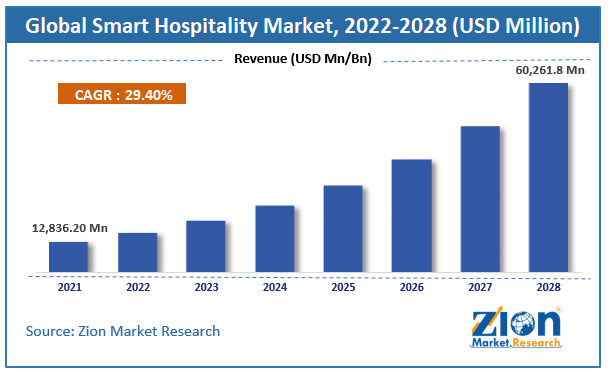
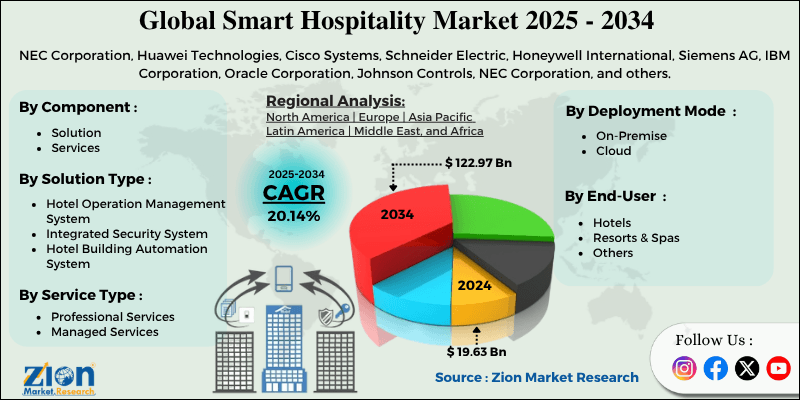
The global smart hospitality market size was worth around USD 19.63 billion in 2024 and is predicted to grow to around USD 122.97 billion by 2034 with a compound annual growth rate (CAGR) of roughly 20.14% between 2025 and 2034.
The report analyzes the global smart hospitality market's drivers, restraints/challenges, and the effect they have on demand during the projection period. In addition, the report explores emerging opportunities in the smart hospitality industry.
Smart Hospitality Market: Overview
Modern hardware and software are used in hotels that practice "smart hospitality" to reduce workloads and keep prices down for all properties. Smart hotels typically make use of artificial intelligence and the internet of things. Smart hotels are developed by combining big data and the internet of things, which helps save operating expenses. The power of the IoT for hotels can be seen in the variety of jobs guests may accomplish on their cellphones. In addition to controlling the temperature, smart hotel guests can also check in and out and order room service.
The business's managers also use IoT to discover the most popular services, improve internal processes, and better understand the demands of their customers. Using big data management tools, smart hotels could improve. Smart hotels may improve their services while lowering costs by utilizing big data management systems. They can more effectively handle bookings and cancellations and boost hotel occupancy in line with the tourist season. As there is a growing need for real-time guest experience management, it is driving the market's expansion. Also expected to offer potential chances for the expansion of the smart hospitality market in the upcoming years are the evolving cloud-based IoT systems.
COVID-19 Impact
The COVID-19 outbreak has significantly impacted the global smart hospitality market. The disease's impacts are already being seen globally, and the smart hotel industry is expected to suffer significantly. Governments all across the world have banned domestic and international travel and shut down international crossings, which has hurt the hospitality sector. The COVID-19 pandemic has made visitors scared. People have postponed their personal and professional trips as a result, which is straining the hospitality sector. However, the easing of travel restrictions is anticipated to have a considerable negative impact on the smart hospitality sector, while the return of flights is anticipated to stimulate market growth.
Key Insights
- As per the analysis shared by our research analyst, the global smart hospitality market is estimated to grow annually at a CAGR of around 20.14% over the forecast period (2025-2034).
- Regarding revenue, the global smart hospitality market size was valued at around USD 19.63 billion in 2024 and is projected to reach USD 122.97 billion by 2034.
- The smart hospitality market is projected to grow at a significant rate due to increasing adoption of IoT and AI for personalized guest experiences, operational efficiency, and growing demand for contactless and automated services.
- Based on Component, the Solution segment is expected to lead the global market.
- On the basis of Solution Type, the Hotel Operation Management System segment is growing at a high rate and will continue to dominate the global market.
- Based on the Service Type, the Professional Services segment is projected to swipe the largest market share.
- By Deployment Mode, the On-Premise segment is expected to dominate the global market.
- In terms of End-User, the Hotels segment is anticipated to command the largest market share.
- Based on region, Europe is predicted to dominate the global market during the forecast period.
Smart Hospitality Market: Growth Drivers
An increase in hospitality technological advancements to drive market growth
New smart hospitality solutions give hoteliers access to data-backed insights and behavior that can create a 360-degree perspective of every visitor and improve their experience through better customer care. Hoteliers can access a dashboard with organized data from all sources, which not only curates a personalized view of each guest but also helps to counterbalance operational load with the aid of integrated digital platforms like Property Management Systems (PMS) and Customer Relationship Management (CRM). Additionally, this lowers hotel operating expenses and boosts guest retention rates, improving brand positioning. Hotels now also benefit by offering a mobile-centric guest experience that improves the guest's convenience and self-service, hence increasing the global smart hospitality market's demand.
Smart Hospitality Market: Restraints
High expense of implementation, upkeep, and training to hinder market expansion
Most hotels using smart hospitality technologies found that maintaining them was expensive. However, the cost of deployment is typically correlated with difficulty in its application integration. Most property management systems have a straightforward pricing structure with a few exceptions. These exceptions include add-on modules, training fees, and API access. A commission percentage on direct new reservations, setup and maintenance fees, and an interface fee for third-party connections may occasionally be added on top of the monthly price schedule. Pay-per-room is the most often used business model for hotel management software. A greater number of rooms leads to a higher price per tier. Some solution providers may also charge a one-time setup cost; this acts as a restraint on market growth.
Smart Hospitality Market: Opportunity
5G evolution will change the smart hospitality sector, offering growth prospects
With new digital tools and platforms, hotel owners continually look for methods to streamline the guest experience. Operators may be able to completely transform their offerings with cutting-edge in-room and cross-facility services thanks to 5G. By providing the fundamental framework for tying together wireless devices, applications, and people, 5G can propel digital transformation in the hospitality sector. Hotel owners should be able to communicate with their customers more effectively and learn more about their journeys thanks to 5G technology. With the use of 5G and ancillary technologies like edge computing, visitors can proactively receive recommendations and travel tips specifically tailored to their tastes; this could be new technology for the global smart hospitality market.
Smart Hospitality Market: Challenges
Challenges to data security and information sharing
Guest preferences and personal information are included in smart hospitality solutions. Any data leakage may have legal repercussions and undermine the hotel brand's integrity. Information exchange across organizations has long been hampered by several obstacles, including intra- and inter-organizational conflicts, technical difficulties, etc. The application of smart hotel big data for the industry might be hampered by inter-organizational problems such as a lack of confidence in the new system and disclosure of corporate data to competitors. Any ecosystem participants' worries may reduce their desire to provide data to the hospitality big data and hence act as a challenge.
Smart Hospitality Market: Segmentation
The Smart Hospitality market is segmented by component, solution type, service type, deployment mode, end-user, and region.
Based on Component Segment, the Smart Hospitality market is divided into Solution and Services. The Solution segment is expected to lead the global market because it encompasses the core software and technology platforms that enable hotel operations, guest services, security, and automation. This leadership drives overall market growth by providing the foundational tools hotels need to deliver personalized experiences and improve efficiency. Services support successful deployment, customization, and ongoing management, contributing complementary value and facilitating broader adoption of smart solutions.
Based on Solution Type Segment, the Smart Hospitality market is divided into Hotel Operation Management System, Integrated Security System, Hotel Building Automation System, Guest Service Management System, and Others. The Hotel Operation Management System segment is growing at a high rate and will continue to dominate due to its central role in coordinating bookings, occupancy, internal processes, and overall property performance. This dominance supports market expansion by addressing the core operational needs of hotels. Integrated Security Systems enhance guest safety and satisfaction, Building Automation Systems optimize energy and facility management, and Guest Service Management Systems focus on personalized interactions, each contributing to a comprehensive smart hospitality ecosystem.
Based on Service Type Segment, the Smart Hospitality market is divided into Professional Services and Managed Services. Professional Services are projected to capture the largest market share as hotels require expertise for system design, implementation, integration, training, and optimization. This leadership helps drive successful technology adoption and long-term value realization. Managed Services provide ongoing support and remote management, offering an attractive option for properties seeking to reduce internal operational burden while maintaining high system performance.
Based on Deployment Mode Segment, the Smart Hospitality market is divided into On-Premise and Cloud. The On-Premise segment is expected to dominate the global market, reflecting preferences among many hospitality operators for local control, data security, and direct management of critical systems. This position anchors significant market volume. Cloud deployment is gaining momentum due to its scalability, remote accessibility, and alignment with IoT and modern digital infrastructure, supporting growth as more properties pursue flexible and cost-efficient technology models.
Based on End-User Segment, the Smart Hospitality market is divided into Hotels, Resorts & Spas, and Others. The Hotels segment is anticipated to command the largest market share because of the large number of properties seeking to enhance guest experiences, streamline operations, and reduce costs through smart technologies. This dominance drives substantial demand for solutions and services. Resorts & Spas and other accommodation types contribute additional growth as they adopt similar technologies to meet rising expectations for personalized, contactless, and efficient stays.
Smart Hospitality Market: Report Scope
| Report Attributes | Report Details |
|---|---|
| Report Name | Smart Hospitality Market |
| Market Size in 2024 | USD 19.63 Billion |
| Market Forecast in 2034 | USD 122.97 Billion |
| Growth Rate | CAGR of 20.14% |
| Number of Pages | 240 |
| Key Companies Covered | NEC Corporation, Huawei Technologies, Cisco Systems, Schneider Electric, Honeywell International, Siemens AG, IBM Corporation, Oracle Corporation, Johnson Controls, and others. |
| Segments Covered | By Component, By Solution Type, By Service Type, By Deployment Mode, By End-User, and By Region |
| Regions Covered | North America, Europe, Asia Pacific (APAC), Latin America, The Middle East and Africa (MEA) |
| Base Year | 2024 |
| Historical Year | 2020 to 2024 |
| Forecast Year | 2025 to 2034 |
| Customization Scope | Avail customized purchase options to meet your exact research needs. Request For Customization |
Smart Hospitals Market: Regional Landscape
Why will Europe continue to dominate the global market during the projection period?
Europe has demonstrated strong activity, with new hotel projects and initiatives focused on contactless solutions and IoT penetration. Expansions of technology brands offering advanced guest services across the region continue to fuel adoption and contribute to market growth through elevated service standards and guest expectations.
According to the TOPHOTELPROJECTS construction database, 42 new hotels will open in the Netherlands over the next few years, including 17 by the end of 2021, 9 by the end of 2022, and 8 by the end of 2023, and another 8 projects by the end of 2024. The hospitality industry's growing demand for contactless solutions and the IoT's high penetration rate incentivize hotels to use this technology. The Louvre Hotels Group announced the expansion of its technological brand "Smart Inside" throughout Europe in June 2021. This technology delivers over 20 cutting-edge services to hotel guests for a better stay. Such changes will fuel this industry's expansion.
Recent Developments
- May 2022: Oracle and Orient Jakarta worked together to create a property management system in May 2022. Due to travel restrictions, the solution enhanced their online presence during the COVID-19 pandemic and provided staff training remotely using Oracle Digital Learning tools.
- September 2021: Infor Hospitality Management Solution (HMS) version 3.8.4 is a fully cloud-enabled hotel management solution that became available in September 2021. Because Infor HMS is readily available in real-time, hotels can quickly customize a smooth and frictionless experience while still keeping up with modern guests' hectic lifestyles and schedules.
- November 2019: The debut of a new generation of location intelligence technology for hotels, known as Guest IQ, was announced by Arrivals, the top location intelligence platform, in November 2019. By tracking all of the visitors' combined movements in real-world settings, this platform uses a variety of mobile location datasets to add behavioral context to existing insight tools.
Smart Hospitality Market: Competitive Landscape
Some of the main competitors dominating the global smart hospitality market include-
- NEC Corporation
- Huawei Technologies
- Cisco Systems
- Schneider Electric
- Honeywell International
- Siemens AG
- IBM Corporation
- Oracle Corporation
- Johnson Controls
Global Smart Hospitality Market is segmented as follows:
By Component
- Solution
- Services
By Solution Type
- Hotel Operation Management System
- Integrated Security System
- Hotel Building Automation System
- Guest Service Management System
- Others
By Service Type
- Professional Services
- Managed Services
By Deployment Mode
- On-Premise
- Cloud
By End-User
- Hotels
- Resorts & Spas
- Others
By Region
- North America
- The U.S.
- Canada
- Europe
- France
- The UK
- Spain
- Germany
- Italy
- Rest of Europe
- Asia Pacific
- China
- Japan
- India
- South Korea
- Southeast Asia
- Rest of Asia Pacific
- Latin America
- Brazil
- Mexico
- Rest of Latin America
- Middle East & Africa
- GCC
- South Africa
- Rest of Middle East & Africa
Table Of Content
Methodology
FrequentlyAsked Questions
The global smart hospitality market is expected to grow due to rising expectations for personalized experiences, IoT integration, and the push for operational efficiency in the hospitality sector.
According to a study, the global smart hospitality market size was worth around USD 19.63 Billion in 2024 and is expected to reach USD 122.97 Billion by 2034.
The global smart hospitality market is expected to grow at a CAGR of 20.14% during the forecast period.
Europe is expected to dominate the smart hospitality market over the forecast period.
Leading players in the global smart hospitality market include NEC Corporation, Huawei Technologies, Cisco Systems, Schneider Electric, Honeywell International, Siemens AG, IBM Corporation, Oracle Corporation, Johnson Controls, among others.
The report explores crucial aspects of the smart hospitality market, including a detailed discussion of existing growth factors and restraints, while also examining future growth opportunities and challenges that impact the market.

HappyClients

