
Smart Home Hub Market Size, Share, Growth, Opportunities 2034

Smart Home Hub Market By Hub Type (Platform/Ecosystem Hubs, Edge-AI-Enabled Hubs, Multi-Protocol Hubs and Security-Focused Hubs), By Connection Technology (Wi-Fi, Z-Wave, Zigbee, Bluetooth/BLE and Thread/Matter), By Control Interface (Voice-Only, Mobile-App-Only, Touch-Display and Hybrid), By Application (Security and Access Control, Entertainment and Lighting, Energy and HVAC Management and Elderly Care and Health Monitoring), By Distribution Channel (Online Retail, Service-Provider Bundled, Offline Retail and Professional Installer / Integrator), By End User (Residential - Single Family, Hospitality, Residential - Multi-Family, Assisted-Living/Healthcare and Commercial - SMB) and By Region - Global and Regional Industry Overview, Market Intelligence, Comprehensive Analysis, Historical Data, and Forecasts 2025 - 2034
| Market Size in 2024 | Market Forecast in 2034 | CAGR (in %) | Base Year |
|---|---|---|---|
| USD 135 Billion | USD 438 Billion | 12.5% | 2024 |
Smart Home Hub Industry Perspective:
What will be the size of the global smart home hub market during the forecast period?
The global smart home hub market size was worth around USD 135 billion in 2024 and is predicted to grow to around USD 438 billion by 2034 with a compound annual growth rate (CAGR) of roughly 12.5% between 2025 and 2034.
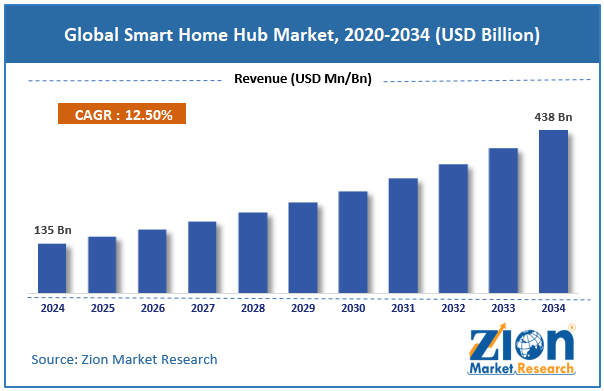
Smart Home Hub Market: Overview
A smart home hub is generally a hardware- or software-based device that integrates, manages, and automates various smart home devices. It provides a needed bridge for communicating with a diverse set of connected smart devices, such as smart lights, thermostats, security cameras, smart locks, speakers, appliances, and sensors, which can communicate using various wireless protocols, including Wi-Fi, Zigbee, Z-Wave, Bluetooth, and Thread. Users can manage and control all compatible smart devices with the smart home hub, typically via a mobile app, voice Assistant, or touchscreen control panel, in a user-friendly way. Smart home hubs can automate various devices and functionalities, such as scheduled or on-demand operation, remote access, energy-saving, notification systems, and others, enhancing the convenience, security, comfort, and energy efficiency of a residence. Smart home hubs are beginning to include some form of AI, with local processing often provided by edge computing and adherence to standards like Matter.
Key Insights
- As per the analysis shared by our research analyst, the global smart home hub market is estimated to grow annually at a CAGR of around 12.5% over the forecast period (2025-2034).
- In terms of revenue, the global smart home hub market size was valued at around USD 135 billion in 2024 and is projected to reach USD 438 billion by 2034.
- Rising focus on home security and surveillance are expected to propel the smart home hub market over the projected period.
- Based on the hub type, the platform/ecosystem hubs segment accounted for the largest revenue share of over 45% in 2024.
- Based on the connection technology, the wi-fi segment accounted for the largest revenue share in 2024 of 52%.
- Based on the control interface, the voice-only segment held the largest market share of 60% in 2024.
- Based on the application, the security and access control segment held a prominent revenue share of 38% in 2024.
- Based on the distribution channel, the online retail segment accounted for the largest revenue share of 48% in 2024.
- Based on the end user, the residential - single family segment holds a prominent revenue share in 2024 of 55%.
- Based on region, North America captures the largest market share in 2024 of over 39%.
Impact of the USA-Israel War on Iran on the Smart Home Hub Market
The war between the USA, Israel, and Iran has adversely impacted markets, as the disruption of the global electronics supply chain has increased semiconductor and PCB prices and driven up shipping and energy costs. Given that the smart home hub market is highly dependent on electronic components, sensors, chips, and wireless communication modules, rising raw material prices and global shipping disruptions have increased production costs and, in turn, the prices of these products. The war has also caused volatility in oil prices and in shipping traffic around the Strait of Hormuz, resulting in higher consumer prices and, hence, delayed product delivery.
Also, given the current economic uncertainty and the decline in consumer confidence in several regions, this could impact the market's growth in the short term.
Smart Home Hub Market: Dynamics
Growth Drivers
Why does the growing adoption of IoT and connected devices drive the smart home hub market?
The growing adoption of IoT and connected devices across the market is helping boost the smart home hub market as consumers adopt multiple smart products (smart lights, thermostats, security cameras, smart TVs, smart speakers, smart door locks, smart appliances, and others) into a common home addressable environment. A growing number of connected devices, managed via platforms across wireless protocols such as Wi-Fi, Zigbee, Z-Wave, Bluetooth, and Thread, is fueling the need for intelligent automation and management of these devices through a single point of control. Smart home hubs not only provide a single point of communication among devices but also enable automation of connected products through features such as voice control, remote monitoring, smart power & energy management, real-time alert monitoring, AI automation & personalization, and more. With the rise in connected living trends, internet & smartphone penetration, and the extensive range of smart appliances, the smart home hub market is growing rapidly.
Restraints
Data privacy and cybersecurity concerns hamper the growth of the smart home hub industry
Privacy and security concerns are a major restraint on market growth for the smart home hub industry because smart home hubs continually record, store, and communicate privacy-sensitive information about users, such as voice recordings, user behavior patterns, video surveillance, access controls, and device activities across connected home networks. As smart home hubs are central control points for numerous devices, they are appealing targets for cyberattacks, hacking, malware, and unauthorized access. Users are expressing greater concern about data being unlawfully accessed, which may lead to identity theft or exploitation by third parties or cloud service providers.
Moreover, the lack of security on unprotected devices, ineffective network encryption, and inconsistent standards across manufacturers also raised concerns about reliability and trust. These are the reasons many consumers’ willingness to embrace smart home technology integration is held back, especially in markets where global data protection standards are strictly enforced.
Opportunities
Why does the growing product launch offer a lucrative opportunity for the smart home hub market?
The growing product launch is expected to offer a lucrative opportunity for the smart home hub market over the projected period. For instance, in November 2025, IKEA made 21 new smart-home products, including smart lighting, sensors, and controls, all designed to work with matter, the industry-defined “language” for smart-home devices, announced at this year's CES. The launch is a step forward toward making smart-home technology more intuitive, accessible, and integrated within people ‘s lives. In doing so, the company is overhauling its smart-home ecosystem from the ground up. The new launch comprises years of development, real-world testing, and a stronger understanding of how people want their smart-home devices to function. The launch also signifies a new direction for the range.
Now, the smart products that were once limited to a few categories will be available to build a smart home with any matter-compatible device; thus, IKEA smart products will be compatible with a wider range of devices.
Challenges
Why does the high initial installation and setup costs pose a significant challenge to the smart home hub market?
The high initial costs of installation and setup are a problem for the smart home hub market as consumers are expected to make high investments in the smart home hub, which itself could be quite expensive, and further in smart devices such as sensors, cameras, smart locks, and thermostats, lighting, networking equipment, in order to upgrade their living environment to a complete smart ecosystem. Moreover, extra costs for professional installation, system integration, monthly subscriptions, and maintenance can double or triple the initial costs of ownership. Compatibility issues between devices and communication protocols will likely force users to replace their existing appliances or to upgrade to expensive high-end products from certain ecosystems.
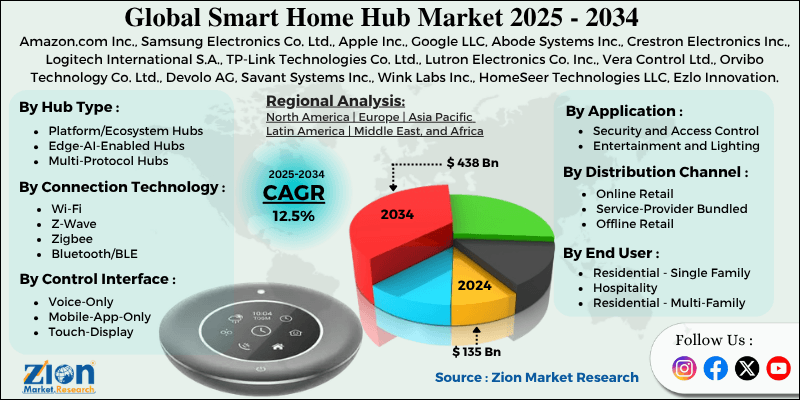
Smart Home Hub Market: Report Scope
| Report Attributes | Report Details |
|---|---|
| Report Name | Smart Home Hub Market |
| Market Size in 2024 | USD 135 Billion |
| Market Forecast in 2034 | USD 438 Billion |
| Growth Rate | CAGR of 12.5% |
| Number of Pages | 225 |
| Key Companies Covered | Amazon.com Inc., Samsung Electronics Co. Ltd., Apple Inc., Google LLC, Abode Systems Inc., Crestron Electronics Inc., Logitech International S.A., TP-Link Technologies Co. Ltd., Lutron Electronics Co. Inc., Vera Control Ltd., Orvibo Technology Co. Ltd., Devolo AG, Savant Systems Inc., Wink Labs Inc., HomeSeer Technologies LLC, Ezlo Innovation, Brilliant Home Technology Inc., Securifi Inc., Aeotec Group GmbH, Hubitat Inc., and others. |
| Segments Covered | By Hub Type, By Connection Technology, By Control Interface, By Application, By Distribution Channel, By End User, and By Region |
| Regions Covered | North America, Europe, Asia Pacific (APAC), Latin America, Middle East, and Africa (MEA) |
| Base Year | 2024 |
| Historical Year | 2019 - 2023 |
| Forecast Year | 2025 - 2034 |
| Customization Scope | Avail customized purchase options to meet your exact research needs. Request For Customization |
Smart Home Hub Market: Segmentation
Hub Type Insights
Why does the platform/ecosystem hubs dominate the smart home hub market?
The platform/ecosystem hubs segment accounted for the largest revenue share of over 45% in 2024. Their growth is driven by their ability to experience and control a broad spectrum of connected smart devices with seamless integration through centralized ecosystems. Ecosystem hubs by leading technology firms such as Amazon, Google, Apple, and Samsung Electronics are witnessing robust revenue growth driven by consumer preferences for seamless interoperability, centralized control, voice assistants, and AI-enabled home automation, among others. The massive proliferation of IoT-enabled devices, such as smart speakers, lighting systems, security cameras, thermostats, ovens, or washing machines, is a key factor in boosting the demand for an ecosystem-of-Hubs which can manage a broad spectrum of devices spanning across protocols such as Wi-Fi, Zigbee, Thread, Bluetooth, and Matter.
Connection Technology Insights
How does the Wi-Fi segment capture the largest market share in the smart home hub market?
The wi-fi segment accounted for the largest revenue share in 2024 of 52%. This is attributed to the proliferation of Wi-Fi infrastructure and the high penetration of smartphones and smart connected home devices. Wi-Fi-based hubs are the most preferred platforms on account of their easy set-up, wide compatibility and support, fast speed, and connectivity with various other smart appliances, security systems, entertainment devices, and voice devices. Additionally, consumers are becoming more comfortable with Wi-Fi-supported hubs that enable monitoring and management of applications from anywhere through mobile or cloud-based applications, without the need for any additional hardware. The demand for Wi-Fi-connected smart platforms is also likely to surge as consumers increasingly shift to smart speakers, smart TVs, home security cameras, lighting systems, and AI-enabled home automation systems.
Control Interface Insights
Does the voice-only segment capture the largest market share in the smart home hub market?
The voice-only segment held the largest market share of 60% in 2024. This growth is driven by the increasing adoption of voice assistants and voice-enabled modern control systems for smart home automation. Consumers want voice-enabled, hands-free control hubs for their smart home automation, as they are more convenient, easier to use, and allow faster interactions with smart home devices via natural language commands. Voice-only smart home hubs are also currently used in the home to control lights, thermostats, home theater systems, security systems, appliances, and smart home automation routines without controllers or touchscreens. The widespread adoption of natural language-capable AI virtual assistants, including Amazon Alexa, Google Assistant, and Apple Siri, has helped spearhead this demand for truly voice-driven smart home ecosystems.
Application Insights
Why does the security and access control segment capture the largest market share in the smart home hub market?
The security and access control segment held a prominent revenue share of 38% in 2024. This is fueled by a surge in consumer awareness of home security and property protection benefits, along with the growing popularity of remote monitoring installations. Smart home hubs are becoming more prevalent, typically linked to interconnected security systems, such as smart locks, sensors, video cameras, video doorbells, alarm systems, biometric access entry methods, and other security monitors, to enable monitored home security control through the hub. As more burglaries, unauthorized entries, and other home security threats occur, residents are increasingly installing smart security systems to enable smartphone control, real-time alerts, live video streaming, and automated emergency response.
Distribution Channel Insights
Does the online retail segment capture the largest market share in the smart home hub market?
The online retail segment accounted for the largest revenue share of 48% in 2024. This growth can be attributed to the rapid evolution of e-commerce platforms, the expanding reach of the internet, and the growing consumer awareness of the benefits of seamless digital purchasing channels. Consumers preferred various online portals and shopping applications to buy smart home hubs and connected devices due to enhanced product availability, competitive prices, comparable product features, customer reviews, and hassle-free home delivery. The increasing adoption of smartphones and digital payment systems has driven global online sales of connected smart homes.
Further, online shopping is helping manufacturers and technology companies market ecosystem-enabled smart home solutions, promotional bundles, and subscription services, and AI-enabled devices to a wider consumer base efficiently. The surging adoption of top-notch e-commerce sites and direct to consumers model has increased product penetration in developing economies.
End User Insights
How does the residential - single family segment capture the largest market share in the smart home hub market?
The residential - single family segment holds a prominent revenue share in 2024 of 55%. Over time, connected home adoption among homeowners seeking convenience, energy efficiency, comfort, and security has expanded. Moreover, the single-family homes segment is considered an attractive environment for implementing a holistic smart home installation, as consumers have greater flexibility to install a wide range of smart devices, such as lighting systems, security cameras, entertainment systems, voice assistants, and smart locks. Growing consumer consciousness of home automation, along with the need for secure remote monitoring and personalized living, is substantially boosting the adoption of smart home hubs in this segment.
Regional Insights
Why does North America lead the smart home hub market?
North America captures the largest market share in 2024 of over 39%. Market growth is primarily supported by high penetration of smart home applications, robust internet infrastructure, and increasing consumer preferences towards connected living in North America. The advent of leading smart device manufacturers, including Amazon, Google, Apple, and Samsung Electronics, has helped boost innovation and drive ecosystem growth in the market. North American consumers are becoming accustomed to using smart home hubs that facilitate centralized management of connected devices and appliances, such as smart speakers, thermostats, security cameras, lighting systems, and connected kitchen appliances, through voice assistants and connected platforms. Moreover, increasing awareness regarding home security, energy efficiency, remote monitoring, and AI-enabled automation is further bolstering demand for sophisticated smart home solutions.
Further, the rising adoption of smart homes, driven by high disposable income, widespread smartphone adoption, high broadband penetration, and the rapid proliferation of IoT-enabled devices, is also supporting market growth. The growing popularity of subscription-based smart home services, advanced IoT standards such as Matter, and significant investments in smart home infrastructure are also driving revenue growth in the North American smart home hub market.
Smart Home Hub Market: Competitive Analysis
The global smart home hub market is dominated by players like:
- Amazon.com Inc.
- Samsung Electronics Co. Ltd.
- Apple Inc.
- Google LLC
- Abode Systems Inc.
- Crestron Electronics Inc.
- Logitech International S.A.
- TP-Link Technologies Co. Ltd.
- Lutron Electronics Co. Inc.
- Vera Control Ltd.
- Orvibo Technology Co. Ltd.
- Devolo AG
- Savant Systems Inc.
- Wink Labs Inc.
- HomeSeer Technologies LLC
- Ezlo Innovation
- Brilliant Home Technology Inc.
- Securifi Inc.
- Aeotec Group GmbH
- Hubitat Inc.
The global smart home hub market is segmented as follows:
By Hub Type
- Platform/Ecosystem Hubs
- Edge-AI-Enabled Hubs
- Multi-Protocol Hubs
- Security-Focused Hubs
By Connection Technology
- Wi-Fi
- Z-Wave
- Zigbee
- Bluetooth/BLE
- Thread/Matter
By Control Interface
- Voice-Only
- Mobile-App-Only
- Touch-Display
- Hybrid
By Application
- Security and Access Control
- Entertainment and Lighting
- Energy and HVAC Management
- Elderly Care and Health Monitoring
By Distribution Channel
- Online Retail
- Service-Provider Bundled
- Offline Retail
- Professional Installer/Integrator
By End User
- Residential - Single Family
- Hospitality
- Residential - Multi-Family
- Assisted-Living/Healthcare
- Commercial - SMB
By Region
- North America
- The U.S.
- Canada
- Mexico
- Europe
- France
- The UK
- Spain
- Germany
- Italy
- Rest of Europe
- Asia Pacific
- China
- Japan
- India
- Australia
- South Korea
- Rest of Asia Pacific
- The Middle East & Africa
- Saudi Arabia
- UAE
- Egypt
- Kuwait
- South Africa
- Rest of the Middle East & Africa
- Latin America
- Brazil
- Argentina
- Rest of Latin America
Table Of Content
Methodology
FrequentlyAsked Questions
A smart home hub is generally a hardware- or software-based device that integrates, manages, and automates various smart home devices. It provides a needed bridge for communicating with a diverse set of connected smart devices, such as smart lights, thermostats, security cameras, smart locks, speakers, appliances, and sensors, which can communicate using various wireless protocols, including Wi-Fi, Zigbee, Z-Wave, Bluetooth, and Thread.
Key growth drivers for the Smart Home Hub Market include rising adoption of IoT-enabled devices, increasing demand for home automation, growing focus on smart security solutions, advancements in AI-powered voice assistants, and expanding wireless connectivity infrastructure.
Major challenges restraining the growth of the Smart Home Hub Market include data privacy and cybersecurity concerns, high initial installation and setup costs, interoperability issues among devices and platforms, dependence on stable internet connectivity, and limited consumer awareness in developing regions.
Based on the application, the security and access control segment is expected to dominate the smart home hub market growth during the projected period.
Emerging trends and innovations impacting the Smart Home Hub Market include the adoption of Matter interoperability standards, integration of AI and machine learning for personalized automation, growth of voice-controlled ecosystems, expansion of edge computing and local processing, increasing use of energy management solutions, enhanced smart security integration, and rising demand for subscription-based smart home services and multifunctional IoT ecosystems.
According to the report, the global smart home hub market size was worth around USD 135 billion in 2024 and is predicted to grow to around USD 438 billion by 2034.
The global smart home hub market is expected to grow at a CAGR of 12.5% during the forecast period.
The global smart home hub industry growth is expected to be led by North America over the forecast period.
The global smart home hub market is dominated by players like Amazon.com Inc., Samsung Electronics Co. Ltd., Apple Inc., Google LLC, Abode Systems Inc., Crestron Electronics Inc., Logitech International S.A., TP-Link Technologies Co. Ltd., Lutron Electronics Co. Inc., Vera Control Ltd., Orvibo Technology Co. Ltd., Devolo AG, Savant Systems Inc., Wink Labs Inc., HomeSeer Technologies LLC, Ezlo Innovation, Brilliant Home Technology Inc., Securifi Inc., Aeotec Group GmbH and Hubitat Inc. among others.
The market report covers the geographical market along with a comprehensive competitive landscape analysis. It also includes cash flow analysis, profit ratio analysis, market basket analysis, market attractiveness analysis, sentiment analysis, PESTLE analysis, trend analysis, SWOT analysis, trade area analysis, demand & supply analysis, Porter’s five forces analysis, and value chain analysis.

HappyClients

