
Smart Cattle Market Size, Share, Trends, Growth and Forecast 2034

Smart Cattle Market By Component (Hardware, Software, and Services), By Application (Health Monitoring, Feeding Management, Milk Harvesting, Breeding Management, Heat Detection, and Behavior Monitoring), By Deployment Mode (Cloud-based and On-premise Solutions), By Farm Type (Small-scale Farms and Large Commercial Farms) and By Region - Global and Regional Industry Overview, Market Intelligence, Comprehensive Analysis, Historical Data, and Forecasts 2025 - 2034
| Market Size in 2024 | Market Forecast in 2034 | CAGR (in %) | Base Year |
|---|---|---|---|
| USD 7.00 Billion | USD 22.7 Billion | 12.5% | 2024 |
Smart Cattle Industry Perspective:
What will be the size of the global smart cattle market during the forecast period?
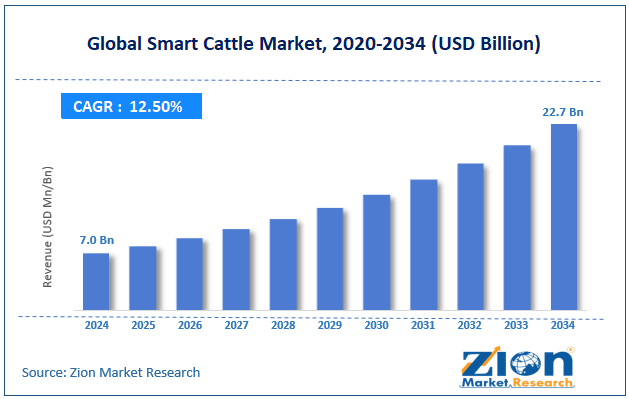
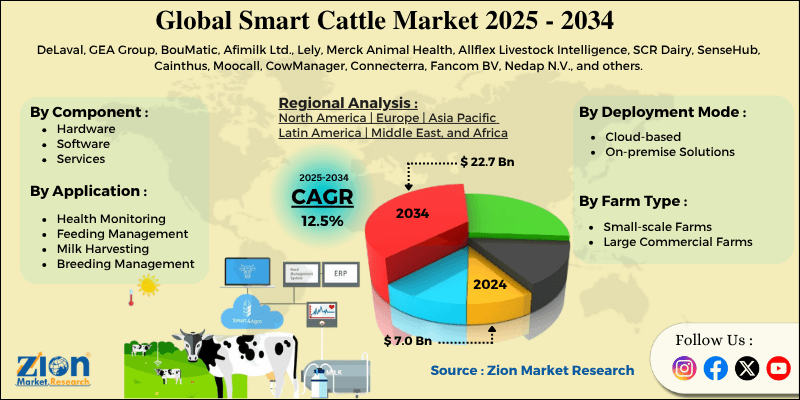
The global smart cattle market size was worth around USD 7.0 billion in 2024 and is predicted to grow to around USD 22.7 billion by 2034 with a compound annual growth rate (CAGR) of roughly 12.5% between 2025 and 2034.
Smart Cattle Market: Overview
The global smart cattle market refers to the industry of providing advanced digital technologies and automated systems to improve cattle herd management practices on commercial farms. Various smart cattle solutions are implemented in the industry to provide real-time and data-accumulated monitoring and analysis of cattle data, including health, feeding behavior, breeding, milk production, and herd performance. These solutions enable cattle farmers to increase herd productivity, assess the health and behavior of the herd, prevent disease outbreaks, reduce labor and operating costs, and improve herd productivity. The market is experiencing significant growth driven by dynamic preferences for precision livestock farming, rising demand for dairy and meat products worldwide, increasing recognition and adoption of animal health and productivity management practices, and the adoption of sustainable, data-driven technology solutions on cattle farms.
Key Insights
- As per the analysis shared by our research analyst, the global smart cattle market is estimated to grow annually at a CAGR of around 12.5% over the forecast period (2025-2034).
- In terms of revenue, the global smart cattle market size was valued at around USD 7.0 billion in 2024 and is projected to reach USD 22.7 billion by 2034.
- Rising adoption of AI and cloud-based herd management platforms are expected to propel the smart cattle market over the projected period.
- Based on the component, the hardware segment accounts for a significant share of the smart cattle market.
- Based on the application, the health monitoring and milk harvesting segment holds the largest market share over the projected period.
- Based on the deployment mode, the cloud-based segment holds a prominent revenue share in 2024.
- Based on the farm type, the large commercial farms segment holds a prominent revenue share in 2024.
- Based on region, North America captures the largest market share in 2024.
Impact of the USA-Israel War on Iran on the Smart Cattle Market
The geopolitical tensions between the USA, Israel, and Iran have had an indirect adverse impact on the smart cattle market by affecting global energy prices, supply chains, fertilizer trade, livestock feed trade, and so on. Strain generated in the Middle East, particularly near the Strait of Hormuz, has raised oil prices, which in turn have increased global transportation costs, adding to the operational costs of raising cattle and dairy farms. The rise in costs of farming operations may cause most of the livestock owners, especially small and medium-scale farms, to delay the adoption of advanced smart cattle technology like sensors with Internet of Things (IOT), RFID tracking devices, automated milking systems, intelligent wearables and applications, herd management application software empowered with AI.
In addition, farm profitability for traditional livestock farmers is adversely affected by higher prices of feed components, fertilizers, and imported agricultural inputs, especially in import-driven and developing economies. Supply chain crises in semiconductors, communication modules, GPS systems, and electronic sensors have caused manufacturing costs to escalate. Urgently place and deliver globally the smart cattle hardware and monitoring solutions needed to support the industry.
However, over the medium and long term, geopolitical risk has further increased the pressure for advanced farm productivity, automation, and precision livestock management, as a hedge against rising costs and supply chain disruptions. Large commercial beef and dairy operations are investing heavily in smart cattle technologies to improve feed efficiency, monitor animal health, reduce reliance on human labor, and position themselves for more competitive returns. Therefore, despite the negative effects that short-term uncertainty can have on market expansion through elevated prices and/or supply shocks, it should drive greater demand for smart cattle platforms that emphasize farm efficiency, environmental sustainability, and lag reduction in the face of uncertainty.
Smart Cattle Market: Dynamics
Growth Drivers
How does the increasing adoption of precision livestock farming technologies drive the smart cattle market?
The increasing adoption of precision livestock farming technologies is contributing towards boost the revenue of the smart cattle market. This has major implications, including improvements in cattle health and productivity, thereby increasing operational efficiency on farms. The major existing technologies, such as sensors with IoT enabled, RFID tags, GPS-enabled collars, automated milking machines, monitoring collars on animals, and an artificial intelligence network system for herd management, are the major solutions that aid in providing data about the health, requirements of feeding and breeding, milk production, and animal activities with respect to time. This technology not only helps identify diseases at the right time and reduce the cattle mortality rate, but also improves the efficiency of milk and meat production.
Moreover, smarter livestock farming can also reduce dependence on labor and farm management overhead by using automation technology in critical farm operations, including milking, feeding, tracking, and caring for the cattle. Platforms, including cloud-based analytical solutions and predictive management products, help farmers make faster, smarter decisions on farm activities that are directly related to farm profitability and operations. The growing awareness of sustainable practices and the careful treatment of livestock on farms also requires advanced cattle technologies to improve traceability, enhance sustainability, reduce environmental impact, and optimize feed, water, and energy use.
Restraints
High initial investment costs associated with smart cattle technologies hamper the growth of the smart cattle industry
The high level of up-front investment remains a major barrier to the deployment of smart cattle market technologies across small- and medium- sized livestock farms. Technologies including automated milking equipment, IoT-enabled sensors, RFID tracking devices, sensor-equipped wearable monitoring collars, herd management software based on artificial intelligence, GPS mapping tools, and cloud-based analytics platforms all entail substantial initial investment in equipment purchase, farm infrastructure modification, and integration.
Furthermore, all these systems require farmers to incur recurring costs. The high deployment and operational costs thus pose economic obstacles for farmers in developing, price-sensitive markets, who might not have access to capital, digital infrastructure, and specialized knowledge and skills. Several livestock farmers in developing economies are thus reluctant to adopt advanced precision livestock farming solutions, fearing they may be too expensive or unsure whether the investments will pay off in the short term. The deployment and operational cost are thus still an impediment to the rapid market penetration of smart cattle solutions across the global livestock farming industry.
Opportunities
Why does the growing partnership in the market offer a lucrative opportunity for the smart cattle market?
The growing partnership in the market is expected to offer a potential opportunity to the smart cattle market during the projected period. For instance, in July 2025, Sumitomo Corporation of Americas has partnered with Grupo Papalotla to advance climate-smart livestock solutions by promoting the adoption of hybrid pasture systems, improving animal productivity, and restoring degraded pasturelands. The initiative aligns with Sumitomo’s Clean Farming Team strategy, which focuses on sourcing high-performance livestock inputs, such as natural feed additives and hybrid pasture seeds, that reduce greenhouse gas (GHG) emissions while enhancing livestock efficiency and sustainability. Sumitomo began collaborating with Papalotla in 2023 to strengthen sustainable livestock farming practices and expand support services for contract farmers. The partnership is expected to encourage the adoption of advanced agricultural inputs, improve pasture rehabilitation, and accelerate the transition to more sustainable, resource-efficient livestock production systems.
In addition, the collaboration represents a significant milestone for Grupo Papalotla as the company seeks to expand global market access, strengthen sustainable livestock production capabilities, and increase the environmental and social impact of its pasture technologies across tropical and subtropical regions worldwide. This development also supports the broader growth of the Smart Cattle Market by encouraging sustainable livestock management practices, productivity optimization, and technology-driven farm modernization.
Challenges
Why does the limited consumer awareness in developing markets pose a significant challenge to the smart cattle market?
A key constraint hampering the development of the smart cattle market is the unavailability of proficient, skilled manpower to operate these advanced technologies. Smart cattle products and systems such as internet of things (IoT)-based sensors, AI-based analytics platform, automated milking systems, RFID identification devices, GPS monitoring and positioning devices, and cloud-based herd management software require highly specific technical knowledge for installation and commissioning, operation and maintenance, as well as effective data interpretation and utilization.
However, numerous cattle farms, particularly in rural areas and developing nations, do not have access to trained and informed personnel with specialist knowledge of precision livestock farming systems and digital farm software. Inadequate technical expertise among farmers and farm laborers could lead to operational inefficiencies, system failures, incorrect data interpretation, and lower profit realization, hindering market growth. In addition, the inadequacy of user training initiatives, digital unawareness, and a lack of knowledge about the operation and advantages of advanced livestock monitoring solutions are also restricting market figures.
Smart Cattle Market: Report Scope
| Report Attributes | Report Details |
|---|---|
| Report Name | Smart Cattle Market |
| Market Size in 2024 | USD 7.0 Billion |
| Market Forecast in 2034 | USD 22.7 Billion |
| Growth Rate | CAGR of 12.5% |
| Number of Pages | 226 |
| Key Companies Covered | DeLaval, GEA Group, BouMatic, Afimilk Ltd., Lely, Merck Animal Health, Allflex Livestock Intelligence, SCR Dairy, SenseHub, Cainthus, Moocall, CowManager, Connecterra, Fancom BV, Nedap N.V., and others. |
| Segments Covered | By Component,By Application, By Deployment Mode, By Farm Type, and By Region |
| Regions Covered | North America, Europe, Asia Pacific (APAC), Latin America, Middle East, and Africa (MEA) |
| Base Year | 2024 |
| Historical Year | 2019 - 2023 |
| Forecast Year | 2025 - 2034 |
| Customization Scope | Avail customized purchase options to meet your exact research needs. Request For Customization |
Smart Cattle Market: Segmentation
Component Insights
Why does the hardware dominate the smart cattle market?
The hardware segment accounts for a significant share of the smart cattle market due to the widespread adoption of RFID tags, GPS tracking devices, wearable sensors, smart collars, automated milking systems, and advanced monitoring equipment used for livestock tracking, health monitoring, and farm management. These technologies enable real-time monitoring of cattle behavior, feeding patterns, breeding activities, and health conditions, helping farmers improve productivity and operational efficiency.
Application Insights
How does the health monitoring and milk harvesting segment capture the largest market share in the smart cattle market?
The health monitoring and milk harvesting segment holds the largest market share over the projected period. The health monitoring and milk harvesting market is expected to be one of the major segments in the Smart Cattle Market, owing to improvements in disease prevention, optimized milk yield, and operational efficiency across the entire cattle farming segment. Various intelligent and automated systems, such as wearable sensors, automated milking systems, RFID tracking and monitoring devices, and AI application platforms, are finding greater adoption in a bid to attain a real-time monitoring facility for cattle health, help in identifying the disease at a very early stage, and support high productivity in a mobile cattle population. Automated systems for milk harvesting aid high-efficiency milking, improve milk quality, reduce employee workload on farms, and support operational optimization, thereby stimulating profitability within a herd population.
Deployment Mode Insights
Does the cloud-based segment capture the largest market share in the smart cattle market?
Cloud-based solutions are among the dominant solutions in the smart cattle market on account of providing an environment that allows access from anywhere, effective data storage, real-time analytical tools, and data analysis in association with connected devices used in IoT-enabled livestock management systems. Cattle health, feeding, milk yield, cattle pregnancies, and farm processes monitoring and management can be remotely carried out using a connected server and a digital dashboard in a cloud-based system at any time. A cloud-based system also enables the use of predictive analysis tools, the creation of automated alerts, and a data-driven decision-making process for farmers, thereby reducing farm operational costs and optimizing herd productivity.
Further, easier scalability of solutions, lower infrastructure requirements, and data synchronization across all farm locations in the mode of operation also contribute to the adoption of cloud-based smart cattle management approaches in the market.
Farm Type Insights
Does the large commercial farms segment capture the largest market share in the smart cattle market?
The large commercial farms segment holds a prominent revenue share in 2024. The growth of this segment is expected to be driven by the rising adoption of precision livestock farming equipment and automated cattle management systems by livestock and dairy farmers to enhance farm productivity and reduce labor costs. The adoption of IoT-enabled monitoring devices, automated milking systems, smart wearable sensors, RFID tracking technologies, and herd management platforms by the large-scale commercial dairy & livestock farms is increasing rapidly to automate the farm procedures and, in turn, improve the cattle health management, and thereby optimize the milk production, milk feeding & breeding, which ultimately reduces labor efforts.
Regional Insights
Why does North America lead the smart cattle market?
North America captures the largest market share in 2024. The regional market is driven by the growing adoption of precision livestock farming (PLF) tools, fast-evolving dairy farm automation, and rising cattle health management needs. Farmers from the United States, Mexico, and Canada are increasingly investing in IoT-enabled sensors, RFID-based tracking systems, wearable monitoring devices, automated milk extraction systems, and AI-based herd management tools to maximize livestock productivity and efficiency. The expansion of the regional market is also supported by rising demand for high-quality dairy and meat products, as well as surging awareness of disease control and animal comfort.
Among others, the presence of top smart cattle system vendors, reliable digital infrastructure, and proliferating support through government initiatives are translating into rapid regional market growth. Additionally, farmers' reliance on automated cattle and farm management systems to overcome labor scarcity is further increasing regional revenue shares. The rising integration of advanced cloud computing, artificial intelligence, and big data analytics with farm management practices is key to fueling revenue growth in the North American smart cattle market.
Smart Cattle Market: Competitive Analysis
The global smart cattle market is dominated by players like:
- DeLaval
- GEA Group
- BouMatic
- Afimilk Ltd.
- Lely
- Merck Animal Health
- Allflex Livestock Intelligence
- SCR Dairy
- SenseHub
- Cainthus
- Moocall
- CowManager
- Connecterra
- Fancom BV
- Nedap N.V.
The global smart cattle market is segmented as follows:
By Component
- Hardware
- Software
- Services
By Application
- Health Monitoring
- Feeding Management
- Milk Harvesting
- Breeding Management
- Heat Detection
- Behavior Monitoring
By Deployment Mode
- Cloud-based
- On-premise Solutions
By Farm Type
- Small-scale Farms
- Large Commercial Farms
By Region
- North America
- The U.S.
- Canada
- Mexico
- Europe
- France
- The UK
- Spain
- Germany
- Italy
- Rest of Europe
- Asia Pacific
- China
- Japan
- India
- Australia
- South Korea
- Rest of Asia Pacific
- The Middle East & Africa
- Saudi Arabia
- UAE
- Egypt
- Kuwait
- South Africa
- Rest of the Middle East & Africa
- Latin America
- Brazil
- Argentina
- Rest of Latin America
Table Of Content
Methodology
FrequentlyAsked Questions
The global smart cattle market refers to the industry of providing advanced digital technologies and automated systems to improve cattle herd management practices on commercial farms. Various smart cattle solutions are implemented in the industry to provide real-time and data-accumulated monitoring and analysis of cattle data, including health, feeding behavior, breeding, milk production, and herd performance.
Key growth drivers for the Smart Cattle Market include increasing adoption of precision livestock farming technologies, rising demand for dairy and meat products, growing focus on animal health monitoring, and increasing implementation of IoT, AI, and automated herd management systems.
Major challenges restraining the growth of the smart cattle market include high initial investment costs, shortage of skilled professionals, limited awareness among small-scale farmers, connectivity issues in rural areas, and high maintenance costs associated with advanced livestock monitoring technologies.
Based on the deployment mode, the cloud-based segment is expected to dominate the smart cattle market growth during the projected period.
Emerging trends and innovations impacting the smart cattle market include AI-powered herd analytics, IoT-enabled wearable sensors, automated milking systems, cloud-based livestock monitoring platforms, GPS tracking technologies, and predictive health management solutions.
According to the report, the global smart cattle market size was worth around USD 7.0 billion in 2024 and is predicted to grow to around USD 22.7 billion by 2034.
The global smart cattle market is expected to grow at a CAGR of 12.5% during the forecast period.
The global smart cattle industry growth is expected to be led by North America over the forecast period.
The global smart cattle market is dominated by players like DeLaval, GEA Group, BouMatic, Afimilk Ltd., Lely, Merck Animal Health, Allflex Livestock Intelligence, SCR Dairy, SenseHub, Cainthus, Moocall, CowManager, Connecterra, Fancom BV, and Nedap N.V. among others.
The market report covers the geographical market along with a comprehensive competitive landscape analysis. It also includes cash flow analysis, profit ratio analysis, market basket analysis, market attractiveness analysis, sentiment analysis, PESTLE analysis, trend analysis, SWOT analysis, trade area analysis, demand & supply analysis, Porter’s five forces analysis, and value chain analysis.

HappyClients

