
Small Cell Networks Market Size, Share, Trends, Growth and Forecast 2034

Small Cell Networks Market By Component (Services and Solutions), By Cell (Picocells, Femtocells, Metro cells, and Microcells), By Deployment (Indoor and Outdoor), By End-User Vertical (Industrial & Manufacturing, Retail & Hospitality, Education, Healthcare, Telecom Operators & Service Providers, Smart Cities & Public Infrastructure, Enterprises, and Others), By Organization (Large Enterprises and Small & Medium Enterprises (SMEs), and By Region - Global and Regional Industry Overview, Market Intelligence, Comprehensive Analysis, Historical Data, and Forecasts 2025 - 2034
| Market Size in 2024 | Market Forecast in 2034 | CAGR (in %) | Base Year |
|---|---|---|---|
| USD 8.94 Billion | USD 32.42 Billion | 15.40% | 2024 |
Small Cell Networks Industry Perspective:
What is the anticipated size of the global small cell networks market during the projection period?
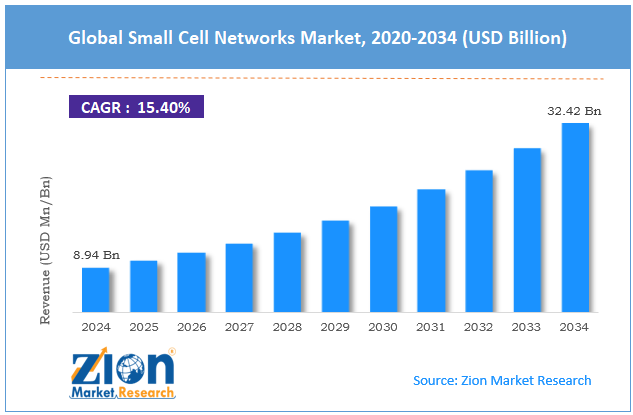
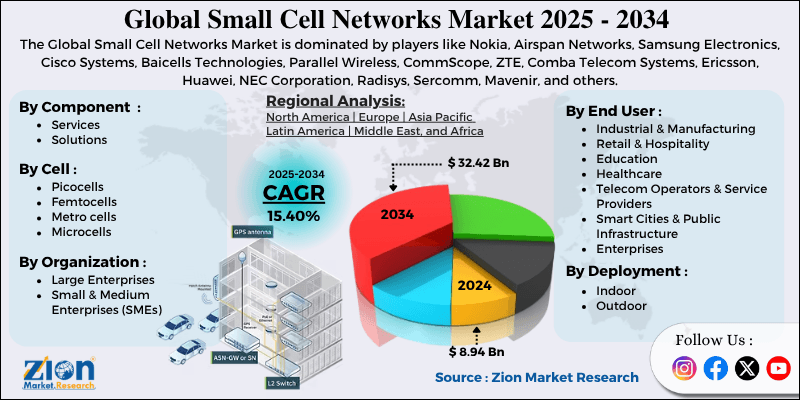
The global small cell networks market size was worth around USD 8.94 billion in 2024 and is predicted to grow to around USD 32.42 billion by 2034, with a compound annual growth rate (CAGR) of roughly 15.40% between 2025 and 2034.
 Request Free SampleRequest Free SampleRequest Free SampleRequest Free Sample
Key Insights:
- As per the analysis shared by our research analyst, the global small cell networks market is estimated to grow annually at a CAGR of around 15.40% over the forecast period (2025-2034)
- In terms of revenue, the global small cell networks market size was valued at around USD 8.94 billion in 2024 and is projected to reach USD 32.42 billion by 2034.
- The small cell networks market is projected to grow at a significant rate due to the rising construction of smart cities.
- Based on the component, the solutions segment is growing at a high rate and will continue to dominate the global market, as per industry projections
- Based on the cell, the microcells segment is anticipated to command the largest market share
- Based on the deployment, the indoor segment is expected to lead the market growth trends
- Based on the end-user vertical, the smart cities & public infrastructure segment is projected to influence revenue in the market
- Based on the organization, the large enterprises will emerge as the fastest-growing segment
- Based on region, North America is projected to dominate the global market during the forecast period
Small Cell Networks Market: Overview
Small cell networks are a type of wireless communication solution designed to improve network coverage and capacity in areas with higher user density. The infrastructure includes the deployment of low-powered cellular base stations, called small cells, to supplement the existing network. Small cells have a lower range as they are compact compared to macro cell towers. Additionally, they can be installed on utility poles, streetlights, buildings, and other facilities due to their flexibility. Small cell network technology has proven beneficial in crowded locations such as urban areas, shopping malls, and stadiums. Small cell networks are a significant part of private networks.
During the forecast period, demand for small cell networks is expected to grow due to the rise in smart city development projects, increasing population density in urban areas, and the expansion of the 5G network. However, the high cost of investment and backhaul limitations may impact market revenue in the long run.
Small Cell Networks Market: Dynamics
Growth Drivers
How will the development of smart cities influence the demand for the small cell networks market?
The global small cell networks market is expected to be led by the rising construction of smart cities. Small cell networks are leveraged as repeaters for gateways to extend the capacity and coverage of the Long Range Wide Area Network (LoRaWAN). Expansion of larger cell towers is a major constraint in urban areas with high population density due to space constraints.
In such cases, small cell networks can be highly beneficial for ensuring the optimal delivery of essential network services. Smart cities use small cell networks to provide seamless, high-speed internet connectivity to multiple users and Internet of Things (IoT) devices. According to official estimates, the global smart city market is expected to cross over USD 1400 billion by 2030. The rapid expansion of smart cities worldwide will facilitate improved revenue for small cell network companies in the coming years.
Expansion of the 5G network to promote the market adoption rate in the coming years
5G infrastructure is one of the largest propellers of small cell networks. Advancements in 5G technology have promoted the use of small cells, as they support the deployment of high-frequency bands and dense networks. Low latency and high data rates promised by 5G are delivered using small cell networks.
In March 2026, Vietnam’s Mobifone initiated talks with Chinese technology companies to build the country’s 5G network. The company is expected to launch a tender to roll out antennas for the region’s 5G infrastructure. Such advancements are projected to work in favor of the global small cell networks market.
Restraints
Why will cost barriers impact the small cell network market revenue in the long run?
The global small cell networks industry is projected to be restricted due to high cost barriers existing in the market. Small cell networks require substantial investment due to the costs of site installation, hardware, maintenance, and fiber backhaul. Additionally, multiple units of small cells are required, as these devices cover only limited areas. Growing economic volatility worldwide will impact the broader adoption of small cell networks in the coming years.
Opportunities
Ongoing advancements in small cell network technology are generating growth opportunities for the industry players
The global small cell networks market is anticipated to generate growth opportunities due to rising technological advancements in the industry. In February 2026, Airspan Networks Holdings LLC, one of the world’s leading wireless network solution providers, launched AirUnity Small Cells. It is a range of next-generation small cells designed to aid mobile network operators (MNOs) and companies in expanding 5G and 4G coverage and capacity. It is the industry’s first integrated baseband supporting 4G LTE and 5G NR - including Standalone (SA) and Non-Standalone (NSA) modes across multiple frequencies.
What will be the contribution of emerging economies toward the small cell networks market growth?
Emerging economies such as African countries, Latin America, and the Asia-Pacific hold tremendous growth opportunities for small cell network solution providers. These economies are witnessing the rapid expansion of telecommunication infrastructure, especially 4G and 5G networks.
Additionally, urbanization, commercialization, and an evolving consumer base will propel small cell network applications in developing countries over the coming years. By September 2025, more than 59 operators in 29 markets across Africa were offering 5G mobile networks. Similar statistics can be observed in other parts of the world as well, creating growth avenues for small-cell network providers.
Challenges
Concerns over signal interference and backhaul limitations to challenge market expansion
The global small cell networks industry is projected to face rising concerns about signal interference with dense deployment. Effective management of densely placed small cells requires process optimization, which can be labor-intensive. Additionally, backhaul limitations, including insufficient fiber infrastructure, bandwidth constraints, latency issues, and cost barriers, may further affect market adoption rates in the coming years.
 Request Free SampleRequest Free SampleRequest Free SampleRequest Free Sample
Small Cell Networks Market: Report Scope
| Report Attributes | Report Details |
|---|---|
| Report Name | Small Cell Networks Market |
| Market Size in 2024 | USD 8.94 Billion |
| Market Forecast in 2034 | USD 32.42 Bllion |
| Growth Rate | CAGR of 15.40% |
| Number of Pages | 226 |
| Key Companies Covered | Nokia, Airspan Networks, Samsung Electronics, Cisco Systems, Baicells Technologies, Parallel Wireless, CommScope, ZTE, Comba Telecom Systems, Ericsson, Huawei, NEC Corporation, Radisys, Sercomm, Mavenir, and others. |
| Segments Covered | By Component, By Cell, By Deployment, By End-User Vertical, By Organization, and By Region |
| Regions Covered | North America, Europe, Asia Pacific (APAC), Latin America, Middle East, and Africa (MEA) |
| Base Year | 2024 |
| Historical Year | 2019 to 2023 |
| Forecast Year | 2025 - 2034 |
| Customization Scope | Avail customized purchase options to meet your exact research needs. Request For Customization |
Small Cell Networks Market: Segmentation
The global small cell networks market is segmented based on component, cell, deployment, end-user vertical, organization, and region.
Why will the solutions segment lead the small cell networks industry revenue during the forecast period?
Based on the component, the global market divisions are services and solutions. In 2024, the highest growth was listed in the solutions segment. It accounted for 68.5% of global revenue in 2024 and is projected to grow at a CAGR of 24% during the forecast period. However, the service segment is anticipated to generate a CAGR of 29.9%, growing at a faster rate due to increasing outsourcing of networking solutions by MNOs worldwide.
Which factors will influence growth in the microcells segment in the small cell networks market during the projection period?
Based on cell, the global market is divided into picocells, femtocells, metro cells, and microcells. In 2024, the femtocells segment was the highest revenue generator, accounting for 37% of global revenue. The microcells segment is anticipated to generate the highest CAGR during the forecast period, growing at 33.75% due to increasing deployment of the cells in urban areas and densely populated outdoor segments.
Why will indoor continue to lead the small cell networks industry in the coming years?
Based on deployment, the global market is fragmented into indoor and outdoor. The highest growth rate in 2024 was listed in the indoor segment, as it accounted for 61% of the global revenue. It will continue to lead the market with a CAGR of 24.9%, driven by the rising installation of small cell networks in corporate offices, shopping malls, and hospitals. The outdoor segment is projected to deliver considerably higher CAGR in the coming years.
What is the projected CAGR for the smart cities & public infrastructure segment in the small cell network industry during the projection period?
Based on end-user verticals, the global market fragments are industrial & manufacturing, retail & hospitality, education, healthcare, telecom operators & service providers, smart cities & public infrastructure, enterprises, and others. The smart cities & public infrastructure segment is expected to lead the market with a CAGR of 35.02% in the coming years. It accounted for 25% of global revenue in 2024, led by the growing use of small cell networks in densely populated urban areas and IoT-connected smart cities.
How are large enterprises expected to perform in the small cell network industry during the forecast period?
Based on organization, the global market segments are large enterprises and small & medium enterprises (SMEs). In 2024, large enterprises led the market with control over 69% of the total revenue. The segment is expected to continue leading the market with a CAGR of 27%. Large companies have the financial status to support large-scale deployment and innovation of small cell networks, thus propelling segmental revenue.
Small Cell Networks Market: Regional Analysis
What is the projected CAGR for North America in the small cell network market during the forecast period?
The global small cell networks market is led by North America, accounting for 38.1% of the global revenue in 2024. It is projected to offer a CAGR of 28.05% during the projection period, driven by the presence of several key players in the US. North America has a strong demand for high-speed, low-latency networks, driven by higher user density, the expansion of smart cities, and rising demand from private network seekers.
Why will Asia-Pacific emerge as the second-highest region in the small cell network market during the forecast period?
Asia-Pacific is set to emerge as the second-highest revenue generator in the global small cell networks market during the forecast period. It contributed nearly 30% of global revenue and is projected to deliver a CAGR of 27% during the forecast period. The rising number of mobile network operators across China, India, Japan, and South Korea, along with extensive user density, will facilitate improved regional revenue. Accelerated growth in 5G infrastructure, along with the surge in smart city construction, may further support regional growth during the forecast period.
Small Cell Networks Market: Competitive Analysis
The global small cell networks market is led by players like:
- Nokia
- Airspan Networks
- Samsung Electronics
- Cisco Systems
- Baicells Technologies
- Parallel Wireless
- CommScope
- ZTE
- Comba Telecom Systems
- Ericsson
- Huawei
- NEC Corporation
- Radisys
- Sercomm
- Mavenir
What are the latest key trends in the small cell networks market?
Artificial Intelligence (AI) integration
Artificial Intelligence (AI)-powered small cell networks are gaining growth momentum among end-user industries. According to official reports, more than 22% of new small cell device installations are powered by AI.
Sustainable small cells
Energy-efficient and sustainable small cells are an emerging class in the industry. Modern small cell networks consume around 37% less energy than traditional counterparts.
The global small cell networks market is segmented as follows:
By Component
- Services
- Solutions
By Cell
- Picocells
- Femtocells
- Metro cells
- Microcells
By Deployment
- Indoor
- Outdoor
By End-User Vertical
- Industrial & Manufacturing
- Retail & Hospitality
- Education
- Healthcare
- Telecom Operators & Service Providers
- Smart Cities & Public Infrastructure
- Enterprises
- Others
By Organization
- Large Enterprises
- Small & Medium Enterprises (SMEs)
By Region
- North America
- The U.S.
- Canada
- Mexico
- Europe
- France
- The UK
- Spain
- Germany
- Italy
- Rest of Europe
- Asia Pacific
- China
- Japan
- India
- Australia
- South Korea
- Rest of Asia Pacific
- The Middle East & Africa
- Saudi Arabia
- UAE
- Egypt
- Kuwait
- South Africa
- Rest of the Middle East & Africa
- Latin America
- Brazil
- Argentina
- Rest of Latin America
Table Of Content
Methodology
FrequentlyAsked Questions
Small cell networks are a type of wireless communication solution designed to improve network coverage and capacity in areas with higher user density.
The global small cell networks market is expected to be led by the rising construction of smart cities.
According to study, the global small cell networks market size was worth around USD 8.94 billion in 2024 and is predicted to grow to around USD 32.42 billion by 2034.
The CAGR value of the small cell networks market is expected to be around 15.40% during 2025-2034.
The global small cell networks industry is projected to be challenged by the rising concerns over signal interference in the case of dense placement.
Artificial Intelligence (AI) integration and sustainable small cells are the emerging trends and innovations impacting the small cell networks market.
The global small cell networks market has performed well so far and will offer similar trends in the coming years.
The global small cell networks market is led by North America, accounting for 38.1% of the global revenue in 2024.
The global small cell networks market is led by players like Nokia, Airspan Networks, Samsung Electronics, Cisco Systems, Baicells Technologies, Parallel Wireless, CommScope, ZTE, Comba Telecom Systems, Ericsson, Huawei, NEC Corporation, Radisys, Sercomm, and Mavenir.
The report explores crucial aspects of the small cell networks market, including a detailed discussion of existing growth factors and restraints, while also browsing future growth opportunities and challenges that impact the market.

HappyClients

