
Global Retro Reflective Material Market Size, Share, Growth Analysis Report - Forecast 2034

Retro Reflective Material Market By Technology Type (Microprismatic, Glass Beads, and Ceramic Beads), By Product Type (Films, Sheets & Tapes, Paints & Inks, and Others), By End-User Industry (Automotive, Industrial, Construction, Textile, and Others), By Application (Traffic Signs & Road Markings, License Plates, Personal Protective Equipment, Clothing & Apparel, Transportation Infrastructure, and Aerospace & Defense), and By Region - Global and Regional Industry Overview, Market Intelligence, Comprehensive Analysis, Historical Data, and Forecasts 2025 - 2034
| Market Size in 2024 | Market Forecast in 2034 | CAGR (in %) | Base Year |
|---|---|---|---|
| USD 13.60 Billion | USD 72.49 Billion | 18.22% | 2024 |
What is the projected value for the retroreflective material market during 2024 to 2032?
What will be the global retro reflective material market size during the forecast period?
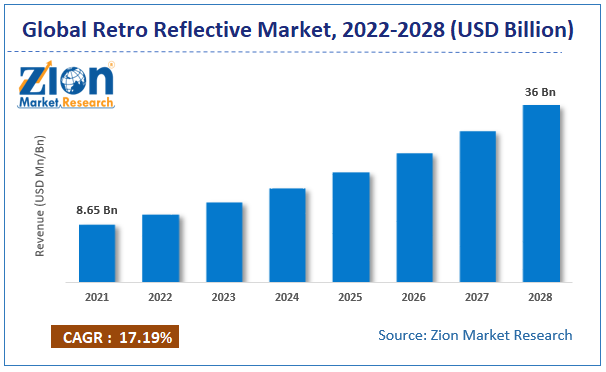
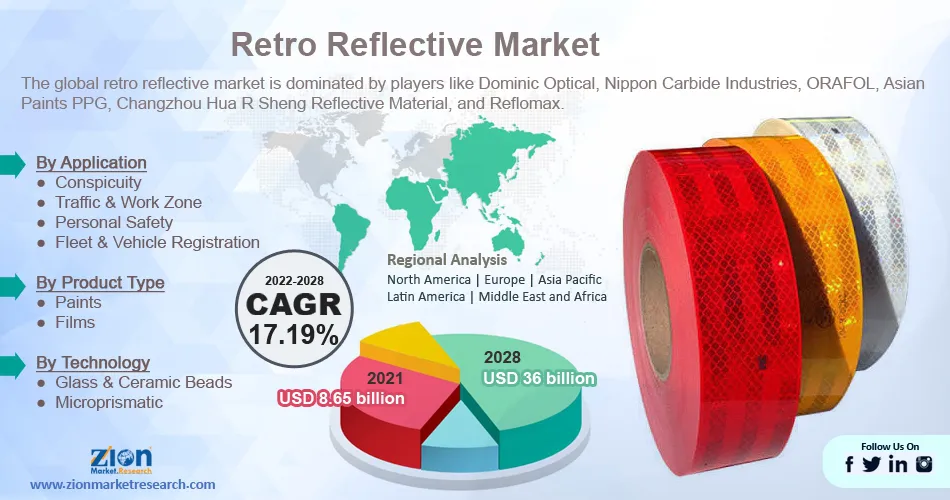
The global retro reflective material market size was worth around USD 13.60 billion in 2024 and is predicted to reach around USD 72.49 billion by 2034, with a compound annual growth rate (CAGR) of roughly 18.22% between 2025 and 2034.
The report examines the primary drivers, challenges, and restraints shaping global demand for the retro reflective material market throughout the forecast period and identifies high-growth opportunities across the industry.
Key Insights
- As per the analysis shared by our research analyst, the global retro reflective material market is estimated to grow annually at a CAGR of around 18.22% over the forecast period (2025-2034).
- Regarding revenue, the global retro reflective material market size was valued at around USD 13.60 Billion in 2024 and is projected to reach USD 72.49 Billion by 2034.
- The retro reflective material market is projected to grow at a significant rate due to increasing focus on road safety, demand for high-visibility materials in construction and apparel, and government regulations promoting reflective signage and markings.
- By Technology Type, the Microprismatic segment is expected to lead the global market.
- By Product Type, the Films segment is growing at a high rate and will continue to dominate the global market.
- By End-User Industry, the Automotive segment is projected to capture the largest market share.
- By Application, the Traffic Signs & Road Markings segment is expected to dominate the global market.
- Based on region, Asia-Pacific is predicted to dominate the global market during the forecast period.
Retro Reflective Material Market: Overview
Retroreflective materials make a surface retroreflective, meaning the surface returns a large portion of light directed toward it back to its source. The brightness of retroreflective material changes depending on the position of the observer and the light source. For instance, for a motorist riding a motor vehicle, the retroreflective material will appear brightest since the rider is closest to the source, i.e., the motor vehicle.
An object's brightness is directly related to the light intensity that strikes it, as well as the material it comprises. In recent times, retro reflective materials have been highly recommended to help improve energy efficiency by reducing the demand for energy required to cool a given area, especially in urban or modern cities and regions.
Regular reflective materials, which are generally colored or white, produce specular and diffuse reflection. When used on roofs, these materials reflect sunlight toward the sky in the absence of surrounding high-rise buildings. But in the case of the use of retro reflective materials, the incident light is reflected from the source independent of the incidence direction, resulting in partial resolution of the problem relating to the reach of reflected light to neighboring areas or buildings.
Retro Reflective Material Market: Growth Drivers
How will the rising infrastructural development propel demand for the retro reflective material market?
The global retro reflective material market is projected to see a surge in demand due to rising urbanization and modernization, along with high investments in infrastructure development, as demand for developed residential and commercial spaces increases rapidly. A 2014 study by the University of Maryland concluded that infrastructure investments contributed over USD 3 to gross domestic product (GDP) for every USD 1 spent in the United States.
In October 2021, the Indian Union Cabinet approved over INR 1963,943 crore for road infrastructure development in the coming years. Between 2019 and 2023, the Indian government announced its plan to spend over 1.4 trillion on infrastructure alone.
Retro Reflective Material Market: Restraints
Does the restricted shelf life of retro reflective material hamper market expansion?
Retro reflective materials have a short shelf life, ranging from 2 to 10 years. The performance durability of the product reduces once the shelf life is crossed, and requirement replacement results in increased cost and low return on investment. This is one of the main reasons developing countries avoid the product and opt for substitutes, limiting further revenue generation in the global market. Retro reflective inks used on wearables are only 12 months, requiring periodic changes. More investment is needed to improve the shelf life of these materials.
Retro Reflective Material Market: Opportunities
Will the use of ceramic bead technology create lucrative growth opportunities for the retro reflective material industry?
Recently, ceramic beads have gained significant global attention over glass beads because they deliver better results and improve the overall performance of retro reflective materials. Since they are iron-free, they can be used with aluminum and stainless steel. The round shape of ceramic beads provides another added benefit, as it helps create visually appealing surfaces.
Retro Reflective Material Market: Challenges
What key challenges do participants in the retro reflective material market face?
The performance of retro reflective materials may be compromised by eventual soiling or physical degradation over time and constant exposure to intense light. Because degradation sets in relatively early compared with other reflective materials, end consumers are reluctant to adopt them when substitutes are available.
Retro Reflective Material Market: Report Scope
| Report Attributes | Report Details |
|---|---|
| Report Name | Retro Reflective Material Market |
| Market Size in 2024 | USD 13.60 Billion |
| Market Forecast in 2034 | USD 72.49 Billion |
| Growth Rate | CAGR of 18.22% |
| Number of Pages | 238 |
| Key Companies Covered | 3M Company, Avery Dennison, ORAFOL, Nippon Carbide Industries, Asian Paints PPG, ALANOD GmbH, Changzhou Hua R Sheng Reflective Material, Coats Group Plc, Paiho Group, REFLOMAX Co., Ltd., and others. |
| Segments Covered | By Technology Type, By Product Type, By End-User Industry, By Application, and By Region |
| Regions Covered | North America, Europe, Asia Pacific (APAC), Latin America, The Middle East and Africa (MEA) |
| Base Year | 2024 |
| Historical Year | 2020 - 2023 |
| Forecast Year | 2025 - 2034 |
| Customization Scope | Avail customized purchase options to meet your exact research needs. Request For Customization |
Retro Reflective Material Market: Segmentation
The retro reflective material market is segmented by technology type, product type, end-user industry, application, and region. All the segments of the retro reflective material market have been analyzed based on present and future trends and the market is estimated from 2025 to 2034.
Based on Technology Type Segment, the retro reflective material market is divided into microprismatic, glass beads, and ceramic beads. The microprismatic segment is expected to lead the market because it offers superior light-return efficiency and reliable performance across demanding visibility applications. Its dominance supports overall market growth by meeting stringent safety standards for traffic control and industrial uses and by encouraging continuous refinement of high-performance retroreflective solutions.
Based on Product Type Segment, the retro reflective material market is divided into films, sheets & tapes, paints & inks, and others. The films segment is growing at a high rate and will continue to dominate because of its versatility in traffic signs, vehicle markings, and protective applications. This leadership drives market expansion by enabling broad adoption across infrastructure and safety programs while supporting innovation in durable, high-visibility film products.
Based on End-User Industry Segment, the retro reflective material market is divided into automotive, industrial, construction, textile, and others. The automotive segment is projected to capture the largest share due to extensive incorporation of reflective materials in vehicle safety features and related components. Its prominence helps propel market growth by linking demand to vehicle production volumes and regulatory safety requirements, while stimulating product development tailored to automotive specifications.
Based on Application Segment, the retro reflective material market is divided into traffic signs & road markings, license plates, personal protective equipment, clothing & apparel, transportation infrastructure, and aerospace & defense. The traffic signs & road markings segment is expected to dominate because of sustained infrastructure safety needs and regulatory mandates for high-visibility control devices. This dominance anchors market volume, drives steady demand for reliable reflective solutions, and encourages advances in weather-resistant, long-lasting materials.
Retro Reflective Material Market: Regional Analysis
Why will Asia-Pacific continue to dominate the global market during the projection period?
The global retro reflective material market is projected to witness staggering revenue growth in Asia-Pacific during the forecast period. This growth is expected to be driven by increasing investments to upgrade infrastructure in regions like India, China, Singapore, Japan, and others. Some of these territories already have high-technology safety systems in place to avoid any accidents.
In October 2022, the Singapore Road Safety Council approved an investment of SGD 5,50,000 to assist road safety programs in the country. By 2027, South Korea's infrastructure sector may grow at a CAGR of 5.9%. It is also ranked 10th in the list of largest GDPs across the globe. The growing importance of traveler safety is a major reason the region is expected to register a high CAGR in the coming years.
North America maintains solid demand supported by established safety regulations and ongoing highway maintenance programs. Europe benefits from stringent visibility standards and mature infrastructure networks. Latin America and the Middle East and Africa are advancing as urbanization and safety awareness increase, creating additional opportunities for reflective material adoption.
Retro Reflective Material Market: Competitive Landscape
The global retro reflective material market is dominated by players
- 3M Company
- Avery Dennison
- ORAFOL
- Nippon Carbide Industries
- Asian Paints PPG
- ALANOD GmbH
- Changzhou Hua R Sheng Reflective Material
- Coats Group Plc
- Paiho Group
- REFLOMAX Co. Ltd.
Retro Reflective Material Market: Key Trends
What are the key trends in the retro reflective material market?
Increasing emphasis on high-visibility safety solutions
Governments and industries continue to prioritize road safety, construction visibility, and protective apparel, driving steady demand for effective retroreflective materials across traffic control, personal protective equipment, and related applications.
Advancement of higher-performance technologies
Interest in microprismatic and ceramic bead technologies is rising because these approaches deliver improved light return, durability, and compatibility advantages, supporting product differentiation and expanded use in demanding environments.
Segments Covered
The global retro reflective material market is segmented as follows;
By Technology Type
- Microprismatic
- Glass Beads
- Ceramic Beads
By Product Type
- Films
- Sheets & Tapes
- Paints & Inks
- Others
By End-User Industry
- Automotive
- Industrial
- Construction
- Textile
- Others
By Application
- Traffic Signs & Road Markings
- License Plates
- Personal Protective Equipment
- Clothing & Apparel
- Transportation Infrastructure
- Aerospace & Defense
By Region
- North America
- The U.S.
- Canada
- Mexico
- Europe
- France
- The UK
- Spain
- Germany
- Italy
- Rest of Europe
- Asia Pacific
- China
- Japan
- India
- Australia
- South Korea
- Rest of Asia Pacific
- The Middle East & Africa
- Saudi Arabia
- UAE
- Egypt
- Kuwait
- South Africa
- Rest of the Middle East & Africa
- Latin America
- Brazil
- Argentina
- Rest of Latin America
Table Of Content
Methodology
FrequentlyAsked Questions
The retro reflective material market comprises materials engineered to return a large portion of incident light back toward its source, used primarily to enhance visibility and safety in traffic signs, road markings, automotive applications, protective equipment, apparel, and related infrastructure.
Key growth drivers include rising focus on road safety, demand for high-visibility materials in construction and apparel, government regulations promoting reflective signage and markings, and substantial infrastructure development investments.
The global retro reflective material market was valued at approximately USD 13.60 billion in 2024 and is projected to reach around USD 72.49 billion by 2034.
The global retro reflective material market is expected to expand at a compound annual growth rate of approximately 18.22% between 2025 and 2034.
Asia-Pacific is expected to dominate and contribute notably, supported by rising infrastructure investments and strong emphasis on traveler safety across key countries in the region.
Major players include 3M Company, Avery Dennison, ORAFOL, Nippon Carbide Industries, Asian Paints PPG, ALANOD GmbH, Changzhou Hua R Sheng Reflective Material, Coats Group Plc, Paiho Group, and REFLOMAX Co., Ltd.
The report delivers comprehensive analysis of market size, growth drivers, restraints, opportunities, segmentation by technology type, product type, end-user industry and application, regional dynamics, competitive landscape, recent developments, and future outlook for the period 2025-2034.

HappyClients

