
Potassium Citrate Market Size & Share, Growth Report 2034

Potassium Citrate Market By Product Type (Monohydrate and Anhydrous), By End Use Industries (Food & Beverage, Pharmaceuticals, Personal Care, Industrial, and Others), and By Region: Global and Regional Industry Overview, Market Intelligence, Comprehensive Analysis, Historical Data, and Forecasts 2025 - 2034
| Market Size in 2024 | Market Forecast in 2034 | CAGR (in %) | Base Year |
|---|---|---|---|
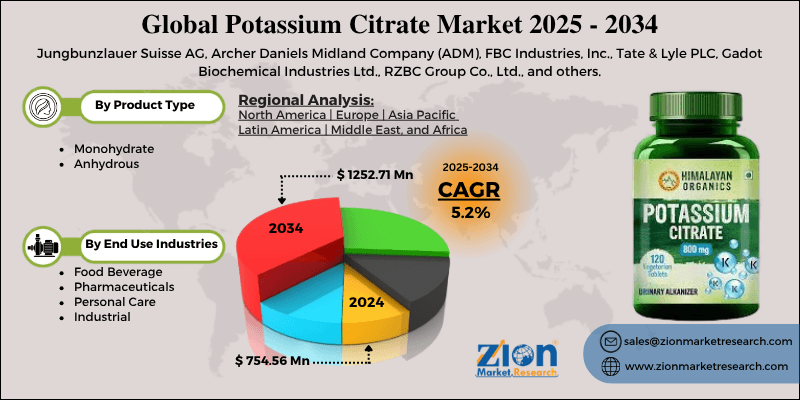
| USD 754.56 Million | USD 1252.71 Million | 5.2% | 2024 |
Potassium Citrate Industry Perspective:
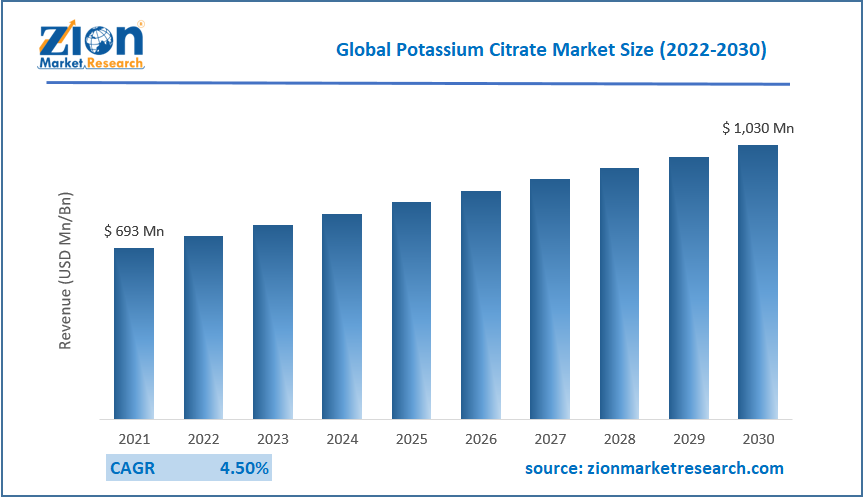
The global Potassium Citrate market size was worth around USD 754.56 million in 2024 and is predicted to reach around USD 1252.71 million by 2034, with a compound annual growth rate (CAGR) of roughly 5.2% between 2025 and 2034. The Potassium Citrate Market is driven by increasing demand in the food and beverage industry for low-sodium formulations, rising prevalence of kidney stones driving pharmaceutical applications, and growing consumer preference for functional foods and dietary supplements.
Potassium Citrate Market: Overview
A white, odorless, citric, hygroscopic crystalline powder known as potassium citrate (K3C6H5O7) or tri-potassium citrate is produced by mixing potassium bicarbonate and citric acid. It functions as a crucial mineral for regulating cell activity, maintaining bodily fluid content, and balancing electrolytes. This, in turn, aids in the treatment of kidney stone problems, lowers the risk of metabolic diseases, produces alkalizing effects in the body to maintain a healthy heart, regulates muscle and nerve function, and balances urinary pH levels.
The market is propelled by expanding applications in personal care and cosmetics, particularly in developing economies, where potassium citrate functions as a metal binder, acid-base regulator, and natural preservative in soaps, oral care products, hair and skin formulations, and related items. Rising healthcare consumption further supports growth through its role in urinary alkalinization, kidney stone prevention, uric acid elimination, and management of metabolic acidosis linked to renal conditions. At the same time, the availability of lower-cost natural substitutes such as citrus fruit consumption and potential adverse health effects associated with elevated potassium levels act as restraints, while opportunities continue to emerge from broader pharmaceutical and functional food adoption.
Key Insights
- As per the analysis shared by our research analyst, the global potassium citrate market is estimated to grow annually at a CAGR of around 5.2% over the forecast period (2025-2034).
- Regarding revenue, the global potassium citrate market size was valued at around USD 754.56 million in 2024 and is projected to reach USD 1252.71 million by 2034.
- The market is driven by increasing demand in the food and beverage industry for low-sodium formulations, rising prevalence of kidney stones driving pharmaceutical applications, and growing consumer preference for functional foods and dietary supplements.
- Based on the Product Type, the Monohydrate segment dominated the market with a share of approximately 62% in 2024, owing to its widespread availability, favorable handling characteristics, and suitability for use as a high-purity food additive and pharmaceutical ingredient that supports consistent performance across formulations.
- Based on the End Use Industries, the Food & Beverage segment held the largest share of around 45% in 2024, driven by its extensive application as a buffering agent, flavoring additive, acidity regulator, and sodium-reduction tool that extends shelf life and improves taste profiles in processed foods and beverages.
- Based on region, Asia Pacific dominated the global market with a share of more than 40% in 2024, primarily due to rising consumption of stabilizers, antioxidants, and flavoring agents across expanding food and beverage, personal care, and cosmetics industries in countries such as China, India, and Japan.
Potassium Citrate Market: Growth Drivers
Growing personal care and cosmetics demand in developing economies to drive the market growth
In a variety of cosmetic products, including soap, colors, oral care items, infant items, hair products, skin products, and others, potassium citrate, the potassium salt of citric acid, is used to treat skin conditions. Potassium citrate bonds metals and regulates the acid/base balance, which further aids in the natural preservation of cosmetics and personal care items.
This means that the global potassium citrate market is expected to develop as a result of the expansion of the cosmetics sector. China's cosmetics business grew by 15.33% in 2019, from US$ 56.21 billion to US$ 61.45 billion, according to Cosmetic Europe, a personal care organization. Other Asian nations like India and Japan are also experiencing a boom in the cosmetics business. Cosmetic Europe, a trade group for personal care products, estimates that the Indian cosmetics market grew by $13.43 billion in 2019 as opposed to $12.63 billion in 2018.
In addition, the US cosmetics market increased by 3.95% in 2019 from US$ 79.36 billion to US$ 82.50 billion. As a result, the demand for potassium citrate as a cosmetic astringent is expected to increase due to the developing cosmetic sector.
Potassium Citrate Market: Restraints
Availability of substitutes to limit the market growth
For certain patients, the cost of long-term potassium citrate therapy may be a financial strain. To control hypocitraturic calcium kidney stones, the alternative intervention of ingesting citrus fruits, particularly lemons, has been suggested. Thus, the availability of substitutes might be hampering the potassium citrate industry growth during the forecast period.
Potassium Citrate Market: Opportunities
Growing healthcare consumption provides a lucrative opportunity
Potassium citrate is used to eliminate protons, or positively charged atoms, which lowers the acidity of the urine and lowers the risk of kidney stones. Potassium citrate preserves optimum pH levels for bone health and guards against increased urine saturation brought on by high-protein meals. In addition, potassium citrate aids in kidney stone prevention and uric acid elimination. Additionally, it helps both prevent and treat some metabolic issues (acidosis) brought on by renal illness. Therefore, it is predicted that the global potassium citrate market will expand as a result of the extensive use of potassium citrate in healthcare.
Potassium Citrate Market: Challenges
Adverse impact on health acts as a major challenge
The potassium salt of citric acid, potassium citrate, can cause several health problems, including black stools, confusion, dizziness, irregular heartbeat, chest pain, high blood pressure, stomach pain, difficulty swallowing, unusual weakness, and others. Additionally, difficulties with quick weight gain, unusually cold skin, and tingling in the hands & feet are brought on by high potassium levels in the blood. Additionally, it damages tissue, which can hinder the potassium citrate industry from expanding.
Potassium Citrate Market: Segmentation
The Potassium Citrate market is segmented by product type, end-use industries, and region.
Based on Product Type Segment, the Potassium Citrate market is divided into monohydrate and anhydrous. The monohydrate segment currently dominates the market because of its favorable physical properties, ease of handling, and broad compatibility with food, pharmaceutical, and personal care formulations. Its hygroscopic crystalline form and consistent purity profile make it the preferred choice for manufacturers seeking reliable performance as a buffering agent, flavoring additive, and electrolyte source. This dominance supports overall market growth by enabling efficient large-scale production and widespread application across high-volume end-use sectors. The anhydrous segment holds the second-largest position, valued for applications requiring lower moisture content and greater stability under specific processing or storage conditions, thereby sustaining complementary demand alongside the leading monohydrate form.
Based on End Use Industries Segment, the Potassium Citrate market is divided into food beverage, pharmaceuticals, personal care, industrial, and others. The food beverage segment leads the market as potassium citrate is extensively used as a food additive to regulate pH in the alkaline range, inhibit enzyme activity, extend shelf life, provide balanced sour flavor, reduce sodium content, and fortify potassium levels in processed foods and beverages. This broad functional versatility drives consistent high-volume demand and underpins overall industry expansion. The pharmaceuticals segment ranks as the second-most dominant category, supported by its critical role in urinary alkalinization, kidney stone management, and treatment of certain metabolic conditions, which continues to generate steady growth as awareness of preventive renal health increases.
otassium Citrate Market: Report Scope
| Report Attributes | Report Details |
|---|---|
| Report Name | Potassium Citrate Market |
| Market Size in 2024 | USD 754.56 Million |
| Market Forecast in 2034 | USD 1252.71 Million |
| Growth Rate | CAGR of 5.2% |
| Number of Pages | 187 |
| Key Companies Covered | Jungbunzlauer Suisse AG, Archer Daniels Midland Company (ADM), FBC Industries, Inc., Tate & Lyle PLC, Gadot Biochemical Industries Ltd., RZBC Group Co., Ltd., and others. |
| Segments Covered | By Product Type, By End Use Industries, and By Region |
| Regions Covered | North America, Europe, Asia Pacific (APAC), Latin America, The Middle East and Africa (MEA) |
| Base Year | 2024 |
| Historical Year | 2020 to 2023 |
| Forecast Year | 2025 - 2034 |
| Customization Scope | Avail customized purchase options to meet your exact research needs. Request For Customization |
Potassium Citrate Market: Regional Analysis
The Asia Pacific is expected to dominate the market during the forecast period
The Asia Pacific dominated the global potassium citrate market in 2021 with a share of more than 40% and is expected to show its dominance over the forecast period. The growth in the region is attributed to the rising use of stabilizers, antioxidants, and other substances from a variety of end-use industries, including personal care & cosmetics, food & beverages, and other end-use industries in Asian countries.
The need for potassium salts of citric acid as flavoring agents is predicted to increase in countries like India, China, Japan, and others, which presents a market potential. The use of potassium citrate is therefore predicted to increase due to the expanding variety of end-use industries in Asian nations.
China's food and beverage industry grew by US$595 billion in 2019, a 7.8% growth from 2018, according to the China Chain Store & Franchise Association. In addition, the personal care market in India is anticipated to reach US$ 20 billion by 2025, according to the India Brand Equity Foundation (IBEF). Furthermore, the cosmetics industry in Japan climbed to euro US$ 36.49 billion in 2019 from US$ 34.7 billion in 2018, according to Cosmetic Europe, a personal care association. Thus, the aforementioned facts supported the expansion of the market over the forecast period.
Besides, North America accounted for a significant market share of potassium citrate in 2021 and is expected to continue this pattern over the forecast period. The growth in the North American region is owing to the growing demand from consumers for various skincare goods like peels, creams, and face masks. Moreover, the United States is the largest exporter of personal care & cosmetics products. For instance, according to data from the U.S. Department of Commerce, the U.S. exported $838 million worth of personal care and cosmetic products to China in 2020, an increase of 2.2% from the previous year.
Recent Developments
- In December 2021, to increase its bio-industrial footprint and better serve industrial customers looking for "greener" ingredient solutions, Cargill acquired Croda's Performance Technologies and Industrial Chemicals business. Cargill's bio-industrial unit has made its largest purchase to date, and nearly 750 employees from around the world have joined. Additionally, about 85% of the resources used to create the goods that will be added to Cargill's bio-industrial portfolio are renewable and biobased, which is consistent with the company's commitment to sustainability.
- In April 2021, the generic version of Urocit-K®, Potassium Citrate ER Tablets, was introduced by Camber Pharmaceuticals. Renal tubular acidosis is a kidney stone problem that is treated with potassium citrate ER tablets. Camber sells potassium citrate ER tablets in 100-count bottles of 5 mEq, 10 mEq, and 15 mEq each.
Potassium Citrate Market: Competitive Analysis
The global potassium citrate market is dominated by players like:
- Jungbunzlauer Suisse AG
- Archer Daniels Midland Company (ADM)
- FBC Industries Inc.
- Tate & Lyle PLC
- Gadot Biochemical Industries Ltd.
- RZBC Group Co. Ltd.
What are the key trends in the Potassium Citrate Market?
Rising demand for low-sodium and functional food formulations
Food and beverage manufacturers are increasingly incorporating potassium citrate as a dual-purpose ingredient that reduces sodium content while providing buffering, flavor enhancement, and shelf-life extension benefits. This trend aligns with broader consumer interest in healthier processed foods and functional beverages.
Expanding pharmaceutical applications for renal and metabolic health
Growing awareness of kidney stone prevention and the management of metabolic acidosis is driving higher utilization of potassium citrate in extended-release tablets and related formulations, reinforcing its position as a clinically relevant mineral salt within the pharmaceutical sector.
The global potassium citrate market is segmented as follows;
By Product Type
- Monohydrate
- Anhydrous
By End-Use Industries
- Food Beverage
- Pharmaceuticals
- Personal Care
- Industrial
- Others
By Region
- North America
- The U.S.
- Canada
- Mexico
- Europe
- France
- The UK
- Spain
- Germany
- Italy
- Rest of Europe
- Asia Pacific
- China
- Japan
- India
- Australia
- South Korea
- Rest of Asia Pacific
- The Middle East & Africa
- Saudi Arabia
- UAE
- Egypt
- Kuwait
- South Africa
- Rest of the Middle East & Africa
- Latin America
- Brazil
- Argentina
- Rest of Latin America
Table Of Content
Methodology
FrequentlyAsked Questions
Potassium citrate is a white, odorless, hygroscopic crystalline powder (K3C6H5O7) produced by combining potassium bicarbonate and citric acid. It functions as a mineral that regulates cell activity, maintains fluid balance, supports electrolyte equilibrium, aids in kidney stone management, produces alkalizing effects, and balances urinary pH.
Key growth drivers include increasing demand in the food and beverage industry for low-sodium formulations, rising prevalence of kidney stones that support pharmaceutical applications, growing consumer preference for functional foods and dietary supplements, and expanding use in personal care and cosmetics products.
The global Potassium Citrate market was valued at approximately USD 754.56 million in 2024 and is projected to reach around USD 1252.71 million by 2034.
The market is expected to expand at a compound annual growth rate (CAGR) of approximately 5.2% during the forecast period from 2025 to 2034.
Major challenges include the availability of lower-cost natural substitutes such as citrus fruits for certain therapeutic applications and potential adverse health effects associated with elevated potassium levels, including gastrointestinal, cardiovascular, and neuromuscular symptoms.
Emerging trends include rising demand for low-sodium and functional food formulations, expanding pharmaceutical applications focused on renal and metabolic health, and increasing incorporation of potassium citrate as a multifunctional ingredient in personal care and cosmetics products.
The value chain typically encompasses sourcing of citric acid and potassium sources, chemical synthesis and purification, quality control and packaging, distribution to food, pharmaceutical, personal care, and industrial customers, application formulation by end users, and continuous product development focused on purity and functionality.
Asia Pacific is expected to contribute notably and continue leading the global Potassium Citrate market during the forecast period.
Major players leveraging the potassium citrate market are Jungbunzlauer Suisse AG, Archer Daniels Midland Company (ADM), FBC Industries, Inc., Tate & Lyle PLC, Gadot Biochemical Industries Ltd., and RZBC Group Co., Ltd.

HappyClients

