
Global Polyetherimide (PEI) Market Size, Share, Growth, Trends, and Forecast, 2032

Polyetherimide (PEI) Market - By Form (Film, Sheet, Granule, Tube, and Rod), By Grade Type (Reinforced and Unreinforced), By Process Type (Injection Molding, Thermoforming, Extrusion, and Compression Molding), By End-User (Electrical & Electronics, Transportation, Consumer Goods, Industrial, Medical, and Others), and By Region - Global Industry Perspective, Comprehensive Analysis, and Forecast, 2024 - 2032
| Market Size in 2023 | Market Forecast in 2032 | CAGR (in %) | Base Year |
|---|---|---|---|
| USD 679.13 Million | USD 1227.71 Million | 6.8% | 2023 |
What is the Polyetherimide (PEI) Market Size?
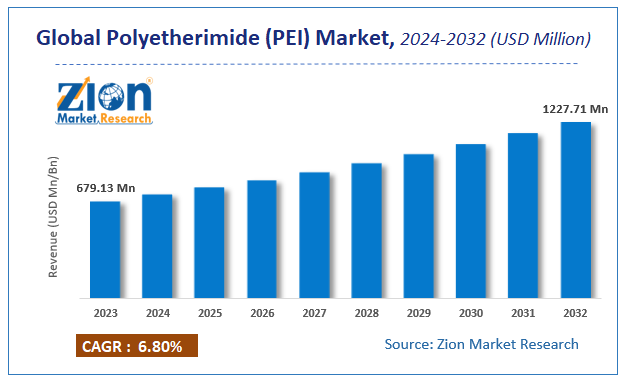
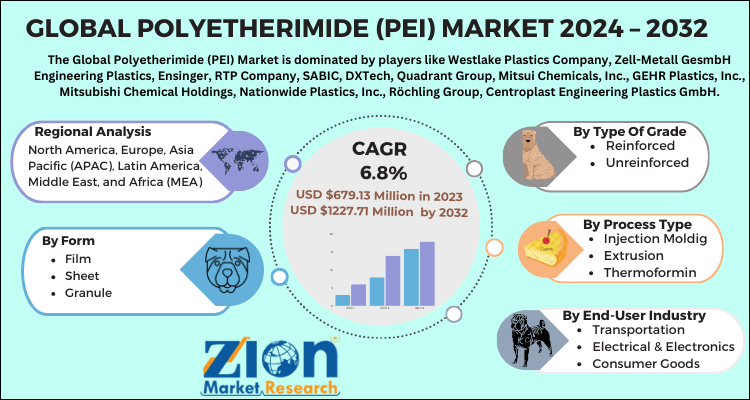
According to a report from Zion Market Research, the global Polyetherimide (PEI) Market was valued at USD 679.13 Million in 2023 and is projected to hit USD 1227.71 Million by 2032, with a compound annual growth rate (CAGR) of 6.8% during the forecast period 2024-2032.
This report explores market strengths, weakness, opportunities, and threats. It also provides valuable insights into the market's growth drivers, challenges, and the future prospects that may emerge in the Polyetherimide (PEI) industry over the next decade.
Market Overview
Polyetherimide (PEI) is a high-performance engineering thermoplastic characterized by ether links and imide groups in its polymer chain. It delivers exceptional mechanical strength, thermal stability, chemical resistance, creep resistance, and inherent flame retardancy, making it suitable for demanding high-temperature applications where heat dissipation and dimensional stability are critical. PEI is valued as a thermally conductive plastic that can replace metals in compact electronic equipment and other precision components.
Demand is propelled by the need for lightweight, durable materials in automotive and aerospace sectors that improve fuel efficiency and reduce emissions. PEI’s unique combination of heat resistance, strength, and electrical insulation supports its use in electrical connectors, under-the-hood parts, aircraft interiors, and medical devices. At the same time, competition from alternative high-performance polymers such as PEEK and PPS, along with processing complexity and higher material costs, influences market dynamics. Continuous advancements in manufacturing processes and the development of specialized grades continue to expand application possibilities across transportation, electronics, industrial, and healthcare industries.
Key Insights
- As per the analysis shared by our research analyst, the global Polyetherimide market is estimated to grow annually at a CAGR of around 6.8% over the forecast period (2025-2034).
- In terms of revenue, the global Polyetherimide market size was valued at around USD 679.13 million in 2024 and is projected to reach USD 1227.71 million by 2034.
- The market is driven by extensive use of polyetherimide as a cost-effective metal substitute in compact electronic equipment and rising demand from automotive and aerospace applications.
- Based on the Form segment, Granule and Sheet forms held leading positions because they support versatile processing into complex shapes for high-precision components across electronics and transportation.
- Based on the Type of Grade segment, Reinforced grades dominated due to enhanced mechanical strength and thermal performance required in structural and high-stress applications.
- Based on the Process Type segment, Injection Molding led the market as it efficiently produces complex shapes and high-precision components with tight tolerances for aerospace, automotive, and electronics uses.
- Based on the End-User Industry segment, Electrical & Electronics held a major share owing to superior electrical insulation and thermal stability needs in connectors, insulators, and compact devices.
- Asia Pacific dominated the global market driven by massive consumption in transportation, healthcare, and electronics sectors together with rising adoption of specialty polymers across the region.
Market Dynamics
Growth Drivers
Will growing need in the automotive and aerospace industries drive the Polyetherimide market growth?
The expanding automotive and aerospace industries significantly propel demand for polyetherimide. PEI’s high heat resistance, mechanical strength, and dimensional stability enable production of lightweight, durable components that support fuel efficiency and emission reduction goals. In automotive applications it is used for electrical connectors, thermostat housings, bezels, interior parts, bumpers, electromechanical systems, and lamp sockets.
Aerospace manufacturers rely on PEI for its ability to withstand extreme temperatures while reducing overall aircraft weight. As these sectors continue to innovate and expand production of next-generation vehicles and aircraft, the need for high-performance materials such as PEI is expected to increase steadily, reinforcing market growth over the forecast period.
Restraints
Will competition from substitute materials hamper the Polyetherimide market?
Competition from alternative high-performance polymers such as PEEK and PPS presents a notable restraint. These materials offer comparable heat resistance, mechanical strength, and chemical stability and may provide cost advantages or specialized benefits in certain applications, potentially capturing market share from PEI.
The ongoing development of new advanced materials and composites further intensifies competitive pressure. Although PEI retains unique advantages in flame retardancy and transparency for specific aerospace and electronics uses, pricing sensitivity and the availability of substitutes can limit broader adoption in cost-conscious segments.
Opportunities
Where do significant growth opportunities exist for polyetherimide?
Opportunities are expanding in high-temperature, lightweight components for aerospace, electronics, and medical devices. The material’s suitability for additive manufacturing grades and continued metal replacement strategies open new application pathways.
Rising requirements for high-performance materials that withstand harsh environments, elevated temperatures, and mechanical stress create additional demand across electrical & electronics, transportation, and healthcare end-use industries. Advances in process efficiency and specialized grades further support market expansion.
Challenges
What major challenges restrain the growth of the Polyetherimide market?
High material costs and processing complexity remain key challenges. The limited number of primary suppliers also constrains supply flexibility and can affect pricing dynamics.
Competition from alternative high-performance polymers continues to exert pressure on pricing and market share. Manufacturers must continually innovate and optimize formulations to maintain competitiveness while addressing these structural barriers.
Polyetherimide (PEI) Market: Report Scope
| Report Attributes | Report Details |
|---|---|
| Report Name | Polyetherimide (PEI) Market |
| Market Size in 2023 | USD 679.13 Million |
| Market Forecast in 2032 | USD 1227.71 Million |
| Growth Rate | CAGR of 6.8% |
| Number of Pages | 110 |
| Key Companies Covered | Westlake Plastics Company, Zell-Metall GesmbH Engineering Plastics, Ensinger, RTP Company, SABIC, DXTech, Quadrant Group, Mitsui Chemicals, Inc., GEHR Plastics, Inc., Mitsubishi Chemical Holdings, Nationwide Plastics, Inc., Röchling Group, Centroplast Engineering Plastics GmbH, PlastiComp, Inc., and Solvay |
| Segments Covered | By Form, By Type Of Grade, By Process Type, By End-User Industry And By Region |
| Regions Covered | North America, Europe, Asia Pacific (APAC), Latin America, Middle East, and Africa (MEA) |
| Base Year | 2023 |
| Historical Year | 2018 - 2022 |
| Forecast Year | 2024 - 2032 |
| Customization Scope | Avail customized purchase options to meet your exact research needs. Request For Customization |
Market Segmentation
The Polyetherimide market is segmented by form, type of grade, process type, end-user industry, and region.
Based on Form Segment, The Polyetherimide market is divided into Film, Sheet, Granule, Tube, Rod, and others. Granule form stands as the most dominant sub-segment because it enables efficient feeding into injection molding and extrusion equipment for high-volume production of complex, high-precision parts used in electronics and automotive applications. Its versatility supports consistent quality and cost-effective manufacturing of intricate geometries. Sheet ranks as the second most dominant form, valued for its use in machining and thermoforming of flat or semi-finished components that require excellent dimensional stability and thermal performance, thereby driving demand in industrial and medical sectors and contributing to overall market volume growth.
Based on Type of Grade Segment, The Polyetherimide market is divided into Reinforced, Unreinforced, and others. Reinforced grades dominate the market due to the superior mechanical strength, stiffness, and thermal performance they provide for structural and high-stress applications in transportation and electronics. Glass-fiber or other reinforcements enhance load-bearing capability while retaining PEI’s inherent heat and flame resistance, making them preferred for demanding end-uses and accelerating market expansion. Unreinforced grades form the second major category, favored where optical clarity, chemical resistance, or ease of processing are prioritized, supporting applications in medical devices and specialized consumer goods.
Based on Process Type Segment, The Polyetherimide market is divided into Injection Molding, Extrusion, Thermoforming, Compression Molding, and others. Injection Molding holds the leading position because of its ability to efficiently produce complex shapes and high-precision components with tight tolerances required in aerospace, automotive, and electronics industries. The process reduces production costs, improves product quality, and shortens time-to-market, directly supporting PEI adoption for intricate parts. Extrusion ranks as the second most significant process, enabling continuous production of film, sheet, tube, and rod forms that serve as feedstock for further fabrication and contribute substantially to market volume.
Based on End-User Industry Segment, The Polyetherimide market is divided into Transportation, Electrical & Electronics, Consumer Goods, Medical, Industrial, and others. Electrical & Electronics constitutes the dominant end-user segment, driven by the need for superior electrical insulation, thermal stability, and dimensional accuracy in connectors, insulators, and compact electronic devices. PEI’s ability to replace metals in these applications further strengthens its position and propels overall market growth. Transportation follows as the second major segment, benefiting from lightweighting initiatives in automotive and aerospace that utilize PEI for under-hood components, interior parts, and structural elements to improve efficiency and performance.
Regional Analysis
Why will Asia Pacific continue to dominate the global market during the projection period?
Asia Pacific is expected to maintain its leading position throughout the forecast period. Strong demand originates from extensive use of polyetherimide in the transportation, healthcare, and electronics sectors across the region. Rapid industrialization, expanding automotive and electronics manufacturing bases, particularly in China, Japan, India, and South Korea, continue to drive consumption of specialty polymers. Supportive regulatory frameworks and investments in high-performance materials further reinforce regional dominance and stimulate innovation in PEI applications, contributing significantly to global market expansion.
North America benefits from mature aerospace and automotive industries that prioritize lightweight, high-temperature materials. The United States leads regional demand through advanced manufacturing capabilities and continuous development of specialized PEI grades for electronics and medical devices.
Europe maintains a solid presence supported by established automotive and aerospace sectors in Germany, France, the United Kingdom, and Italy. Emphasis on fuel efficiency, emission reduction, and high-performance engineering plastics sustains steady adoption of polyetherimide across industrial and transportation applications.
Latin America and the Middle East & Africa represent emerging markets. Growth in these regions is linked to gradual industrialization, expanding electronics assembly, and rising interest in high-performance materials for automotive and industrial uses, although overall volumes remain lower than in the leading regions.
Recent Developments
- In July 2024, SABIC commissioned a major new ULTEM resin manufacturing facility in Singapore, expanding global PEI production capacity by more than 50 percent to meet rising demand from aerospace, medical, 5G, AI, and new-energy vehicle applications in the Asia-Pacific region.
- In October 2025, SABIC introduced three new families of non-fluorinated Siltem polyetherimide/siloxane resin blends designed as alternatives to fluoropolymers in wire and cable applications for automotive, industrial, and oil & gas sectors.
- In May 2026, SABIC unveiled Ultem SU3102P, a reactive polyetherimide oligomer toughening agent for thermoset composites that enables up to 50 percent loading while improving toughness-stiffness balance and processing efficiency for primary and secondary aerospace structures.
- In June 2026, Kingfa Science & Technology brought a kiloton-scale polyetherimide pilot production line into operation, with products entering small-batch sales and supporting further industrialization of PEI capacity.
Key players profiled in the polyetherimide (PEI) market include-
- Westlake Plastics Company
- Zell-Metall GesmbH Engineering Plastics
- Ensinger
- RTP Company
- SABIC
- DXTech
- Quadrant Group
- Mitsui Chemicals
- GEHR Plastics
- Mitsubishi Chemical Holdings
- Nationwide Plastics
- Röchling Group
- Centroplast Engineering Plastics GmbH
- PlastiComp
- Solvay
What are the key trends in the Polyetherimide Market?
Growing adoption of reinforced and specialized grades for metal replacement
Manufacturers are increasingly developing reinforced PEI grades and specialized formulations that enable effective metal substitution in compact electronics, automotive connectors, and aerospace components. These grades deliver the required strength, heat resistance, and dimensional stability while supporting lightweighting objectives and design freedom.
Expansion of capacity and focus on sustainable and high-flow formulations
Leading producers are expanding production capacity and introducing high-flow, colorable, and bio-based or recyclable PEI grades. These innovations address demand for thinner-wall designs, improved processability, and sustainability requirements across electronics, medical, and transportation applications.
The global polyetherimide (PEI) market is segmented as follows:
By Form
- Film
- Sheet
- Granule
- Tube
- Rod
By Type of Grade
- Reinforced
- Unreinforced
By Process Type
- Injection Molding
- Extrusion
- Thermoforming
- Compression Molding
By End-User Industry
- Transportation
- Electrical & Electronics
- Consumer Goods
- Medical
- Industrial
- Others
By Region
- North America
- The U.S.
- Canada
- Mexico
- Europe
- France
- The UK
- Spain
- Germany
- Italy
- Rest of Europe
- Asia Pacific
- China
- Japan
- India
- Australia
- South Korea
- Rest of Asia Pacific
- The Middle East & Africa
- Saudi Arabia
- UAE
- Egypt
- Kuwait
- South Africa
- Rest of the Middle East & Africa
- Latin America
- Brazil
- Argentina
- Rest of Latin America
Table Of Content
Methodology
FrequentlyAsked Questions
Polyetherimide is a high-performance thermoplastic with excellent heat resistance. It is used in aerospace, electronics, and medical devices.
The global polyetherimide (PEI) market is expected to be driven by the demand for high-performance thermoplastics, lightweight components, and use in aerospace and electronics.
According to study, the global polyetherimide (PEI) market size was worth around USD 679.13 Million in 2023 and is predicted to grow to around USD 1227.71 Million By 2032.
The global polyetherimide (PEI) market is expected to grow at a Compound Annual Growth Rate (CAGR) of around CAGR 6.8% during the forecast period from 2024-2032.
The global polyetherimide (PEI) industry is projected to be challenged by Challenges include high material costs, processing complexity, and limited supplier base. Competition from alternative high-performance polymers pressures pricing.
The Opportunities lie in high-temperature, lightweight components for aerospace, electronics, and medical devices. Additive manufacturing grades and metal replacement drive growth will offer significant growth opportunities in the polyetherimide (PEI) market.
High-temperature and lightweight engineering plastic; use in aerospace and medical devices; recyclable PEI grades are the emerging trends and innovations impacting the polyetherimide (PEI) market.
The global polyetherimide (PEI) market is expected to be led by APAC during the forecast period.
Some of the prominent players operating in the global polyetherimide (PEI) market are; Westlake Plastics Company, Zell-Metall GesmbH Engineering Plastics, Ensinger, RTP Company, SABIC, DXTech, Quadrant Group, Mitsui Chemicals, Inc., GEHR Plastics, Inc., Mitsubishi Chemical Holdings, Nationwide Plastics, Inc., Röchling Group, Centroplast Engineering Plastics GmbH, PlastiComp, Inc., and Solvay and others.
The report explores crucial aspects of the polyetherimide (PEI) market, including a detailed discussion of existing growth factors and restraints, while also browsing future growth opportunities and challenges that impact the market.

List of Contents
What is the Market Size?Market OverviewKey InsightsMarket DynamicsReport ScopeMarket SegmentationRegional AnalysisRecent DevelopmentsKey players profiled in the polyetherimide (PEI) market include-What are the key trends in the Polyetherimide Market?The global polyetherimide (PEI) market is segmented as follows:HappyClients

