
Global Plastic Surgery Instruments Market Size, Share Report 2034

Plastic Surgery Instruments Market By Product Type (Handheld Instruments and Electrosurgical Instruments), By Procedure (Cosmetic Surgery and Reconstructive Surgery), By End User (Hospitals, Ambulatory Surgical Centers, and Specialty & Cosmetic Clinics), and Region - Global and Regional Industry Overview, Market Intelligence, Comprehensive Analysis, Historical Data, and Forecasts 2026 - 2034
| Market Size in 2025 | Market Forecast in 2034 | CAGR (in %) | Base Year |
|---|---|---|---|
| USD 1.65 Billion | USD 3.19 Billion | 7.6% | 2025 |
Plastic Surgery Instruments Industry Perspective:
What will be the size of the global plastic surgery instruments market during the forecast period?
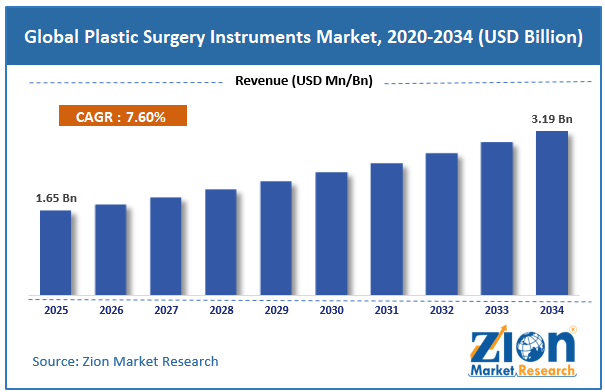
The global plastic surgery instruments market size was worth around USD 1.65 billion in 2025 and is predicted to grow to around USD 3.19 billion by 2034, with a compound annual growth rate (CAGR) of roughly 7.6% between 2026 and 2034.
 Request Free SampleRequest Free Sample
Key Insights
- As per the analysis shared by our research analyst, the global plastic surgery instruments market is estimated to grow annually at a CAGR of around 7.6% over the forecast period (2026-2034).
- In terms of revenue, the global plastic surgery instruments market size was valued at around USD 1.65 billion in 2025 and is projected to reach USD 3.19 billion by 2034.
- Growth of minimally invasive procedures is expected to drive the Plastic surgery instruments market.
- Based on the product type, the handheld instruments segment dominates with a revenue share of 45.2% in 2025.
- Based on the procedure, the cosmetic surgery segment holds a majority of market share in 2025 of 59.3%.
- Based on the end user, the hospitals segment holds a majority of market share in 2025 of 66%.
- Based on region, North America dominates the Plastic Surgery Instruments market with a revenue share of 42.5% in 2025.
Plastic Surgery Instruments Market: Overview
Plastic surgery instruments are specialized medical devices that surgeons use during various procedures on tissue, skin, face, breast, hands, and other body parts. They include scalpels, scissors, forceps, retractors, needle holders, skin hooks, elevators, clamps, and other instruments needed for tissue dissection, suturing, grafting, flap surgery, skin surgery, wound repair, rhinoplasty, and other facial surgeries. Such surgical instruments are made of high-quality stainless steel or other corrosion-resistant materials. A growing number of cosmetic and reconstructive surgeries due to burns, trauma, or other conditions, along with advances in microsurgery, minimally invasive surgical procedures and techniques, and innovations in conventional surgery, are driving the plastic surgery instruments market.
Impact of the USA-Israel War on Iran on the Plastic Surgery Instruments Market
The U.S.-Israel-initiated war against Iran is expected to have an adverse effect on the Iranian plastic surgery instruments market due to disrupted healthcare supplies, imports, and logistics, and reduced purchasing power. Disrupted commercial and trade routes have hindered the free flow of medical equipment, while increased sanctions and financial restrictions are affecting the import of medical instruments. Surgeries and medical procedures require costly equipment, machinery, and raw materials. A surge in the prices of transport fuel, energy, and raw materials will also raise the prices of plastic surgery instruments. As a result, hospitals and clinics will reduce surgeries and investments in new equipment, although the demand for reconstructive surgeries is likely to increase due to combat-related injuries.
Plastic Surgery Instruments Market: Dynamics
Growth Drivers
How does the rising demand for cosmetic procedures drive the growth of the plastic surgery instruments market?
Growing demand for cosmetic procedures is a major driver of the plastic surgery instruments market. As the number of cosmetic surgeries increases, demand for surgical scissors, forceps, retractors, scalpels, needle holders, electrosurgical instruments, and other surgical instruments rises. According to the American Society of Plastic Surgeons 2024 data, nearly 1.6 million cosmetic surgeries and 28.5 million minimally invasive procedures are expected to be performed in the U.S. in 2024. Out of which, the most common procedures are liposuction (349,728 procedures), breast augmentation (306,196 procedures), abdominoplasty (171,064 procedures), breast lift (153,616 procedures), and eyelid surgery (120,755 procedures). A 1% rise in cosmetic surgeries and a 3% increase in minimally invasive procedures compared to 2023 will further raise the need for plastic surgery instruments, including those used in body contouring, breast surgery, facial surgery, and minimally invasive procedures. Moreover, more cosmetic surgeries will encourage hospitals, surgical centers, and cosmetic clinics to expand their instrument holdings, further accelerating market growth.
Restraints
Risk of postoperative complications and infections act as a major restraint on the growth of the plastic surgery instruments industry
The risks of postoperative complications and surgical-site infections (SSIs) can restrain growth in the plastic surgery instruments market by limiting the number of patients who opt for surgery due to increased concerns about safety and outcomes. Surgical procedures can involve various post-surgery risks, including infections, incision-site dehiscence, seroma, wound necrosis, delayed healing, and scarring requiring revision surgery. According to a 2026 Systematic review, SSIs occurred in approx. 5% of plastic surgery patients, while the Centers for Disease Control and Prevention (CDC) acknowledge that SSIs require additional healthcare resources and, in some cases, another surgical procedure.
Moreover, post-surgery risks can limit adoption of cosmetic procedures and drive strict sterilization, infection control, and reprocessing practices among healthcare facilities, raising healthcare costs. Indeed, the CDC reported adverse patient outcomes, including infections, from cosmetic procedures and indicated deficiencies in environmental cleaning, hand hygiene, and surgical-equipment reprocessing in some investigations. Therefore, concerns about post-surgery complications, patient outcomes and safety, legal liability, and additional treatment costs can reduce the number of plastic surgery procedures and restrain the market growth.
Opportunities
How does the rising innovative product launch offer a lucrative opportunity for the plastic surgery instruments market?
The growing launch of innovative products is expected to create opportunities for growth in the plastic surgery instruments industry. For instance, in November 2025, W&H Medical has announced the launch of the Piezo & Drill Combination Console, the only FDA-cleared medical device in the U.S. that combines the latest in piezo technology with a high-performance surgical motor. This innovative 2-in-1 modular system was developed to meet the evolving needs of today’s facial plastics, ENT, rhinoplasty, and craniomaxillofacial (CMF) surgeons, offering best-in-class accuracy and efficiency to improve clinical outcomes.
Challenges
Why does the shortage of skilled surgeons pose a significant challenge to the growth of the plastic surgery instruments industry?
The shortage of skilled plastic surgeons significantly constrains growth in the plastic surgery instruments market. Advanced plastic surgery instruments require professional handling, and the limited availability of skilled professionals reduces adoption of complex cosmetic and reconstructive procedures, especially in untapped and emerging markets, thereby lowering demand for such instruments. The shortage of plastic surgeons is not only relevant to emerging markets but is also evident in developed countries.
According to the projection of the United States Health Resources and Services Administration (HRSA) Health Workforce Simulation Model for 2026, the number of plastic and reconstructive surgeons in the US is estimated to decrease from 10,310 in 2024 to 8,540 in 2037, while the demand for them is projected to rise from 11,280 to 11,600. The lack of medical professionals is a critical restraint to market growth, given the uneven distribution of plastic surgeons worldwide, as highlighted by the World Health Organization (WHO). In other words, limited access to qualified, skilled surgeons in remote areas and developing countries reduces the number of plastic surgeries and, consequently, demand for advanced plastic surgery instruments.
Plastic Surgery Instruments Market: Report Scope
| Report Attributes | Report Details |
|---|---|
| Report Name | Plastic Surgery Instruments Market |
| Market Size in 2025 | USD 1.65 Billion |
| Market Forecast in 2034 | USD 3.19 Billion |
| Growth Rate | CAGR of 7.6% |
| Number of Pages | 228 |
| Key Companies Covered | KLS Martin Group, Anthony Products, Zimmer Biomet, Integra LifeSciences, B. Braun Melsungen, Sklar Surgical Instruments, BMT Medizintechnik, Tekno-Medical Optik-Chirurgie, Bolton Surgical, Blink Medical, Surgicon Pvt., Stryker, Johnson & Johnson, Medtronic, Arthrex, Conmed Corporation, Ethicon, Olympus Corporation, MicroAire, Boston Scientific, and others. |
| Segments Covered | By Product Type, By Procedure, By End User, and By Region |
| Regions Covered | North America, Europe, Asia Pacific (APAC), Latin America, Middle East, and Africa (MEA) |
| Base Year | 2025 |
| Historical Year | 2020 - 2024 |
| Forecast Year | 2026 - 2034 |
| Customization Scope | Avail customized purchase options to meet your exact research needs. Request For Customization |
Plastic Surgery Instruments Market: Segmentation
Product Type Insights
Why does the handheld instruments segment hold a prominent position in the plastic surgery instruments market?
The handheld instruments segment dominates with a revenue share of 45.2% in 2025. Growth is mainly driven by the heavy use of handheld surgical instruments like forceps, retractors, graspers, cutters, elevators, cannulas, and dissectors, especially in cosmetic and reconstructive surgeries. These instruments provide direct feedback, precision, and control to the surgeon during the procedure and are versatile, as they can be used in various surgical procedures.
Procedure Insights
How does the cosmetic surgery segment capture the largest share in the plastic surgery instruments market?
The cosmetic surgery segment holds a majority share of the plastic surgery instruments industry in 2025, at 59.3%. Increasing disposable income, growing awareness of aesthetic procedures, social media influence, advances in minimally invasive procedures, and greater affordability are driving demand for cosmetic surgeries. This directly affects the use and replacement of plastic surgery instruments, which in turn contributes positively to the segment's revenue.
End User Insights
How does the hospitals segment capture the largest share in the plastic surgery instruments market?
The hospitals segment holds the largest share of the plastic surgery instruments market in 2025, at 66%. Revenue growth is driven by rising cosmetic surgeries, reconstructive treatments after trauma and cancer, and hospitals’ investments in modern equipment. In addition, medical institutions need various tools for plastic surgery, such as forceps, scissors, retractors, needle holders, cannulas, and electrocautery devices. Moreover, hospitals offer comprehensive treatment and care for all types of conditions and patients, including high-risk cases, which attracts people to choose hospital plastic surgery and creates demand for advanced surgical instruments.
Regional Insights
What factors drive the North America region in the plastic surgery instruments market?
North America dominates the plastic surgery instruments market with a revenue share of 42.5% in 2025. The growth is driven by a high volume of cosmetic and reconstructive procedures, advanced healthcare infrastructure, major medical device manufacturers, and the rapid adoption of innovative surgical technology. Product innovation also drives regional growth. For example, in March 2025, TELA Bio commercially launched larger sizes of its OviTex PRS Reinforced Tissue Matrix in the United States, specifically designed for plastic and reconstructive surgery; the larger sizes can reduce the need for multiple smaller pieces and potentially simplify complex reconstructive procedures. The introduction of such products reflects continued investment in technologies that improve surgical handling and procedural efficiency.
In addition, a growing demand for minimally invasive procedures, technological advancements, high healthcare expenditure, and increased patient awareness are encouraging hospitals and specialist clinics to update their surgical instrument portfolios, supporting revenue growth in North America.
Plastic Surgery Instruments Market: Competitive Analysis
The global plastic surgery instruments market is dominated by players like:
- KLS Martin Group
- Anthony Products
- Zimmer Biomet
- Integra LifeSciences
- B. Braun Melsungen
- Sklar Surgical Instruments
- BMT Medizintechnik
- Tekno-Medical Optik-Chirurgie
- Bolton Surgical
- Blink Medical
- Surgicon Pvt.
- Stryker
- Johnson & Johnson
- Medtronic
- Arthrex
- Conmed Corporation
- Ethicon
- Olympus Corporation
- MicroAire
- Boston Scientific
The global plastic surgery instruments market is segmented as follows:
By Product Type
- Handheld Instruments
- Forceps
- Scissors
- Retractors
- Others
- Electrosurgical Instruments
- Bipolar Instruments
- Monopolar Instruments
By Procedure
- Cosmetic Surgery
- Breast Procedures
- Face & Head Cosmetic Surgery
- Body & Extremities Procedures
- Reconstructive Surgery
- Breast Reconstruction
- Congenital Deformity Correction
- Tumor Removal
- Other Reconstructive Surgeries
By End User
- Hospitals
- Ambulatory Surgical Centers
- Specialty & Cosmetic Clinics
By Region
- North America
- The U.S.
- Canada
- Mexico
- Europe
- France
- The UK
- Spain
- Germany
- Italy
- Rest of Europe
- Asia Pacific
- China
- Japan
- India
- Australia
- South Korea
- Rest of Asia Pacific
- The Middle East & Africa
- Saudi Arabia
- UAE
- Egypt
- Kuwait
- South Africa
- Rest of the Middle East & Africa
- Latin America
- Brazil
- Argentina
- Rest of Latin America
Table Of Content
Methodology
FrequentlyAsked Questions
Plastic surgery instruments are specialized medical devices that surgeons use during various procedures on tissue, skin, face, breast, hands, and other body parts. They include scalpels, scissors, forceps, retractors, needle holders, skin hooks, elevators, clamps, and other instruments needed for tissue dissection, suturing, grafting, flap surgery, skin surgery, wound repair, rhinoplasty, and other facial surgeries.
The key growth drivers for the plastic surgery instruments market include the rising number of cosmetic and reconstructive procedures, increasing awareness of aesthetic treatments, growing disposable income, and the rising adoption of minimally invasive and electrosurgical techniques. Technological advancements are also encouraging hospitals and clinics to adopt more precise, ergonomic, and efficient surgical instruments. In addition, an aging population, the expansion of ambulatory surgical centers, medical tourism, and growing healthcare infrastructure in emerging economies are creating further demand for plastic surgery instruments.
The major challenges restraining the plastic surgery instruments market include the high cost of advanced surgical instruments, stringent regulatory requirements, and the risk of postoperative complications and infections. High-quality electrosurgical and precision instruments require significant investment, which can limit adoption among small clinics and healthcare facilities in emerging markets.
Based on the product type, the handheld instruments segment is expected to dominate the plastic surgery instruments market growth during the projected period.
The plastic surgery instruments market is being influenced by several emerging trends, including the growing adoption of minimally invasive and robotic-assisted procedures, advanced electrosurgical instruments, AI-enabled surgical technologies, high-resolution imaging, and ergonomically designed instruments. Robotic systems are increasingly being explored in plastic and reconstructive surgery because they can improve visualization, dexterity, tremor reduction, and surgical precision. Electrosurgical technologies are also gaining traction because energy-based instruments can improve tissue cutting and coagulation while reducing operative time and tissue trauma.
According to the report, the global plastic surgery instruments market size was worth around USD 1.65 billion in 2025 and is predicted to grow to around USD 3.19 billion by 2034.
The global plastic surgery instruments market is expected to grow at a CAGR of 7.6% during the forecast period.
The global plastic surgery instruments industry growth is expected to be led by North America over the forecast period.
The global plastic surgery instruments market is dominated by players like KLS Martin Group, Anthony Products, Zimmer Biomet, Integra LifeSciences, B. Braun Melsungen, Sklar Surgical Instruments, BMT Medizintechnik, Tekno-Medical Optik-Chirurgie, Bolton Surgical, Blink Medical, Surgicon Pvt., Stryker, Johnson & Johnson, Medtronic, Arthrex, Conmed Corporation, Ethicon, Olympus Corporation, MicroAire, and Boston Scientific, among others.
The plastic surgery instruments market report covers the geographical market along with a comprehensive competitive landscape analysis. It also includes cash flow analysis, profit ratio analysis, market basket analysis, market attractiveness analysis, sentiment analysis, PESTLE analysis, trend analysis, SWOT analysis, trade area analysis, demand & supply analysis, Porter’s five forces analysis, and value chain analysis.

HappyClients