
Plant Protein Ingredients Market Size, Share, Industry Analysis, Trends, Growth, Forecasts, 2032

Plant Protein Ingredients Market By form (liquid and dry), By type (isolates, textured proteins, and isolates), By source (wheat, pea, soy, and others), By application (food & beverages, cosmetics & personal care, animal feed, and others) And By Region: - Global And Regional Industry Overview, Market Intelligence, Comprehensive Analysis, Historical Data, And Forecasts, 2024-2032
| Market Size in 2023 | Market Forecast in 2032 | CAGR (in %) | Base Year |
|---|---|---|---|
| USD 13.18 Billion | USD 26.86 Billion | 8.23% | 2023 |
Description
How big is the Plant Protein Ingredients Market?
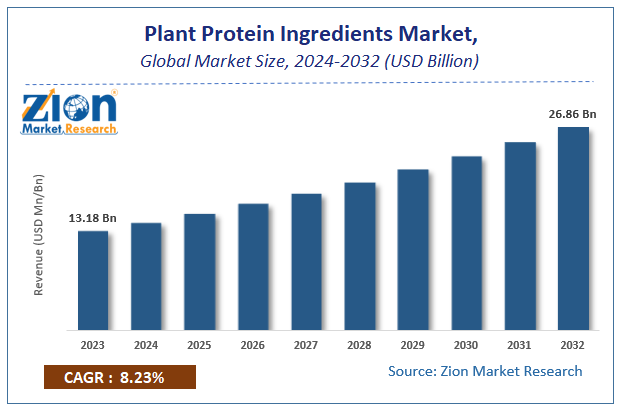
According to the report published by Zion Market Research, the global Plant Protein Ingredients Market size was valued at USD 13.18 Billion in 2023 and is predicted to reach USD 26.86 Billion by the end of 2032. The market is expected to grow with a CAGR of 8.23% during the forecast period. The report analyzes the global Plant Protein Ingredients Market's growth drivers, restraints, and impact on demand during the forecast period. It will also help navigate and explore the arising opportunities in the Plant Protein Ingredients industry.
 Request Free SampleRequest Free Sample
Global Plant Protein Ingredients Market: Overview
The human body is made up of 20% proteins. As proteins are not stored in the body, it is essential to consume protein-rich food every day to get enough protein from the diet. Plant proteins make up a high proportion of the human diet. A wide range of plant protein ingredients such as insoluble, functional, soluble, and textural forms are produced for several applications including sports & slimming foods, snacks & cereals, gluten-free foods, clinical nutrition products, soups & sauces, and meat products. The plant protein ingredients are proteins that are derived from plant-based sources such as wheat, soybean, cereals, pea, and many more.
Global Plant Protein Ingredients Market: Growth Factors
The growing trend of veganism, rise in consumer preferences towards a healthy diet, rise in demand for animal feed, and growing importance of plant proteins in sports nutrition are the major factors that are augmenting the growth of the global plant protein ingredients market at a rapid pace. Plant protein ingredients are widely used in food products that are essential for weight management. Nowadays, most of the population is adopting a diet that is fortified with proteins. In developed and developing countries, obesity and its comorbidities are becoming a public health problem across the world. As per the data and statistics provided by CDC, in 2017-18, the prevalence of obesity was around 42.4 percent which ultimately leads to obesity-related conditions such as stroke, heart diseases, diabetes, and many more.
Thus, the government is taking initiatives by conducting national educational campaigns to modify consumer behavior and eating habits to fight the rising obesity factor. Thus, there is a huge demand for plant protein ingredients in weight loss and weight management. In addition to this, they are also a good alternative for meat products. The population with lactose intolerance is also opting for plant proteins instead of dairy protein ingredients. Owing to all these factors, there is significant growth in the global market. Moreover, huge investment in R&D activities to launch new products and increasing use of soya & rice-based proteins will drive the growth of the global plant protein ingredients market during the forecast period. However, certain allergies associated to plant protein ingredients may hamper the growth of the global plant protein ingredients market.
During the first and second quarter of the year 2020, the global plant protein ingredients market experienced a setback in growth due to strict lockdown and restriction on movement. However, with the removal of lockdown, most of the industries have started functioning at full pace. Consumers are turning towards a healthy diet & plant-based products and are avoiding meat due to the impact on meat production. Thus, the market will experience a healthy growth rate in the forthcoming years.
Key Insights
- As per the analysis shared by our research analyst, the global Plant Protein Ingredients Market is estimated to grow annually at a CAGR of around 8.23% over the forecast period (2024-2032).
- In terms of revenue, the global Plant Protein Ingredients Market size was valued at around USD 13.18 Billion in 2023 and is projected to reach USD 26.86 Billion by 2032.
- Based on the form, the dry form segment holds the dominant position. This preference is largely due to the ease of handling, storage, and transportation associated with dry forms such as powders and granules. Dry plant proteins are widely utilized across various applications, including food and beverages, sports nutrition, and animal feed, owing to their longer shelf life and versatility in formulation processes.
- Based on the type, soy protein emerges as the most dominant segment in the plant protein ingredients market. Soy protein's prominence is attributed to its comprehensive amino acid profile, cost-effectiveness, and functional properties that make it suitable for diverse applications, particularly in meat and dairy alternatives. Its widespread acceptance in both human nutrition and animal feed further reinforces its market leadership.
- Based on the source, soybeans are the leading source of plant protein ingredients. Soybeans' high protein content, approximately 40%, and their versatility in producing various protein forms like isolates and concentrates contribute to their dominance. Additionally, the established supply chain and processing infrastructure for soybeans support their leading position in the market.
- Based on the application, the food and beverages sector is the most dominant segment in the plant protein ingredients market. This dominance is driven by the increasing consumer demand for plant-based alternatives to meat and dairy products, as well as the incorporation of plant proteins into bakery, confectionery, and beverage products. The growing health consciousness and preference for sustainable food options among consumers further bolster this segment's leading position.
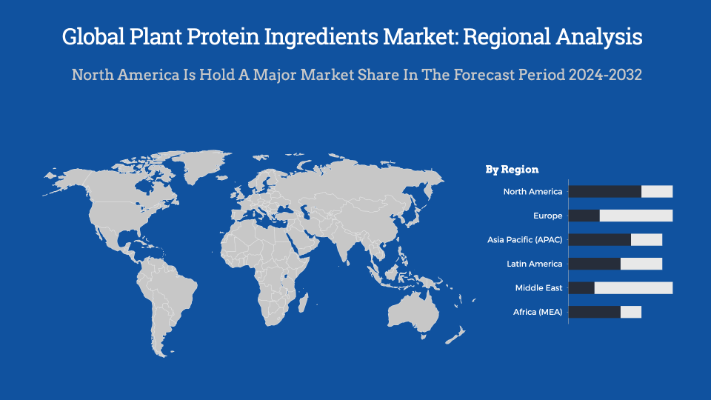
- Based on the region, North America holds the largest share in the plant protein ingredients market. This is primarily due to the region's well-established food and beverage industry, rising vegan population, and increasing demand for meat substitutes. Moreover, the presence of major market players and ongoing product innovations contribute to North America's market dominance.
Global Plant Protein Ingredients Market: Report Scope
| Report Attributes | Report Details |
|---|---|
| Report Name | Plant Protein Ingredients Market |
| Market Size in 2023 | USD 13.18 Billion |
| Market Forecast in 2032 | USD 26.86 Billion |
| Growth Rate | CAGR of 8.23% |
| Number of Pages | 192 |
| Key Companies Covered | Kerry Inc, Chaitanya Chemicals, Cargill, PEVES, Axiom Food Incorporation, Glanbia Nutritionals, Prinova Group, A & B Ingredients, Glanbia Nutritionals, and Medix Laboratoires |
| Segments Covered | By Form, By Type, By Source, By Application And By Region |
| Regions Covered | North America, Europe, Asia Pacific (APAC), Latin America, Middle East, and Africa (MEA) |
| Base Year | 2023 |
| Historical Year | 2018 - 2022 |
| Forecast Year | 2024 - 2032 |
| Customization Scope | Avail customized purchase options to meet your exact research needs. Request For Customization |
Global Plant Protein Ingredients Market: Segmentation
 Request Free SampleRequest Free Sample
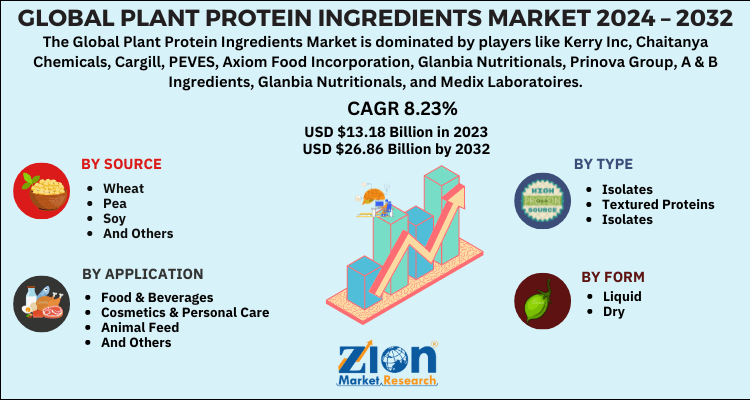
The global plant protein ingredients market is bifurcated by form, type, source, application, and region. All the segments have been analyzed based on present and future trends and the market is estimated from 2024 to 2032.
Based on the form, the global plant protein ingredients market is divided into liquid and dry.
Based on the type, the global market is split into isolates, textured proteins, and isolates.
Based on the source, the global market is categorized into wheat, pea, soy, and others.
The application segment is divided into food & beverages, cosmetics & personal care, animal feed, and others.
The regional segment includes the current and forecast demand for North America, Europe, Asia Pacific, Latin America, and the Middle East and Africa.
Global Plant Protein Ingredients Market: Regional Analysis
 Request Free SampleRequest Free Sample
North America is anticipated to dominate the global plant protein ingredients market during the forecast period followed by Europe. Factors such as the presence of major players, the growing trend of veganism, the rising prevalence of obesity, and heavy investments in the manufacturing of the products are contributing to the growth of the global market in this region. On the other hand, the market in Asia Pacific is expected to grow at a substantial rate. This is attributable to the growing demand for functional foods, growing initiatives of the government, and rise in demand in the sports & animal feed industry.
Global Plant Protein Ingredients Market: Competitive Players
The global plant protein ingredients market is highly competitive. Some of the major players operating in the global market are:
- Kerry Inc
- Chaitanya Chemicals
- Cargill
- PEVES
- Axiom Food Incorporation
- Glanbia Nutritionals
- Prinova Group
- A & B Ingredients
- Glanbia Nutritionals
- Medix Laboratoires.
Global Plant Protein Ingredients Market: Segmentation
The Global Plant Protein Ingredients Market is segmented as follows:
By Form
- Liquid
- Dry
By Type
- Isolates
- Textured Proteins
- Isolates
By Source
- Wheat
- Pea
- Soy
- And Others
By Application
- Food & Beverages
- Cosmetics & Personal Care
- Animal Feed
- And Others
By Region
- North America
- The U.S.
- Canada
- Mexico
- Europe
- France
- The UK
- Spain
- Germany
- Italy
- Rest of Europe
- Asia Pacific
- China
- Japan
- India
- Australia
- South Korea
- Rest of Asia Pacific
- The Middle East & Africa
- Saudi Arabia
- UAE
- Egypt
- Kuwait
- South Africa
- Rest of the Middle East & Africa
- Latin America
- Brazil
- Argentina
- Rest of Latin America
What Reports Provides
- Full in-depth analysis of the parent market
- Important changes in market dynamics
- Segmentation details of the market
- Former, on-going, and projected market analysis in terms of volume and value
- Assessment of niche industry developments
- Market share analysis
- Key strategies of major players
- Emerging segments and regional markets
- Testimonials to companies in order to fortify their foothold in the market.
Table Of Content

FrequentlyAsked Questions
Plant protein ingredients are protein extracts derived from plants such as soy, pea, or wheat. They are widely used in food products for nutrition and meat alternatives.
The global Plant Protein Ingredients market is expected to be driven by the Growth is supported by rising demand for plant-based diets, health and wellness trends, and sustainability concerns. Expanding use in food, beverages, and nutritional products boosts market growth.
According to study, the global Plant Protein Ingredients market size was worth around USD 13.18 Billion in 2023 and is predicted to grow to around USD 26.86 Billion By 2032.
The global Plant Protein Ingredients market is expected to grow at a Compound Annual Growth Rate (CAGR) of around CAGR 8.23% during the forecast period from 2024-2032.
The global Plant Protein Ingredients industry is projected to be challenged by Challenges include taste and texture limitations, allergen and labeling complexity, and price volatility of raw materials like peas and soy.
The Opportunities include rising vegan and flexitarian diets, innovation in protein blends and processing, growth in sports nutrition and functional foods, and expansion across Asia and Latin America will offer significant growth opportunities in the Plant Protein Ingredients market.
Improved taste/texture via fermentation and extrusion; functional blends for dairy/meat alternatives; clean-label processing and traceable sourcing are the emerging trends and innovations impacting the Plant Protein Ingredients market.
The global Plant Protein Ingredients market is expected to be led by Europe during the forecast period.
Some of the prominent players operating in the global Plant Protein Ingredients market are; Kerry Inc, Chaitanya Chemicals, Cargill, PEVES, Axiom Food Incorporation, Glanbia Nutritionals, Prinova Group, A & B Ingredients, Glanbia Nutritionals, and Medix Laboratoires and others.
The report explores crucial aspects of the Plant Protein Ingredients market, including a detailed discussion of existing growth factors and restraints, while also browsing future growth opportunities and challenges that impact the market.
HappyClients

