
Global Picture Archiving and Communication System (PACS) Market Size 2034

Picture Archiving and Communication System (PACS) Market By Component (Hardware, Software, and Services), By Deployment Model (On-Premises and Cloud-based), By End-User (Hospitals, Ambulatory Surgical Centers, Diagnostic Centers, and Others), By Imaging Type (Computed Tomography, Magnetic Resonance Imaging, X-ray, Ultrasound, and Others), and Region - Global and Regional Industry Overview, Market Intelligence, Comprehensive Analysis, Historical Data, and Forecasts 2026 - 2034
| Market Size in 2025 | Market Forecast in 2034 | CAGR (in %) | Base Year |
|---|---|---|---|
| USD 4.24 Billion | USD 7.99 Billion | 7.3% | 2025 |
Picture Archiving and Communication System (PACS) Industry Perspective:
What will be the size of the global Picture Archiving and Communication System (PACS) market during the forecast period?
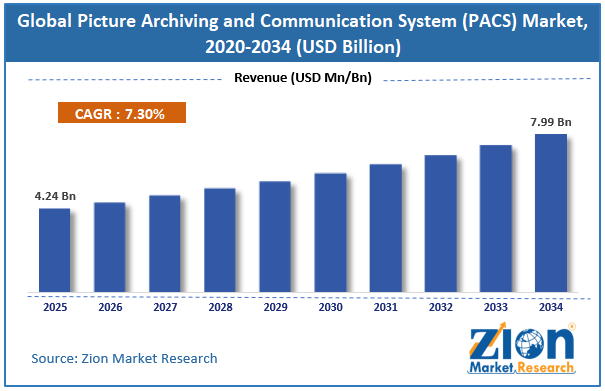
The global picture archiving and communication system (PACS) market size was worth around USD 4.24 billion in 2025 and is predicted to grow to around USD 7.99 billion by 2034, with a compound annual growth rate (CAGR) of roughly 7.3% between 2026 and 2034.
Key Insights
- As per the analysis shared by our research analyst, the global Picture Archiving and Communication System (PACS) market is estimated to grow annually at a CAGR of around 7.3% over the forecast period (2026-2034).
- In terms of revenue, the global Picture Archiving and Communication System (PACS) market size was valued at around USD 4.24 billion in 2025 and is projected to reach USD 7.99 billion by 2034.
- Expansion of telemedicine and teleradiology is expected to drive the Picture Archiving and Communication System (PACS) market.
- Based on the component, the software segment dominates the Picture Archiving and Communication System (PACS) Market with a revenue share of 42.9% in 2025.
- Based on the deployment model, the on-premises segment holds a majority of market share in 2025 of 68.3%.
- Based on the end-user, the hospitals segment holds a majority of market share in 2025 of 53.4%.
- Based on the imaging type, the X-ray segment dominates the market with over 39% in 2025.
- Based on region, North America dominates the Picture Archiving and Communication System (PACS) market with a revenue share of 39.5% in 2025.
Picture Archiving and Communication System (PACS) Market: Overview
Picture Archiving and Communication System (PACS) is a medical imaging technology used to store, retrieve, manage, distribute, and view digital medical images such as X-rays, computed tomography (CT), magnetic resonance imaging (MRI), ultrasound, and mammography scans. PACS replaces traditional film-based image storage with electronic storage and allows authorized healthcare professionals to access images through computers and other connected devices. The system generally connects to Radiology Information Systems (RIS) and Electronic Health Records (EHRs), enabling the sharing of images and relevant patient information between hospitals, diagnostic centers, and clinics. PACS improves diagnostic workflow, eliminates the need for physical storage, enables remote image interpretation, and speeds collaboration between radiologists and other healthcare professionals.
Impact of the USA-Israel War on Iran on the Picture Archiving and Communication System (PACS) Market
In the near term, the Picture Archiving and Communication System (PACS) market in Iran and the wider Middle East is likely to be impacted negatively by the USA–Israel war on Iran. Disruptions to healthcare infrastructure, international trade routes, banking channels, and medical-technology supply chains may delay procurement of PACS hardware, servers, storage systems, networking equipment, and related software and services. The conflict has already further strained medical supply chains and increased logistics costs. Sanctions and other financial restrictions remain hurdles to procuring medical technology.
At the same time, damage to healthcare facilities and the growing need for diagnostic services could lead to longer-term demand for digital imaging and PACS as healthcare providers rebuild and modernize their infrastructure. Therefore, the conflict is likely to constrain PACS investment initially but may underpin reconstruction-driven demand in the longer term.
Picture Archiving and Communication System (PACS) Market: Growth Drivers
How does the increasing number of medical imaging procedures drive the Picture Archiving and Communication System (PACS) market?
The growing number of medical imaging tests is a major driver of the Picture Archiving and Communication System (PACS) market. Each X-ray, CT, MRI, ultrasound, and other digital imaging test generates images that must be efficiently stored, retrieved, transmitted, and managed. The scale of this demand is highlighted by government figures from NHS England, which reported 48.7 million diagnostic imaging tests in England in January to December 2024.
In December 2024 alone, the NHS carried out around 1.72 million X-rays, 850,000 ultrasounds, 640,000 CT scans and 370,000 MRIs. NHS England said an average of 2.4 million diagnostic tests were carried out each month in 2024/25, up 8% compared with the previous year and 25% higher than pre-pandemic levels in 2019/20. Thus, these factors drive industry growth.
Restraints
Shortage of skilled IT professionals acts as a major restraint on the growth of the Picture Archiving and Communication System (PACS) industry
A shortage of qualified IT specialists may hold back expansion of the Picture Archiving and Communication System (PACS) market, as PACS relies on expert staff to manage deployment, integration, cybersecurity, data storage, interoperability, and ongoing maintenance. Official data highlight the wider deficit of pertinent digital skills. The UK Department for Science, Innovation and Technology projected an annual shortfall of 3,800 cyber-security workers in 2025, with the market needing roughly 12,900 new professionals but only 9,100 joining the workforce each year. Moreover, 49% of UK businesses cited gaps in basic technical cybersecurity skills, while 30% cited gaps in more advanced technical skills.
This shortfall can hit hospitals and diagnostic centers adopting PACS especially hard, because a shortage of qualified IT staff can slow implementation, drive up training and recruitment costs, make integration with RIS/EHR systems harder, and heighten cybersecurity risks. The issue is particularly significant as healthcare organizations continue to digitize imaging workflows and handle growing volumes of sensitive patient data.
Opportunities
How does the rise in product launches create a lucrative opportunity for the Picture Archiving and Communication System (PACS) market?
As the PACS market sees more product launches, there is significant room for growth through more efficient, versatile, and cost-effective imaging management services. New developments in the PACS market include cloud PACS, artificial intelligence integration, mobile imaging applications, and interoperable imaging systems that improve image storage and retrieval, provide remote access, and improve workflow. All of the above will enable healthcare facilities to process increasing amounts of imaging data without increasing hardware or operating costs. Competition in the PACS vendor market is expected to increase, with potential offerings in AI diagnostics, cybersecurity, scalable cloud storage, and interoperability with EHR/RIS platforms.
For instance, in February 2025, DeepHealth, Inc., a global leader in AI-powered health informatics and a wholly owned subsidiary of RadNet, Inc., introduced next-generation AI-powered radiology informatics and population screening solutions at the European Congress of Radiology (ECR) 2025 in Vienna. To enable breakthroughs in imaging-enabled care, DeepHealth’s suite of solutions addresses critical clinical and operational challenges faced by healthcare providers worldwide. DeepHealth’s solutions are powered by DeepHealth OS, a secure, scalable, and cloud-native operating system that integrates data across various solutions and enables interoperability with broader healthcare IT ecosystems. To enable AI adoption at scale, DeepHealth has established strategic collaborations that enable integrated solutions with industry-leading ecosystem partners.
Challenges
Why does the resistance to technology adoption pose a significant challenge to the growth of the Picture Archiving and Communication System (PACS) industry?
Resistance to technology adoption is one of the major challenges Picture Archiving and Communication System (PACS) manufacturers face. Some healthcare providers and medical professionals may hesitate or outright oppose replacing their current practice with a new system. Issues such as cost, employee training, disruption of practice, safety, security, and system complexity may affect a medical organization's decision to adopt a PACS.
Moreover, improper training of medical personnel in modern computer technology may require more experienced IT specialists, which, in turn, increases costs and causes additional inconvenience. Thus, fear of changing well-established routines may hinder the spread of PACS in the healthcare market and the transition of health care toward a more integrated, digital system.
Picture Archiving and Communication System (PACS) Market: Report Scope
| Report Attributes | Report Details |
|---|---|
| Report Name | Picture Archiving and Communication System (PACS) Market |
| Market Size in 2025 | USD 4.24 Billion |
| Market Forecast in 2034 | USD 7.99 Billion |
| Growth Rate | CAGR of 7.3% |
| Number of Pages | 230 |
| Key Companies Covered | Carestream Health, Fujifilm Holding Corporation, Siemens Healthineers AG, Infinitt Healthcare Co. Ltd, General Electric Company, Agfa-Gevaert Group, IBM Corporation, Sectra AB, PACSHealth, LLC, Merge Healthcare Solutions Inc, Brit Systems, ScImage, Inc., McKesson Corporation, and others. |
| Segments Covered | By Component, By Deployment Model, By End-User, By Imaging Type, and By Region |
| Regions Covered | North America, Europe, Asia Pacific (APAC), Latin America, Middle East, and Africa (MEA) |
| Base Year | 2025 |
| Historical Year | 2020 - 2024 |
| Forecast Year | 2026 - 2034 |
| Customization Scope | Avail customized purchase options to meet your exact research needs. Request For Customization |
Picture Archiving and Communication System (PACS) Market: Segmentation
Component Insights
Why does the software segment hold a prominent position in the Picture Archiving and Communication System (PACS) market?
The software segment dominates the Picture Archiving and Communication System (PACS) Market with a revenue share of 42.9% in 2025. Growth is primarily driven by the increasing volume of diagnostic imaging data, the rising adoption of cloud-based PACS, and the need for software that integrates with Electronic Health Records (EHR), Radiology Information Systems (RIS), and hospital information systems (HIS). In addition, the integration of Artificial Intelligence (AI), advanced visualization, automated workflow management, and remote image access is driving the value and functionality of PACS software. Healthcare organizations are also moving away from proprietary software toward software-as-a-service (SaaS) and subscription-based models, which can reduce initial infrastructure costs and increase PACS adoption in smaller healthcare facilities.
Deployment Model Insights
How does the On-Premises segment capture the largest share in the Picture Archiving and Communication System (PACS) market?
The on-premises segment holds the largest share of the picture archiving and communication system market in 2025, at 68.3%. Hospitals and large diagnostic centers continue to prefer on-premises systems to retain direct control over medical imaging data and IT infrastructure. On-premises PACS solutions let healthcare organizations maintain direct control over the storage, security, access permissions, and system configuration of medical imaging data, which is essential for managing sensitive patient information.
End-User Insights
How does the hospitals segment capture the largest market share in the Picture Archiving and Communication System (PACS) market?
The hospitals segment holds the largest share of the picture archiving and communication system market in 2025, at 53.4%. The growing use of digital imaging and the high volume of hospital diagnostics have created a major need for digital image storage. Hospitals generate huge quantities of X-rays, CT scans, MRIs, ultrasounds, and mammograms that must be organized, stored safely, and kept easily accessible. This is why PACS benefits hospitals: it stores all images in one secure location with easy access and retrieval, and it can also be shared with the EHR, RIS, and other hospital systems to support diagnosis.
Imaging Type Insights
What factor drives the X-ray segment in the Picture Archiving and Communication System (PACS) market?
The X-ray segment dominates the picture archiving and communication system market, accounting for over 39% in 2025. The PACS industry is growing because X-ray is the most common medical diagnostic imaging procedure in clinics and hospitals. As a result, the sheer number of diagnostic procedures requires efficient storage, retrieval, distribution, and management of the large volume of X-ray images produced. Moreover, the transition from conventional X-ray film-based technologies to digital ones (digital radiography or computed radiography) supports PACS market growth.
Regional Insights
What factors drive the North America region in the Picture Archiving and Communication System (PACS) market?
North America dominates the Picture Archiving and Communication System (PACS) market with a revenue share of 39.5% in 2025. Rapid digitization of the healthcare industry, a high volume of diagnostic imaging procedures, and significant investment in advanced medical imaging IT systems are driving market growth. Manufacturers' continuous development of products incorporating innovative solutions attracts more clients to PACS. Moreover, in 2025, companies have launched products that provide a competitive advantage in the market.
For instance, in May 2025, GE HealthCare announced a product development that will transform its True PACS and Centricity PACS solutions into a cloud-based, AI-driven, interoperable, and workflow-centric system. The new tools include predictive analytics to optimize the radiology department's operations, workload distribution, and reading capacity. Similarly, Konica Minolta Healthcare Americas launched the next-generation Exa PACS|RIS with an API platform, advanced visualization tools, and 3D reconstructions and segmentations in April 2025.
During the same period, Fujifilm announced an enhanced cloud-based strategy with AWS. In particular, AWS validated the company's Synapse PACS portfolio for cloud migration. Later in 2025, the company introduced a new integrated cloud-based solution, Synapse One, that unifies PACS, RIS, 3D imaging, scheduling, and other modules in one secure AWS-powered environment.
Picture Archiving and Communication System (PACS) Market: Competitive Analysis
The global Picture Archiving and Communication System (PACS) market is dominated by players like:
- Carestream Health
- Fujifilm Holding Corporation
- Siemens Healthineers AG
- Infinitt Healthcare Co. Ltd
- General Electric Company
- Agfa-Gevaert Group
- IBM Corporation
- Sectra AB
- PACSHealth LLC
- Merge Healthcare Solutions Inc
- Brit Systems
- ScImage Inc.
- McKesson Corporation
The global Picture Archiving and Communication System (PACS) market is segmented as follows:
By Component
- Hardware
- Software
- Services
By Deployment Model
- On-Premises
- Cloud-based
By End-User
- Hospitals
- Ambulatory Surgical Centers
- Diagnostic Centers
- Others
By Imaging Type
- Computed Tomography
- Magnetic Resonance Imaging
- X-ray
- Ultrasound
- Others
By Region
- North America
- The U.S.
- Canada
- Mexico
- Europe
- France
- The UK
- Spain
- Germany
- Italy
- Rest of Europe
- Asia Pacific
- China
- Japan
- India
- Australia
- South Korea
- Rest of Asia Pacific
- The Middle East & Africa
- Saudi Arabia
- UAE
- Egypt
- Kuwait
- South Africa
- Rest of the Middle East & Africa
- Latin America
- Brazil
- Argentina
- Rest of Latin America
Table Of Content
Methodology
FrequentlyAsked Questions
A Picture Archiving and Communication System (PACS) is a medical imaging technology used to store, retrieve, manage, distribute, and view digital medical images such as X-rays, computed tomography (CT), magnetic resonance imaging (MRI), ultrasound, and mammography scans. PACS replaces traditional film-based image storage with electronic storage and allows authorized healthcare professionals to access images through computers and other connected devices.
The key growth drivers for the Picture Archiving and Communication System (PACS) market include the increasing volume of medical imaging procedures, rising prevalence of chronic diseases, and the rapid digitalization of healthcare infrastructure. Growing adoption of cloud-based PACS, AI-enabled imaging, telemedicine, and teleradiology is further supporting market expansion by enabling remote access, automated image analysis, and efficient workflow management.
The major challenges restraining the growth of the Picture Archiving and Communication System (PACS) market include high implementation and maintenance costs, data privacy and cybersecurity concerns, interoperability issues with existing EHR, RIS, and hospital information systems, and a shortage of skilled IT professionals. Dependence on reliable digital infrastructure and internet connectivity can also limit adoption in smaller healthcare facilities and developing regions.
Based on the component, the software segment is expected to dominate the Picture Archiving and Communication System (PACS) market growth during the projected period.
The Picture Archiving and Communication System (PACS) market is being shaped by several emerging trends and innovations, including the adoption of cloud-based and SaaS PACS, AI-powered image analysis, advanced visualization and 3D imaging, mobile and remote image access, and greater interoperability with EHR and RIS platforms. AI integration enables automated image interpretation, workflow prioritization, and decision support, while cloud platforms provide scalable storage and support teleradiology and multi-site collaboration. Vendors are also increasingly focusing on cybersecurity, zero-footprint viewers, vendor-neutral archives (VNA), and unified enterprise imaging platforms to improve data accessibility and security. These innovations are making PACS more scalable, connected, and efficient for hospitals and diagnostic centers.
According to the report, the global Picture Archiving and Communication System (PACS) market size was worth around USD 4.24 billion in 2025 and is predicted to grow to around USD 7.99 billion by 2034.
The global Picture Archiving and Communication System (PACS) market is expected to grow at a CAGR of 7.3% during the forecast period.
The global Picture Archiving and Communication System (PACS) industry growth is expected to be led by North America over the forecast period.
The global Picture Archiving and Communication System (PACS) market is dominated by players like Carestream Health, Fujifilm Holding Corporation, Siemens Healthineers AG, Infinitt Healthcare Co. Ltd, General Electric Company, Agfa-Gevaert Group, IBM Corporation, Sectra AB, PACSHealth, LLC, Merge Healthcare Solutions Inc, Brit Systems, ScImage, Inc., and McKesson Corporation, among others.
The market report covers the geographical market along with a comprehensive competitive landscape analysis. It also includes cash flow analysis, profit ratio analysis, market basket analysis, market attractiveness analysis, sentiment analysis, PESTLE analysis, trend analysis, SWOT analysis, trade area analysis, demand & supply analysis, Porter’s five forces analysis, and value chain analysis.

HappyClients

