
Global Ozone Meter Market Size, Share, Trend andGrowth Report 2032

Ozone Meter Market By Product Type (Portable Ozone Meters and Fixed Ozone Meters), By Application (Industrial, Environmental Monitoring, Research Laboratories, Commercial, and Others), By End-User (Manufacturing, Healthcare, Food and Beverage, Water Treatment, and Others), By Distribution Channel (Online and Offline), and By Region - Global and Regional Industry Overview, Market Intelligence, Comprehensive Analysis, Historical Data, and Forecasts 2024 - 2032
| Market Size in 2023 | Market Forecast in 2032 | CAGR (in %) | Base Year |
|---|---|---|---|
| USD 1,236.40 Million | USD 2,234.90 Million | 6.92% | 2023 |
Ozone Meter Industry Perspective
What will be the global ozone meter market size during the forecast period
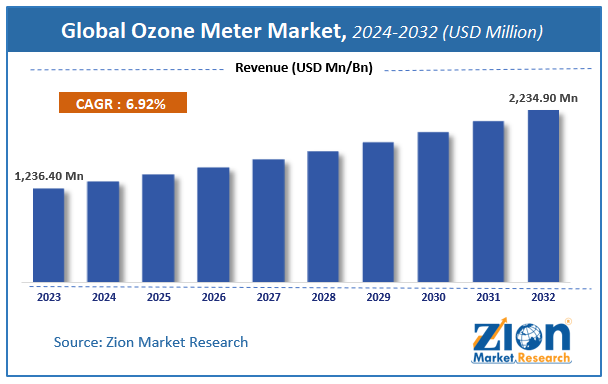
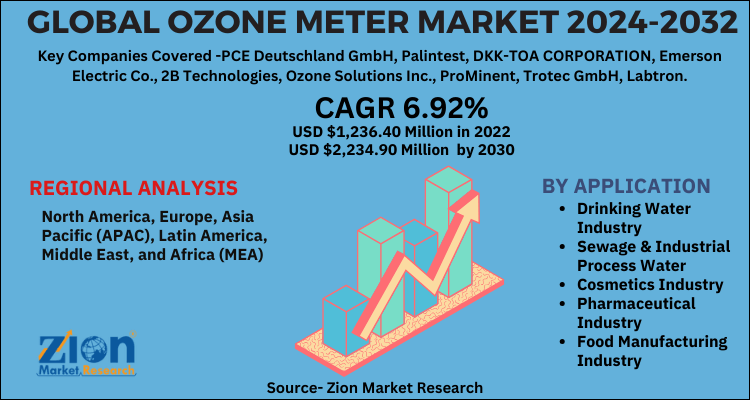
The global ozone meter market size was worth around USD 1,236.40 million in 2023 and is predicted to grow to around USD 2,234.90 million by 2032 with a compound annual growth rate (CAGR) of roughly 6.92% between 2024 and 2032.
This report provides a comprehensive analysis of the growth drivers, restraints, and challenges shaping demand across the global ozone meter market throughout the forecast period, while highlighting high-potential emerging opportunities within the industry.
Key Insights
- As per the analysis shared by our research analyst, the global ozone meter market is estimated to grow annually at a CAGR of around 6.92% over the forecast period (2024-2032).
- In terms of revenue, the global ozone meter market size was valued at around USD 1,236.40 million in 2023 and is projected to reach USD 2,234.90 million by 2032.
- The ozone meter market is projected to grow at a significant rate due to stringent environmental regulations, rising demand for water treatment solutions, industrial safety compliance requirements, and increasing focus on air and water quality monitoring across industrial and municipal applications.
- Based on the product type, the portable ozone meters segment held the largest share at 58.4% owing to their flexibility, battery operation, real-time displays, and suitability for field operations in environmental monitoring, water treatment validation, and healthcare settings.
- Based on the application, the environmental monitoring segment is expected to lead due to regulatory mandates for continuous air and water quality assessment and growing public and governmental emphasis on pollution control.
- Based on the end-user, the water treatment segment dominates as ozone meters are critical for validating disinfection processes and ensuring compliance in municipal and industrial water systems.
- Based on region, Asia Pacific dominated with 38.2% revenue share, driven by rapid industrialization in China, India, Vietnam, and Indonesia along with tightening environmental regulations and expanding manufacturing and infrastructure activities.
Ozone Meter Market: Overview
An ozone meter is a device used to measure the concentration of ozone (O3) in the atmosphere or specific environments. These meters are crucial for monitoring air quality, as ozone, a strong oxidant, can have harmful effects on human health and the environment. Ozone meters use various detection methods, such as ultraviolet (UV) absorption, electrochemical sensors, or chemiluminescence, to provide accurate and real-time measurements of ozone levels. They are widely used in environmental monitoring, industrial settings, laboratories, and for regulatory compliance to ensure that ozone concentrations remain within safe limits.
Ozone Meter Market: Growth Factors
How are stringent environmental regulations and water treatment needs propelling the ozone meter market?
Growth factors for the ozone meter market include increasing awareness of air pollution and its health impacts, which drives demand for accurate and reliable air quality monitoring tools. Stringent environmental regulations and standards set by government agencies worldwide necessitate the use of ozone meters for compliance and monitoring purposes. Technological advancements, such as the development of portable and more user-friendly ozone meters, enhance their accessibility and usability across various sectors.
Additionally, the growth of industries like manufacturing, pharmaceuticals, and food processing, where ozone is used for disinfection and sterilization, further boosts the demand for ozone meters. The rising focus on environmental sustainability and the need for continuous monitoring of air quality in urban areas also support market growth.
Ozone Meter Market: Restraints
What cost and technical factors limit broader adoption of ozone meters?
High initial acquisition and ongoing maintenance costs of advanced ozone meters, particularly high-precision fixed systems, restrict adoption among smaller organizations and in cost-sensitive markets. Regular calibration, sensor replacement, and technical expertise requirements add to the total cost of ownership and can delay investment decisions.
Technical complexity and the need for specialized training also act as restraints. In regions with limited technical infrastructure or skilled personnel, the effective deployment and long-term operation of sophisticated ozone monitoring systems remain challenging, slowing penetration in certain developing markets.
Ozone Meter Market: Report Scope
| Report Attributes | Report Details |
|---|---|
| Report Name | Ozone Meter Market Research Report |
| Market Size in 2023 | USD 1,236.40 million |
| Market Forecast in 2032 | USD 2,234.90 million |
| Growth Rate | CAGR of 6.92% |
| Number of Pages | 275 |
| Key Companies Covered | Thermo Fisher Scientific Inc., Horiba, Ltd., Teledyne Technologies Incorporated, 2B Technologies, Inc., Ecotech Pty Ltd, Aeroqual Limited, Environmental Sensors Co., Draegerwerk AG & Co. KGaA, TSI Incorporated, and Others. |
| Segments Covered | By Product Type, By Application, By End-User, By Distribution Channel, and By Region |
| Regions Covered | North America, Europe, Asia Pacific (APAC), Latin America, Middle East, and Africa (MEA) |
| Base Year | 2023 |
| Historical Year | 2018 - 2022 |
| Forecast Year | 2024 - 2032 |
| Customization Scope | Avail customized purchase options to meet your exact research needs. Request For Customization |
Ozone Meter Market: Segmentation
The ozone meter market is segmented by product type, application, end-user, distribution channel, and region. All the segments of the ozone meter market have been analyzed based on present and future trends and the market is estimated from 2024 to 2032.
Based on Product Type, the ozone meter market is divided into portable ozone meters and fixed ozone meters. The portable ozone meters segment is the most dominant, holding approximately 58.4% share, due to their flexibility, battery-powered operation, real-time digital displays, and data logging capabilities that make them ideal for fieldwork in environmental monitoring, water treatment validation, and on-site industrial or healthcare applications. This dominance drives market growth by enabling rapid deployment and widespread use across diverse user groups that require mobility. Fixed ozone meters represent the second most significant segment, preferred for continuous, automated monitoring in permanent installations such as municipal plants and industrial facilities where long-term reliability and integration with control systems are essential.
Based on Application, the ozone meter market is divided into industrial, environmental monitoring, research laboratories, commercial, and others. The environmental monitoring segment leads because of mandatory air and water quality assessment programs driven by regulatory bodies and growing public concern over pollution. Continuous and accurate ozone data collection supports compliance reporting and policy decisions, thereby sustaining high demand and contributing substantially to overall market expansion. Industrial applications form a strong secondary segment, where process safety, emissions control, and workplace exposure monitoring require dependable ozone measurement solutions that further support industry volume growth.
Based on End-User, the ozone meter market is divided into manufacturing, healthcare, food and beverage, water treatment, and others. The water treatment segment is the most dominant end-user owing to the critical role of ozone meters in optimizing disinfection processes, verifying residual ozone levels, and ensuring regulatory compliance in both municipal and industrial water systems. This leadership position drives consistent demand and technological refinement within the market. Manufacturing and healthcare end-users rank as important secondary segments, where occupational safety, process control, and sterilization monitoring requirements sustain additional market activity and diversification.
Based on Distribution Channel, the ozone meter market is divided into online and offline. The offline channel remains significant for complex, high-value instruments that require technical consultation, demonstration, and after-sales support. However, the online channel is gaining traction for portable and standardized models due to convenience, broader reach, and competitive pricing, supporting wider accessibility, especially among smaller buyers and research users.
Ozone Meter Market: Regional Analysis
Why will Asia Pacific continue to dominate the global market during the projection period?
Asia Pacific is expected to maintain its leading position through rapid industrialization, expanding manufacturing bases, and increasingly stringent environmental regulations across major economies such as China, India, Vietnam, and Indonesia. Large-scale investments in water treatment infrastructure, urban air quality networks, and industrial safety systems continue to generate strong demand for both portable and fixed ozone meters, reinforcing the region’s contribution to global market growth, innovation adoption, and capacity expansion.
North America demonstrates mature and stable demand supported by well-established regulatory frameworks, advanced environmental monitoring networks, and high awareness of occupational and public health standards. The United States in particular drives consistent requirements for high-precision instruments and continuous monitoring solutions that influence global technology standards and best practices.
Europe maintains solid market activity driven by comprehensive air quality directives, strong emphasis on industrial emissions control, and progressive water treatment standards. Countries such as Germany, the United Kingdom, and France contribute through regulatory enforcement and ongoing modernization of monitoring infrastructure that supports steady regional demand and technological refinement.
Ozone Meter Market: Competitive Landscape
The report covers a detailed competitive outlook, including the market share and company profiles of the key participants operating in the global ozone meter market. The key players operating in the global ozone meter market are:
- Thermo Fisher Scientific Inc.
- Horiba, Ltd.
- Teledyne Technologies Incorporated
- 2B Technologies, Inc.
- Ecotech Pty Ltd
- Aeroqual Limited
- Environmental Sensors Co.
- Draegerwerk AG & Co. KGaA
- TSI Incorporated
The global ozone meter market is segmented as follows:
By Product Type
- Portable Ozone Meters
- Fixed Ozone Meters
By Application
- Industrial
- Environmental Monitoring
- Research Laboratories
- Commercial
- Others
By End-User
- Manufacturing
- Healthcare
- Food and Beverage
- Water Treatment
- Others
By Distribution Channel
- Online
- Offline
By Region
- North America
- The U.S.
- Canada
- Mexico
- Europe
- France
- The UK
- Spain
- Germany
- Italy
- Rest of Europe
- Asia Pacific
- China
- Japan
- India
- Australia
- South Korea
- Rest of Asia Pacific
- The Middle East & Africa
- Saudi Arabia
- UAE
- Egypt
- Kuwait
- South Africa
- Rest of the Middle East & Africa
- Latin America
- Brazil
- Argentina
- Rest of Latin America
Table Of Content
Methodology
FrequentlyAsked Questions
An ozone meter is an analytical instrument used to measure ozone concentrations in air or water. It provides accurate data essential for environmental compliance, industrial process control, water disinfection validation, and occupational safety monitoring.
Key growth drivers include stringent environmental regulations governing air and water quality, rising demand for effective water treatment and disinfection processes, industrial safety compliance requirements, and increasing investment in environmental monitoring infrastructure worldwide.
According to study, the global ozone meter market size was worth around USD 1,236.40 Million in 2023 and is predicted to grow to around USD 2,234.90 Million By 2032.
The global ozone meter market is expected to grow at a Compound Annual Growth Rate (CAGR) of around 6.92% during the forecast period from 2024 to 2032.
The global ozone meter industry is projected to be challenged by Challenges include sensor calibration drift, environmental interference, and equipment costs.
The opportunities include air quality monitoring, industrial safety regulations, water treatment applications, and environmental compliance demand will offer significant growth opportunities in the Ozone Meter market.
Portable and real-time ozone monitoring; IoT-enabled data logging; applications in environmental and industrial safety are the emerging trends and innovations impacting the Ozone Meter market.
Asia Pacific is expected to contribute notably and maintain a leading position in the global ozone meter market value, supported by rapid industrialization, tightening environmental regulations, and expanding water treatment and manufacturing activities.
Major players include Thermo Fisher Scientific Inc., Horiba, Ltd., Teledyne Technologies Incorporated, 2B Technologies, Inc., Ecotech Pty Ltd, Aeroqual Limited, Environmental Sensors Co., Draegerwerk AG & Co. KGaA, and TSI Incorporated.
The report delivers a comprehensive analysis of market size and growth projections, detailed segmentation by product type, application, end-user, and distribution channel, regional insights, competitive landscape, key drivers, restraints, opportunities, challenges, recent developments, and strategic outlook covering the period from 2024 to 2032.

HappyClients

