
Global Over-the-Counter Drugs Market Size, Share, Trends, Opportunities Analysis Forecast Report 2032

Over-The-Counter Drugs Market By Product (Cough & Flu Products, Analgesics, Cold, Weight Loss Products, Mineral and Vitamin Supplements, Gastrointestinal Products, Ophthalmic Products, Skin Products, and Others), By End-Users (Specialty Clinic, Home Care, Hospital, and Others), By Distribution Channel (Hospital Pharmacy, Retail Pharmacy, Online Pharmacy, and Others), and By Region - Global and Regional Industry Overview, Market Intelligence, Comprehensive Analysis, Historical Data, and Forecasts 2024 - 2032
| Market Size in 2023 | Market Forecast in 2032 | CAGR (in %) | Base Year |
|---|---|---|---|
| USD 125.4 Billion | USD 218.8 Billion | 6.5% | 2023 |
Over-the-Counter Drugs Market: Industry Perspective
What will be the global over-the-counter drugs market size during the forecast period?
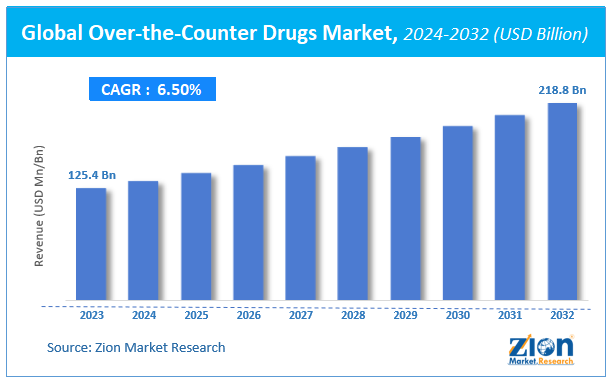
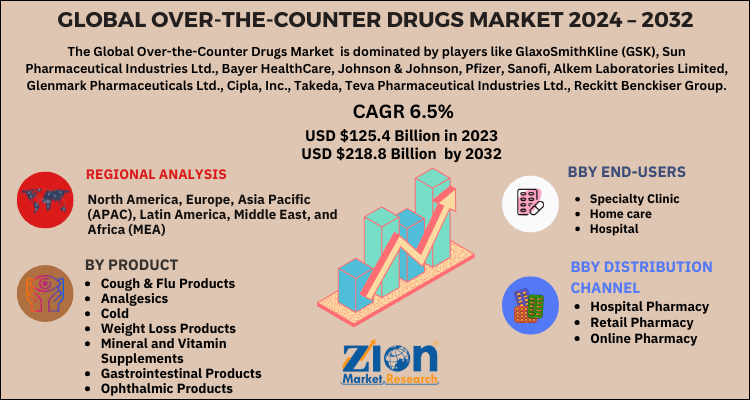
The global over-the-counter drugs market size was worth around USD 125.4 billion in 2023 and is predicted to reach around USD 218.8 billion by 2032, with a compound annual growth rate (CAGR) of roughly 6.5% between 2024 and 2032.
The report examines the primary drivers, challenges, and restraints shaping global demand for the over-the-counter drugs market throughout the forecast period and identifies high-growth opportunities across the industry.
Key Insights
- As per the analysis shared by our research analyst, the over-the-counter drugs market is estimated to grow annually at a CAGR of roughly 6.5% over the forecast period from 2024 to 2032.
- In terms of revenue, the global over-the-counter drugs market size was valued at around USD 125.4 Billion in 2023 and is projected to reach USD 218.8 Billion by 2032.
- The over-the-counter drugs market is driven by increasing trend of self-medication, growing patent expirations of blockbuster formulations, proactive cost-saving healthcare behavior in developing nations, and the strategic transition from prescription to consumer healthcare products.
- Based on the product, the mineral and vitamin supplements category accounted for the leading share of 28.4% in the global over-the-counter drugs market because rising consumer awareness of preventive health, nutritional deficiencies, and convenient retail accessibility drive strong daily adoption.
- Based on the end-users, the home care category accounted for the leading share of 54.2% in the global over-the-counter drugs market because self-management of minor aches, fever, and common seasonal conditions directly within domestic household settings reduces out-of-pocket medical visit expenses.
- Based on the distribution channel, the retail pharmacy category accounted for the leading share of 46.8% in the global over-the-counter drugs market because physical pharmacy storefronts provide immediate geographic proximity, professional pharmacist counseling, and rapid over-the-counter access without consultation delays.
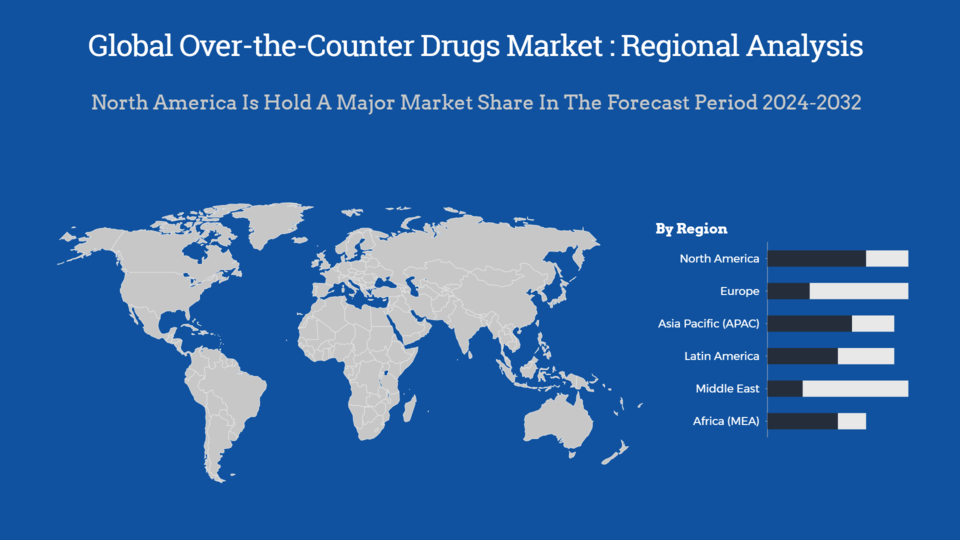
- North America dominated the global over-the-counter drugs market with a share of over 38.5% in 2023 due to ease of availability, robust sales of higher quality products, high disposable health spending, and the dominant presence of leading pharmaceutical corporations across the United States.
Over-the-Counter Drugs Market: Overview
Over-the-counter drugs are medicines that can be bought without a doctor’s prescription. Some OTC medicines help relieve itches, pains, and aches, while others help prevent or cure certain conditions. In contrast, prescription medicines can be sold only after a verified prescription is presented. In most countries, OTC drugs are designated by a governing agency to ensure that they contain ingredients that are effective and safe when used without a doctor’s care. OTC products are frequently regulated with respect to their active pharmaceutical ingredient (API) rather than final products, which allows producers flexibility to develop components or mixtures into distinctive formulations.
Over-the-Counter Drugs Market: Growth Drivers
What factors are primarily accelerating demand in the over-the-counter drugs market?
The increasing trend of self-medication is a primary growth driver as consumers seek convenient access to treatments for common conditions without visiting a physician for every minor ailment. Growing patent expirations and prescription-to-OTC switches by pharmaceutical companies expand the range of products available without prescription.
Cost savings for people in developing regions, convenience of purchasing OTC medicines, high demand from emerging countries, advantageous regulatory structures, and increasing awareness due to information available on the web further support global market growth.
Over-the-Counter Drugs Market: Restraints
What factors are limiting the expansion of the over-the-counter drugs market?
Concerns regarding improper diagnosis can restrict growth when consumers self-treat without adequate medical guidance. Misuse or delayed care for conditions that require professional evaluation remains a risk for regulators and public health systems.
Issues related to substance abuse associated with certain OTC products also constrain unrestricted expansion and may lead to tighter controls or labeling requirements in some markets.
Over-the-Counter Drugs Market: Opportunities
Where do significant growth opportunities lie for the over-the-counter drugs market?
Product innovation and increasing focus of major pharmaceutical companies on OTC medicines act as opportunities for market players. Expanding portfolios in supplements, cough and flu care, and other high-demand categories supports growth.
Rising demand for dietary supplements and cold and flu medicines, particularly in fast-growing regions, and continued investment in healthcare in emerging markets create additional avenues for expansion.
Over-the-Counter Drugs Market: Challenges
What key challenges confront participants in the over-the-counter drugs market?
Balancing broad consumer access with safe use remains a central challenge. Ensuring clear labeling, appropriate dosing guidance, and responsible marketing helps mitigate risks of improper self-diagnosis.
Regulatory variation across countries and the need to maintain quality while competing on convenience and price require continuous investment from manufacturers and distributors.
 Request Free Sample
Over-the-Counter Drugs Market: Report Scope
| Report Attributes | Report Details |
|---|---|
| Report Name | Over-the-Counter Drugs Market Research Report |
| Market Size in 2023 | USD 125.4 Billion |
| Market Forecast in 2032 | USD 218.8 Billion |
| Growth Rate | CAGR of 6.5% |
| Number of Pages | 229 |
| Key Companies Covered | GlaxoSmithKline (GSK), Sun Pharmaceutical Industries Ltd., Bayer HealthCare, Johnson & Johnson, Pfizer, Sanofi, Alkem Laboratories Limited, Glenmark Pharmaceuticals Ltd., Cipla, Inc., Takeda, Teva Pharmaceutical Industries Ltd., Reckitt Benckiser Group Plc, Innovus Pharmaceutical Inc., Piramal, and Dr. Reddy's Laboratories, among others. |
| Segments Covered | By Product, By End-Users, By Distribution Channel, and By Region |
| Regions Covered | North America, Europe, Asia Pacific (APAC), Latin America, Middle East, and Africa (MEA) |
| Base Year | 2023 |
| Historical Year | 2018 - 2022 |
| Forecast Year | 2024 - 2032 |
| Customization Scope | Avail customized purchase options to meet your exact research needs. Request For Customization |
Over-the-Counter Drugs Market: Segmentation
The over-the-counter drugs market is segmented by product, end-users, distribution channel, and region. All the segments of the over-the-counter drugs market have been analyzed based on present and future trends and the market is estimated from 2024 to 2032.
By product segment, the over-the-counter drugs market is divided into cough & flu products, analgesics, cold, weight loss products, mineral and vitamin supplements, gastrointestinal products, ophthalmic products, skin products, and others. The mineral and vitamin supplements category is the most dominant division in this sector, commanding the largest market share due to surging worldwide consumer demand for preventive wellness and daily nutritional balance. Consumers across all age cohorts routinely purchase multivitamins, vitamin C, zinc, and calcium formulations to boost immune resilience, support bone health, and prevent dietary deficiencies. Its universal adoption, high recurring purchase cycles, and broad availability across diverse retail formats establish mineral and vitamin supplements as the primary revenue generator worldwide. Meanwhile, the cough & flu products category is the second-largest division, capturing strong seasonal market value driven by the recurring prevalence of respiratory infections, seasonal influenza outbreaks, and the need for fast-acting symptomatic relief.
By end-user segment, the over-the-counter drugs market is divided into specialty clinic, home care, hospital, and others. The home care category is the dominant division in this sector, accounting for the highest market share because non-prescription medicines empower individuals to manage minor medical complaints independently at home. Families routinely maintain personal medicine cabinets stocked with pain relievers, cold remedies, digestive antacids, and antiseptic skin ointments to treat acute symptoms without incurring outpatient clinical fees. The convenience of immediate home administration firmly solidifies home care as the primary end-user market. Concurrently, the hospital category is the second-largest segment, maintaining steady demand through inpatient administration of supportive non-prescription therapeutics, including postoperative analgesics, digestive laxatives, and preventive nutritional supplements during clinical care recovery.
By distribution channel segment, the over-the-counter drugs market is divided into hospital pharmacy, retail pharmacy, online pharmacy, and others. The retail pharmacy category is the most dominant division in this sector, capturing the largest market share because brick-and-mortar drugstores and community pharmacies serve as the primary first-line destination for health consumers seeking immediate symptomatic relief. Retail pharmacies offer extensive in-store displays, direct brand access, and the key benefit of on-site pharmacist counseling to ensure safe use. The immediate nature of acute symptoms like headache or nausea means consumers often prefer local retail purchasing over waiting for delivery. Meanwhile, the online pharmacy category is the second most dominant segment, showing rapid growth as digital healthcare adoption, subscription home delivery, and competitive online discounts attract consumers buying chronic supplements and preventive wellness products.
Over-the-Counter Drugs Market: Regional Analysis
Why will North America continue to dominate the global market during the projection period?
North America will be the foremost region during the estimate period. Ease of availability, sale of higher-quality products, and the existence of top market players enhance market growth in this region. Strong retail and pharmacy infrastructure supports broad consumer access to OTC medicines and supplements. Regulatory frameworks that designate safe and effective OTC ingredients further sustain a mature self-care market. This leadership drives overall market growth by maintaining high product standards, encouraging continuous portfolio innovation, and influencing global practices in OTC regulation, branding, and distribution.
Europe will be the second-largest market, supported by growing awareness of OTC medicines and high demand for cold and flu medicines. Asia Pacific will proliferate at a speedy rate over the forecast period due to increased investment in the healthcare domain and high demand for dietary supplements. Latin America is expected to progress at a noteworthy rate during the estimate period. The Middle East and Africa are expected to experience noticeable growth in the projected time frame.
Recent Developments
-
In January 2024, Sanofi completed the strategic acquisition of a specialized consumer healthcare pipeline to expand its over-the-counter portfolio, focusing on advanced fast-acting digestive relief and seasonal cough formulations.
-
In November 2023, Bayer HealthCare announced the commercial launch of an upgraded topical analgesic formulation featuring micro-encapsulated active ingredients engineered to provide sustained, targeted relief for localized muscular and joint aches.
Over-the-Counter Drugs Market: Competitive Players
Some of the leading players in the global market include
- GlaxoSmithKline (GSK)
- Sun Pharmaceutical Industries Ltd.
- Bayer HealthCare
- Johnson & Johnson
- Pfizer
- Sanofi
- Alkem Laboratories Limited
- Glenmark Pharmaceuticals Ltd.
- Cipla Inc.
- Takeda
- Teva Pharmaceutical Industries Ltd.
- Reckitt Benckiser Group Plc
- Innovus Pharmaceutical Inc.
- Piramal
- Dr. Reddy's Laboratories
Segments Covered
By Product
- Cough & Flu Products
- Analgesics
- Cold
- Weight Loss Products
- Mineral and Vitamin Supplements
- Gastrointestinal Products
- Ophthalmic Products
- Skin Products
- Others
By End-Users
- Specialty Clinic
- Home care
- Hospital
- Others
By Distribution Channel
- Hospital Pharmacy
- Retail Pharmacy
- Online Pharmacy
- Others
By Region
- North America
- The U.S.
- Canada
- Mexico
- Europe
- France
- The UK
- Spain
- Germany
- Italy
- Rest of Europe
- Asia Pacific
- China
- Japan
- India
- Australia
- South Korea
- Rest of Asia Pacific
- The Middle East & Africa
- Saudi Arabia
- UAE
- Egypt
- Kuwait
- South Africa
- Rest of the Middle East & Africa
- Latin America
- Brazil
- Argentina
- Rest of Latin America
Table Of Content
Methodology
FrequentlyAsked Questions
Over-the-counter drugs are medicines that can be purchased without a doctor’s prescription. They are used to relieve common symptoms or to help prevent or manage certain conditions and are typically regulated to ensure safety and effectiveness when used without direct medical supervision.
Key growth drivers include the increasing trend of self-medication, patent expirations, cost savings in developing regions, prescription-to-OTC switches, convenience of purchase, demand from emerging countries, favorable regulatory structures, and rising consumer awareness through online information.
The global over-the-counter drugs market was valued at approximately USD 125.4 billion in 2023 and is projected to reach around USD 218.8 billion by 2032.
The global over-the-counter drugs market is expected to expand at a compound annual growth rate of approximately 6.5% between 2024 and 2032.
North America will be the foremost region during the estimate period. Europe will be the second largest market, and Asia Pacific will grow at a speedy rate.
Major players include GlaxoSmithKline (GSK), Sun Pharmaceutical Industries Ltd., Bayer HealthCare, Johnson & Johnson, Pfizer, Sanofi, Alkem Laboratories Limited, Glenmark Pharmaceuticals Ltd., Cipla, Inc., Takeda, Teva Pharmaceutical Industries Ltd., Reckitt Benckiser Group Plc, Innovus Pharmaceutical Inc., Piramal, and Dr. Reddy's Laboratories.
The report provides comprehensive analysis of market size, growth drivers, restraints, opportunities, segmentation by product and related channels, regional dynamics, competitive landscape, and future outlook for the period 2024-2032.

List of Contents
Over-the-Counter Drugs Industry PerspectiveKey InsightsOver-the-Counter Drugs OverviewOver-the-Counter Drugs Growth DriversOver-the-Counter Drugs RestraintsOver-the-Counter Drugs OpportunitiesOver-the-Counter Drugs ChallengesOver-the-Counter Drugs Report ScopeOver-the-Counter Drugs SegmentationOver-the-Counter Drugs Regional AnalysisRecent DevelopmentsOver-the-Counter Drugs Competitive PlayersSegments CoveredHappyClients

