
Online Language Learning Market Size, Share, Trends, Growth and Forecast 2034

Online Language Learning Market By Learning Mode (Tutoring and Self-Learning Applications), By Age Group (Below 13 Years, Between 13 to 17 Years, Between 18 to 20 Years, Between 21 to 30 Years, Between 31 to 40 years, and Above 40 Years), By Language (Spanish, Hindi, Korean, Mandarin, French, English, Arabic, Japanese, German, and Others), By End-User Vertical (Corporate Learners, Government Institutes, Individual Learners, and Educational Institutes), and By Region - Global and Regional Industry Overview, Market Intelligence, Comprehensive Analysis, Historical Data, and Forecasts 2025 - 2034
| Market Size in 2024 | Market Forecast in 2034 | CAGR (in %) | Base Year |
|---|---|---|---|
| USD 17.93 Billion | USD 51.84 Billion | 12.53% | 2024 |
Online Language Learning Industry Perspective:
What is the anticipated size of the global online language learning market during the projection period?
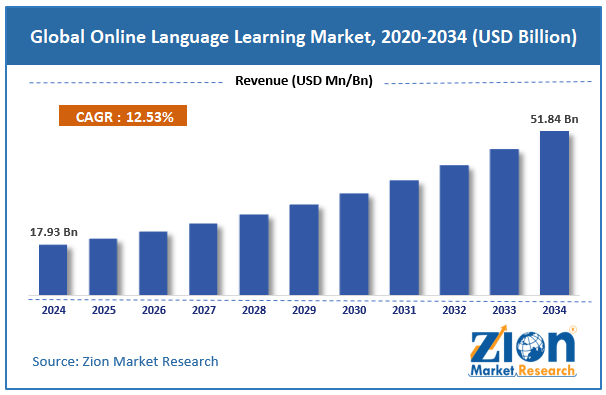
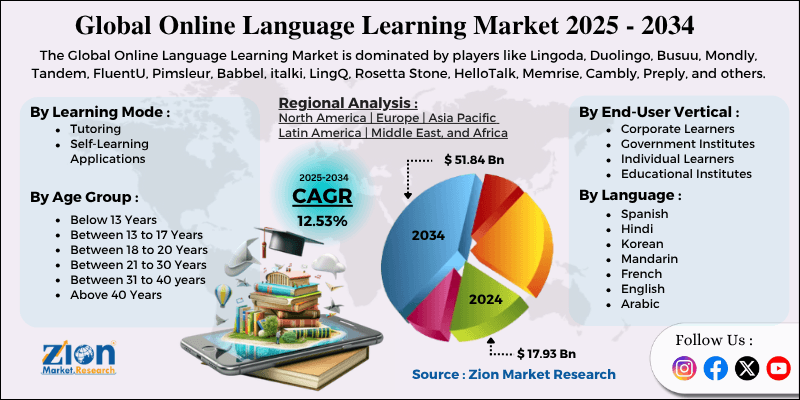
The global online language learning market size was worth around USD 17.93 billion in 2024 and is predicted to grow to around USD 51.84 billion by 2034, with a compound annual growth rate (CAGR) of roughly 12.53% between 2025 and 2034.
Key Insights:
- As per the analysis shared by our research analyst, the global online language learning market is estimated to grow annually at a CAGR of around 12.53% over the forecast period (2025-2034)
- In terms of revenue, the global online language learning market size was valued at around USD 17.93 billion in 2024 and is projected to reach USD 51.84 billion by 2034.
- The online language learning market is projected to grow at a significant rate due to the rising corporate globalization.
- Based on the learning mode, the self-learning applications segment is growing at a high rate and will continue to dominate the global market, as per industry projections
- Based on the age group, the below-13-year segment is anticipated to command the largest market share
- Based on the language, the English segment is expected to lead the market growth trends
- Based on the end-user vertical, the individual learners segment is projected to influence revenue in the market
- Based on region, North America is projected to dominate the global market during the forecast period
Online Language Learning Market: Overview
Online language learning refers to the use of digital technologies to learn a foreign language. The industry leverages internet connectivity, application-based services, smartphones, laptops, and other smart devices to allow learners access to digital platforms specially dedicated to learning a new language. The primary benefit of online language learning is flexibility, as users can learn languages depending on their convenience and time availability. Additionally, learning languages online is more cost-effective than traditional classroom-based learning.
However, it also has specific disadvantages, especially in the form of difficulties with student compliance and tough competition in the market. During the forecast period, demand for online language learning is expected to continue to grow due to rising globalization in the corporate world. The growing need among employees to upskill as job markets become saturated will further aid industry expansion in the coming years.
Additionally, access to affordable internet, gamified learning, and Artificial Intelligence (AI) integration in virtual classrooms may further benefit market players. Competition from conventional learning methods and motivational challenges may limit market growth trends in the future.
Online Language Learning Market: Dynamics
Growth Drivers
How will corporate globalization influence the growth of the online language learning market?
The global online language learning market is expected to benefit from the rising corporate globalization. Businesses worldwide are rapidly expanding into new markets to tap into novel consumer groups. However, most often, corporate globalization requires employees from different countries and languages to work as a team, driving demand for foreign language learning. Online platforms and language applications are beneficial to corporates, as they enable efficient employee training and enhance cross-border communication.
In February 2026, HCL GUVI, an Indian edtech company, announced a partnership with OpenAI to integrate advanced Artificial Intelligence (AI) tools and other global development practices into structured learning programs. The evolving enterprise-grade workforce capabilities are a driving force behind the collaboration.
Rising applications across educational institutes work in favor of the industry leaders
Online language learning portals have been adopted by educational institutions, including schools, colleges, and universities. Educational facilities are increasingly incorporating foreign languages into their respective curriculum to stay competitive and offer globally oriented learning avenues to their students. Growing student exchange programs, a rising emphasis on global education, and evolving career prospects for students will facilitate improved revenue in the global online language learning market.
In April 2025, Duolingo, one of the world’s most prominent mobile learning platforms, launched 148 new language courses promoting access to German, French, Spanish, Japanese, Korean, Italian, and Mandarin.
Restraints
What are the disadvantages affecting online language learning market growth trends?
The global online language learning industry is expected to be restricted due to several disadvantages associated with the market. For instance, online language learning offers limited direct human interaction. This can lead to difficulties in imparting body language, non-verbal cues, and cultural context, resulting in miscommunication. Moreover, the success of online applications depends on the student’s motivation level, and challenges in ensuring learners' compliance may impact business revenue in the long run.
Opportunities
AI integration in learning programs to offer renewed growth opportunities to the market players
The global online language learning market is anticipated to generate growth opportunities due to the rising adoption of Artificial Intelligence (AI)-powered tools. Additionally, modern online language learning platforms offer novel solutions, such as speech recognition and customized programs, that further benefit industry players.
In January 2026, the Indian Institute of Technology (IIT) - Madras announced the launch of AI for All. It is a national digital learning initiative offering 6 free AI courses in Hindi on the SWAYAM Plus platform. In April 2025, Coursera, a significant player in the industry, launched AI-dubbed versions in Brazilian, German, French, Spanish, and Portuguese.
What will be the impact of access to the internet on the online language learning market?
Access to affordable internet and smart devices, such as laptops and mobile phones, will accelerate the online language learning adoption rate. These technologies assist in simplifying access to digital learning programs, especially driven by fast-speed internet connections such as 5G networks. As more people gain web access, demand for online language learning programs will continue to rise.
Challenges
Competition from traditional learning methods challenges the market expansion trajectory
The global online language learning industry is projected to face intense competition from traditional learning methods. Physical classroom-based learning is considered more effective because it allows higher interaction among students. Additionally, high subscription costs for digital portals and extreme dependence on technology to access classes may affect market revenue in the long run.
Online Language Learning Market: Report Scope
| Report Attributes | Report Details |
|---|---|
| Report Name | Online Language Learning Market |
| Market Size in 2024 | USD 17.93 Billion |
| Market Forecast in 2034 | USD 51.84 Bllion |
| Growth Rate | CAGR of 12.53% |
| Number of Pages | 227 |
| Key Companies Covered | Lingoda, Duolingo, Busuu, Mondly, Tandem, FluentU, Pimsleur, Babbel, italki, LingQ, Rosetta Stone, HelloTalk, Memrise, Cambly, Preply, and others. |
| Segments Covered | By Learning Mode, By Age Group, By Language, By End-User Vertical, and By Region |
| Regions Covered | North America, Europe, Asia Pacific (APAC), Latin America, Middle East, and Africa (MEA) |
| Base Year | 2024 |
| Historical Year | 2019 to 2023 |
| Forecast Year | 2025 - 2034 |
| Customization Scope | Avail customized purchase options to meet your exact research needs. Request For Customization |
Online Language Learning Market: Segmentation
The global online language learning market is segmented based on learning mode, age group, language, end-user vertical, and region.
Why will the self-learning applications segment lead the online language learning industry revenue during the forecast period?
Based on learning mode, the global market is divided into tutoring and self-learning applications. In 2024, the highest growth was listed in the self-learning applications segment, accounting for 65% of the global revenue. During the forecast period, it is expected to lead the industry with a CAGR of 15% due to the growing adoption of AI-powered learning applications and the growing demand among employees for skill development.
Which factors will influence growth in the between 13 and 17-year-old segment in the online language learning market during the projection period?
Based on age group, the global online language learning industry is divided into below 13 years, between 13 and 17 years, between 18 and 20 years, between 21 and 30 years, between 31 and 40 years, and above 40 years. 2024 was dominated by the 13 to 17 years segment, leading 28.45% of the global revenue.
However, during the forecast period, the below 13 years segment is expected to grow at a faster CAGR of 18.01%, led by the rising adoption of online learning programs across schools and the rising emphasis on global education from an early age.
Why will English continue to lead the online language learning industry in the coming years?
Based on language, the global market is fragmented into Spanish, Hindi, Korean, Mandarin, French, English, Arabic, Japanese, German, and others. Around 41% of global revenue in 2024 was listed in the English segment, and it will continue leading the market with a CAGR of 19%. English is the most widely spoken language and is considered a critical language for communication among corporations, fueling segmental revenue.
What is the projected CAGR for the individual learners segment in the online language learning industry during the projection period?
Based on end-user verticals, the global market fragments are corporate learners, government institutes, individual learners, and educational institutes. As per industry analysis, individual learners contributed around 56% of global revenue in 2024. It is projected to deliver a CAGR of 21.09% during the forecast period due to increased demand for flexible and self-paced learning among students, employees, and other participants.
Online Language Learning Market: Regional Analysis
What is the projected CAGR for North America in the online language learning market during the forecast period?
The global online language learning market is led by North America, accounting for 37% of the global revenue in 2024. It is projected to offer a CAGR of 17.02% during the projection period, driven by the presence of several key players in the US and Canada. Additionally, the increasing adoption of technology by educational institutions and corporate offices across North America will further facilitate higher revenue in the region. Strong high-speed internet penetration, along with corporate globalization, will further influence regional revenue.
Why will Asia-Pacific emerge as the fastest-growing region in the online language learning market during the forecast period?
Asia-Pacific is set to emerge as the fastest-growing region in the online language learning market during the forecast period with a CAGR of 20%. It currently controls 32.6% of global revenue, driven by a growing workforce in emerging Asian countries such as China and India.
Moreover, the growing use of smartphones, rising regional government initiatives to promote national-level learning opportunities, and the introduction of several domestically produced online language learning programs will aid regional expansion.
Online Language Learning Market: Competitive Analysis
The global online language learning market is led by players like:
- Lingoda
- Duolingo
- Busuu
- Mondly
- Tandem
- FluentU
- Pimsleur
- Babbel
- italki
- LingQ
- Rosetta Stone
- HelloTalk
- Memrise
- Cambly
- Preply
What are the latest key trends in the online language learning market?
Government initiatives
Governments across the globe are developing innovative programs and partnering with international companies to offer language learning that meets regional requirements. These initiatives will allow greater revenue for digital language learning service providers.
Customized solutions
Online language learning programs customized as per the learner’s requirements are getting more attention. Tailored solutions are more beneficial and highly effective than standard programs.
The global online language learning market is segmented as follows:
By Learning Mode
- Tutoring
- Self-Learning Applications
By Age Group
- Below 13 Years
- Between 13 to 17 Years
- Between 18 to 20 Years
- Between 21 to 30 Years
- Between 31 to 40 years
- Above 40 Years
By Language
- Spanish
- Hindi
- Korean
- Mandarin
- French
- English
- Arabic
- Japanese
- German
- Others
By End-User Vertical
- Corporate Learners
- Government Institutes
- Individual Learners
- Educational Institutes
By Region
- North America
- The U.S.
- Canada
- Mexico
- Europe
- France
- The UK
- Spain
- Germany
- Italy
- Rest of Europe
- Asia Pacific
- China
- Japan
- India
- Australia
- South Korea
- Rest of Asia Pacific
- The Middle East & Africa
- Saudi Arabia
- UAE
- Egypt
- Kuwait
- South Africa
- Rest of the Middle East & Africa
- Latin America
- Brazil
- Argentina
- Rest of Latin America
Table Of Content
Methodology
FrequentlyAsked Questions
Online language learning refers to the use of digital technologies to learn a foreign language.
The global online language learning market is expected to benefit from the rising corporate globalization.
According to study, the global online language learning market size was worth around USD 17.93 billion in 2024 and is predicted to grow to around USD 51.84 billion by 2034.
The CAGR value of the online language learning market is expected to be around 12.53% during 2025-2034.
The global online language learning industry is projected to be challenged by the high competition the market faces from traditional learning methods.
Government initiatives and customized solutions are the emerging trends and innovations impacting the online language learning market.
The global online language learning market has performed well so far and will offer similar trends in the coming years.
The global online language learning market is led by North America, accounting for 37% of the global revenue in 2024.
The global online language learning market is led by players like Lingoda, Duolingo, Busuu, Mondly, Tandem, FluentU, Pimsleur, Babbel, italki, LingQ, Rosetta Stone, HelloTalk, Memrise, Cambly, and Preply.
The report explores crucial aspects of the online language learning market, including a detailed discussion of existing growth factors and restraints, while also browsing future growth opportunities and challenges that impact the market.

HappyClients

