
Neurosurgical Drills Market Size, Share, Trends, Growth and Forecast 2034

Neurosurgical Drills Market By Product Type (High Speed Pneumatic Drills, Electric Powered Drills, Battery Operated Drills, Craniotomy and Craniectomy Drills), By Application (Cranial Surgery Procedures, Spinal Surgery Procedures, Ear Nose and Throat Procedures, Orthopedic and Trauma Procedures), By End-User (Hospitals and Multi-Specialty Centers, Ambulatory Surgical Centers, Neurology and Spine Clinics, Academic and Research Institutes), By Product Category (Drill Handpieces and Motors, Cutting Attachments and Burrs, Footswitches and Console Units, Sterilization and Maintenance Kits), and By Region - Global and Regional Industry Overview, Market Intelligence, Comprehensive Analysis, Historical Data, and Forecasts 2026 - 2034
| Market Size in 2025 | Market Forecast in 2034 | CAGR (in %) | Base Year |
|---|---|---|---|
| USD 782.56 Million | USD 1,326.94 Million | 5.95% | 2025 |
Neurosurgical Drills Industry Perspective:
What will be the size of the neurosurgical drills market during the forecast period?
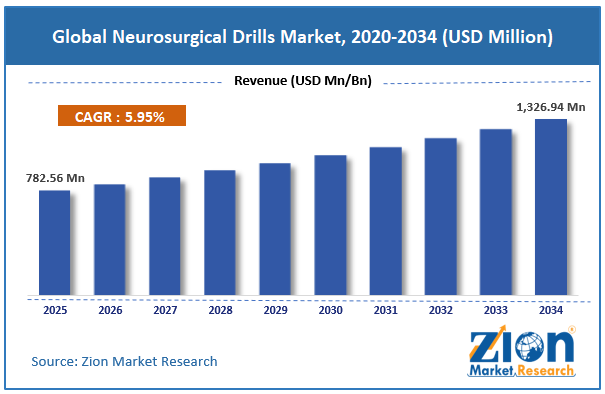
The global neurosurgical drills market size was approximately USD 782.56 million in 2025 and is projected to reach around USD 1,326.94 million by 2034, with a compound annual growth rate of roughly 5.95% between 2026 and 2034.
Key Insights
- As per the analysis shared by our research analyst, the global neurosurgical drills market is estimated to grow annually at a compound annual growth rate of around 5.95% over the forecast period from 2026 to 2034.
- In terms of revenue, the global neurosurgical drills market size was valued at approximately USD 782.56 million in 2025 and is projected to reach USD 1,326.94 million by 2034.
- The neurosurgical drills market is expected to grow steadily, driven by a rising number of cases of brain tumors and spinal disorders, growing preference for minimally invasive techniques, higher healthcare spending in developing countries, expanding neurosurgical training programs, and continuous product innovation by major medical device makers.
- Based on product type, high-speed pneumatic drills are expected to lead the market, while battery-operated drills are anticipated to grow steadily as surgeons seek cordless tools that offer better handling during long procedures.
- Based on application, cranial surgery procedures are expected to lead the neurosurgical drills market, while spinal surgery procedures are anticipated to grow rapidly, supported by an aging population and rising cases of spinal degeneration.
- Based on end-user, hospitals and multi-specialty centers are the largest current end-user group, while ambulatory surgical centers are expected to grow rapidly during the forecast period as more procedures shift to outpatient settings.
- Based on product category, drill handpieces and motors are expected to lead the market, while cutting attachments and burrs are anticipated to grow steadily as surgical volumes increase across regions.
- Based on region, North America is projected to dominate the global neurosurgical drills market during the estimated period, followed by Europe.
Neurosurgical Drills Market: Overview
Neurosurgical drills are precision surgical tools used by surgeons to cut, shape, or remove bone tissue during operations on the brain, spine, and skull. These instruments are built to operate with extreme accuracy, as even a tiny mistake near the brain or spinal cord can cause serious harm. Modern neurosurgical drills come with high-speed motors, interchangeable cutting attachments, safety stop mechanisms, and irrigation systems that keep the surgical area cool and free from bone debris during long procedures. Surgeons rely on these tools for tasks such as opening the skull for brain surgery, drilling through vertebrae during spinal operations, and performing other delicate bone work in ear, nose, and throat procedures. Hospitals and surgical centers use both pneumatic and electric-powered drills, along with newer battery-operated versions that offer greater freedom of movement in the operating room. The growing number of brain and spine-related disorders, rising awareness about minimally invasive surgery, and continuous upgrades in surgical drill technology are pushing demand higher across the world. As surgical safety standards become stricter and hospitals seek more reliable, precise tools, neurosurgical drills have become essential in modern operating rooms and specialized neuro centers.
The neurosurgical drills industry is growing due to a rising number of brain and spine surgeries, rapid advances in surgical drill engineering, and increased spending on hospital infrastructure worldwide.
Impact of the USA-Israel War on Iran on the Neurosurgical Drills Market
Ongoing tensions among the United States, Israel, and Iran could disrupt the medical device supply chain, particularly for raw materials and components shipped through affected trade routes in the Middle East. Some hospitals in the region may face temporary delays in equipment purchases or maintenance contracts as budgets shift toward other pressing needs. Strong global demand for brain and spine surgeries, supported by major healthcare markets in North America, Europe, and Asia-Pacific, is expected to drive continued growth in the neurosurgical drills market despite short-term regional challenges.
Neurosurgical Drills Market: Technology Roadmap 2025–2034
What is the projected development roadmap of the neurosurgical drills market over the forecast period?
The neurosurgical drills market is advancing with smarter motor controls, robot-assisted drilling systems, improved safety sensors, and lighter handheld designs that make long surgeries easier on surgeons' hands. The market is expected to grow at a compound annual growth rate of around 5.95% over the forecast period, supported by continued investment in surgical technology and rising demand for safer, more precise operating tools.
The following roadmap outlines key development phases expected through 2034.
2025–2027: Precision Enhancement and Ergonomic Design Phase
- Manufacturers are expected to refine motor speed control and torque settings, giving surgeons finer control while cutting through delicate bone structures.
- Lighter and better-balanced handpieces are expected to become more common, reducing hand fatigue during lengthy cranial and spinal procedures.
- Improved irrigation and suction systems are expected to be built directly into drill units, helping keep the surgical site clear and reducing the risk of thermal tissue damage.
2028–2031: Smart Sensors and Robot-Assisted Surgery Phase
- Companies are expected to introduce drills with built-in depth sensing and automatic stop features that reduce the chance of drilling too far into sensitive areas.
- Robot-assisted and navigation-guided drilling systems are expected to see wider use in complex cranial and spinal cases, improving accuracy and reducing surgeon strain.
- Data connectivity between drills and hospital surgical planning software is expected to grow, allowing better tracking of usage, maintenance schedules, and procedure outcomes.
2032–2034: Fully Integrated Smart Surgical Systems Phase
- Neurosurgical drills are expected to become part of larger integrated surgical platforms that combine imaging, navigation, and cutting tools into a single coordinated system.
- Self-monitoring drill components are expected to alert hospital staff to wear and tear before failure occurs, reducing surgical delays.
- Fully automated or semi-automated drilling assistance is expected to become more common in leading hospitals, helping standardize outcomes across different surgical teams.
Neurosurgical Drills Market: Dynamics
Growth Drivers
What is driving growth in the neurosurgical drills market as brain and spine surgeries increase worldwide?
The neurosurgical drills market is growing steadily as the number of brain tumor removals, spinal fusions, and skull-based surgeries continues to rise across both developed and developing countries. Aging populations in North America, Europe, and parts of Asia are experiencing higher rates of spinal degeneration, disc problems, and neurological conditions that often require surgical treatment. At the same time, better access to diagnostic tools such as magnetic resonance imaging and computed tomography scans is helping doctors detect brain and spine conditions earlier, which in turn increases the number of surgeries performed each year. Hospitals and surgical centers are responding to this rising demand by investing in modern neurosurgical drills that offer greater precision, safety, and speed than older manual tools. Growing patient awareness of minimally invasive brain and spine procedures is also encouraging hospitals to adopt advanced drilling systems that enable smaller incisions and faster recovery times.
In addition, government health programs in many countries are expanding coverage for neurological and spinal treatments, which is increasing patient access to surgery and, as a result, boosting demand for reliable surgical drilling equipment across public and private healthcare facilities.
Rising investment in neurosurgical training and hospital infrastructure is driving growth in the neurosurgical drills market.
The neurosurgical drills industry is growing due to increased investment in specialized neurosurgery departments, surgeon training programs, and modern operating rooms across many countries. As more hospitals and medical colleges establish dedicated brain and spine care units, the demand for high-quality neurosurgical drills continues to increase. Surgeons also prefer equipment that provides smooth performance, low vibration, and reliable safety features, especially during delicate brain and spinal surgeries where precision is critical. Medical device companies are supporting this demand by offering training programs, technical assistance, service contracts, and hands-on demonstrations to help healthcare professionals use advanced drill systems with confidence.
Many hospitals are also upgrading their operating rooms with modern surgical equipment and navigation technologies that improve the accuracy and efficiency of neurosurgical procedures. Growing investment in surgical facilities, advanced technology, and professional training is expected to drive steady demand for modern neurosurgical drills worldwide.
Restraints
High equipment costs and strict regulatory approval processes are key challenges in the neurosurgical drills market.
The neurosurgical drills market faces several challenges, primarily due to the high cost of advanced drilling systems and the lengthy approval processes required before these devices can be used in hospitals. Many smaller hospitals and surgical centers, particularly in developing countries, struggle to afford top-tier neurosurgical drills, even though these tools can improve surgical outcomes and reduce complications. Getting new surgical drills approved by health authorities often takes a long time, since these devices must go through strict testing to prove they are safe for use near the brain and spinal cord. This lengthy approval process can delay the launch of new and improved products in certain markets.
In addition, maintaining and servicing these precision instruments requires trained technicians and specialized parts, which can be difficult to source in remote or under-resourced areas. Budget limitations in public healthcare systems often slow down the pace at which hospitals can upgrade to newer drill models. Together, these factors continue to limit faster adoption of advanced neurosurgical drilling technology, despite its clear safety and performance benefits.
Opportunities
How are rising neurosurgery volumes and emerging healthcare markets driving the neurosurgical drills market?
The neurosurgical drills market is creating strong growth opportunities as hospitals in emerging economies expand their neurosurgery and spine care capabilities. Countries across the Asia Pacific, Latin America, and parts of the Middle East are investing heavily in building new hospitals and upgrading existing surgical departments, creating fresh demand for modern neurosurgical equipment. Growing medical tourism in countries known for affordable and high-quality surgical care is also encouraging hospitals to invest in advanced drilling systems to attract international patients seeking brain and spine treatment. Rising awareness about early diagnosis of neurological conditions is leading to more surgical interventions, which further supports demand for reliable surgical tools.
At the same time, medical device companies are working on more affordable drill models designed specifically for smaller hospitals and clinics with limited budgets, making advanced technology more accessible. The growing popularity of minimally invasive spine surgery, which often requires specialized, smaller drills and attachments, is also opening new product opportunities. Together, these trends are creating strong long-term opportunities for the global neurosurgical drills market while supporting safer and more accessible neurological and spinal care worldwide.
Challenges
What challenges does the neurosurgical drills market face due to precision requirements and skilled workforce shortages?
The neurosurgical drills industry faces several challenges, including the constant need for extremely high precision and a shortage of trained surgeons and technicians capable of properly operating and maintaining advanced drilling systems. Even small errors during cranial or spinal drilling can lead to serious complications, so manufacturers must continuously improve safety features and reliability, a process that requires ongoing research and substantial investment. Many regions, especially rural and under-resourced areas, face a shortage of neurosurgeons and trained operating room staff capable of using the latest drilling technology safely and effectively.
As new drill features become more advanced and connected to digital surgical systems, the need for specialized technical training continues to grow. The market is also becoming increasingly competitive, with established global manufacturers and newer regional players competing for hospital contracts, which puts pressure on pricing across the industry. Smaller companies often struggle to keep pace with rapid technological change, while larger companies must continue investing in research, staff training, and after-sales support. These challenges can slow the pace of market growth and make it harder for many healthcare facilities to adopt the newest neurosurgical drilling solutions.
Neurosurgical Drills Market: Report Scope
| Report Attributes | Report Details |
|---|---|
| Report Name | Neurosurgical Drills Market |
| Market Size in 2025 | USD 782.56 Million |
| Market Forecast in 2034 | USD 1,326.94 Million |
| Growth Rate | CAGR of 5.95% |
| Number of Pages | 229 |
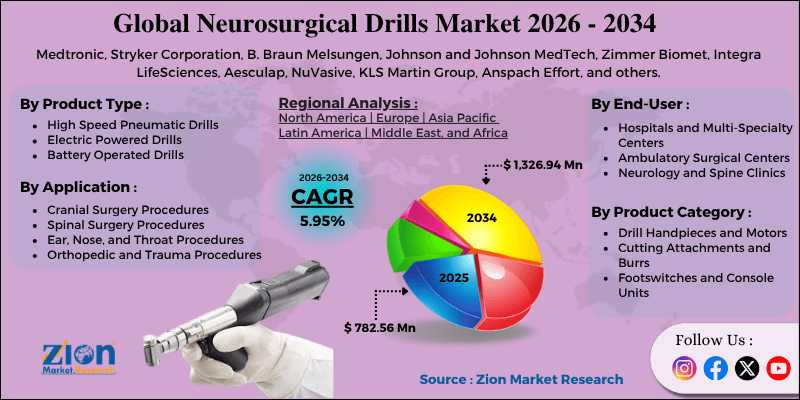
| Key Companies Covered | Medtronic, Stryker Corporation, B. Braun Melsungen, Johnson and Johnson MedTech, Zimmer Biomet, Integra LifeSciences, Aesculap, NuVasive, KLS Martin Group, Anspach Effort, and others. |
| Segments Covered | By Product Type, By Application, By End-User, By Product Category, and By Region |
| Regions Covered | North America, Europe, Asia Pacific (APAC), Latin America, Middle East, and Africa (MEA) |
| Base Year | 2025 |
| Historical Year | 2020 - 2024 |
| Forecast Year | 2026 - 2034 |
| Customization Scope | Avail customized purchase options to meet your exact research needs. Request For Customization |
Neurosurgical Drills Market: Segmentation
The global neurosurgical drills market is segmented by product type, application, end-user, product category, and region.
How do high-speed pneumatic drills maintain their leading position in the neurosurgical drills market?
Based on product type, the global neurosurgical drills market is classified into high-speed pneumatic drills, electric powered drills, battery-operated drills, and craniotomy and craniectomy drills. High-speed pneumatic drills hold about 39% market share, leading due to their strong cutting power, consistent speed control, and longstanding trust among experienced neurosurgeons. Battery-operated drills hold around 24% share. It is one of the fastest-growing segments, driven by increasing demand for cordless tools that offer more flexibility and easier handling during long operations.
What makes the cranial surgery procedures application segment the leader in the neurosurgical drills market?
Based on application, the neurosurgical drills market is segregated into cranial surgery procedures, spinal surgery procedures, ear, nose, and throat procedures, and orthopedic and trauma procedures. The cranial surgery procedures segment accounts for about 35% of the global neurosurgical drills market, driven by the steady number of brain tumor removals and skull-based operations performed each year. The spinal surgery procedures segment holds around 29% share. It is one of the fastest-growing segments, driven by an aging global population and rising cases of spinal disorders requiring surgical treatment.
How do hospitals and multi-specialty centers maintain their leading position in the neurosurgical drills market?
Based on end-user, the market is divided into hospitals and multi-specialty centers, ambulatory surgical centers, neurology and spine clinics, and academic and research institutes. Hospitals and multi-specialty centers lead with about a 44% share, driven by their capacity to perform complex brain and spine surgeries through dedicated neurosurgery departments. Ambulatory surgical centers hold around 21% share. They are growing rapidly as more spine-related and minor neurological procedures shift toward outpatient care settings.
What makes drill handpieces and motors the leading product category in the neurosurgical drills market?
Based on product category, the neurosurgical drills industry is categorized into drill handpieces and motors, cutting attachments and burrs, footswitches and console units, and sterilization and maintenance kits. Drill handpieces and motors account for about 42% of the market, leading due to their central role in every neurosurgical drilling procedure. Cutting attachments and burrs account for around 26% of the market share. They are growing steadily as surgical volumes rise and hospitals require frequent replacement of these consumable components.
Neurosurgical Drills Market: Regional Analysis
Why does North America lead the global neurosurgical drills market?
North America accounts for approximately 39% of the global neurosurgical drills market share, making it the largest regional market. Growth is driven by the high number of brain and spine surgeries, advanced healthcare infrastructure, and continuous investment in modern surgical technologies. The United States leads the region because it has many specialized neurosurgery hospitals, experienced surgeons, and strong health insurance coverage for neurological treatments. Canada is also supporting market growth through public healthcare investments that improve access to brain and spinal surgeries. Hospitals across the region are increasingly adopting advanced neurosurgical drills to improve surgical precision and patient safety. Growing awareness of minimally invasive procedures is encouraging healthcare providers to replace older surgical equipment with more advanced systems. Strong partnerships between hospitals and medical device companies are helping introduce new technologies more quickly. Medical schools and training centers are also producing more skilled neurosurgeons, increasing the demand for reliable surgical equipment. Continuous healthcare spending, ongoing technological innovation, and rising demand for advanced neurosurgical procedures continue to strengthen North America's leadership in the global neurosurgical drills market.
What makes Europe a key market for neurosurgical drills?
Europe accounts for approximately 29% of the global neurosurgical drills market share, making it the second-largest regional market. Well-developed healthcare systems, rising cases of neurological disorders, and increasing investments in advanced surgical technologies support growth. Germany is the largest market in the region because of its strong medical device industry and large number of specialized neurosurgery hospitals. The United Kingdom is also experiencing steady growth due to increasing demand for brain and spine surgeries and continued investment in public healthcare.
France, Italy, and other European countries are expanding the use of advanced neurosurgical equipment through growing medical research and wider adoption of minimally invasive surgical techniques. Nordic countries and the Benelux region are also modernizing hospitals and improving surgical facilities, supporting market growth. Governments across Europe continue investing in hospital infrastructure, surgeon training, and healthcare modernization. Strong collaboration between hospitals and medical device manufacturers, along with stable healthcare spending, continues to support Europe's position as one of the leading markets for neurosurgical drills worldwide.
Recent Market Developments
- In March 2026, Stryker announced plans to expand its Signature 2 high-speed neurosurgical drill portfolio with advanced motors, attachments, and cutting accessories designed to improve precision, visibility, and surgeon control during cranial and spinal procedures.
- In April 2026, Medtronic announced the first successful clinical cases using its Stealth AXiS™ Surgical System, integrating AI-powered navigation and robotic guidance to improve precision and workflow during complex neurosurgical procedures.
Neurosurgical Drills Market: Competitive Analysis
The leading players in the global neurosurgical drills market are:
- Medtronic
- Stryker Corporation
- B. Braun Melsungen
- Johnson and Johnson MedTech
- Zimmer Biomet
- Integra LifeSciences
- Aesculap
- NuVasive
- KLS Martin Group
- Anspach Effort
The global neurosurgical drills market is segmented as follows:
By Product Type
- High Speed Pneumatic Drills
- Electric Powered Drills
- Battery Operated Drills
- Craniotomy and Craniectomy Drills
By Application
- Cranial Surgery Procedures
- Spinal Surgery Procedures
- Ear, Nose, and Throat Procedures
- Orthopedic and Trauma Procedures
By End-User
- Hospitals and Multi-Specialty Centers
- Ambulatory Surgical Centers
- Neurology and Spine Clinics
- Academic and Research Institutes
By Product Category
- Drill Handpieces and Motors
- Cutting Attachments and Burrs
- Footswitches and Console Units
- Sterilization and Maintenance Kits
By Region
- North America
- The U.S.
- Canada
- Mexico
- Europe
- France
- The UK
- Spain
- Germany
- Italy
- Rest of Europe
- Asia Pacific
- China
- Japan
- India
- Australia
- South Korea
- Rest of Asia Pacific
- The Middle East & Africa
- Saudi Arabia
- UAE
- Egypt
- Kuwait
- South Africa
- Rest of the Middle East & Africa
- Latin America
- Brazil
- Argentina
- Rest of Latin America
Table Of Content
Methodology
FrequentlyAsked Questions
Neurosurgical drills are precision surgical tools used by surgeons to cut, shape, or remove bone tissue during operations on the brain, spine, and skull. These instruments are built to operate with extreme accuracy, since even a tiny mistake near the brain or spinal cord can cause serious harm.
The global neurosurgical drills market is expected to grow, driven by a rising number of brain and spine surgeries, growing preference for minimally invasive procedures, expanding hospital infrastructure in developing regions, increasing neurosurgeon training programs, and continuous innovation in surgical drill technology.
According to research, the global neurosurgical drills market size was valued at around USD 782.56 million in 2025 and is projected to reach around USD 1,326.94 million by 2034.
The compound annual growth rate value of the neurosurgical drills market is expected to be around 5.95% during 2026 to 2034.
North America is expected to lead the global neurosurgical drills market during the forecast period, driven by strong hospital infrastructure, a high volume of neurosurgical procedures, and continuous investment in advanced surgical technology.
The major players in the global neurosurgical drills market include Medtronic, Stryker Corporation, B. Braun Melsungen, Johnson and Johnson MedTech, Zimmer Biomet, Integra LifeSciences, Aesculap, NuVasive, KLS Martin Group, and Anspach Effort.
The report examines key aspects of the neurosurgical drills market, including growth drivers, restraints, emerging opportunities, challenges, a competitive landscape analysis, regional breakdowns, and a detailed future outlook across all major product types, applications, end users, and geographies.
The neurosurgical drills market requires stakeholders to invest in product innovation, improve drill precision and safety features, integrate navigation and robotic technologies, strengthen surgeon training programs, and expand partnerships with hospitals to enhance clinical outcomes and maintain a competitive advantage.
The neurosurgical drills market offers significant growth opportunities in brain tumor surgeries, spinal procedures, minimally invasive neurosurgery, skull base surgeries, and image-guided neurosurgical applications, driven by rising rates of neurological disorders and increasing demand for advanced surgical care.
The neurosurgical drills market is being transformed by high-speed drilling systems, robotic-assisted surgery, AI-based navigation, lightweight ergonomic designs, and improved safety features that enhance surgical precision, reduce operating time, and improve patient outcomes.

HappyClients

