
Neodymium Magnet Market Size, Share, Trends, Growth and Forecast 2034

Neodymium Magnet Market By Type (Neodymium-Iron-Boron (NdFeB) Magnets, Samarium-Cobalt (SmCo) Magnets), By Product (Sintered, Bonded), By End-User (Consumer Electronics, Automotive, General Industrial, Medical Devices, Energy), and By Region - Global and Regional Industry Overview, Market Intelligence, Comprehensive Analysis, Historical Data, and Forecasts 2025 - 2034
| Market Size in 2024 | Market Forecast in 2034 | CAGR (in %) | Base Year |
|---|---|---|---|
| USD 15.86 Billion | USD 28.19 Billion | 7.45% | 2024 |
Neodymium Magnet Industry Perspective:
What will be the size of the global neodymium magnet market during the forecast period?
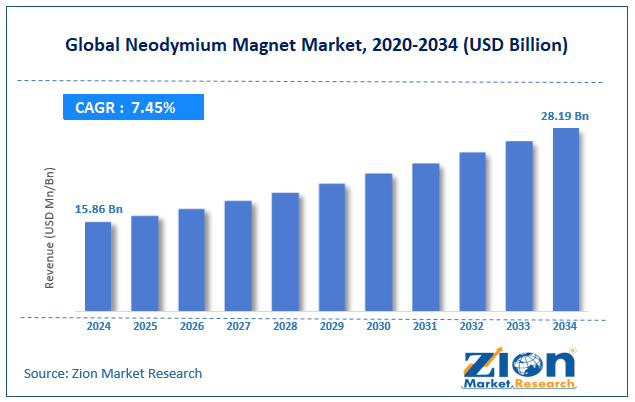
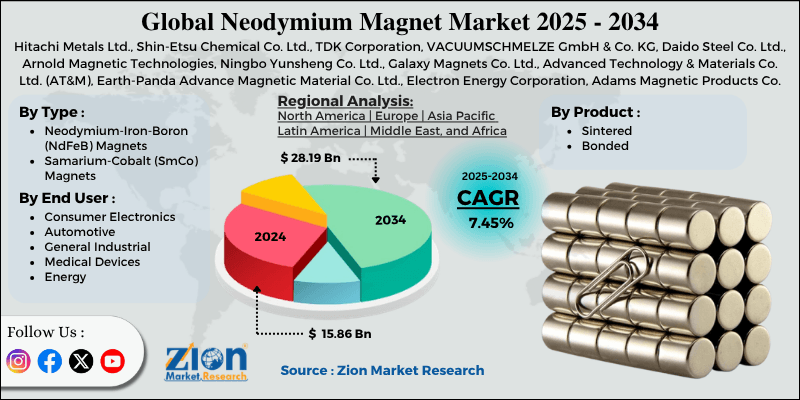
The global neodymium magnet market size was around USD 15.86 billion in 2024 and is projected to reach USD 28.19 billion by 2034, with a compound annual growth rate (CAGR) of roughly 7.45% between 2025 and 2034.
 Request Free SampleRequest Free SampleRequest Free Sample
Key Insights:
- As per the analysis shared by our research analyst, the global neodymium magnet market is estimated to grow annually at a CAGR of around 7.45% over the forecast period (2025-2034)
- In terms of revenue, the global neodymium magnet market size was valued at around USD 15.86 billion in 2024 and is projected to reach USD 28.19 billion by 2034.
- The neodymium magnet market is projected to grow significantly owing to rising wind energy installations, increased use in industrial automation, and the expansion of the aerospace and defense sector.
- Based on type, the Neodymium-Iron-Boron (NdFeB) magnets segment is expected to lead the market, while the Samarium-Cobalt (SmCo) magnets segment is expected to grow considerably.
- Based on product, the sintered segment is the dominating segment, while the bonded segment is projected to witness sizeable revenue over the forecast period.
- Based on end-user, the automotive segment is expected to lead the market, followed by the consumer electronics segment.
- Based on region, the Asia Pacific is projected to dominate the global market during the estimated period, followed by Europe.
Neodymium Magnet Market: Overview
A neodymium magnet is a strong magnet comprising an alloy of neodymium, iron, and boron (NdFeB), valued for its exceptional strength compared to its size. It is widely used in applications such as headphones, electric motors, wind turbines, and hard drives due to its strong magnetic field and high efficiency. The global neodymium magnet market is projected to witness substantial growth, driven by the expansion of renewable energy, growth in consumer electronics, and industrial automation and robotics. Wind turbines and other renewable energy systems majorly rely on neodymium magnets for high-performance direct-drive motors. These magnets enable efficient electricity generation from a variable energy source. Investments in clean energy projects are increasing the global demand for magnets.
Moreover, laptops, smartphones, and audio devices use compact neodymium magnets to enhance performance while minimizing size. Growing digital adoption and disposable incomes are fueling electronics production. Subsequently, the growth of consumer electronics continues to sustain demand for NdFeB magnets. Furthermore, robotics and automation systems use high-performance magnets in actuators and motors to improve efficiency and precision. Industries adopting smart manufacturing increase magnet consumption. The expanding industrial automation is the major driver of the industry.
Although drivers exist, the global market is challenged by factors such as the concentration of raw material supply and the price volatility of rare earths. Neodymium production is concentrated in a few countries, making the supply chain vulnerable. Any disturbance may impact worldwide manufacturing. This reliance hampers market growth and stability. Similarly, fluctuating neodymium prices create uncertainty for manufacturers and affect profit margins. Sudden cost changes complicate long-term planning. Price volatility may slow industry growth.
Even so, the global neodymium magnet industry is well-positioned due to recycling and the circular economy, and advanced medical applications. Recycling end-of-life magnets from EVs and electronics provides a sustainable source of raw materials. Advanced recovery processes reduce reliance on primary mining. Circular economy practices offer economic and environmental benefits. Additionally, neodymium magnets are used in surgical tools, MRI machines, and diagnostic devices. Healthcare technology developments require high-performing, compact magnets. The medical industry offers stable and high-value growth opportunities.
Neodymium Magnet Market: Dynamics
Growth Drivers
How is miniaturization in consumer electronics fueling the worldwide neodymium magnet market?
Neodymium magnets are widely used in high-performance, compact consumer electronics such as speakers, smartphones, wearables, and haptics. With worldwide smartphone shipments recently crossing 1.3 billion units and continual growth in demand for miniaturized magnets and smart devices, demand is steadily surging. Manufacturers favor NdFeB magnets for their superior flux density in small form factors. This broad base of electronic demand adds volume and consistency to growth in the neodymium magnet market. The trend towards more energy-efficient and connected devices further supports this propeller.
How is the neodymium magnet market driven by elevating prices & strategic investment?
Neodymium and praseodymium (NdPr) oxide prices have recently reached multi-year highs, at times surpassing $120/kg, indicating tight downstream magnet demand and constrained refined supply. Higher prices have made domestic rare-earth projects economically viable and have supported strategic investment in refining, mining, and magnet production outside dominant regions. Governments are backing supply stability through price floors, industrial policy frameworks, and incentives. Strong pricing also signals strong demand fundamentals and encourages new entrants to the value chains.
Restraints
Price volatility of rare earth inputs unfavorably impacts the market progress
Critical rare earth oxides such as praseodymium, neodymium, dysprosium, and terbium have historically experienced notable price swings, with neodymium prices showing dramatic year-on-year fluctuations. This volatility directly inflates production costs for NdFeB magnets, making long-term contracts risky and compressing margins. Manufacturers experience frequent recalibrations of raw material costs due to limited hedging tools. Unpredictable and high input costs also pose a challenge for small players seeking to scale or enter operations. Downstream sectors such as wind turbines and EVs face pricing headwinds due to high component costs.
Opportunities
How does material innovation reduce HREE dependency, offering advantageous conditions for the growth of the neodymium magnet market?
Research into grain boundary diffusion techniques and high-cerium substitution is reducing reliance on costly, heavy rare-earth elements like dysprosium without sacrificing thermal performance. These next-generation NdFeB formulations maintain high coercivity at elevated temperatures while using more abundant materials, reducing reliance on heavy rare earths. Commercialization of these materials could stabilize costs and broaden their application scope. Reduced reliance on constrained inputs improves supply security. Material innovation improves competitiveness against substitutes. This ultimately drives the worldwide neodymium magnet industry.
Challenges
Recycling infrastructure adoption restricts the market growth
Despite technological progress, commercial magnet recycling infrastructure remains limited relative to potential demand. Collection systems for end-of-life magnets are nascent or fragmented, reducing feedstock availability. Quality inconsistencies in recycled rare-earth materials can compromise magnet performance in high-precision applications. High upfront costs and uncertain ROI slow broad adoption across the industry. Overcoming technical, logistical, and economic barriers is vital for recycling to serve as a reliable supply source.
 Request Free SampleRequest Free SampleRequest Free Sample
Neodymium Magnet Market: Report Scope
| Report Attributes | Report Details |
|---|---|
| Report Name | Neodymium Magnet Market |
| Market Size in 2024 | USD 15.86 Billion |
| Market Forecast in 2034 | USD 28.19 Bllion |
| Growth Rate | CAGR of 7.45% |
| Number of Pages | 229 |
| Key Companies Covered | Hitachi Metals Ltd., Shin-Etsu Chemical Co. Ltd., TDK Corporation, VACUUMSCHMELZE GmbH & Co. KG, Daido Steel Co. Ltd., Arnold Magnetic Technologies, Ningbo Yunsheng Co. Ltd., Galaxy Magnets Co. Ltd., Advanced Technology & Materials Co. Ltd. (AT&M), Earth-Panda Advance Magnetic Material Co. Ltd., Electron Energy Corporation, Adams Magnetic Products Co., Bunting Magnetics Co., Goudsmit Magnetics Group, JPMF Guangdong Co. Ltd., and others. |
| Segments Covered | By Type, By Product, By End User, and By Region |
| Regions Covered | North America, Europe, Asia Pacific (APAC), Latin America, Middle East, and Africa (MEA) |
| Base Year | 2024 |
| Historical Year | 2019 to 2023 |
| Forecast Year | 2025 - 2034 |
| Customization Scope | Avail customized purchase options to meet your exact research needs. Request For Customization |
Neodymium Magnet Market: Segmentation
The global neodymium magnet market is segmented based on type, product, end-user, and region.
Why is the Neodymium-Iron-Boron (NdFeB) Magnets segment projected to dominate the neodymium magnet market?
Based on type, the global neodymium magnet industry is divided into Neodymium-Iron-Boron (NdFeB) magnets and Samarium-Cobalt (SmCo) magnets. The Neodymium-Iron-Boron (NdFeB) magnets segment registered a dominant 96% share of the market due to their exceptionally high magnetic strength, broad use across key applications, and cost-effectiveness. Their efficiency and superior performance have made them the default choice for the majority of modern industries that need strong magnets, especially in electrification and clean energy.
Conversely, the Samarium-Cobalt (SmCo) magnets segment ranks second in the market with 15% share. They are highly valued for their exceptional corrosion resistance and thermal stability in niche applications such as defense, aerospace, and high-temperature industrial equipment. Though more expensive than NdFeB magnets, these magnets are crucial when operating conditions exceed the environmental or thermal limits of neodymium magnets.
What factors help the Sintered segment lead the neodymium magnet market?
Based on product, the global neodymium magnet market is segmented into sintered and bonded. The sintered segment captures nearly 80% of the market. They are highly preferred for their superior magnetic strength and stability under demanding conditions. And high energy density. These magnets are extensively use din wind turbines, electric vehicle motors, and industries machinery. Their dominance reflects their ability to deliver the highest performance in critical applications.
However, the bonded segment holds the second-largest share in the market at 25%. They are highly valued for cost-effective production, adaptability to complex designs, and flexibility in shapes. Bonded magnets are commonly used in automotive sensors, small motors, and consumer electronics. While their magnetic strength is lower than that of sintered types, their versatility is driving growing adoption across diverse applications.
What are the key reasons for the leadership of the Automotive segment in the neodymium magnet market?
Based on end user, the global market is segmented into consumer electronics, automotive, general industrial, medical devices, and energy. The automotive segment leads the market with 38% of the total share, fueled by the rising use of NdFeB magnets in sensors, electric vehicles, and actuators. Advanced vehicle electronics and electrification continue to drive demand. This sector remains the leading contributor to industry revenue.
Nevertheless, the consumer electronics segment holds second place, with nearly 30% market share, driven by demand for high-strength, compact magnets in laptops, audio devices, smartphones, and other portable devices. Innovation and miniaturization sustain strong usage. It is a major, steadily growing segment after the automotive segment.
Neodymium Magnet Market: Regional Analysis
What enables Asia Pacific to have a strong foothold in the global Neodymium Magnet Market?
Asia Pacific is likely to sustain its leadership in the neodymium magnet market, with a 7.5-8.5% CAGR, driven by a strong manufacturing base, abundant rare-earth resources, and rapid growth in the electronics and EV sectors. Asia Pacific houses major manufacturing hubs for automotive, electronics, and industrial machinery, creating high demand for these magnets. Economies like China produce and export large quantities of NdFeB magnets. The regional manufacturing capabilities make it the leading supplier and consumer worldwide.
Also, China holds a substantial share of the world's rare-earth reserves, including neodymium. Easy access to raw materials reduces production costs and promises a stable supply. This resource benefit strengthens APAC’s industry dominance. Furthermore, the growth in EV adoption and consumer electronics production in economies such as South Korea, Japan, and China drives demand for magnets. Expanding smart devices and industrial automation also make notable contributions. These growth trends consistently fuel the regional leading rank.
Why does Europe rank second in the global Neodymium Magnet Market?
Europe continues to hold the second-highest share, with a 6.5-7.5% CAGR in the neodymium magnet industry, owing to a focus on renewable energy, technological advancement, R&D, and stringent quality and environmental standards. European economies are investing heavily in wind turbines and other renewable energy projects that require strong magnets for direct-drive generators. Commitment to carbon-reduction and clean-energy targets drives magnet consumption. The renewable energy push strengthens the region’s market ranking. Europe focuses R&D on high-performing magnet applications across aerospace, robotics, and industry. Continuous innovation enhances magnet efficiency, application range, and durability. This technological dominance backs industry growth.
Additionally, European industries prioritize high-quality and eco-compliant materials, thereby encouraging the use of advanced magnets with reliable performance and sustainable production. Compliance fuels demand for premium NdFeB magnets. This focus promises steady industry adoption.
Neodymium Magnet Market: Competitive Analysis
The leading players in the global neodymium magnet market are:
- Hitachi Metals Ltd.
- Shin-Etsu Chemical Co. Ltd.
- TDK Corporation
- VACUUMSCHMELZE GmbH & Co. KG
- Daido Steel Co. Ltd.
- Arnold Magnetic Technologies
- Ningbo Yunsheng Co. Ltd.
- Galaxy Magnets Co. Ltd.
- Advanced Technology & Materials Co. Ltd. (AT&M)
- Earth-Panda Advance Magnetic Material Co. Ltd.
- Electron Energy Corporation
- Adams Magnetic Products Co.
- Bunting Magnetics Co.
- Goudsmit Magnetics Group
- JPMF Guangdong Co. Ltd.
What are the key trends in the global Neodymium Magnet Market?
Focus on magnet recycling and sustainability:
Recycling end-of-life magnets from electronics, wind turbines, and EVs is becoming a key focus for reducing dependence on mined rare earths. Advanced recovery technologies are enhancing material reuse rates and minimizing supply risks. Sustainability initiatives are promoting companies to invest in circular economy solutions.
Development of high‑temperature and corrosion‑resistant grades:
Manufacturers are advancing new magnet formulations and coatings to enhance corrosion resistance and thermal stability. These improved materials expand application potential in aerospace, harsh industrial, and energy environments. Improved performance characteristics help meet stringent industry requirements.
The global neodymium magnet market is segmented as follows:
By Type
- Neodymium-Iron-Boron (NdFeB) Magnets
- Samarium-Cobalt (SmCo) Magnets
By Product
- Sintered
- Bonded
By End User
- Consumer Electronics
- Automotive
- General Industrial
- Medical Devices
- Energy
By Region
- North America
- The U.S.
- Canada
- Mexico
- Europe
- France
- The UK
- Spain
- Germany
- Italy
- Rest of Europe
- Asia Pacific
- China
- Japan
- India
- Australia
- South Korea
- Rest of Asia Pacific
- The Middle East & Africa
- Saudi Arabia
- UAE
- Egypt
- Kuwait
- South Africa
- Rest of the Middle East & Africa
- Latin America
- Brazil
- Argentina
- Rest of Latin America
Table Of Content
Methodology
FrequentlyAsked Questions
A neodymium magnet is a strong magnet comprising an alloy of neodymium, iron, and boron (NdFeB), valued for its exceptional strength compared to its size. It is widely used in applications such as headphones, electric motors, wind turbines, and hard drives due to its strong magnetic field and high efficiency.
The global neodymium magnet market is projected to grow due to the expansion of the electric vehicles (EVs) market, rising demand in consumer electronics, and the miniaturization trend in electronic components.
According to a study, the global neodymium magnet market size was around USD 15.86 billion in 2024 and is expected to grow to around USD 28.19 billion by 2034.
The CAGR value of the neodymium magnet market is expected to be around 7.45% during 2025-2034.
Macroeconomic factors like trade policies, raw material prices, and global industrial growth will influence production costs, demand, and market expansion.
Asia Pacific is expected to lead the global neodymium magnet market during the forecast period.
China is the largest contributor to the global neodymium magnet market, supplying the majority of finished magnets and rare-earth materials.
The key players profiled in the global neodymium magnet market include Hitachi Metals, Ltd., Shin-Etsu Chemical Co., Ltd., TDK Corporation, VACUUMSCHMELZE GmbH & Co. KG, Daido Steel Co., Ltd., Arnold Magnetic Technologies, Ningbo Yunsheng Co., Ltd., Galaxy Magnets Co., Ltd., Advanced Technology & Materials Co., Ltd. (AT&M), Earth-Panda Advance Magnetic Material Co., Ltd., Electron Energy Corporation, Adams Magnetic Products Co., Bunting Magnetics Co., Goudsmit Magnetics Group, and JPMF Guangdong Co., Ltd.
The competitive landscape is dominated by a few large global manufacturers with vertical integration, strong R&D, and regional production networks, alongside smaller specialized players.
The report examines key aspects of the neodymium magnet market, including a detailed analysis of current growth factors and restraints, as well as future growth opportunities and challenges that will affect the market.

HappyClients

