Military Unmanned Underwater Vehicles (UUV) Market Size and Forecast 2034

Military Unmanned Underwater Vehicles (UUV) Market By UUV Type (Hybrid Underwater Vehicles (HUV), Autonomous Underwater Vehicles (AUV), and Remotely Operated Vehicles (ROV)), By Sub-System (Communication & Navigation, Payloads & Imaging, Collision Avoidance, Drive System, and Propulsion), By Operational Range (Shallow Vehicles, Medium Vehicles, and Large Vehicles), By Application (Naval & Coastal Defense, Oil & Gas, Oceanography, Search & Salvage Operations, Environmental & Meteorological Research, and Others), and By Region - Global and Regional Industry Overview, Market Intelligence, Comprehensive Analysis, Historical Data, and Forecasts 2025 - 2034
| Market Size in 2024 | Market Forecast in 2034 | CAGR (in %) | Base Year |
|---|---|---|---|
| USD 5.80 Billion | USD 13.40 Billion | 9.75% | 2024 |
Military Unmanned Underwater Vehicles (UUV) Market Industry Perspective:
What is the anticipated CAGR for the military unmanned underwater vehicles (UUV) market during the projection period?
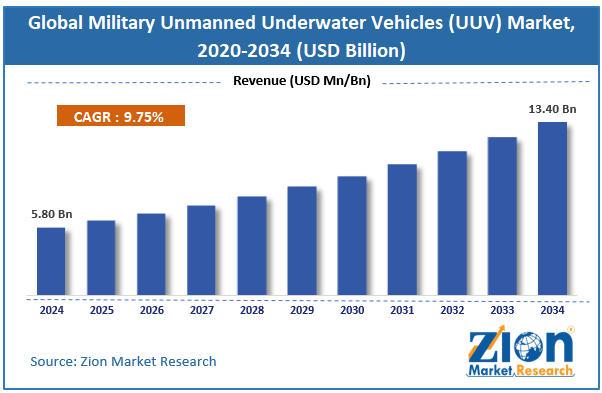
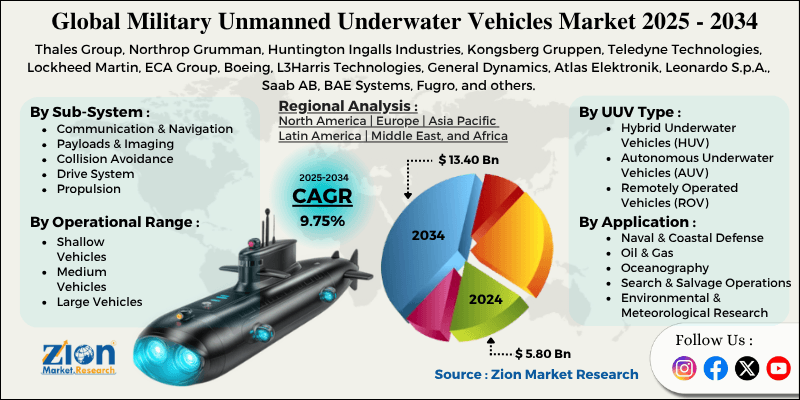
The global military unmanned underwater vehicles (UUV) market size was worth around USD 5.80 billion in 2024 and is predicted to grow to around USD 13.40 billion by 2034 with a compound annual growth rate (CAGR) of roughly 9.75% between 2025 and 2034.
 Request Free SampleRequest Free Sample
Key Insights:
- As per the analysis shared by our research analyst, the global military unmanned underwater vehicles (UUV) market is estimated to grow annually at a CAGR of around 9.75% over the forecast period (2025-2034)
- In terms of revenue, the global military unmanned underwater vehicles (UUV) market size was valued at around USD 5.80 billion in 2024 and is projected to reach USD 13.40 billion by 2034.
- The market is projected to grow at a significant rate due to the benefit from the cost defense spending across the globe.
- Based on the UUV type, the remotely operated vehicles (ROV) segment is growing at a high rate and will continue to dominate the global market, as per industry projections
- Based on the sub-systems, the payloads & imaging segment is anticipated to command the largest market share
- Based on the operational range, the large vehicle segment is expected to lead the market growth trends
- Based on the application, the naval & coastal segment is projected to influence revenue in the market
- Based on region, the Asia-Pacific is projected to dominate the global market during the forecast period
Military Unmanned Underwater Vehicles (UUV) Market: Overview
Military unmanned underwater vehicles (UUVs) are a range of subsea technologies used for military applications. It includes autonomous underwater vehicles (AUVs) and remotely operated vehicles (ROVs). Military UUVs are used across several mission profiles ranging from harbour security, undersea surveillance, anti-submarine warfare, and mine countermeasures. Unmanned underwater vehicles improve maritime domain awareness and reduce operational risk to personnel. According to official reports, modern unmanned underwater vehicles are designed to offer precision, high endurance, and autonomous functionality.
In addition, military UUVs can withstand an extreme subsea environment, including high pressure. During the forecast period, the demand for military unmanned underwater vehicles is expected to grow due to the rising geopolitical tension worldwide. Ongoing war between the US, Israel, and Iran, along with other territorial disputes, will further promote the use of military UUVs. However, the high cost of UUV production and strict regulatory framework will limit market expansion trends in the coming years.
Military Unmanned Underwater Vehicles (UUV) Market: Dynamics
Growth Drivers
How will an increase in defense spending influence the military unmanned underwater vehicles (UUV) market?
The global military unmanned underwater vehicles (UUV) market is expected to benefit from the cost of defense spending across the globe. Countries worldwide are increasing naval modernization expenditure to keep up with rising threats to national security. In February 2026, reports emerged suggesting that Europe is registering an increase in its defense spending, with Germany leading the regional investments. Furthermore, industry research confirms that the global defense spending increased to over USD 2.6 trillion in 2025. Military unmanned underwater vehicles are next-generation defense technologies designed to help security agencies track and identify naval threats.
Growing focus on mine countermeasures (MCM) will impact business revenue in the long run
Naval mines have emerged as a prominent form of maritime threat in the last few years. The ongoing war between Israel, the USA, and Iran has raised global concerns over the long-term implications of naval mines. According to official reports, naval mines, after an explosion, can remain active for decades, disrupting global trade for years. Governments are spending heavily on developing mine countermeasure vehicles that detect and destroy naval mines using a range of technologies, including the solutions available in the global military unmanned underwater vehicles (UUV) market.
Restraints
Why will the high cost of investment limit the expansion of the military unmanned underwater vehicles (UUV) market?
The global military unmanned underwater vehicles (UUV) industry is expected to be limited by the high cost of investment associated with the market. Military UUVs are modern technologies equipped and developed using high-end engineering solutions. The average cost of a simple surveillance UUV can range between USD 200,000 and USD 1.1 million. Large UUVs can cost over USD 100 million per unit. High expenses associated with the production and maintenance of military UUVs will limit market adoption trends in the future.
Opportunities
Technological innovations in the industry are generating growth opportunities for industry players
The global military unmanned underwater vehicles (UUV) market is expected to generate growth opportunities due to rising investments in technological innovations that enhance overall performance and applications of UUVs. In February 2026, Lockheed Martin announced the launch of its Lamprey Multi‑Mission Autonomous Undersea Vehicle. The latest UUV by the company can attach itself to ships, deploy airborne drones, and launch torpedoes. It is equipped with a 24-foot payload bay and can be modified to perform several additional functions. In the same month, General Dynamics announced that the company was working on developing MEDUSA. It is an unmanned underwater vehicle that will be installed in US Navy submarines, offering long-range offensive mine warfare capability.
Challenges
How will limited underwater communication and battery life challenge the military unmanned underwater vehicles (UUV) market?
The global military unmanned underwater vehicles (UUV) industry is projected to be challenged by the limited underwater communication of the vehicles. Since radio waves do not travel effectively in the deep sea, UUVs are vulnerable to interference. Furthermore, the limited battery life of UUVs is a major challenge for the market players to overcome since longer missions will require vehicles equipped with high-capacity batteries.
 Request Free SampleRequest Free Sample
Military Unmanned Underwater Vehicles (UUV) Market: Report Scope
| Report Attributes | Report Details |
|---|---|
| Report Name | Military Unmanned Underwater Vehicles (UUV) Market |
| Market Size in 2024 | USD 5.80 Billion |
| Market Forecast in 2034 | USD 13.40 Billion |
| Growth Rate | CAGR of 9.75% |
| Number of Pages | 226 |
| Key Companies Covered | Thales Group, Northrop Grumman, Huntington Ingalls Industries, Kongsberg Gruppen, Teledyne Technologies, Lockheed Martin, ECA Group, Boeing, L3Harris Technologies, General Dynamics, Atlas Elektronik, Leonardo S.p.A., Saab AB, BAE Systems, Fugro, and others. |
| Segments Covered | By UUV Type, By Sub-System, By Operational Range, By Application, and By Region |
| Regions Covered | North America, Europe, Asia Pacific (APAC), Latin America, Middle East, and Africa (MEA) |
| Base Year | 2024 |
| Historical Year | 2019 to 2023 |
| Forecast Year | 2025 - 2034 |
| Customization Scope | Avail customized purchase options to meet your exact research needs. Request For Customization |
Military Unmanned Underwater Vehicles (UUV) Market: Segmentation
The global military unmanned underwater vehicles (UUV) market is segmented based on UUV type, sub-system, operational range, application, and region.
Why will the remotely operated vehicles (ROV) segment lead the military unmanned underwater vehicles (UUV) revenue during the forecast period?
Based on UUV type, the global market segments are hybrid underwater vehicles (HUV), autonomous underwater vehicles (AUV), and remotely operated vehicles (ROV). In 2024, the highest growth was listed in the remotely operated vehicles (ROV) segment, accounting for 61% of the global revenue.
During the forecast period, autonomous underwater vehicles (AUVs) are expected to emerge as the leading segment, growing at a CAGR of 14.02% due to the rising introduction of Artificial Intelligence (AI)-equipped AUVs with improved endurance.
Which will be the fastest-growing sub-system type during the forecast period in the military unmanned underwater vehicles (UUV) market?
Based on sub-systems, the global military unmanned underwater vehicles industry is divided into communication & navigation, payloads & imaging, collision avoidance, drive system, and propulsion. In 2024, the payloads & imaging segment was the highest revenue generator, accounting for 35.1% of the global revenue. During the forecast period, communication & navigation is expected to lead the market with a CAGR of 18.2%, driven by advancements in subsea communication technologies.
Why will large vehicles lead the military unmanned underwater vehicles (UUV) market in the coming years?
Based on operational range, the global market segments are shallow vehicles, medium vehicles, and large vehicles. In 2024, the largest part of the market share was held by large vehicles, contributing up to 51% of the global revenue. It is expected to lead the industry growth trends in the future with a CAGR of 16% as demand for maritime surveillance is expected to reach its peak in the coming years.
How will naval & coastal defense applications shape the military unmanned underwater vehicles (UUV) market during the forecast period?
Based on application, the global market is fragmented into naval & coastal defense, oil & gas, oceanography, search & salvage operations, environmental & meteorological research, and others. In 2024, the naval & coastal defense segment led the global market revenue, accounting for 60% of the industry share. It will continue leading the market with a CAGR of 15% as global defense spending continues to grow in the backdrop of rising national security threats.
Military Unmanned Underwater Vehicles (UUV) Market: Regional Analysis
Why does North America lead the military unmanned underwater vehicles (UUV) market?
The global military unmanned underwater vehicles (UUV) market is currently led by North America, accounting for 40% of the global trade. It is expected to register a CAGR of 13% during the forecast period, with the US leading the regional market. According to official reports, the US Navy has the world’s highest defense budget, which is expected to continue growing in the coming years. In addition, growing regional research & development and applications of UUVs in the ongoing war will aid accelerated growth across North America.
What is the projected CAGR for Asia-Pacific in the military unmanned underwater vehicles (UUV) market during the forecast period?
Asia-Pacific is projected to emerge as the fastest-growing market with a CAGR of 19%, with China, India, and Japan leading the regional growth trends. Growing defense budget, intensifying geopolitical tension across coastal borders, and military modernization will influence regional market expansion. Furthermore, increasing production of domestic UUVs and increasing global strategic partnerships will work in favor of the regional players.
Military Unmanned Underwater Vehicles (UUV) Market: Competitive Analysis
The global military unmanned underwater vehicles (UUV) market is led by players like:
- Thales Group
- Northrop Grumman
- Huntington Ingalls Industries
- Kongsberg Gruppen
- Teledyne Technologies
- Lockheed Martin
- ECA Group
- Boeing
- L3Harris Technologies
- General Dynamics
- Atlas Elektronik
- Leonardo S.p.A.
- Saab AB
- BAE Systems
- Fugro
What are the latest key trends in the military unmanned underwater vehicles (UUV) market?
AI integration
Military UUV producers are actively working on integrating AI as a critical technology. Artificial Intelligence can help improve target recognition and real-time decision-making when using military UUVs.
Environmental analysis
Military UUVs are leveraged to conduct deep-sea research and environmental analysis. Unmanned subsea vehicles can play a crucial role in pollution tracking.
The global military unmanned underwater vehicles (UUV) market is segmented as follows:
By UUV Type
- Hybrid Underwater Vehicles (HUV)
- Autonomous Underwater Vehicles (AUV)
- Remotely Operated Vehicles (ROV)
By Sub-System
- Communication & Navigation
- Payloads & Imaging
- Collision Avoidance
- Drive System
- Propulsion
By Operational Range
- Shallow Vehicles
- Medium Vehicles
- Large Vehicles
By Application
- Naval & Coastal Defense
- Oil & Gas
- Oceanography
- Search & Salvage Operations
- Environmental & Meteorological Research
- Others
By Region
- North America
- The U.S.
- Canada
- Mexico
- Europe
- France
- The UK
- Spain
- Germany
- Italy
- Rest of Europe
- Asia Pacific
- China
- Japan
- India
- Australia
- South Korea
- Rest of Asia Pacific
- The Middle East & Africa
- Saudi Arabia
- UAE
- Egypt
- Kuwait
- South Africa
- Rest of the Middle East & Africa
- Latin America
- Brazil
- Argentina
- Rest of Latin America
Table Of Content
Methodology
FrequentlyAsked Questions
Military unmanned underwater vehicles (UUVs) are a range of subsea technologies used for military applications.
The global military unmanned underwater vehicles (UUV) market is expected to benefit from the cost of defense spending across the globe.
According to study, the global military unmanned underwater vehicles (UUV) market size was worth around USD 5.80 billion in 2024 and is predicted to grow to around USD 13.40 billion by 2034.
The CAGR value of the military unmanned underwater vehicles (UUV) market is expected to be around 9.75% during 2025-2034.
The global military unmanned underwater vehicles (UUV) industry is projected to be challenged by limited underwater communication of the vehicles.
AI Integration and environmental analysis are the emerging trends and innovations impacting the military unmanned underwater vehicles (UUV) market.
The global military unmanned underwater vehicles (UUV) market has performed well so far and will offer similar trends in the coming years.
Asia-Pacific is projected to emerge as the fastest-growing market with a CAGR of 19%, with China, India, and Japan leading the regional growth trends.
The global military unmanned underwater vehicles (UUV) market is led by players like Thales Group, Northrop Grumman, Huntington Ingalls Industries, Kongsberg Gruppen, Teledyne Technologies, Lockheed Martin, ECA Group, Boeing, L3Harris Technologies, General Dynamics, Atlas Elektronik, Leonardo S.p.A., Saab AB, BAE Systems, and Fugro.
The report explores crucial aspects of the military unmanned underwater vehicles (UUV) market including detailed discussion of existing growth factors and restraints while also browsing future growth opportunities and challenges that impact the market.

List of Contents
MarketIndustry Perspective:Key Insights:OverviewDynamicsReport ScopeSegmentationRegional AnalysisCompetitive AnalysisWhat are the latest key trends in the military unmanned underwater vehicles (UUV) market?The global military unmanned underwater vehicles (UUV) market is segmented as follows:HappyClients