
Global Magneto-Rheological Fluid (MRF) Market Size, Trends, Growth & Forecast 2032

Magneto-Rheological Fluid (MRF) Market By Base Fluid (Water, Hydraulic Oil, Paraffin Oil, Synthetic Hydrocarbon Oil, Mineral Oil, Synthetic Oil, and Others), By Application (Robotics, Medical and Prosthetics, Electrical and Electronics, Optics, Military and Defence, Building and Construction, Aerospace, Automotive, and Others), and By Region - Global and Regional Industry Overview, Market Intelligence, Comprehensive Analysis, Historical Data, and Forecasts 2024 - 2032
| Market Size in 2023 | Market Forecast in 2032 | CAGR (in %) | Base Year |
|---|---|---|---|
| USD 1.59 Billion | USD 8.72 Billion | 20.85% | 2023 |
Magneto-Rheological Fluid (MRF) Industry Perspective
What will be the global magneto-rheological fluid (MRF) market size during the forecast period?
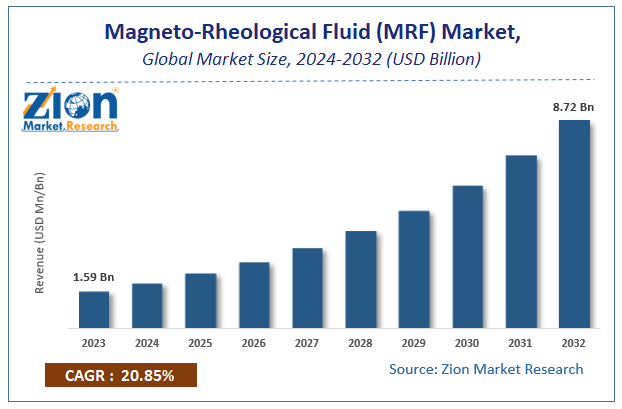
According to Zion Market Research, the global magneto-rheological fluid (MRF) market size was worth USD 1.59 billion in 2023. The market is forecast to reach USD 8.72 billion by 2032, growing at a compound annual growth rate (CAGR) of 20.85% during the forecast period 2024-2032.
This report provides a comprehensive analysis of the growth drivers, restraints, and challenges shaping demand across the global magneto-rheological fluid (MRF) market throughout the forecast period, while highlighting high-potential emerging opportunities within the industry.
Key Insights
- As per the analysis shared by our research analyst, the global magneto-rheological fluid market is estimated to grow annually at a CAGR of around 20.85% over the forecast period (2024-2032).
- In terms of revenue, the global magneto-rheological fluid market size was valued at around USD 1.59 billion in 2023 and is projected to reach USD 8.72 billion by 2032.
- The market is driven by rising adoption of adaptive damping and vibration control systems across automotive, robotics, aerospace, and industrial applications, supported by continuous research investments and growing awareness of controllable fluid benefits.
- Based on the base fluid segment, hydraulic oil dominated the market due to its excellent thermal and oxidative stability, broad compatibility with magnetic particles and additives, and cost-effectiveness
- Based on the application segment, automotive held a leading position as magneto-rheological fluids are extensively used in controllable suspension systems that enhance ride comfort and handling on multiple vehicle platforms
- By region, Asia Pacific dominated the global market owing to rising consumer awareness of magneto-rheological fluid benefits and expanding industrial and automotive manufacturing bases
Magneto-Rheological Fluid (MRF) Market: Overview
Magneto-rheological fluid, or MR fluid, is a controllable, non-colloidal fluid, which is a mixture of ferromagnetic particles dispersed randomly in water or oil. This fluid is mixed with surfactants to avoid the settlement of the suspended particles. The demand and popularity of the magneto-rheological fluid market on a global scale can be attributed to the rising number of innovative applications, such as engine mounting and haptic knobs across a wide range of industries, such as optics, robotics, and automotive.
Magneto-Rheological Fluid (MRF) Market: Growth Factors
What factors are accelerating demand for magneto-rheological fluid?
The major growth driver in the global magneto-rheological fluid market is the increased product usage in various sectors, such as robotics, automotive, electrical and electronics, aerospace, and optics, among others. Several vehicle platforms, including Corvette and Cadillac, use fluid-based suspension systems that utilize magneto-rheological fluid. Additionally, the robotics sector utilizes magneto-rheological fluid in damping and braking systems, whereas the aerospace sector uses it in landing gear.
Huge investments made in research and development by key market players, universities, and government research organizations, and increasing consumer awareness about the benefits of using MR fluid are contributing to the expansion of the magneto-rheological fluid market across the world in the upcoming years.
Magneto-Rheological Fluid (MRF) Market: Restraints
What barriers are limiting market expansion?
The relatively high cost of magneto-rheological fluid remains a significant restraint, limiting penetration in price-sensitive applications and markets. Specialized particle synthesis, surfactant packages, and quality control contribute to elevated production expenses compared with conventional fluids.
Performance stability over extended operating cycles and under varying temperature or contamination conditions also presents technical challenges that can slow adoption in demanding continuous-duty environments. A limited supplier base for high-performance grades further constrains rapid scaling in some regions.
Magneto-Rheological Fluid (MRF) Market: Report Scope
| Report Attributes | Report Details |
|---|---|
| Report Name | Magneto-Rheological Fluid (MRF) Market |
| Market Size in 2023 | USD 1.59 Billion |
| Market Forecast in 2032 | USD 8.72 Billion |
| Growth Rate | CAGR of 20.85% |
| Number of Pages | 250 |
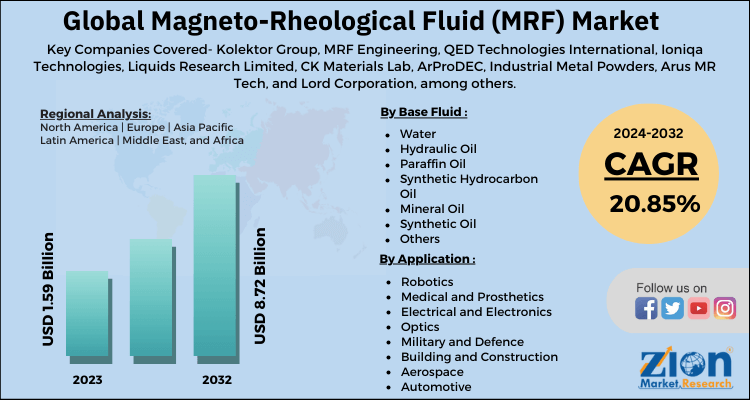
| Key Companies Covered | Kolektor Group, MRF Engineering, QED Technologies International, Ioniqa Technologies, Liquids Research Limited, CK Materials Lab, ArProDEC, Industrial Metal Powders, Arus MR Tech, and Lord Corporation, among others |
| Segments Covered | By Base Fluid, By Application And By Region |
| Regions Covered | North America, Europe, Asia Pacific (APAC), Latin America, Middle East, and Africa (MEA) |
| Base Year | 2023 |
| Historical Year | 2018 - 2022 |
| Forecast Year | 2024 - 2032 |
| Customization Scope | Avail customized purchase options to meet your exact research needs. Request For Customization |
Magneto-Rheological Fluid (MRF) Market: Segmentation
The magneto-rheological fluid market is segmented by base fluid, application, and region. All the segments of the magneto-rheological fluid market have been analyzed based on present and future trends and the market is estimated from 2024 to 2032.
Based on Base Fluid, this market includes water, hydraulic oil, paraffin oil, synthetic hydrocarbon oil, mineral oil, synthetic oil, and others. Hydraulic oil leads the category because of its favorable thermal and oxidative stability, excellent compatibility with magnetic particles and additives, and cost-effectiveness that support reliable performance across industrial, automotive, and defense applications. This dominance drives market growth by enabling robust, widely deployable formulations that meet the durability requirements of commercial damping and control systems. Synthetic hydrocarbon oil ranks as the second major option; its tailored viscosity and temperature characteristics support specialized high-performance uses, contributing to product differentiation and expansion into demanding aerospace and precision applications.
On the basis of Application, this market is segmented into robotics, medical and prosthetics, electrical and electronics, optics, military and defence, building and construction, aerospace, automotive, and others. Automotive dominates due to widespread adoption of magneto-rheological suspension systems that deliver adaptive ride control and improved vehicle dynamics on multiple production platforms. This leadership propels overall market expansion through high-volume demand and continuous refinement of fluid formulations for automotive duty cycles. Robotics forms the second key application area, utilizing the fluid in damping, braking, and actuation systems that require precise, rapid response; its growth stimulates innovation in compact, high-force devices and supports broader industrial automation trends.
Magneto-Rheological Fluid (MRF) Market: Regional Analysis
Why will Asia Pacific continue to dominate the global market during the projection period?
In 2023, the Asia Pacific magneto-rheological fluid market dominated globally and is anticipated to maintain its position over the estimated period as well. This was due to the increase in consumer awareness regarding the benefits of MR fluid usage. The North American and European regions are likely to show a good rate of growth in this market over the estimated time period. When subjected to any type of magnetic field, MR fluids’ viscosity rapidly increases, thus transforming into a viscoelastic solid.
Similarly, in the absence of a magnetic field, the MR fluid transforms to its original state, i.e., liquid. Thus, the growing use of MR fluid in damping, braking, and clutching systems in varied industries, such as aerospace, building and construction, automotive, military and defence, robotics, and optics. Developed countries in both regions, such as the U.S., Canada, Germany, etc., are making huge investments for developing new technology, which, in turn, is likely to further drive this market in the future.
Magneto-Rheological Fluid (MRF) Market: Competitive Analysis
Some of the most important market players in the global magneto-rheological fluid market include -
- Kolektor Group
- MRF Engineering
- QED Technologies International
- Ioniqa Technologies
- Liquids Research Limited
- CK Materials Lab
- ArProDEC
- Industrial Metal Powders
- Arus MR Tech
- Lord Corporation
Segments Covered
The global magneto-rheological fluid (MRF) market is segmented as follows:
By Base Fluid
- Water
- Hydraulic Oil
- Paraffin Oil
- Synthetic Hydrocarbon Oil
- Mineral Oil
- Synthetic Oil
- Others
By Application
- Robotics
- Medical and Prosthetics
- Electrical and Electronics
- Optics
- Military and Defence
- Building and Construction
- Aerospace
- Automotive
- Others
By Region
- North America
- The U.S.
- Canada
- Mexico
- Europe
- France
- The UK
- Spain
- Germany
- Italy
- Rest of Europe
- Asia Pacific
- China
- Japan
- India
- Australia
- South Korea
- Rest of Asia Pacific
- The Middle East & Africa
- Saudi Arabia
- UAE
- Egypt
- Kuwait
- South Africa
- Rest of the Middle East & Africa
- Latin America
- Brazil
- Argentina
- Rest of Latin America
Table Of Content
Methodology
FrequentlyAsked Questions
Magneto-rheological fluid is a smart, controllable fluid consisting of ferromagnetic particles suspended in a carrier liquid. Its viscosity increases rapidly under a magnetic field, allowing precise control of damping, braking, and force transmission in mechanical systems.
Key growth drivers include rising demand for adaptive damping and vibration control systems, expanding applications in automotive suspension, robotics, aerospace, and industrial machinery, and substantial research investments that improve fluid performance and awareness.
According to study, the global Magneto-Rheological Fluid (MRF) market size was worth around USD 1.59 Billion in 2023 and is predicted to grow to around USD 8.72 Billion By 2032.
The global Magneto-Rheological Fluid (MRF) market is expected to grow at a Compound Annual Growth Rate (CAGR) of around CAGR 20.85% during the forecast period from 2024-2032.
The global Magneto-Rheological Fluid (MRF) industry is projected to be challenged by Challenges include high material costs, limited supplier base, and performance stability over long operating cycles.
The Opportunities include demand in automotive suspension, vibration control systems, robotics, and advanced defense applications will offer significant growth opportunities in the Magneto-Rheological Fluid (MRF) market.
Advanced formulations with faster response times; growing use in adaptive dampers and prosthetics; integration in automotive and defense systems are the emerging trends and innovations impacting the Magneto-Rheological Fluid (MRF) market.
Asia Pacific is expected to contribute notably and lead the global magneto-rheological fluid market during the forecast period, supported by rising awareness, manufacturing growth, and research investments.
Some of the prominent players operating in the global Magneto-Rheological Fluid (MRF) market are; Kolektor Group, MRF Engineering, QED Technologies International, Ioniqa Technologies, Liquids Research Limited, CK Materials Lab, ArProDEC, Industrial Metal Powders, Arus MR Tech, and Lord Corporation, among others and others.
The report explores crucial aspects of the Magneto-Rheological Fluid (MRF) market, including a detailed discussion of existing growth factors and restraints, while also browsing future growth opportunities and challenges that impact the market.

HappyClients

