
M-Commerce Market Size, Share, Trends, Growth and Forecast 2032

M-Commerce Market By payment mode (wireless application protocol, near field communication, direct carrier billing, and premium SMS), By type of users (feature phone users and smart device users), By transactions (M-billing, M-retailing, M-ticketing/booking, and other M-commerce services) And By Region: - Global And Regional Industry Overview, Market Intelligence, Comprehensive Analysis, Historical Data, And Forecasts, 2024-2032
| Market Size in 2023 | Market Forecast in 2032 | CAGR (in %) | Base Year |
|---|---|---|---|
| USD 361.31 Billion | USD 2997.08 Billion | 26.5% | 2023 |
Description
How big is the M-Commerce Market?
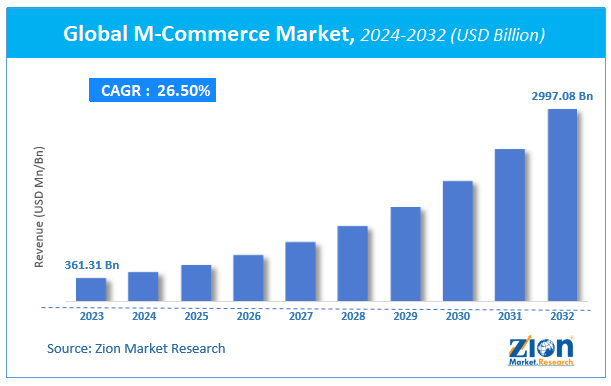
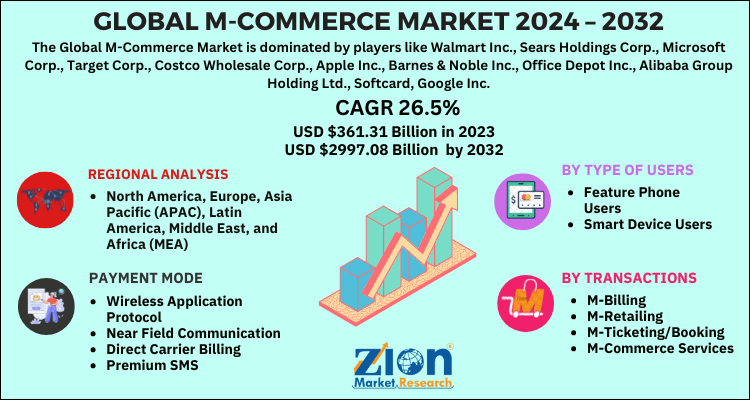
According to the report published by Zion Market Research, the global M-Commerce Market size was valued at USD 361.31 Billion in 2023 and is predicted to reach USD 2997.08 Billion by the end of 2032. The market is expected to grow with a CAGR of 26.5% during the forecast period. The report analyzes the global M-Commerce Market's growth drivers, restraints, and impact on demand during the forecast period. It will also help navigate and explore the arising opportunities in the M-Commerce Market industry.
 Request Free SampleRequest Free Sample
Global M-Commerce Market: Overview
M-commerce stands for mobile commerce and it uses wireless technology to conduct commercial transactions online. This technology uses laptops, cellular phones, tablets, and others. Mobile commerce consists of purchase and delivery of wallpapers, mobile games, and ringtones. Owing to the convergence of the mobile phones, video players, and portable audio players the purchase and the delivery of the full-length music tracks and videos have risen. 4G networks make it possible to buy movies and much more online.
Global M-Commerce Market: Growth Factors
The increasing adoption of electronic commerce has positively influenced the global M-commerce market. Technological advancements made in the wireless handheld devices gives the benefit of great computing power, rapid adoption of online commerce, and rapid growth of mobile commerce these are some of the major factors that are driving the global market. Increasing concerns regarding security issues and rising mobile consumer base anticipate fueling the M-commerce market. Mobile commerce is beneficial for various industries such as entertainment, education, enterprise resource planning, commerce, dispatching and inventory tracking, travel and ticketing, and traffic thus opening up new growth opportunities. However, the inadequate power of processing, slow internet speed in some regions, and a dearth of mobile literacy are factors that hamper the M-commerce market growth to some extent.
 Request Free SampleRequest Free Sample
Global M-Commerce Market: Segmentation
The global M-commerce market is categorized based on the payment mode, type of users, and transactions.
The payment mode is segmented into wireless application protocol, near field communication, direct carrier billing, and premium SMS.
Based on the type of users, the market is segregated into feature phone users and smart device users.
On the basis of transactions, the M-commerce market is diversified into M-billing, M-retailing, M-ticketing/booking, and other M-commerce services.
M-Commerce Market: Report Scope
| Report Attributes | Report Details |
|---|---|
| Report Name | M-Commerce Market |
| Market Size in 2023 | USD 361.31 Billion |
| Market Forecast in 2032 | USD 2997.08 Billion |
| Growth Rate | CAGR of 26.5% |
| Number of Pages | 206 |
| Key Companies Covered | Walmart Inc., Sears Holdings Corp., Microsoft Corp., Target Corp., Costco Wholesale Corp., Apple Inc., Barnes & Noble Inc., Office Depot Inc., Alibaba Group Holding Ltd., Softcard, Google Inc., J. C. Penney, Liberty Interactive, and GameStop. Other prominent market vendors include Amazon.com Inc., LL Bean, Newegg, MasterCard Inc., Groupon, Netflix Inc., Kohl's, Bank of America Corp., Zynga Inc., Best Buy, Macy's, Rakuten Inc., BlackBerry Ltd., Staples, Visa Inc., eBay Inc., ASOS.com, and PayPal Inc |
| Segments Covered | By payment mode, By type of users, By transactions and By Region |
| Regions Covered | North America, Europe, Asia Pacific (APAC), Latin America, Middle East, and Africa (MEA) |
| Base Year | 2023 |
| Historical Year | 2018 to 2022 |
| Forecast Year | 2024 - 2032 |
| Customization Scope | Avail customized purchase options to meet your exact research needs. Request For Customization |
Global M-Commerce Market: Regional Analysis
Growing adoption of mobile commerce in the Asia Pacific region is the major key factor fuelling the global M-commerce market growth. The growing purchasing power and the increasing disposable incomes in the emerging economies such as China and India provide the choice to the consumers to purchase more products which largely foster the growth of the market. North America has proactively participated in making M-commerce a vital part of the daily commercial transactions. Rising consumer base for mobile commerce, increasing popularity of handheld devices, and proliferation of technology are some of the factors that contribute to the market growth in the European region. Increasing awareness about mobile wallets and several benefits that are provided by them has widely increased the use of online transactions across the Latin America and the Middle East regions.
Global M-Commerce Market: Competitive Players
Major players dominating the global M-commerce market are:
- Walmart Inc.
- Sears Holdings Corp.
- Microsoft Corp.
- Target Corp.
- Costco Wholesale Corp.
- Apple Inc.
- Barnes & Noble Inc.
- Office Depot Inc.
- Alibaba Group Holding Ltd.
- Softcard
- Google Inc.
- J. C. Penney
- Liberty Interactive
- GameStop.
Other prominent market vendors include:
- Amazon.com Inc.
- LL Bean
- Newegg
- MasterCard Inc.
- Groupon
- Netflix Inc.
- Kohl's, Bank of America Corp.
- Zynga Inc.
- Best Buy
- Macy's, Rakuten Inc.
- BlackBerry Ltd.
- Staples
- Visa Inc.
- eBay Inc.
- ASOS.com
- PayPal Inc.
The Global M-Commerce Market is segmented as follows:
payment mode
- wireless application protocol
- near field communication
- direct carrier billing
- premium SMS
By type of users
- feature phone users
- smart device users
By transactions
- M-billing
- M-retailing
- M-ticketing/booking
- M-commerce services
By Region
- North America
- The U.S.
- Canada
- Mexico
- Europe
- France
- The UK
- Spain
- Germany
- Italy
- Rest of Europe
- Asia Pacific
- China
- Japan
- India
- Australia
- South Korea
- Rest of Asia Pacific
- The Middle East & Africa
- Saudi Arabia
- UAE
- Egypt
- Kuwait
- South Africa
- Rest of the Middle East & Africa
- Latin America
- Brazil
- Argentina
- Rest of Latin America
What Report Provides
- Full in-depth analysis of the parent market
- Important changes in market dynamics
- Segmentation details of the market
- Former, on-going, and projected market analysis in terms of volume and value
- Assessment of niche industry developments
- Market share analysis
- Key strategies of major players
- Emerging segments and regional markets
- Testimonials to companies in order to fortify their foothold in the market.
Table Of Content

FrequentlyAsked Questions
M-commerce, or mobile commerce, refers to buying and selling goods and services through mobile devices such as smartphones and tablets.
The global M-commerce market is expected to be driven by the The market is driven by rising smartphone penetration, growing mobile internet usage, and increasing consumer preference for convenient digital shopping and payment solutions.
According to study, the global M-commerce market size was worth around USD 361.31 Billion in 2023 and is predicted to grow to around USD 2997.08 Billion By 2032.
The global M-commerce market is expected to grow at a Compound Annual Growth Rate (CAGR) of around CAGR 26.5% during the forecast period from 2024-2032.
The global M-commerce industry is projected to be challenged by Challenges include data security concerns, payment fraud risks, and intense competition. User experience consistency across devices is critical.
The Opportunities are driven by digital wallets, super-app ecosystems, personalized AI commerce, and growth in emerging markets with rising smartphone penetration and faster mobile internet will offer significant growth opportunities in the M-commerce market.
Integration with mobile wallets and AR shopping, AI personalization, and seamless omnichannel experiences are the emerging trends and innovations impacting the M-commerce market.
The global M-commerce market is expected to be led by APAC during the forecast period.
Some of the prominent players operating in the global M-commerce market are; Walmart Inc., Sears Holdings Corp., Microsoft Corp., Target Corp., Costco Wholesale Corp., Apple Inc., Barnes & Noble Inc., Office Depot Inc., Alibaba Group Holding Ltd., Softcard, Google Inc., J. C. Penney, Liberty Interactive, and GameStop. Other prominent market vendors include Amazon.com Inc., LL Bean, Newegg, MasterCard Inc., Groupon, Netflix Inc., Kohl's, Bank of America Corp., Zynga Inc., Best Buy, Macy's, Rakuten Inc., BlackBerry Ltd., Staples, Visa Inc., eBay Inc., ASOS.com, and PayPal Inc and others.
The report explores crucial aspects of the M-commerce market, including a detailed discussion of existing growth factors and restraints, while also browsing future growth opportunities and challenges that impact the market.
HappyClients

