
Global Livestock Monitoring and Identification Market Size, Share Report, Analysis, Trends, Growth 2030

Livestock Monitoring and Identification Market By component (services, software, and hardware), By end-use (goat & pig farm, deer farm, sheep farm, beef farm, and dairy farm.) And By Region: - Global and Regional Industry Overview, Market Intelligence, Comprehensive Analysis, Historical Data, and Forecasts, 2023-2030
| Market Size in 2022 | Market Forecast in 2030 | Growth Rate (in %) | Base Year |
|---|---|---|---|
| USD 1,706.90 Million | USD 3,619.10 Million | CAGR at 9.85% | 2022 |
Description
What is Livestock Monitoring and Identification Market Size?
According to the report published by Zion Market Research, the global Livestock Monitoring and Identification Market size was valued at USD 1,706.90 Million in 2022 and is predicted to reach USD 3,619.10 Million by the end of 2030. The market is expected to grow with a CAGR of 9.85% during the forecast period. The report analyzes the global Livestock Monitoring and Identification Market’s growth drivers, restraints, and impact on demand during the forecast period. It will also help navigate and explore the arising opportunities in the Livestock Monitoring and Identification Market industry.
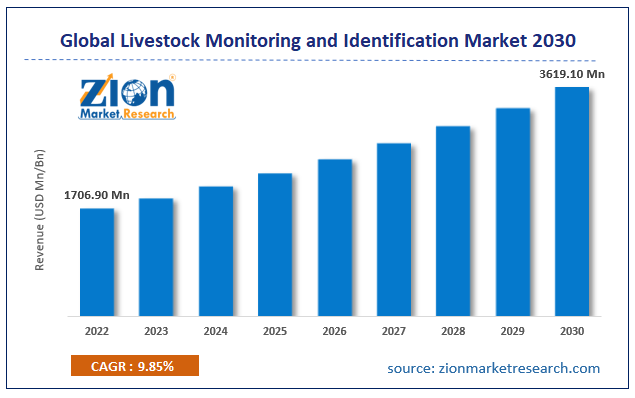
Global Livestock Monitoring and Identification Market: Overview
Livestock farming can be extremely tiring as it involves the management of a wide range of animals on the farm. The livestock monitoring and identification software is a framework that aids the farmers to track and maintain the livestock right from they are born till the time they are sold. With the use of this system, it becomes easy for the farmers to keep a track of the number of farm animals, their performance & cost metrics, and their financial tracking unit sales.
Global Livestock Monitoring and Identification Market: Growth Factors
The global livestock monitoring and identification market are growing at a speedy rate. The increasing prevalence of livestock diseases, the growing need for livestock monitoring and identification solutions in small & mid-sized farms and rapidly growing dairy farms with the increasing population of cattle are some of the primary factors that are fueling the growth of the global market. Further, the livestock monitoring and identification solutions collect and analyze the critical data points both on the herd and individual level.
The identification system also allows the farmers to easily record livestock identification information by entering the animals directly into the software as soon as they are born. The farmers can also better manage the flocks & herds, obtain access anytime, anywhere to the livestock ID tags, track the livestock from birth to relocation or processing, and enhance the consumer trust with transparent traceability. All such factors coupled with the ability of livestock monitoring and identification in disease management, vaccine schedule, and feed management helps to reduce mortality rate and improve overall production and thus are leading to the rapid adoption of these solutions which in turn is propelling the growth of the global market.
Moreover, the increase in penetration of IoT-based technologies and smart sensors in livestock monitoring and identification is also fostering the growth of the global livestock monitoring and identification market. Furthermore, the increasing awareness in livestock producing farmers regarding the importance of digital technology for effective management of livestock to increase overall productivity will provide better growth opportunities to the growth of the global livestock monitoring and identification market during the forecast period. However, the high price of livestock monitoring and identification software and services along with less penetration of technology in low and middle-income countries may hamper the growth of the global livestock monitoring and identification market.
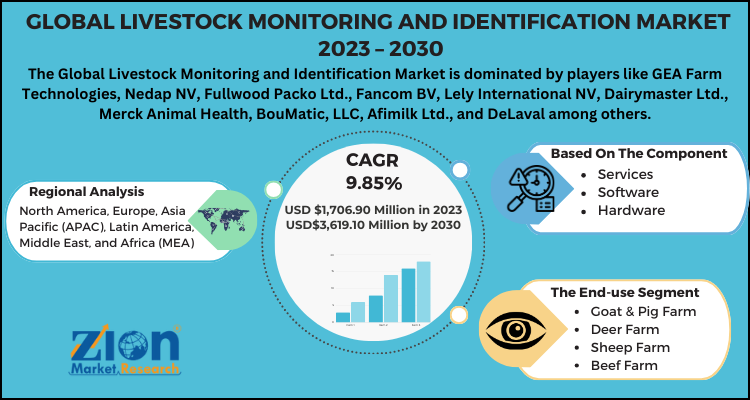
Global Livestock Monitoring and Identification Market: Segmentation
The livestock monitoring and identification market is bifurcated based on component, end-use, and region.
Based on the component, the global livestock monitoring and identification market is divided into services, software, and hardware.
The end-use segment consists of goat & pig farm, deer farm, sheep farm, beef farm, and dairy farm.
Livestock Monitoring and Identification Market: Report Scope
| Report Attributes | Report Details |
|---|---|
| Report Name | Livestock Monitoring and Identification Market Research Report |
| Market Size in 2022 | USD 1,706.90 Million |
| Market Forecast in 2030 | USD 3,619.10 Million |
| Growth Rate | CAGR of 9.85% |
| Number of Pages | 180 |
| Key Companies Covered | GEA Farm Technologies, Nedap NV, Fullwood Packo Ltd., Fancom BV, Lely International NV, Dairymaster Ltd., Merck Animal Health, BouMatic, LLC, Afimilk Ltd., and DeLaval among others. |
| Segments Covered | By component, By end-use, By Region |
| Regions Covered | North America, Europe, Asia Pacific (APAC), Latin America, Middle East, and Africa (MEA) |
| Base Year | 2022 |
| Historical Year | 2017 - 2021 |
| Forecast Year | 2023 - 2030 |
| Customization Scope | Avail customized purchase options to meet your exact research needs. Request For Customization |
Global Livestock Monitoring and Identification Market: Regional Analysis
Asia Pacific is expected to remain a major revenue contributor in the global livestock monitoring and identification market during the forecast period. Some of the prominent factors that are contributing to the major share of the market in this region include the large number of pig & poultry farms, increasing penetration of digital technologies, and growing awareness regarding the benefits of livestock monitoring and identification solutions. China is expected to hold the maximum share of the market in Asia Pacific region owing to the presence of livestock farms. North America is projected to contribute significant revenue in the global livestock monitoring and identification market. Factors such as high adoption of digital technologies, increasing use of livestock management solutions, and the presence of key players in the region are combinedly contributing to the healthy share of the market.
Global Livestock Monitoring and Identification Market: Competitive Players
The key participants that are operating in the global livestock monitoring and identification market are:
- GEA Farm Technologies
- Nedap NV
- Fullwood Packo Ltd.
- Fancom BV
- Lely International NV
- Dairymaster Ltd.
- Merck Animal Health
- BouMatic
- LLC
- Afimilk Ltd.
- DeLaval among others.
Global Global Livestock Monitoring and Identification Market Segmentation Analysis
By Component
- Services
- Software
- Hardware
By End-Use
- Goat & Pig Farm
- Deer Farm
- Sheep Farm
- Beef Farm
- Dairy Farm
By Region
- North America
- The U.S.
- Canada
- Mexico
- Europe
- France
- The UK
- Spain
- Germany
- Italy
- Rest of Europe
- Asia Pacific
- China
- Japan
- India
- Australia
- South Korea
- Rest of Asia Pacific
- The Middle East & Africa
- Saudi Arabia
- UAE
- Egypt
- Kuwait
- South Africa
- Rest of the Middle East & Africa
- Latin America
- Brazil
- Argentina
- Rest of Latin America
What Reports Provides
- Full in-depth analysis of the parent market
- Important changes in market dynamics
- Segmentation details of the market
- Former, on-going, and projected market analysis in terms of volume and value
- Assessment of niche industry developments
- Market share analysis
- Key strategies of major players
- Emerging segments and regional markets
- Testimonials to companies in order to fortify their foothold in the market.
Table Of Content

FrequentlyAsked Questions
This uses digital tools to track animals. It improves health management and farm productivity
The global Livestock Monitoring and Identification market is expected to be driven by the demand for animal health management and traceability. Adoption of RFID, IoT, and smart farming solutions supports growth.
According to study, the global Livestock Monitoring and Identification market size was worth around USD 1,707 Million in 2022 and is predicted to grow to around USD 3,619 Million by 2030.
The global Livestock Monitoring and Identification market is expected to grow at a Compound Annual Growth Rate (CAGR) of around CAGR 9.85% during the forecast period from 2023-2030.
The global Livestock Monitoring and Identification industry is projected to be challenged by Challenges include hardware costs and connectivity limitations in rural areas.
The Opportunities include precision farming, animal health tracking, productivity optimization, and IoT adoption in agriculture will offer significant growth opportunities in the Livestock Monitoring and Identification market.
IoT tags and wearable sensors; real-time health and location tracking; data-driven herd management platforms are the emerging trends and innovations impacting the Livestock Monitoring and Identification market.
The global Livestock Monitoring and Identification market is expected to be led by Europe during the forecast period.
Some of the prominent players operating in the global Livestock Monitoring and Identification market are; GEA Farm Technologies, Nedap NV, Fullwood Packo Ltd., Fancom BV, Lely International NV, Dairymaster Ltd., Merck Animal Health, BouMatic, LLC, Afimilk Ltd., and DeLaval among others. and others.
The report explores crucial aspects of the Livestock Monitoring and Identification market, including a detailed discussion of existing growth factors and restraints, while also browsing future growth opportunities and challenges that impact the market.
HappyClients

