
Global Laser Microdissection (LMD) System Market Size, Share, Growth Analysis Report - Forecast 2034

Laser Microdissection (LMD) System Market By Product Type (Ultraviolet LMD, Infrared LMD), By Application (Research Institutions, Medical Institutions), By End User (Hospitals, Clinics, Research Labs), By Distribution Channel (Direct Sales, Distributor), and By Region: Global and Regional Industry Overview, Market Intelligence, Comprehensive Analysis, Historical Data, and Forecasts 2025 - 2034
| Market Size in 2024 | Market Forecast in 2034 | CAGR (in %) | Base Year |
|---|---|---|---|
| USD 207.5 Million | USD 502.24 Million | 8.5% | 2024 |
Laser Microdissection (LMD) System Market: Industry Perspective
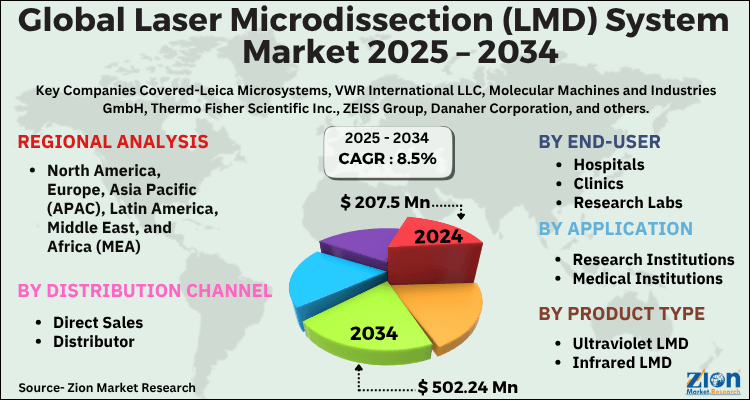
The global laser microdissection (LMD) system market size was worth around USD 207.5 Million in 2024 and is predicted to grow to around USD 502.24 Million by 2034 with a compound annual growth rate (CAGR) of roughly 8.5% between 2025 and 2034. The report analyzes the global laser microdissection (LMD) system market's drivers, restraints/challenges, and the effect they have on the demands during the projection period. In addition, the report explores emerging opportunities in the laser microdissection (LMD) system industry.
-system-market-size.png)
Laser Microdissection (LMD) System Market: Overview
Laser microdissection, sometimes referred to as LMD or LCM (Laser Capture Microdissection), is a technique for separating certain single cells or large regions of tissue from a variety of tissue samples without needing to come into touch with any outside contaminants. The original tissue's thickness, texture, and method of preparation are mostly irrelevant. Following that, the dissectate can be used for further molecular biology procedures such as PCR, real-time PCR, proteomics, and other analytical approaches. Many scientific disciplines currently employ laser microdissection, including neurology, cancer research, plant analysis, forensics, and climate studies. In the meanwhile, the technique is also used to microengrave coverslips and manipulate cell cultures.
Key Insights
- As per the analysis shared by our research analyst, the global laser microdissection (LMD) system market is estimated to grow annually at a CAGR of around 8.5% over the forecast period (2025-2034).
- Regarding revenue, the global laser microdissection (LMD) system market size was valued at around USD 207.5 Million in 2024 and is projected to reach USD 502.24 Million by 2034.
- The laser microdissection (LMD) system market is projected to grow at a significant rate due to rising demand for precision in cancer research, advancements in genomic and proteomic studies, increasing adoption in pathology, and technological innovations in laser-based dissection techniques.
- Based on Product Type, the Ultraviolet LMD segment is expected to lead the global market.
- On the basis of Application, the Research Institutions segment is growing at a high rate and will continue to dominate the global market.
- Based on the End User, the Hospitals segment is projected to swipe the largest market share.
- By Distribution Channel, the Direct Sales segment is expected to dominate the global market.
- Based on region, North America is predicted to dominate the global market during the forecast period.
Laser Microdissection (LMD) System Market: Growth Drivers
The Laser Microdissection (LMD) System market is primarily driven by the growing demand for precise cell and tissue analysis in molecular biology, genomics, and proteomics research. The rising prevalence of cancer and genetic disorders has increased the need for advanced diagnostic and research tools that allow the isolation of specific cells without contamination. Technological advancements, such as automation, improved laser accuracy, and integration with advanced imaging systems, are enhancing efficiency and accuracy in sample preparation. Moreover, increasing investments in life sciences research and government funding for biomedical research further fuel the adoption of LMD systems across academic, clinical, and pharmaceutical research institutions.
Restraints:
The high cost of LMD systems and their maintenance remains a significant restraint for market growth, especially in small laboratories and academic institutions with limited budgets. The requirement for skilled professionals to operate these sophisticated instruments also limits their adoption in certain regions. Additionally, the availability of alternative technologies for cell separation and tissue dissection can pose competition, reducing the adoption rate of LMD systems. Limited awareness and lack of infrastructure in developing countries further hinder market penetration, creating a gap between developed and emerging economies.
Opportunities:
Emerging economies offer substantial growth opportunities for the LMD system market as healthcare and research infrastructure continue to improve. The rising focus on personalized medicine and precision diagnostics is driving the need for highly accurate tissue isolation tools, creating new prospects for LMD systems. Integration of artificial intelligence (AI) and machine learning in image analysis and cell identification is expected to enhance system capabilities, providing significant potential for innovation. Moreover, collaborations between research institutions and biotechnology companies to develop novel disease models and biomarkers are likely to expand the applications of LMD systems in translational research.
Challenges:
One of the key challenges in the LMD system market is the complexity of system integration and operation, which requires continuous training and technical expertise. The long replacement cycle of laboratory instruments and high initial investment costs can delay purchasing decisions among end users. Furthermore, inconsistent sample quality and contamination risks during manual handling can affect the reproducibility of results. Economic uncertainties and budget constraints in research and healthcare sectors may also restrict investments in high-end analytical systems like LMD, posing a challenge to sustained market growth.
Laser Microdissection (LMD) System Market: Segmentation
The global Laser Microdissection (LMD) System industry is segmented based on the product type, application, end-user, distribution channel, and region. All the segments have been analyzed based on present and future trends and the market is estimated from 2025 to 2034.
Based on the product type, the global market is bifurcated into Ultraviolet LMD and Infrared LMD. The Ultraviolet LMD segment is expected to hold a significant laser microdissection system market share over the forecast period. UV lasers offer higher precision in cell isolation, allowing researchers to target specific cells with minimal collateral damage. This is particularly important when working with delicate or rare cell populations. Moreover, UV lasers can minimize autofluorescence, making them suitable for applications where preserving the natural fluorescence of the sample is important, such as in fluorescence microscopy or downstream fluorescence-based analyses. Thus, this advantage drives the market growth.
Based on the application, the global laser microdissection system industry is bifurcated into research institutions and medical institutions. The research institutes segment is expected to grow at the highest CAGR during the forecast period. The segment expansion is attributed to the growing research studies on cells and tissues due to the growing prevalence of chronic conditions. In addition, research institutes often secure funding from government agencies, private foundations, and industry partners to support their research activities. This funding can be instrumental in acquiring advanced LMD systems, conducting experiments, and driving innovation in the field. Thereby, driving the market growth.
Based on the end user, the global laser microdissection system market is bifurcated into hospitals, clinics, and research labs. The research labs segment is expected to hold the largest market share over the projected period. LMD systems are used in research labs all around the world for many different purposes, such as transcriptomics, proteomics, genomics, and other biological and medical research fields. LMD makes it easier to isolate particular cells or tissues for a thorough examination, which advances several scientific domains.
Based on the distribution channel, the global laser microdissection system industry is bifurcated into direct sales and distribution. Direct sales are expected to hold the largest market share over the forecast period.
The Regional, this segment includes the current and forecast demand for North America, Europe, Asia Pacific, Latin America,and the Middle East and Africa.
Laser Microdissection (LMD) System Market: Report Scope
| Report Attributes | Report Details |
|---|---|
| Report Name | Laser Microdissection (LMD) System Market |
| Market Size in 2024 | USD 207.5 Million |
| Market Forecast in 2034 | USD 502.24 Million |
| Growth Rate | CAGR of 8.5% |
| Number of Pages | 224 |
| Key Companies Covered | Leica Microsystems, VWR International LLC, Molecular Machines and Industries GmbH, Thermo Fisher Scientific Inc., ZEISS Group, Danaher Corporation, and others. |
| Segments Covered | By Product Type, By Application, By End User, By Distribution Channel, and By Region |
| Regions Covered | North America, Europe, Asia Pacific (APAC), Latin America, The Middle East and Africa (MEA) |
| Base Year | 2024 |
| Historical Year | 2020 to 2023 |
| Forecast Year | 2025 - 2034 |
| Customization Scope | Avail customized purchase options to meet your exact research needs. Request For Customization |
Laser Microdissection System Market: Regional Analysis
North America is expected to dominate the market over the forecast period
North America is expected to dominate the global laser microdissection system market over the forecast period. The market growth in the region is attributed to the growing prevalence of chronic diseases such as cancer, diabetes, heart disease, and others. According to CDC, 11.3% of Americans, or 37.3 million individuals, suffer from diabetes. 28.7 million persons were projected to have been diagnosed with diabetes. 8.6 million people worldwide suffer from diabetes but are not yet aware of their condition. Moreover, the region is home to numerous leading research institutions and universities engaged in cutting-edge research across various disciplines. The demand for precise cell isolation technologies like LMD is high in research areas such as genomics, cancer research, neuroscience, and developmental biology. This is expected to propel the market growth in the region.
Laser Microdissection (LMD) System Market: Competitive Analysis
The report provides a company market share analysis to give a broader overview of the key market players. In addition, the report also covers key strategic developments of the market, including acquisitions & mergers, new product launches, agreements, partnerships, collaborations & joint ventures, research & development, and regional expansion of major participants involved in the laser microdissection (LMD) system market on a global and regional basis.
The global Laser Microdissection (LMD) System market is dominated by players like:
- Leica Microsystems
- VWR International LLC
- Molecular Machines and Industries GmbH
- Thermo Fisher Scientific Inc.
- ZEISS Group
- Danaher Corporation
The global Laser Microdissection (LMD) System market is segmented as follows:
By Product Type
- Ultraviolet LMD
- Infrared LMD
By Application
- Research Institutions
- Medical Institutions
By End User
- Hospitals
- Clinics
- Research Labs
By Distribution Channel
- Direct Sales
- Distributor
By Region
- North America
- The U.S.
- Canada
- Europe
- France
- The UK
- Spain
- Germany
- Italy
- Rest of Europe
- Asia Pacific
- China
- Japan
- India
- South Korea
- Southeast Asia
- Rest of Asia Pacific
- Latin America
- Brazil
- Mexico
- Rest of Latin America
- Middle East & Africa
- GCC
- South Africa
- Rest of Middle East & Africa
Table Of Content
Methodology
FrequentlyAsked Questions
Laser microdissection, sometimes referred to as LMD or LCM (Laser Capture Microdissection), is a technique for separating certain single cells or large regions of tissue from a variety of tissue samples without needing to come into touch with any outside contaminants. The original tissue's thickness, texture, and method of preparation are mostly irrelevant.
The global laser microdissection (LMD) system market is expected to grow due to increasing demand for precision medicine, rising cancer incidence, growing adoption in clinical diagnostics, and advancements in molecular biology and genomics.
According to a study, the global laser microdissection (LMD) system market size was worth around USD 207.5 Million in 2024 and is expected to reach USD 502.24 Million by 2034.
The global laser microdissection (LMD) system market is expected to grow at a CAGR of 8.5% during the forecast period.
North America is expected to dominate the laser microdissection (LMD) system market over the forecast period.
Leading players in the global laser microdissection (LMD) system market include Leica Microsystems, VWR International LLC, Molecular Machines and Industries GmbH, Thermo Fisher Scientific Inc., ZEISS Group, Danaher Corporation, among others.
The report explores crucial aspects of the laser microdissection (LMD) system market, including a detailed discussion of existing growth factors and restraints, while also examining future growth opportunities and challenges that impact the market.

HappyClients