
Interesterified Fats Market Size, Share, Trends, Growth and Forecast 2034

Interesterified Fats Market By Process (Chemical and Enzymatic), By Source (Soybean Oil, Palm Oil, Groundnut Oil, Coconut Oil, Rapeseed Oil, Sunflower Oil, Cottonseed Oil, and Others), By End-Use (Food Processing, Food Service, Bakery and Confectionary, and Others), and By Region - Global and Regional Industry Overview, Market Intelligence, Comprehensive Analysis, Historical Data, and Forecasts 2025 - 2034
| Market Size in 2024 | Market Forecast in 2034 | CAGR (in %) | Base Year |
|---|---|---|---|
| USD 4.8 Billion | USD 8.7 Billion | 6.2% | 2024 |
Interesterified Fats Industry Perspective:
What will be the size of the global interesterified fats market during the forecast period?
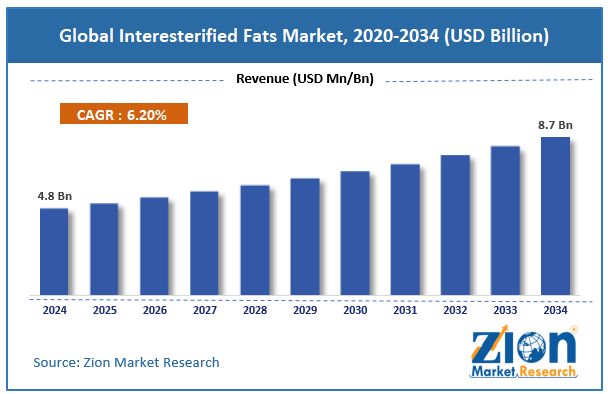
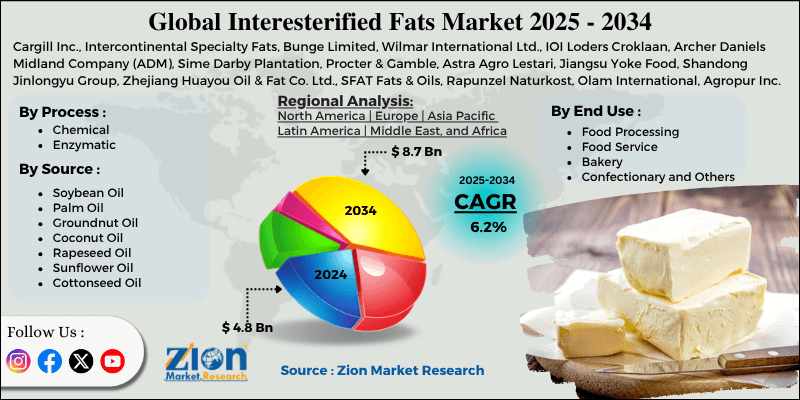
The global interesterified fats market size was worth around USD 4.8 billion in 2024 and is predicted to grow to around USD 8.7 billion by 2034, with a compound annual growth rate (CAGR) of roughly 6.2% between 2025 and 2034.
Key Insights
- As per the analysis shared by our research analyst, the global interesterified fats market is estimated to grow annually at a CAGR of around 6.2% over the forecast period (2025-2034).
- In terms of revenue, the global interesterified fats market size was valued at around USD 4.8 billion in 2024 and is projected to reach USD 8.7 billion by 2034.
- Clean-label trends and demand for natural ingredients are expected to propel the interesterified fats market over the projected period.
- Based on the process, the chemical segment dominated the market in 2024 with a market share of 58%.
- Based on the source, the soybean source segment accounted for the largest market share of 35% in 2024.
- Based on the end-use, the bakery and confectionery segment is growing at a substantial rate during the projected period.
- Based on region, Europe dominates the market with the largest market share of 34% in 2024.
Interesterified Fats Market: Overview
Interesterified fats are structurally modified fats obtained by redistributing triglyceride molecules through interesterification, breaking and reforming their fatty acid chains. The distribution of fatty acids along the glyceride molecule in natural fats and oils is specific, with each fatty acid present at a particular nitrogen position, meaning that fatty acids are distributed at specific points within the glyceride molecule. Redistribution of fatty acids between glyceride molecules occurs through interesterification, where fatty acids are redistributed without changing the existing chemical structure: either in complete acid interesterification, catalyzed by sodium methoxide, or in enzymatic interesterification (by the lipase enzyme). No trans fatty acids are formed during interesterification, making it a suitable alternative to partial hydrogenation.
Interesterified Fats Market: Dynamics
Growth Drivers
How does the rising demand for trans-fat-free alternatives drive the interesterified fats market?
The increasing consumer demand for trans-fat-free products is one of the major factors affecting the interesterified fats market, as it is a direct response to regulations and changing consumption patterns toward healthier foods. Many governments and public health agencies around the world have implemented severe restrictions or high-tax bans on the use of PHO, the primary source of industrial trans-fat consumption, based on the link between trans fats and cardiovascular disease. Makers of processed foods are already working to convert their existing products away from trans fats without sacrificing flavor, texture, or shelf life. Interesterified fats can be manipulated so that they possess all the physical characteristics of trans fat firmness, spreadability, color, texture, and oxidative stability without the production of trans fats to meet the performance needs of bakery goods, margarine, chocolate, and processed foods. As consumers quickly move toward healthier eating and cleaner-label products, they are demanding a shift away from trans fats in the health foods produced today.
Furthermore, R&D leaders in the packaged foods industry are making a strong push to convert their formulas to interesterified fats, especially enzymatically interesterified fats, to achieve more predictable and dynamic results. This paradigm shift in consumer motivation is continually boosting the interesterified fats market and the ever-expanding total interesterification industry.
Restraints
Fluctuation in raw material price hamper the interesterified fats market
Volatility in the cost of raw materials, including palm oil, soybean oil, sunflower oil, and other vegetable oils, also severely hampers growth in the interesterified fats market. It results in an unwieldy cost uncertainty for the manufacturers. As the interesterification process uses vegetable oils and fats as inputs, instability in their costs due to factors such as climate change, crop yield variations, geopolitical issues, trade restrictions, and transport and supply chain hiccups translates into unpredictable costs for the intermediate and starting materials required for the process. This jeopardizes profit margins and other operational efficiencies, which are critical to a product's competitiveness in the fast-growing global food industry.
Moreover, the continual price volatility curtails long-term procurement planning for the interesterification process, which in turn acts as a restraint on investment in the development and wide-scale application of interesterified fats. Additionally, it also hampers the scale-up of the interesterified fats market and the sharing of innovations with the market. Rising input costs can also make end products more expensive than the fat alternatives, thereby hampering market growth.
Opportunities
Why does increasing consumer health awareness and preference for healthier dietary options offer a potential opportunity for the interesterified fats market?
Growing consumer health awareness and the ongoing trend toward healthier dietary choices would serve as an opportunity driver for the interesterified fats market, as they shift consumer demand for safer, healthier fat alternatives. Growing consumer understanding of the dire consequences of consuming trans fats and high levels of saturated fatty acids, such as obesity and cardiovascular risks, has prompted consumers to buy healthier, cleaner-labelled products with reduced levels of unhealthy fats and improved nutritional value. This behavioral change has prompted food producers to reformulate their products to healthier fat alternatives that meet consumer expectations. Interesterified fats are well-suited to this scenario, as they would help clarify that trans fats pose cardiovascular risk while retaining the key functional qualities of traditional hydrogenated alternatives, such as stability, taste, and texture.
In addition, interesterified fats would provide product developers with the flexibility to alter product recipes to achieve optimal levels of saturated and unsaturated fatty acids, unlike traditional hydrogenated fats, which do not offer ingredient customization. This capability to design personalized product labels aligned with healthy eating would enable bakeries, dairy alternatives, spreads, and other processed food producers to differentiate their products with a high-quality/performing product pack. This growing trend of functional foods and plant-based diets, in combination with the clean-label trend, would compel food producers to adopt enzymatic interesterification technology, enabling nutritionists and consumers to design edible items that meet needs and are closer to nature. The combination of both trends, coupled with product and process innovation, would not only amplify health benefits but also provide a premium range of choice, helping to increase product value and drive healthy everyday eating in the most natural way possible.
Challenges
Why does the competition from alternatives pose a significant challenge to the interesterified fats market?
Competition from other fat technologies will act as a constraint to interesterified fats market. The manufacturer will be able to choose from a range of ‘competing’ technology solutions that can meet or exceed the functionality and market benefits of interesterified fats. For example, naturally stable vegetable oils such as high-oleic Sunflower and Canola, fully hydrogenated oils blended with liquid vegetable oil, palm-based fractions, or artificially structured lipids can be more readily available, cheaper, or provide more consumer-appealing benefits. This makes the technology options less urgent than interesterification, which requires additional investment and processing complexity. A potential barrier here is the 3rd-party perception of interesterified fats, particularly with regard to labeling, because although interesterified fats do not contain trans fats, they are not perceived as ‘natural’, ‘whole’, or ‘clean’, which has value and marketing implications.
Conversely, other options may be perceived as more transparent or natural. In addition, certain options may be less costly or require less complex processing (e.g., blending or fractionation techniques rather than enzymatic or chemical interesterification), which is most relevant to FTMs and mid-sized companies, where cost and processing complexity can be very important in competitive markets.
Interesterified Fats Market: Report Scope
| Report Attributes | Report Details |
|---|---|
| Report Name | Interesterified Fats Market |
| Market Size in 2024 | USD 4.8 Billion |
| Market Forecast in 2034 | USD 8.7 Bllion |
| Growth Rate | CAGR of 6.2% |
| Number of Pages | 228 |
| Key Companies Covered | Cargill Inc., Intercontinental Specialty Fats, Bunge Limited, Wilmar International Ltd., IOI Loders Croklaan, Archer Daniels Midland Company (ADM), Sime Darby Plantation, Procter & Gamble, Astra Agro Lestari, Jiangsu Yoke Food, Shandong Jinlongyu Group, Zhejiang Huayou Oil & Fat Co. Ltd., SFAT Fats & Oils, Rapunzel Naturkost, Olam International, Agropur Inc., Kerry Group, Sunwin Group, Glanbia Nutritionals, Mitra Adiperkasa Group, and others. |
| Segments Covered | By Process, By Source, By End Use, and By Region |
| Regions Covered | North America, Europe, Asia Pacific (APAC), Latin America, Middle East, and Africa (MEA) |
| Base Year | 2024 |
| Historical Year | 2019 to 2023 |
| Forecast Year | 2025 - 2034 |
| Customization Scope | Avail customized purchase options to meet your exact research needs. Request For Customization |
Interesterified Fats Market: Segmentation
Process Insights
Why does the chemical hold a dominant position in the interesterified fats market?
The chemical segment dominated the interesterified fats market in 2024 with a market share of 58%. This growth is driven by the process’s low costs and its ability to be mass-produced. It is a chemically catalyzed process (using, for instance, sodium methoxide) to strip triglycerides so that the properties of a fat can be manipulated in a relatively low-cost environment when compared to an enzymic alternative, this being desirable to large food processors, especially selling into price-sensitive markets where it is important to stay price competitive. This segment is also experiencing growth driven by increased consumer demand for trans-fat-free foods, with affordability a key factor in developing regions in particular. It is suitable for producing functional fats for bakery shortenings, margarines, and confectionery in a cost-effective environment. The technology is proven and can be scaled up using existing infrastructure without requiring extensive capital expenditure.
Source Insights
Is the soybean source growing at the highest rate in the interesterified fats market?
The soybean source segment accounted for the largest market share of 35% in 2024. The rise in popularity is attributed to extensive availability, economic advantages, and an advantageous fatty acid composition. Soybean oil is the most widely produced vegetable oil in the world today. Its consistent, scalable production makes it an ideal feedstock for interesterification as we seek functional, trans-free fats. Its low cost compared to other specialty oils increases its market potential.
End Use Insights
Do bakery and confectionery end-use account for a substantial share of the interesterified fats market?
The bakery and confectionery segment is growing at a substantial rate during the projected period. The exciting growth results from the high functional demand for structured fats in these applications. Products such as breads, cakes, pastries, biscuits, chocolates, and fillings require fats that impart a range of characteristics, such as aeration, mouthfeel, flakiness, creaminess, and long-term stability, all of which can be optimally achieved with interesterified fats. With more people worldwide consuming baked products and confectionery due to urbanization, changing lifestyles, and rising demand for convenience foods, demand is likely to increase.
Regional Insights
Why does Europe lead the interesterified fats market?
Europe dominates the market with the largest market share of 34% in 2024. The market is experiencing growth primarily driven by stringent government regulations and health-conscious consumers. Europe's regulatory agencies have stringent limits on industrial trans fats in food products, which have driven food manufacturers away from partially hydrogenated oils toward interesterified fats, which deliver the same functional effects without trans fats.
Riding on this platform, along with growing consumer awareness among health-conscious, convenience-seeking consumers, the use of interesterified fats has been rapidly expanding in Europe. The large-scale bakery, confectionery, and processed foods industries are high-value contributors, which require high-performance fats with functional attributes, including melting profile, mouthfeel, characteristic retention, and shelf stability, while adhering to health standards. Investment in customer-centric innovation and technologies for natural processing, including esterification and interesterification, has been increasing. The presence of global and local leading food companies and supply chains, along with increased demand for PMF and plant-based foods, will support this growth.
Interesterified Fats Market: Competitive Analysis
The global interesterified fats market is dominated by players like:
- Cargill Inc.
- Intercontinental Specialty Fats
- Bunge Limited
- Wilmar International Ltd.
- IOI Loders Croklaan
- Archer Daniels Midland Company (ADM)
- Sime Darby Plantation
- Procter & Gamble
- Astra Agro Lestari
- Jiangsu Yoke Food
- Shandong Jinlongyu Group
- Zhejiang Huayou Oil & Fat Co. Ltd.
- SFAT Fats & Oils
- Rapunzel Naturkost
- Olam International
- Agropur Inc.
- Kerry Group
- Sunwin Group
- Glanbia Nutritionals
- Mitra Adiperkasa Group
The global interesterified fats market is segmented as follows:
By Process
- Chemical
- Enzymatic
By Source
- Soybean Oil
- Palm Oil
- Groundnut Oil
- Coconut Oil
- Rapeseed Oil
- Sunflower Oil
- Cottonseed Oil
- Others
By End Use
- Food Processing
- Food Service
- Bakery
- Confectionary and Others
By Region
- North America
- The U.S.
- Canada
- Mexico
- Europe
- France
- The UK
- Spain
- Germany
- Italy
- Rest of Europe
- Asia Pacific
- China
- Japan
- India
- Australia
- South Korea
- Rest of Asia Pacific
- The Middle East & Africa
- Saudi Arabia
- UAE
- Egypt
- Kuwait
- South Africa
- Rest of the Middle East & Africa
- Latin America
- Brazil
- Argentina
- Rest of Latin America
Table Of Content
Methodology
FrequentlyAsked Questions
Interesterified fats are a type of structurally modified fat obtained by redistributing triglyceride molecules through interesterification, breaking and reforming them. The distribution of fatty acids along the glyceride molecule in natural fats and oils is specific, with each fatty acid present at a particular nitrogen position, meaning that fatty acids are distributed at specific points within the glyceride molecule.
The growth of the interesterified fats market is mainly driven by the increasing demand for trans-fat-free alternatives due to strict regulations and health concerns, along with rising consumer awareness toward healthier diets. The expansion of the processed and convenience food industry further boosts demand, as these fats provide the desired texture and stability. Additionally, the growing preference for clean-label and plant-based products, coupled with advancements in fat-modification technologies, is accelerating global market adoption.
One major issue is the high production cost, particularly for enzymatic interesterification, which requires advanced technology and increases overall manufacturing expenses. Additionally, fluctuations in raw material prices (such as vegetable oils) create cost instability and impact profit margins. The market also struggles with consumer skepticism and limited awareness, as some consumers perceive interesterified fats as highly processed, raising concerns about their long-term health effects.
Based on the process, the chemical segment is expected to dominate the interesterified fats market growth during the projected period.
The interesterified fats market is being significantly influenced by several emerging trends and technological innovations focused on health, sustainability, and functionality. One of the most prominent trends is the advancement of enzymatic interesterification technology, which enables more precise fat modification, improves nutritional profiles, and reduces unwanted by-products, making it a preferred and cleaner alternative to chemical methods.
According to the report, the global interesterified fats market size was worth around USD 4.8 billion in 2024 and is predicted to grow to around USD 8.7 billion by 2034.
The global interesterified fats market is expected to grow at a CAGR of 6.2% during the forecast period.
The global interesterified fats industry growth is expected to be led by Europe over the forecast period.
The global interesterified fats market is dominated by players like Cargill, Inc., Intercontinental Specialty Fats, Bunge Limited, Wilmar International Ltd., IOI Loders Croklaan, Archer Daniels Midland Company (ADM), Sime Darby Plantation, Procter & Gamble, Astra Agro Lestari, Jiangsu Yoke Food, Shandong Jinlongyu Group, Zhejiang Huayou Oil & Fat Co., Ltd., SFAT Fats & Oils, Rapunzel Naturkost, Olam International, Agropur Inc., Kerry Group, Sunwin Group, Glanbia Nutritionals, and Mitra Adiperkasa Group among others.
The interesterified fats market report covers the geographical market along with a comprehensive competitive landscape analysis. It also includes cash flow analysis, profit ratio analysis, market basket analysis, market attractiveness analysis, sentiment analysis, PESTLE analysis, trend analysis, SWOT analysis, trade area analysis, demand & supply analysis, Porter’s five forces analysis, and value chain analysis.

HappyClients