
In-Building Wireless Market Size, Share, Growth Report 2032

In-Building Wireless Market By Solution (Services And System Components), By System Components (Cabling, Repeaters, Antennas, Cabling, Small Cells, And Distributed Antenna System), By Business Models (Host, Enterprise, And Carrier), By Business Type (New And Existing), By End Users (Hospitals, Commercials, Government, Institutions, Industrial, And Retail), By Building Size (Large, Medium, And Small), By Region - Global And Regional Industry Overview, market Intelligence, Comprehensive Analysis, Historical Data, And Forecasts 2024-2032
| Market Size in 2023 | Market Forecast in 2032 | CAGR (in %) | Base Year |
|---|---|---|---|
| USD 17.89 Billion | USD 52.35 Billion | 12.67% | 2023 |
Description
What is the projected value for the In-Building Wireless Market during 2024 to 2032?
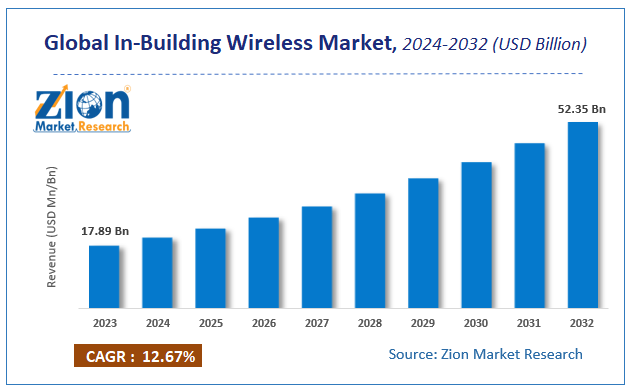
The global In-Building Wireless market size was worth around USD 17.89 billion in 2023 and is predicted to grow to around USD 52.35 billion by 2032 with a compound annual growth rate (CAGR) of roughly 12.67% between 2024 and 2032.
The study provides historical data from 2018 to 2022 along with a forecast from 2024 to 2032 based on revenue (USD Billion). The report covers a forecast and an analysis of the In-Building Wireless market on a global and regional level.
 Request Free SampleRequest Free Sample
Global In-Building Wireless Market: Overview
In-building wireless is basically used to help improve the communication as well as the network coverage in the buildings especially the core structures where the signals are not reachable. The in-building wireless products are used in the several commercial and building areas.
Key Insights
- As per the analysis shared by our research analyst, the global in-building wireless market is estimated to grow annually at a CAGR of around 12.67% over the forecast period (2024-2032).
- In terms of revenue, the global smart healthcare products market size was valued at around USD 17.89 billion in 2023 and is projected to reach USD 52.35 billion by 2032.
- By System Components, the Distributed Antenna System (DAS) segment is the most dominant in the in-building wireless market.
- By Solutions, the Services segment, which includes installation, maintenance, and consulting services, dominates the in-building wireless market.
- By Business Models, the Carrier-Owned Networks segment is the most dominant business model in the in-building wireless market.
- By Business Type, the Commercial Buildings segment, including offices, shopping malls, hotels, and airports, is the most dominant in the in-building wireless market.
- By End Users, the Enterprise segment leads the in-building wireless market, as companies invest heavily in private wireless networks, enhanced communication systems, and secure connectivity solutions.
- By Building Size, the Large Buildings segment dominates the market, as skyscrapers, hospitals, stadiums, and airports require complex in-building wireless solutions to ensure reliable coverage.
- By Region, North America is the leading region in the in-building wireless market, driven by high smartphone penetration, advanced telecom infrastructure, and widespread 5G deployment.
Global In-Building Wireless Market: Growth Factors
The global in-building wireless market is gaining momentum due to the increased use for the mobile operations and overall coverage capacity in end number of enterprises. The in-building wireless products are beneficial for the organizations as a result of its credible communication delivery infrastructure. The growing demand for an improved network capacity and excellent coverage and a connected environment is mainly due to the dependency on the mobile service communications which in turn boosts the global market.
The rising congestion in the networks and strict government regulatory policies for building cell sites for a better connectivity, communication, and excellent mobility is expected to fuel the global in-building wireless market. In the coming years, the global in-building wireless market will experience growth due to the adoption of ‘Bring Your Own Devices’ concept in the various organizations and higher data delivery. In short, the adoption of the project-oriented culture in the various organizations across the globe helps the global market turn productive. The demand for skilled labor and security issues related to the data hinders the global market growth.
In-Building Wireless Market: Dynamics
The in-building wireless market is expanding due to the increasing demand for seamless connectivity in commercial and residential spaces. The rise of smart buildings, IoT integration, and 5G deployment are major growth drivers. Businesses and consumers expect uninterrupted wireless coverage for work, entertainment, and smart home applications. Additionally, government regulations and initiatives promoting digital transformation and smart infrastructure further accelerate market adoption.
Despite its rapid growth, the in-building wireless market faces restraints such as high installation and maintenance costs. Deploying wireless solutions in large buildings requires significant investment in equipment, cabling, and labor. Additionally, complex building structures, such as high-rise offices and underground facilities, pose challenges for signal penetration, making network planning and optimization more difficult. Compliance with regulatory standards and frequency licensing issues also add to deployment challenges.
The growing adoption of 5G technology presents significant opportunities for the in-building wireless market. As enterprises and industries shift towards digitalization, there is an increasing need for high-speed, low-latency wireless communication. The expansion of smart cities and public infrastructure projects further drives demand for robust indoor connectivity solutions. Additionally, advancements in Distributed Antenna Systems (DAS) and small cell technologies are opening new avenues for enhanced network coverage and capacity.
One of the major challenges in the in-building wireless market is network interference and spectrum congestion. The increasing number of connected devices and overlapping frequency bands can lead to performance issues. Additionally, integrating in-building wireless solutions with existing network infrastructure without disrupting operations requires careful planning and technical expertise. The evolving technology landscape, with frequent updates in wireless standards and security protocols, also presents a challenge for long-term investment and scalability.
 Request Free SampleRequest Free Sample
Global In-Building Wireless Market: Segmentation
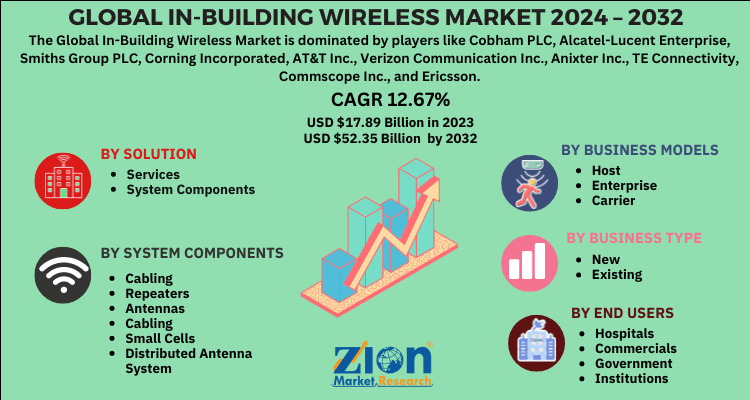
The global in-building wireless market is segmented based on the system components, solutions, business models, business type, end users, and building size.
By solution segment is divided into services and system components.
By system components segment is categorized into cabling, repeaters, antennas, cabling, small cells, and distributed antenna system.
By business models segment is classified as host, enterprise, and carrier.
By business type segment is grouped into new and existing.
Based on end users segment is bifurcated into hospitals, commercials, government, institutions, industrial, and retail.
By building size segment is divided into large, medium, and small.
Recent Development
- In June 2025, Nokia partnered with Andorix, a smart-building infrastructure specialist, to accelerate the deployment of private indoor 5G and neutral host network solutions across the North American real estate market.
- In June 2025, Ericsson and Telstra deployed the AIR 3284, the world’s first 5G triple-band FDD Massive MIMO radio, to improve coverage, capacity, and overall network performance as part of Telstra’s network transformation.
- In April 2025, Bharti Airtel expanded its partnership with Nokia to deploy Packet Core and Fixed Wireless Access (FWA) solutions for integrated 4G/5G networks. The initiative aims to enhance service delivery, meet growing data demands, and accelerate the launch of new services through automation.
- In April 2025, Airspan Networks completed the acquisition of Corning’s wireless business, including DAS and SpiderCloud small cell 4G/5G solutions, bolstering its in‑building wireless portfolio to deliver enhanced indoor connectivity for operators, venues, and enterprises.
- In April 2025, AT&T completed a major FirstNet expansion, launching 1,000 new Band 14 cell sites across 46 states and D.C., ahead of schedule. The expansion enhances connectivity for first responders, particularly in rural and tribal areas, and strengthens dedicated public safety coverage at critical locations such as fire stations, hospitals, and police departments.
- In February 2025, Comba Telecom launched a 5G NR Repeater designed to improve indoor connectivity, offering high adaptability and cost-efficiency across diverse environments.
In-Building Wireless Market: Report Scope
| Report Attributes | Report Details |
|---|---|
| Report Name | In-Building Wireless Market |
| Market Size in 2023 | USD 17.89 Billion |
| Market Forecast in 2032 | USD 52.35 Billion |
| Growth Rate | CAGR of 12.67% |
| Number of Pages | 211 |
| Key Companies Covered | Cobham PLC, Alcatel-Lucent Enterprise, Smiths Group PLC, Corning Incorporated, AT&T Inc., Verizon Communication Inc., Anixter Inc., TE Connectivity, Commscope Inc., and Ericsson. The other players that dominate the global market are Betacom Incorporated, Lord and Company Technologies, Ethertronics, Telecommunication Systems Inc., Lemko Corporation, and Oberon Inc |
| Segments Covered | By system components, By solutions, By business models, By business type, By end users, By building size and By Region |
| Regions Covered | North America, Europe, Asia Pacific (APAC), Latin America, Middle East, and Africa (MEA) |
| Base Year | 2023 |
| Historical Year | 2018 to 2022 |
| Forecast Year | 2024 - 2032 |
| Customization Scope | Avail customized purchase options to meet your exact research needs. Request For Customization |
Global In-Building Wireless Market: Regional Analysis
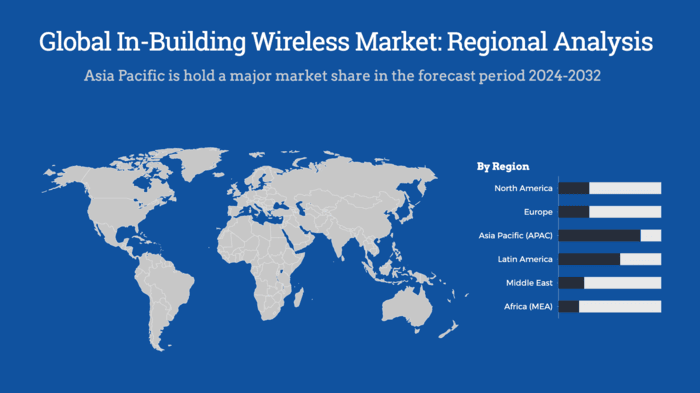
Asia-Pacific, North America, and Europe are expected to dominate the global in-building wireless market due to the increasing demand for the in-building wireless products in the various organizations. The regions such as the Middle East and Africa and Latin America are also proving to be the emerging markets for the in-building wireless products.
 Request Free SampleRequest Free Sample
Global In-Building Wireless Market: Competitive Players
The major players in the global in-building wireless market include
- Cobham PLC
- Alcatel-Lucent Enterprise
- Smiths Group PLC
- Corning Incorporated
- AT&T Inc.
- Verizon Communication Inc.
- Anixter Inc.
- TE Connectivity
- Commscope Inc.
- Ericsson.
- Betacom Incorporated
- Lord and Company Technologies
- Ethertronics
- Telecommunication Systems Inc.
- Lemko Corporation
- Oberon Inc.
The Global In-Building Wireless Market is segmented as follows:
By Solution
- Services
- System Components
By System Components
- Cabling
- Repeaters
- Antennas
- Cabling
- Small Cells
- Distributed Antenna System
By Business Models
- Host
- Enterprise
- Carrier
By Business Type
- New
- Existing
By End Users
- Hospitals
- Commercials
- Government
- Institutions
- Industrial
- Retail
By Building Size
- Large
- Medium
- Small
By Region
- North America
- The U.S.
- Canada
- Mexico
- Europe
- France
- The UK
- Spain
- Germany
- Italy
- Rest of Europe
- Asia Pacific
- China
- Japan
- India
- Australia
- South Korea
- Rest of Asia Pacific
- The Middle East & Africa
- Saudi Arabia
- UAE
- Egypt
- Kuwait
- South Africa
- Rest of the Middle East & Africa
- Latin America
- Brazil
- Argentina
- Rest of Latin America
What Report Provides
- Full in-depth analysis of the parent market
- Important changes in market dynamics
- Segmentation details of the market
- Former, on-going, and projected market analysis in terms of volume and value
- Assessment of niche industry developments
- Market share analysis
- Key strategies of major players
- Emerging segments and regional markets
- Testimonials to companies in order to fortify their foothold in the market.
Table Of Content

FrequentlyAsked Questions
In-building wireless systems improve network coverage inside buildings. They support reliable voice and data communication indoors.
The global In-Building Wireless market is expected to be driven by the Growth is driven by rising data consumption indoors, rollout of 5G, and demand for reliable connectivity in enterprises, hospitals, and public venues. Increasing use of DAS and small cells to eliminate coverage gaps boosts growth.
According to study, the global In-Building Wireless market size was worth around USD 17.89 Billion in 2023 and is predicted to grow to around USD 52.35 Billion By 2032.
The global In-Building Wireless market is expected to grow at a Compound Annual Growth Rate (CAGR) of around CAGR 12.67% during the forecast period from 2024-2032.
The global In-Building Wireless industry is projected to be challenged by Challenges include high installation and retrofit costs, complex site surveys and interference management, regulatory and operator coordination, and long sales cycles for enterprises.
The Opportunities include rising demand for 5G indoor coverage, smart building and IoT expansion, growth in large venues and campuses, and increased investment in private LTE/5G networks will offer significant growth opportunities in the In-Building Wireless market.
Private 5G and neutral-host DAS expansion; AI-driven RF planning and self-optimizing networks; multi-operator, multi-band indoor coverage solutions are the emerging trends and innovations impacting the In-Building Wireless market.
The global In-Building Wireless market is expected to be led by North America during the forecast period.
Some of the prominent players operating in the global In-Building Wireless market are; Cobham PLC, Alcatel-Lucent Enterprise, Smiths Group PLC, Corning Incorporated, AT&T Inc., Verizon Communication Inc., Anixter Inc., TE Connectivity, Commscope Inc., and Ericsson. The other players that dominate the global market are Betacom Incorporated, Lord and Company Technologies, Ethertronics, Telecommunication Systems Inc., Lemko Corporation, and Oberon Inc and others.
The report explores crucial aspects of the In-Building Wireless market, including a detailed discussion of existing growth factors and restraints, while also browsing future growth opportunities and challenges that impact the market.
HappyClients

