
Global Immunity Booster Market Size, Share, Growth Trends, and Forecast 2032

Immunity Booster Market By Nature Type (Organic and Conventional), By Source (Plant-based, Animal-based, and Other), By Form (Tablets, Capsules, Powder, and Liquid), By Sales Channel (Hypermarkets/Supermarkets, Specialty Stores, Pharmacy & Drug Stores, and Online Retail), and By Region - Global and Regional Industry Overview, Market Intelligence, Comprehensive Analysis, Historical Data, and Forecasts 2024 - 2032
| Market Size in 2023 | Market Forecast in 2032 | CAGR (in %) | Base Year |
|---|---|---|---|
| USD 25.55 Billion | USD 63.77 Billion | 10.82% | 2023 |
Immunity Booster Industry Perspective
What will be the global immunity booster market size during the forecast period?
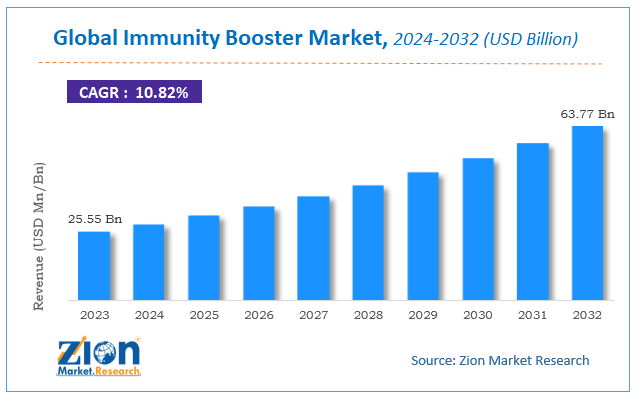
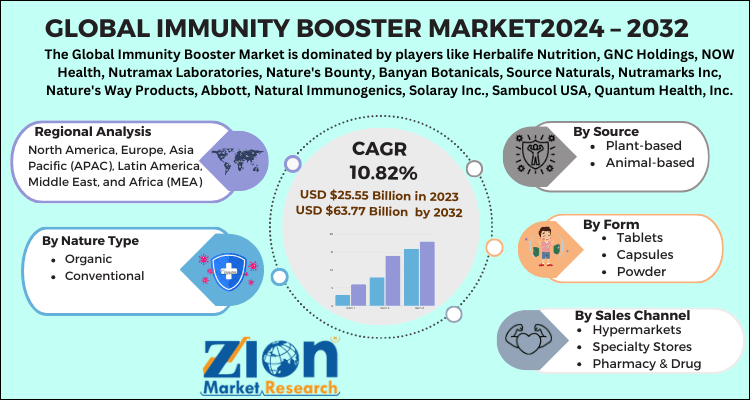
The global immunity booster market was worth around USD 25.55 billion in 2023 and is predicted to grow to around USD 63.77 billion by 2032 with a compound annual growth rate (CAGR) of roughly 10.82% between 2024 and 2032.
This report provides a comprehensive analysis of the growth drivers, restraints, and challenges shaping demand across the global immunity booster market throughout the forecast period, while highlighting high-potential emerging opportunities within the industry.
Key Insights
- As per the analysis shared by our research analyst, the global immunity booster market is estimated to grow annually at a CAGR of around 10.82% over the forecast period (2024-2032).
- In terms of revenue, the global immunity booster market size was valued at around USD 25.55 billion in 2023 and is projected to reach USD 63.77 billion by 2032.
- The immunity booster market is projected to grow at a significant rate due to the impact of pandemics such as COVID-19, rising disease prevalence, growing consumer awareness of preventive health, and continued investment in research and development.
- Based on the nature type segment, conventional products hold a substantial share due to established manufacturing scale, broad retail availability, and competitive pricing, while organic options are expanding with rising preference for clean-label formulations.
- Based on the source segment, plant-based ingredients represent a leading and fast-growing category driven by consumer demand for natural and botanical immune-support solutions.
- Based on the form segment, tablets and capsules remain widely preferred for convenience and precise dosing, while powders and liquids offer flexibility for different consumer preferences and usage occasions.
- Based on the sales channel segment, pharmacy and drug stores along with online retail play prominent roles in distribution, supported by trust in pharmacy channels and the convenience and reach of e-commerce.
- Based on region, North America is expected to dominate the immunity booster market over the forecast period due to high disease awareness, easy product access, and the strong presence of major market players.
Immunity Booster Market: Overview
An immunity booster is any product or approach that helps strengthen the body’s natural defenses against illness. This category primarily includes dietary supplements, functional formulations, and related products containing vitamins, minerals, antioxidants, botanicals, and other bioactive ingredients designed to support immune function. These products are available in multiple forms and are used by consumers seeking to maintain resilience, address nutritional gaps, and respond to heightened health awareness.
Immunity Booster Market: Dynamics
Growth Drivers
What factors are propelling the expansion of the immunity booster market?
Pandemics such as COVID-19 and the increasing number of diseases have significantly heightened consumer attention on immune health. This has translated into sustained demand for products that support the body’s natural defenses. Growing awareness of the link between nutrition, lifestyle, and immune resilience further encourages regular use of vitamins, minerals, antioxidants, and botanical formulations.
High investments in research and development by industry participants create opportunities for new ingredient combinations, improved delivery formats, and scientifically supported claims. Easy availability through multiple retail and online channels, combined with the presence of established brands, supports broad market penetration and continued category growth.
Restraints
What factors are limiting the growth of the immunity booster market?
Regulatory scrutiny around health claims and the need for substantiated evidence can slow product launches and marketing in certain jurisdictions. Variability in product quality and the presence of less rigorously formulated options may affect consumer confidence in parts of the category.
Price sensitivity in some consumer segments and competition from functional foods and fortified beverages can also moderate growth of traditional supplement formats. Ensuring consistent supply of high-quality botanical and specialty ingredients remains an operational consideration for manufacturers.
Opportunities
What opportunities are emerging in the immunity booster market?
High investments in research and development offer significant opportunities for market participants to introduce differentiated and evidence-based products. Expansion in emerging markets, driven by rising healthcare awareness and improving retail infrastructure, presents additional growth potential.
Challenges
What challenges does the immunity booster market face?
Maintaining scientific credibility while meeting consumer expectations for efficacy and transparency is an ongoing challenge. The category faces increasing expectations for clinical support, clear labeling, and responsible marketing. Supply-chain complexity for natural ingredients, competition from a wide range of wellness products, and the need to educate consumers on appropriate use and realistic outcomes require continuous investment in quality systems, research, and communication.
Immunity Booster Market: Report Scope
| Report Attributes | Report Details |
|---|---|
| Report Name | Immunity Booster Market |
| Market Size in 2023 | USD 25.55 Billion |
| Market Forecast in 2032 | USD 63.77 Billion |
| Growth Rate | CAGR of 10.82% |
| Number of Pages | 240 |
| Key Companies Covered | Herbalife Nutrition, GNC Holdings, NOW Health, Nutramax Laboratories, Nature's Bounty, Banyan Botanicals, Source Naturals, Nutramarks Inc., Nature's Way Products, Abbott, Natural Immunogenics, Solaray Inc., Sambucol USA, Quantum Health, Inc., Vitabiotics Ltd., Rainbow Light, AdvoCare, Pure Encapsulations, LLC, Country Life, LLC, Natural Health Concept, and others. |
| Segments Covered | By Nature Type, By Source, By Form, By Sales Channel, and By Region |
| Regions Covered | North America, Europe, Asia Pacific (APAC), Latin America, The Middle East and Africa (MEA) |
| Base Year | 2023 |
| Historical Year | 2018 - 2022 |
| Forecast Year | 2024 - 2032 |
| Customization Scope | Avail customized purchase options to meet your exact research needs. Request For Customization |
Immunity Booster Market: Segmentation Analysis
The immunity booster market is segmented by nature type, source, form, sales channel, and region. All the segments of the immunity booster market have been analyzed based on present and future trends and the market is estimated from 2024 to 2032.
On the basis of Nature, the global immunity booster market is divided into organic and conventional. Conventional products currently account for a substantial share of the market due to established large-scale manufacturing, broad distribution, and accessible pricing that supports high-volume sales. These products meet mainstream demand for everyday immune support across vitamins, minerals, and antioxidant formulations. Organic offerings are expanding as consumers increasingly seek clean-label and naturally positioned options. The balance between conventional scale and organic growth helps drive overall market expansion by serving both mass and premium segments and encouraging continuous product improvement across the category.
Based on the source, the immunity booster market is divided into plant-based, animal-based, and other. Plant-based sources represent a leading and rapidly growing category. Consumer preference for botanical ingredients, herbal extracts, and plant-derived nutrients aligns with broader trends toward natural and sustainable wellness solutions. These ingredients support a wide range of immune-focused formulations and appeal to health-conscious and flexitarian consumers. Animal-based and other sources continue to serve specific nutritional needs and traditional formulations. The strength of plant-based innovation helps expand the addressable market and supports differentiation among brands.
Based on Form, the global immunity booster market is segmented into tablets, capsules, powder, and liquid. Tablets and capsules remain widely preferred because of convenience, portability, precise dosing, and long shelf life. These formats dominate everyday supplement routines and benefit from strong acceptance among consumers and retailers. Powders and liquids offer flexibility for mixing into beverages or for consumers who prefer alternative delivery methods, supporting use occasions beyond traditional pill formats. The diversity of forms enables broader consumer reach and helps drive category growth by matching different lifestyle and preference needs.
Based on Sales Channel, the immunity booster market is divided into hypermarkets/supermarkets, specialty stores, pharmacy & drug stores, and online retail. Pharmacy and drug stores hold a trusted position for health-related purchases and continue to play a major role in recommending and dispensing immune-support products. Online retail has expanded rapidly due to convenience, product variety, subscription models, and direct-to-consumer engagement. Hypermarkets/supermarkets and specialty stores contribute additional volume through impulse and destination shopping. The combination of trusted pharmacy channels and the reach of e-commerce supports strong distribution coverage and overall market growth.
Immunity Booster Market: Regional Analysis
Why will North America continue to dominate the global market during the projection period?
The immunity booster market is expected to be led by North America due to factors like elevated health consciousness following recent pandemics, disease prevalence, easy access to boosters, and major market players. Advanced retail and e-commerce infrastructure, combined with established consumer habits around dietary supplements, further reinforce regional demand. The United States in particular drives innovation, brand activity, and high per-capita consumption, contributing to overall market leadership and the setting of trends that influence global product development and marketing approaches.
Europe follows closely due to growing awareness and the pandemic's impact. Regulatory frameworks and consumer interest in quality and substantiated products shape the regional landscape.
Asia Pacific is projected for rapid growth due to healthcare advancements, rising middle-class spending, frequent disease awareness campaigns, and expanding retail and online channels in countries such as China, India, and Japan. Latin America and the Middle East and Africa are anticipated to register rising demand as health awareness and product availability continue to improve.
Immunity Booster Market: Competitive Analysis
The global immunity booster market is dominated by players like:
- Herbalife Nutrition
- GNC Holdings
- NOW Health
- Nutramax Laboratories
- Nature's Bounty
- Banyan Botanicals
- Source Naturals
- Nutramarks Inc
- Nature's Way Products
- Abbott
- Natural Immunogenics
- Solaray Inc.
- Sambucol USA
- Quantum Health, Inc.
- Vitabiotics Ltd.,
- Rainbow Light
- AdvoCare
- Pure Encapsulations, LLC
- Country Life, LLC
- Natural Health Concept
The global immunity booster market is segmented as follows:
By Nature Type
- Organic
- Vitamins
- Minerals
- Antioxidants
- Others
- Conventional
- Vitamins
- Minerals
- Antioxidants
- Others
By Source
- Plant-based
- Animal-based
- Other
By Form
- Tablets
- Capsules
- Powder
- Liquid
By Sales Channel
- Hypermarkets/Supermarkets
- Specialty Stores
- Pharmacy & Drug Stores
- Online Retail
By Region
- North America
- The U.S.
- Canada
- Mexico
- Europe
- France
- The UK
- Spain
- Germany
- Italy
- Rest of Europe
- Asia Pacific
- China
- Japan
- India
- Australia
- South Korea
- Rest of Asia Pacific
- The Middle East & Africa
- Saudi Arabia
- UAE
- Egypt
- Kuwait
- South Africa
- Rest of the Middle East & Africa
- Latin America
- Brazil
- Argentina
- Rest of Latin America
Table Of Content
Methodology
FrequentlyAsked Questions
An immunity booster is anything that helps strengthen the body’s natural defenses against illness. This can include foods, supplements, or lifestyle practices, with the commercial market focused primarily on formulated products containing vitamins, minerals, antioxidants, botanicals, and related ingredients.
According to a study, the global immunity booster market size was worth around USD 25.55 billion in 2023 and is expected to reach USD 63.77 billion by 2032.
The global immunity booster market is expected to grow at a CAGR of 10.82% during the forecast period.
North America is expected to dominate the immunity booster market over the forecast period.
Leading players in the global immunity booster market include Herbalife Nutrition, GNC Holdings, NOW Health, Nutramax Laboratories, Nature's Bounty, Banyan Botanicals, Source Naturals, Nutramarks Inc., Nature's Way Products, Abbott, Natural Immunogenics, Solaray Inc., Sambucol USA, Quantum Health, Inc., Vitabiotics Ltd., Rainbow Light, AdvoCare, Pure Encapsulations, LLC., Country Life, LLC, and Natural Health Concept, among others.
Key growth drivers include the impact of pandemics and rising disease prevalence, growing consumer awareness of preventive health and immune resilience, easy product access, the presence of major market players, and high investments in research and development.

HappyClients

