Global Hemoglobinopathies Market Size, Share, Trends, Growth, and Forecasts 2032
Hemoglobinopathies Market by Indication (sickle cell disease, alpha thalassemia, beta thalassemia and others), Therapy (blood transfusion, iron chelation therapy, bone marrow transplant, and others), Diagnosis (blood testing, genetic testing, pre-implantation genetic diagnosis (PGD) and others), End user (Hospitals, Diagnostic laboratories, Clinics, Other End-user), and By Region - Global Industry Perspective Comprehensive Analysis and Forecast, 2024-2032
| Market Size in 2023 | Market Forecast in 2032 | CAGR (in %) | Base Year |
|---|---|---|---|
| USD 9.63 Billion | USD 27.81 Billion | 12.5% | 2023 |
What is the Hemoglobinopathies Market Size?
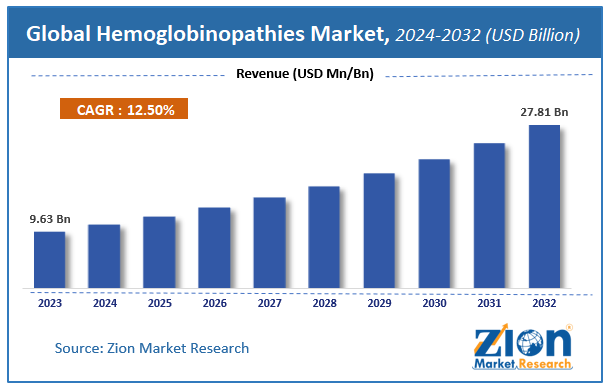
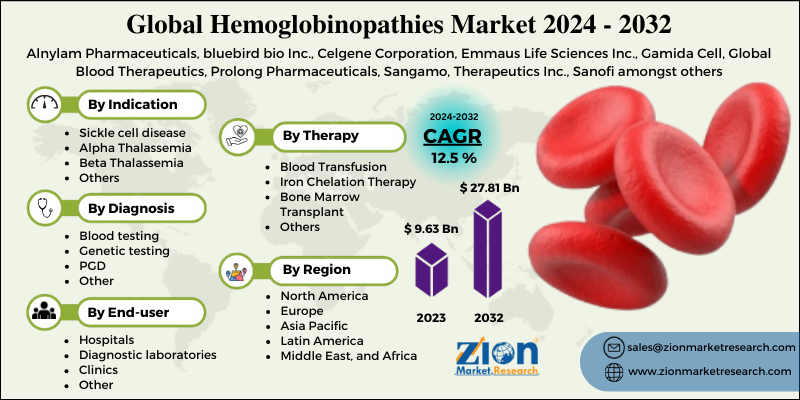
The global Hemoglobinopathies Market size was valued at USD 9.63 Billion in 2023 and is predicted to reach USD 27.81 Billion by the end of 2032. The market is expected to grow with a CAGR of 12.5% during the forecast period. The report analyzes the global Hemoglobinopathies Market's growth drivers, restraints, and impact on demand during the forecast period. It will also help navigate and explore the arising opportunities in the Hemoglobinopathies industry.
Hemoglobinopathies Market: Overview
The report covers forecasts and analyses for the Hemoglobinopathies market on a global and regional level. The study provides historic data from 2018 to 2022 along with a forecast from 2024 to 2032 based on revenue (USD Million). The study includes drivers and restraints for the Hemoglobinopathies market along with the impact they have on the demand over the forecast period. Additionally, the report includes the study of opportunities available in the Hemoglobinopathies market on a global level.
In order to give the users of this report a comprehensive view of the Hemoglobinopathies market, we have included a competitive landscape and analysis of Porter’s Five Forces model for the market. The study encompasses a market attractiveness analysis, wherein indication, therapy, diagnosis, end-user, and regional segments are benchmarked based on their market size, growth rate, and general attractiveness.
Hemoglobinopathies Market: Growth Dynamics
Hemoglobinopathies are formed as a result of gene defects and anemia. The development of abnormal hemoglobin is found in three circumstances such as structural defects in the molecule of hemoglobin, reduced production of one of the two subunits of the molecule of hemoglobin, and irregular associations of otherwise healthy subunits. There may be serious or moderate illnesses. The most common tools/tests for hemoglobinopathy diagnosis and thalassemia disorders are genetic diagnosis preimplantation, genetic and blood testing, electrophoresis of alkaline and acid gel, electrophoresis of hemoglobin, genetic prenatal testing and chromatography of ion exchange HbA2.
Hemoglobinopathies Market: Report Scope
| Report Attributes | Report Details |
|---|---|
| Report Name | Hemoglobinopathies Market |
| Market Size in 2023 | USD 9.63 Billion |
| Market Forecast in 2032 | USD 27.81 Billion |
| Growth Rate | CAGR of 12.5% |
| Number of Pages | 205 |
| Key Companies Covered | Alnylam Pharmaceuticals, bluebird bio Inc., Celgene Corporation, Emmaus Life Sciences Inc., Gamida Cell, Global Blood Therapeutics, Prolong Pharmaceuticals, Sangamo, Therapeutics Inc., Sanofi amongst others |
| Segments Covered | By Indication, By Therapy, By Diagnosis, By End-user and By region |
| Regions Covered | North America, Europe, Asia Pacific (APAC), Latin America, Middle East, and Africa (MEA) |
| Base Year | 2023 |
| Historical Year | 2018 - 2022 |
| Forecast Year | 2024 - 2032 |
| Customization Scope | Avail customized purchase options to meet your exact research needs. Request For Customization |
Hemoglobinopathies Market: Segmentation Analysis
The study provides a decisive view of the Hemoglobinopathies market by segmenting the market based on treatment product, application, technique, end user, and regions. All the segments have been analyzed based on present and future trends and the market is estimated from 2024 to 2032. Based on Indication, the market is segmented into sickle cell disease, alpha thalassemia, beta thalassemia, and others. In 2023, SCD was the largest sales group. Due to increasing efforts to improve patient understanding of the condition and subsequent progress in diagnosis and treatment, the segment is also projected to grow over the forecast period at a healthy CAGR.
Based on therapy, the market is segmented into Blood Transfusion, Iron Chelation Therapy, Bone Marrow Transplant, and Others. In 2018, blood transfusion therapy held the largest market share. Increasing the number of blood donations in government initiatives is a high-impact making factor for the hemoglobinopathy market.
Based on the diagnosis, the market is segmented into blood testing, genetic testing, pre-implantation genetic diagnosis (PGD), and others. Blood testing led the revenue-related treatment segment in 2023. A key contributor to its major market share is the fact that blood testing is widely used as the first-line screening process. Due to its efficacy in accurate diagnosis and monitoring, genetic testing for SCD diagnosis is projected to be the fastest-growing segment over the forecast period. Based on end-user, the market is segmented into hospitals, diagnostic laboratories, clinics, and other end-user. In 2018, the market was dominated by hospitals.
Hemoglobinopathies Market: Regional Analysis
The regional segmentation includes the current and forecast demand for North America, Europe, Asia Pacific, Latin America, and Middle East & Africa with its further bifurcation into major countries such as US, Canada, Germany, UK, France, China, Japan, India, GCC countries, Brazil. Due to rising R&D investments by key players, better reimbursement scenario, and the availability of high-quality healthcare services, North America led the overall revenue market in 2023.
It is expected that increased R&D efforts aimed at developing new treatments would lead to market growth. The National Heart, Lung, and Blood Institute (NHLBI), part of the National Institutes of Health (NIH), supports SCD research projects to develop new ways of detecting and treating the disease, as well as enhancing patient outcomes. New procedures that include modifying or deleting the defective SCD gene and transplanting the repaired gene back to the patients are being established using developments in gene-editing technology. Increasing funding for SCD prevention and treatment by enacting legislation such as the Sickle Cell Disease Study, Monitoring, Prevention, and Treatment Act, 2023 is also likely to help in enhanced management of the situation.
Some of the leading players in the global market include
- Alnylam Pharmaceuticals
- bluebird bio Inc.
- Celgene Corporation
- Emmaus Life Sciences Inc.
- Gamida Cell
- Global Blood Therapeutics
- Prolong Pharmaceuticals
- Sangamo
- Therapeutics Inc.
- Sanofi
The report segments the global Hemoglobinopathies market as follows:
By Indication
- Sickle cell disease
- Alpha Thalassemia
- Beta Thalassemia
- Others
By Therapy
- Blood Transfusion
- Iron Chelation Therapy
- Bone Marrow Transplant
- Others
By Diagnosis
- Blood testing
- Genetic testing
- Pre-implantation Genetic Diagnosis (PGD)
- Other
By End-user
- Hospitals
- Diagnostic laboratories
- Clinics
- Other End-user
By Region
- North America
- The U.S.
- Canada
- Mexico
- Europe
- France
- The UK
- Spain
- Germany
- Italy
- Rest of Europe
- Asia Pacific
- China
- Japan
- India
- Australia
- South Korea
- Rest of Asia Pacific
- The Middle East & Africa
- Saudi Arabia
- UAE
- Egypt
- Kuwait
- South Africa
- Rest of the Middle East & Africa
- Latin America
- Brazil
- Argentina
- Rest of Latin America
Table Of Content
Methodology
FrequentlyAsked Questions
Hemoglobinopathies are inherited blood disorders affecting hemoglobin structure. Common examples include sickle cell disease and thalassemia.
The global hemoglobinopathies market is expected to be driven by the genetic disorder screening programs, advances in disease-modifying therapies, and increasing healthcare access.
According to study, the global hemoglobinopathies market size was worth around USD 9.63 Billion in 2023 and is predicted to grow to around USD 27.81 Billion By 2032.
The global hemoglobinopathies market is expected to grow at a Compound Annual Growth Rate (CAGR) of around CAGR 12.5% during the forecast period from 2024-2032.
The global hemoglobinopathies industry is projected to be challenged by Key challenges include limited curative options, high treatment costs, and access to specialized care. Long-term management burden and genetic screening gaps persist.
The Opportunities include gene therapies, improved diagnostics, and supportive treatments. Newborn screening and expanded access programs drive patient identification and care will offer significant growth opportunities in the hemoglobinopathies market.
Gene therapy and advanced diagnostics; improved disease screening; personalized treatment strategies are the emerging trends and innovations impacting the hemoglobinopathies market.
The global hemoglobinopathies market is expected to be led by APAC during the forecast period.
Some of the prominent players operating in the global hemoglobinopathies market are; Alnylam Pharmaceuticals, bluebird bio Inc., Celgene Corporation, Emmaus Life Sciences Inc., Gamida Cell, Global Blood Therapeutics, Prolong Pharmaceuticals, Sangamo, Therapeutics Inc., Sanofi amongst others and others.
The report explores crucial aspects of the hemoglobinopathies market, including a detailed discussion of existing growth factors and restraints, while also browsing future growth opportunities and challenges that impact the market.

HappyClients