
Global Floating Solar Panels Market Size, Growth, Industry Analysis 2034

Floating Solar Panels Market By Type (Thin Film Floating Solar Panels, Crystalline Silicon Floating Solar Panels, Bifacial Floating Solar Panels, Flexible Floating Solar Panels), By Application (Hydropower Reservoirs, Irrigation Ponds, Industrial Water Bodies, Wastewater Treatment Facilities), By End-User (Utility Companies, Industrial Facilities, Agricultural Cooperatives, Municipal Water Authorities), By Component (Floats and Pontoons, Anchoring and Mooring Systems, Solar PV Modules, Cabling and Connectors), and By Region - Global and Regional Industry Overview, Market Intelligence, Comprehensive Analysis, Historical Data, and Forecasts 2026 - 2034
| Market Size in 2025 | Market Forecast in 2034 | CAGR (in %) | Base Year |
|---|---|---|---|
| USD 1.49 Billion | USD 3.59 Billion | 10.26% | 2025 |
Floating Solar Panels Industry Perspective:
What will be the size of the floating solar panels market during the forecast period?
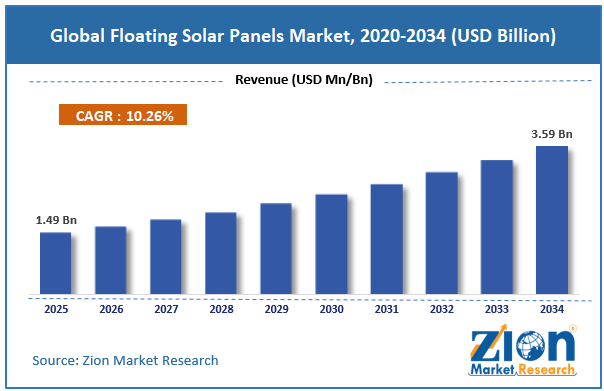
The global floating solar panels market size was valued at approximately USD 1.49 billion in 2026 and is projected to reach around USD 3.59 billion by 2034, growing at a compound annual growth rate of approximately 10.26% between 2026 and 2034.
Key Insights
- As per the analysis shared by our research team, the global floating solar panels market is estimated to grow at a compound annual growth rate of approximately 10.26% during the forecast period from 2026 to 2034.
- In terms of revenue, the global floating solar panels market was valued at approximately USD 1.49 billion in 2026 and is projected to reach USD 3.59 billion by 2034.
- The floating solar panels market is expected to grow strongly due to rising renewable energy targets, increasing land scarcity, growing preference for water-based solar installations, and expanding investment in clean power infrastructure.
- Based on type, crystalline silicon floating solar panels lead the market because of their high efficiency and long operational lifespan, while bifacial floating solar panels are gaining strong momentum as one of the fastest-growing technologies due to their ability to capture reflected sunlight from water surfaces.
- Based on application, hydropower reservoirs lead the market due to the natural fit between floating solar systems and existing dam infrastructure. At the same time, wastewater treatment facilities are the fastest-growing segment as more municipalities adopt dual-purpose water and energy solutions.
- Based on end-user, utility companies lead the market due to large-scale project financing and grid connection capabilities, while industrial facilities are steadily growing as more manufacturers seek on-site renewable power for their operations.
- Based on component, solar PV modules lead the market because they form the core power-generating element of every floating installation, while floats and pontoons are seeing rapid innovation as manufacturers develop lighter and more durable materials.
- Based on region, Asia Pacific leads the global floating solar panels market. At the same time, Europe is the fastest-growing region due to rising clean energy targets and limited available land for ground-mounted solar farms.
Floating Solar Panels Market: Overview
Floating solar panels are solar panels that are installed on water bodies such as lakes, reservoirs, ponds, canals, and dams instead of on land or rooftops. Also called floating solar systems or floatovoltaics, they generate clean electricity by using sunlight while floating on specially designed platforms that keep them stable on the water. These systems include thin-film panels, crystalline silicon panels, bifacial panels, and flexible panels, with each type offering different levels of efficiency and durability. One of the biggest advantages of floating solar panels is that they save valuable land, making them ideal for countries where land is limited, but water bodies are widely available. The water also helps keep the panels cool, allowing them to produce electricity more efficiently than many land-based systems. The market is growing rapidly due to increasing demand for renewable energy, rising land shortages, and strong government support for clean power projects. Utility companies, industries, and water authorities are installing floating solar systems because they provide reliable, cost-effective, and environmentally friendly electricity while making better use of unused water surfaces.
The floating solar panels industry continues to grow as governments, energy companies, and communities look for smarter ways to produce clean electricity without using up limited land resources.
Impact of the USA-Israel War on Iran on the Floating Solar Panels Market
The floating solar panels market may experience short-term disruptions due to ongoing geopolitical tensions between the United States, Israel, and Iran, which could affect the supply of raw materials such as aluminum, polymers, and specialized solar-grade components. Manufacturers are working to diversify their supplier networks and build stronger regional production capacity to limit these risks. Even with these near-term pressures, the growing global push toward clean energy and water surface utilization is expected to keep supporting long-term market growth.
Floating Solar Panels Market: Technology Roadmap 2026–2034
What is the projected development roadmap of the floating solar panels market over the forecast period?
The floating solar panels market is advancing through improved float materials, smarter anchoring systems, higher-efficiency solar cells, and better integration with existing hydropower infrastructure, making renewable energy generation more practical and widespread. The market is expected to grow at a compound annual growth rate of approximately 10.26% over the forecast period, driven by accelerating clean energy investment, developing regulatory frameworks, and continuous refinement of floating platform technology.
The following roadmap outlines key development phases expected through 2034.
2026-2028: Pilot Expansion and Infrastructure Development Phase
- Engineers are expected to develop stronger and corrosion-resistant float materials that allow installations to withstand harsher water conditions, including choppy reservoirs and coastal water bodies.
- Stricter environmental and safety standards are expected to encourage manufacturers to improve testing processes, helping ensure floating solar installations are both durable and safe for surrounding ecosystems.
- Growing collaboration between energy companies, engineering firms, and government water authorities is expected to speed up the approval and deployment of new floating solar projects.
2029-2031: Efficiency Optimization and Scale Deployment Phase
- Advanced manufacturing methods are expected to become more widely used, helping produce floating solar systems with greater consistency, lower installation costs, and faster deployment timelines.
- The growing use of hybrid systems, where floating solar panels are paired with hydropower plants or battery storage, is expected to improve energy reliability for regions with variable power demand.
- Improved monitoring tools are expected to help operators track panel performance and water quality together, supporting more efficient and sustainable project management.
2032-2034: Next-generation Floating Energy Phase
- Floating solar systems are expected to become more refined, with designs aimed at reducing maintenance needs while increasing the amount of electricity generated per installation.
- Smaller and more adaptable floating platforms are expected to support the growing demand for systems that can be installed on irregularly shaped or smaller water bodies.
- New technologies combining floating solar panels with real-time water and weather monitoring are expected to help operators respond quickly to changing conditions, improving safety and energy output.
Floating Solar Panels Market: Dynamics
Growth Drivers
What is driving growth in the floating solar panels market as demand for water-based renewable energy rises?
The floating solar panels market is growing as more countries look for clean energy solutions that do not require large areas of land. Floating solar panels are installed on lakes, reservoirs, ponds, and other water bodies to generate electricity while making better use of unused water surfaces. The growing demand for renewable energy, limited land availability, and supportive government policies are driving the market forward. Utility companies, industries, and water authorities are increasingly adopting these systems because they help produce clean electricity without affecting farming or urban development. Floating solar panels are commonly used on hydropower reservoirs, irrigation ponds, industrial water storage facilities, and wastewater treatment plants. Another major advantage is that the water helps keep the panels cool, improving their efficiency and energy output. These systems can also reduce water evaporation and slow algae growth, providing added environmental benefits. With continuous improvements in floating platform technology and increasing investments in renewable energy projects, the market is expected to witness strong and steady growth in the coming years.
The growing demand for land-efficient renewable energy is driving the floating solar panels market.
The floating solar panels industry is creating significant growth opportunities as governments, businesses, and energy providers invest in clean energy solutions that save land and reduce environmental impact. Floating solar panels are installed on lakes, reservoirs, ponds, canals, and other water bodies, allowing electricity to be generated without using valuable land for solar farms. This makes them an ideal solution for regions with limited land availability. Utility companies, industries, and municipal water authorities are increasingly adopting these systems because they deliver reliable power while making better use of existing water resources. Floating solar projects are also expanding into wastewater treatment plants, industrial water storage facilities, and irrigation ponds, opening new opportunities for market growth. Continuous improvements in floating platform design, anchoring systems, and solar panel efficiency are making these projects more reliable and cost-effective. Governments are supporting the market through renewable energy policies, funding programs, and pilot projects that encourage wider adoption.
Restraints
Why are high installation costs and environmental concerns challenging the floating solar panels market?
The floating solar panels market faces several challenges that may affect its growth. Setting up floating solar systems is more expensive than installing solar panels on land because they require special floating platforms, anchoring systems, and underwater cables. Many small companies find it difficult to afford these higher costs or manage large projects without technical expertise. Environmental approvals can also take time, as authorities must study the possible impact on water quality, fish, and other aquatic life before giving permission. In addition, floating solar systems need regular inspections and maintenance to protect them from corrosion, strong winds, and changing water levels, increasing operating costs.
Some countries also have limited suitable water bodies or unclear regulations, making project development more difficult. There is also a shortage of skilled professionals with experience in floating solar technology. Despite these challenges, better technology, lower installation costs, and stronger government support are expected to drive the market forward.
Opportunities
Expanding water surface applications and emerging markets are driving growth opportunities in the floating solar panels market.
The floating solar panels market offers strong growth opportunities as governments, energy companies, and water authorities look for smarter ways to use lakes, reservoirs, ponds, canals, and other water bodies. Floating solar systems generate clean electricity without using valuable land, making them ideal for regions with limited space. They are widely installed on hydropower reservoirs, irrigation ponds, industrial water storage facilities, and wastewater treatment plants. These projects also help reduce water evaporation and support better water management. Countries such as India, Vietnam, Indonesia, and several African nations are investing heavily in renewable energy infrastructure, creating new opportunities for the market. Manufacturers are improving floating platforms, anchoring systems, and solar panel efficiency to lower costs, increase durability, and simplify installation.
Government incentives, renewable energy targets, and private investments are encouraging more floating solar projects across the world. As technology continues to improve and awareness grows, the market is expected to expand steadily, providing clean electricity, lower carbon emissions, sustainable development, economic growth, and long-term benefits for communities and businesses alike.
Challenges
High installation costs and regulatory challenges are impacting the growth of the floating solar panels market.
The floating solar panels market faces several challenges that could slow its growth. Installing floating solar systems requires high initial investment, specialized floating platforms, anchoring systems, and skilled engineering, making projects more expensive than traditional land-based solar farms. Smaller companies often struggle to secure funding and technical expertise for large-scale installations. Environmental approvals can also take time because authorities must evaluate the possible impact on water quality, aquatic life, and surrounding ecosystems before granting permission. Different rules and regulations across countries further increase project costs and delay development. In addition, the market needs more trained engineers and technicians to design, install, and maintain these systems effectively. A reliable supply of floating structures, anchoring equipment, and other specialized materials is also essential to avoid project delays. However, continuous technological advancements, supportive government policies, and growing investments in clean energy are expected to support long-term market growth.
Floating Solar Panels Market: Report Scope
| Report Attributes | Report Details |
|---|---|
| Report Name | Floating Solar Panels Market |
| Market Size in 2025 | USD 1.49 Billion |
| Market Forecast in 2034 | USD 3.59 Billion |
| Growth Rate | CAGR of 10.26% |
| Number of Pages | 227 |
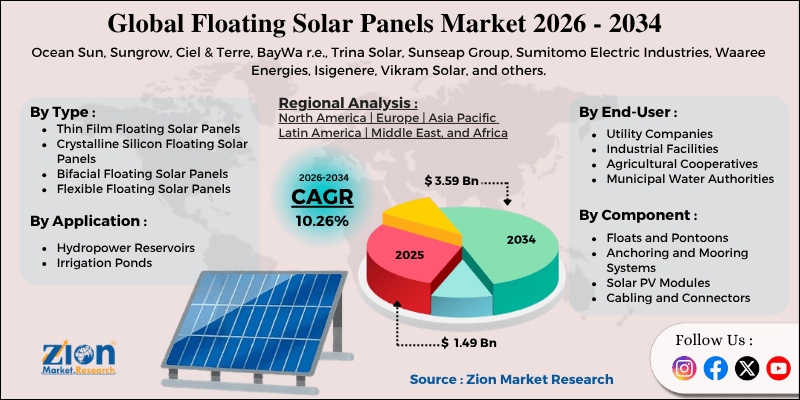
| Key Companies Covered | Ocean Sun, Sungrow, Ciel & Terre, BayWa r.e., Trina Solar, Sunseap Group, Sumitomo Electric Industries, Waaree Energies, Isigenere, Vikram Solar, and others. |
| Segments Covered | By Type, By Application,By End-User, By Component, and By Region |
| Regions Covered | North America, Europe, Asia Pacific (APAC), Latin America, Middle East, and Africa (MEA) |
| Base Year | 2025 |
| Historical Year | 2020 - 2024 |
| Forecast Year | 2026 - 2034 |
| Customization Scope | Avail customized purchase options to meet your exact research needs. Request For Customization |
Floating Solar Panels Market: Segmentation
The global floating solar panels market is segmented by type, application, end-user, component, and region.
What makes crystalline silicon floating solar panels the dominant type in the floating solar panels market?
Based on type, the global floating solar panels market is categorized into thin film floating solar panels, crystalline silicon floating solar panels, bifacial floating solar panels, and flexible floating solar panels. Crystalline silicon floating solar panels hold about 45% of the market share, leading due to their proven efficiency, long operational lifespan, and strong performance across different water and weather conditions. Bifacial floating solar panels hold around 25% market share. They are the fastest-growing segment because of their ability to generate extra electricity from sunlight reflected off the water surface.
How does hydropower reservoir application maintain its leading position in the floating solar panels market?
Based on application, the floating solar panels industry is divided into hydropower reservoirs, irrigation ponds, industrial water bodies, and wastewater treatment facilities. Hydropower reservoirs account for approximately 36% of the global market share, driven by the natural compatibility between floating solar systems and existing dam and grid infrastructure. Industrial water bodies hold around 23% market share. They are the fastest-growing segment due to expanding use of on-site renewable power by manufacturing facilities.
What makes utility companies the dominant end-users in the floating solar panels market?
Based on end-user, the market is segregated into utility companies, industrial facilities, agricultural cooperatives, and municipal water authorities. Utility companies lead with about a 44% share because of their access to large capital investments and established grid connection networks. Industrial facilities hold around 26% market share. They are growing steadily as more manufacturers seek reliable and cost-effective on-site power generation.
How does the solar PV module component shape the technology landscape of the floating solar panels market?
Based on component, the floating solar panels market is classified into floats and pontoons, anchoring and mooring systems, solar PV modules, and cabling and connectors. Solar PV modules account for about 41% of the market, leading because they represent the core power-generating technology within every floating installation. Floats and pontoons hold around 29% market share. They are supported by continuous innovation in lightweight and durable materials designed for long-term water exposure.
Floating Solar Panels Market: Regional Analysis
Why is Asia Pacific leading the global floating solar panels market?
The Asia Pacific floating solar panels market accounted for around 48.7% of the global market share during the forecast period. This strong position is supported by the region’s large number of reservoirs, lakes, ponds, and dams, along with increasing investments in renewable energy projects. China dominates the regional market because of its advanced solar manufacturing industry, extensive hydropower reservoirs, and strong government support for clean energy. The country continues to build large floating solar projects to meet rising electricity demand while reducing pressure on land resources. Japan is another major market due to limited land availability and the growing use of floating solar systems on reservoirs and water bodies. South Korea and Vietnam are also expanding their floating solar capacity through supportive government policies, renewable energy targets, and new infrastructure investments. India is emerging as a key growth market with abundant irrigation ponds, reservoirs, and increasing investments in renewable energy projects.
Government initiatives, private sector funding, and continuous improvements in floating solar technology are encouraging wider adoption across the region. Growing awareness of clean energy, better land utilization, water conservation, and carbon emission reduction is expected to support the long-term growth of the Asia Pacific floating solar panels market during the forecast period.
What makes Europe the fastest-growing region in the floating solar panels market?
The Europe floating solar panels market accounted for around 22.4% of the global market share during the forecast period. The market is growing quickly as European countries invest more in clean energy and look for better ways to generate electricity without using valuable land. Floating solar panels are installed on lakes, reservoirs, ponds, and other water bodies, making them an ideal solution for regions with limited land availability. The Netherlands leads the market because of its large network of canals, lakes, and reservoirs, along with strong government support for renewable energy. France is another major market, supported by its hydropower reservoirs and growing floating solar projects. Germany is expanding rapidly as it increases investments in renewable energy to reduce carbon emissions and improve energy security. Spain and Italy are also seeing strong growth due to abundant sunlight, supportive government policies, and rising investments in solar power. Norway, Sweden, and Denmark are adopting floating solar systems as part of their clean energy transition. The growing need for energy independence and lower greenhouse gas emissions is encouraging more countries to invest in floating solar projects.
Rising public and private investments, along with faster adoption of advanced solar technologies, are creating new opportunities across the region. Growing government incentives, continuous improvements in floating solar technology, and increasing investments in renewable energy infrastructure are expected to drive the long-term growth of the European floating solar panels market over the forecast period.
Recent Market Developments
- In May 2026, Ocean Sun signed a memorandum of understanding (MoU) with ACEN-Silverwolf to collaborate on the deployment of utility-scale floating solar projects across selected Asian markets, combining Ocean Sun's membrane-based floating solar technology with ACEN-Silverwolf's regional project development expertise.
Floating Solar Panels Market: Competitive Analysis
The leading players in the global floating solar panels market are:
- Ocean Sun
- Sungrow
- Ciel & Terre
- BayWa r.e.
- Trina Solar
- Sunseap Group
- Sumitomo Electric Industries
- Waaree Energies
- Isigenere
- Vikram Solar
The global floating solar panels market is segmented as follows:
By Type
- Thin Film Floating Solar Panels
- Crystalline Silicon Floating Solar Panels
- Bifacial Floating Solar Panels
- Flexible Floating Solar Panels
By Application
- Hydropower Reservoirs
- Irrigation Ponds
- Industrial Water Bodies
- Wastewater Treatment Facilities
By End-User
- Utility Companies
- Industrial Facilities
- Agricultural Cooperatives
- Municipal Water Authorities
By Component
- Floats and Pontoons
- Anchoring and Mooring Systems
- Solar PV Modules
- Cabling and Connectors
By Region
- North America
- The U.S.
- Canada
- Mexico
- Europe
- France
- The UK
- Spain
- Germany
- Italy
- Rest of Europe
- Asia Pacific
- China
- Japan
- India
- Australia
- South Korea
- Rest of Asia Pacific
- The Middle East & Africa
- Saudi Arabia
- UAE
- Egypt
- Kuwait
- South Africa
- Rest of the Middle East & Africa
- Latin America
- Brazil
- Argentina
- Rest of Latin America
Table Of Content
Methodology
FrequentlyAsked Questions
Floating solar panels are solar panels that are installed on water bodies such as lakes, reservoirs, ponds, canals, and dams instead of on land or rooftops. Also called floating solar systems or floatovoltaics, they generate clean electricity by using sunlight while floating on specially designed platforms that keep them stable on the water.
The global floating solar panels market is expected to grow due to rising renewable energy targets, increasing land scarcity, growing demand for water-based solar installations, and expanding investment in clean power infrastructure worldwide.
According to research, the global floating solar panels market was valued at approximately USD 1.49 billion in 2026 and is projected to reach approximately USD 3.59 billion by 2034.
The compound annual growth rate of the floating solar panels market is expected to be approximately 10.26% from 2026 to 2034.
Asia Pacific is expected to lead the global floating solar panels market throughout the forecast period, driven by its abundance of water bodies, strong manufacturing base, and significant investment in renewable energy infrastructure.
The major players in the global floating solar panels market include Ocean Sun, Sungrow, Ciel & Terre, BayWa r.e., Trina Solar, Sunseap Group, Sumitomo Electric Industries, Waaree Energies, Isigenere, and Vikram Solar.
The report examines key aspects of the floating solar panels market, including research and development drivers, adoption barriers, application opportunities, competitive landscape dynamics, detailed regional market performance analysis, and a comprehensive forward-looking outlook across all major types, applications, end-user segments, components, and geographic regions through 2034.
The floating solar panels market is influenced by environmental impact assessments, water use regulations, and renewable energy policies that govern project approvals. Government incentives, carbon reduction targets, and biodiversity protection requirements are also shaping the pace of market expansion across different regions.
The floating solar panels market is expected to benefit from rising investments in renewable energy, increasing electricity demand, and growing infrastructure spending. However, inflation, higher interest rates, raw material price fluctuations, and supply chain disruptions may affect project costs and investment decisions.
The floating solar panels market offers strong opportunities through partnerships between solar developers, utility companies, water authorities, and technology providers. Increasing government funding, public-private collaborations, and investments in floating platform innovation are expected to accelerate large-scale project development worldwide.

HappyClients

