
Flexitank Market Size Report, Industry Share, Analysis, Growth, 2032

Flexitank Market - by Loading Type (Top Loading and Bottom Loading), by Type (Multilayer and Monolayer), by Application (Non-Hazardous Chemicals/Liquids, Food-Grade Liquids, and Pharmaceutical Liquids), and by Region - Global Industry Perspective, Comprehensive Analysis, and Forecast, 2024 - 2032
| Market Size in 2023 | Market Forecast in 2032 | CAGR (in %) | Base Year |
|---|---|---|---|
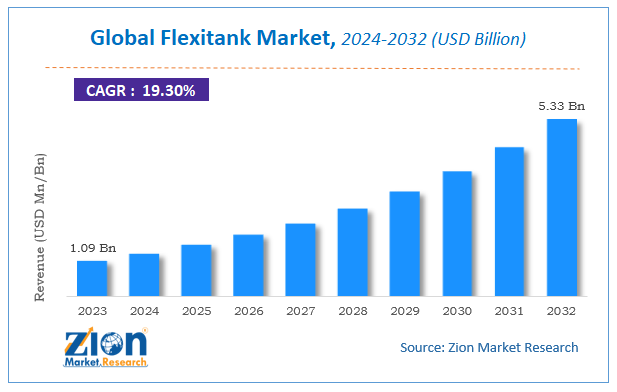
| USD 1.09 Billion | USD 5.33 Billion | 19.3% | 2023 |
Global Flexitank Market Insights
According to Zion Market Research, the global Flexitank Market was worth USD 1.09 Billion in 2023. The market is forecast to reach USD 5.33 Billion by 2032, growing at a compound annual growth rate (CAGR) of 19.3% during the forecast period 2024-2032. The report offers a comprehensive analysis of the market, highlighting the factors that will determine growth, potential challenges, and opportunities that could emerge in the Flexitank industry over the next decade.
Introduction
Flexitank was developed by the U.S defense & military sector for storing as well as transporting diesel & water in 1960. Furthermore, Flexitank is a bulk liquid storage facility and is made up of many polyethylene layers. These products are immensely utilized for transport of food items like edible oil, beverages, fruit concentrates, and harmless chemicals. The ability of Flexitank to offer protection against contamination will steer its demand across the globe.
Moreover, Flexitank is the container or a good that can be boxed and then shipped. In addition to this, Flexitank are designed to maintain the value & quality of the product during the transportation.
What are the Market Dynamics of Flexitank Market?
Growth Drivers
The growth drivers of the flexitank market are primarily fueled by the surge in global commodity trade, particularly in emerging economies where imports of edible oils, chemicals, and agricultural liquids have risen significantly. For instance, advancements in flexitank materials enhance durability and compatibility with multimodal transport, reducing overall shipping expenses and appealing to cost-conscious shippers. Additionally, the shift toward sustainable packaging solutions, such as recyclable polyethylene layers, aligns with environmental regulations and corporate sustainability goals, further propelling adoption across industries like food and chemicals.
Restraints
Restraints in the flexitank market include stringent regulatory compliance and safety standards for handling liquids, which can increase operational costs and limit market entry for smaller players. Environmental concerns over plastic waste from single-use flexitanks pose challenges, as disposal and recycling infrastructure varies globally, potentially leading to bans or restrictions in eco-sensitive regions. Moreover, volatility in raw material prices, such as polyethylene, impacts profitability and hinders widespread adoption in price-sensitive markets.
Opportunities
Opportunities abound in the flexitank market through innovation in eco-friendly and reusable designs, catering to the growing demand for sustainable logistics in pharmaceuticals and high-value chemicals. Expansion into untapped regions like Africa and Latin America, where port infrastructure investments are rising, offers potential for market penetration amid increasing trade volumes. Partnerships with e-commerce platforms and integration with temperature-controlled systems also present avenues for growth in specialty applications like wine and spirits transportation.
Challenges
Challenges facing the flexitank market involve ensuring product integrity during long-haul shipments, as temperature fluctuations and handling errors can lead to leaks or contamination, eroding user confidence. Intense competition among suppliers necessitates continuous R&D investment, straining resources for mid-tier companies. Furthermore, geopolitical tensions and supply chain disruptions, such as port congestions, exacerbate logistical hurdles and delay market expansion in key trade routes.
Global Flexitank Market: Segmentation
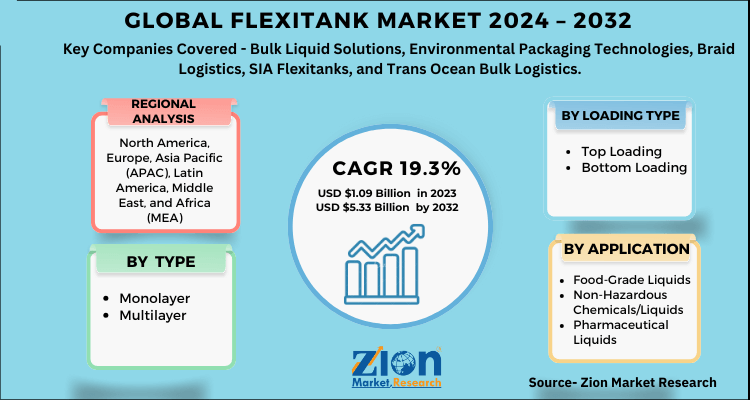
The study provides a decisive view of the flexitank market by segmenting the market based on by type, by loading type, by application and by region. All the segments have been analyzed based on present and future trends and the market is estimated from 2024 to 2032.
By Type segment analysis includes monolayer, multilayer.
By loading type segment analysis includes top loading, bottom loading.
By application segment analysis includes food-grade liquids, non-hazardous chemicals/liquids, pharmaceutical liquids.
The regional segment includes the current and forecast demand for North America, Europe, Asia Pacific, Latin America, and the Middle East and Africa.
Flexitank Market: Report Scope
| Report Attributes | Report Details |
|---|---|
| Report Name | Flexitank Market |
| Market Size in 2023 | USD 1.09 Billion |
| Market Forecast in 2032 | USD 5.33 Billion |
| Growth Rate | CAGR of 19.3% |
| Number of Pages | 110 |
| Key Companies Covered | Bulk Liquid Solutions, Environmental Packaging Technologies, Braid Logistics, SIA Flexitanks, and Trans Ocean Bulk Logistics |
| Segments Covered | By Type, By Loading Type, By Application And By Region |
| Regions Covered | North America, Europe, Asia Pacific (APAC), Latin America, Middle East, and Africa (MEA) |
| Base Year | 2023 |
| Historical Year | 2018 - 2022 |
| Forecast Year | 2024 - 2032 |
| Customization Scope | Avail customized purchase options to meet your exact research needs. Request For Customization |
What is the Regional Analysis of Flexitank Market?
Asia Pacific to dominate the global market.
Asia Pacific holds the largest share in the flexitank market, driven by robust economic growth, extensive port networks, and high demand for liquid imports in countries like China, which dominates the region due to its massive edible oil and chemical consumption, accounting for significant trade volumes and low-cost manufacturing hubs that attract global outsourcing.
North America exhibits strong growth potential, with the United States leading as the dominating country through its advanced food and beverage sector, high per capita income, and increasing e-commerce integration, where flexitanks support efficient transport of wines, cheeses, and industrial liquids amid a focus on sustainable packaging.
Europe maintains a prominent position, led by Germany as the dominating country, bolstered by major pharmaceutical exporters and stringent environmental regulations promoting recyclable flexitanks, facilitating the shipment of temperature-sensitive goods and chemicals across well-established trade routes.
Latin America is emerging as a key market, with Brazil dominating through its agricultural exports and growing industrial base, utilizing flexitanks for oils and chemicals to leverage cost advantages and expand trade with Asia and North America.
The Middle East and Africa show promising expansion, dominated by South Africa, where investments in port infrastructure and rising commodity trades, particularly in oils and agricultural liquids, drive adoption amid efforts to reduce carbon emissions in logistics.
Global Flexitank Market: Competitive Players
Key players profiled in the report include-
- Bulk Liquid Solutions
- Environmental Packaging Technologies
- Braid Logistics
- SIA Flexitanks
- Trans Ocean Bulk Logistics
Flexitank Market: Segmentation
The global Flexitank market is segmented as follows:
By Type:
- Monolayer
- Multilayer
By Loading Type:
- Top Loading
- Bottom Loading
By Application
- Food-Grade Liquids
- Non-Hazardous Chemicals/Liquids
- Pharmaceutical Liquids
By Region
- North America
- The U.S.
- Canada
- Mexico
- Europe
- France
- The UK
- Spain
- Germany
- Italy
- Rest of Europe
- Asia Pacific
- China
- Japan
- India
- Australia
- South Korea
- Rest of Asia Pacific
- The Middle East & Africa
- Saudi Arabia
- UAE
- Egypt
- Kuwait
- South Africa
- Rest of the Middle East & Africa
- Latin America
- Brazil
- Argentina
- Rest of Latin America
Table Of Content
Methodology
FrequentlyAsked Questions
Rise in the green logistics practices due to government strict laws as a result of growing environmental concerns will define the growth of Flexitank market over the forecast timeline.
The CAGR of the industry is expected to be nearly 21% during the forecast timespan.
Asia Pacific region will contribute sizably towards the global market revenue over the estimated timeline.
The key market participants include Bulk Liquid Solutions, Braid Logistics, SIA Flexitanks, Environmental Packaging Technologies, and Trans Ocean Bulk Logistics.
The report provides comprehensive analysis on size, trends, segments, key players, regional outlook, and forecasts from 2024-2032.
Stages include raw material procurement, manufacturing, design and customization, distribution, installation in containers, transportation, and end-use disposal or recycling.
Trends are shifting toward sustainable, reusable designs, with consumers preferring eco-friendly options that reduce costs and environmental impact in liquid logistics.
Factors include stringent safety standards for liquid handling, environmental regulations on plastic waste, and IMO net-zero rules favoring lightweight, low-carbon solutions.

HappyClients

