
Edible Bird’s Nest Market Size, Growth, Global Trends, Forecast 2034

Edible Bird's Nest Market By Type of Bird's Nest (Raw Edible Bird's Nest, Processed Edible Bird's Nest), By Form (Whole Bird's Nest, Broken Bird's Nest, Bird's Nest Powder), By Distribution Channel (Direct Sales, Retail Sales, Online Sales), By End-Use Application (Food & Beverage Industry, Cosmetics & Skincare Industry, Nutraceuticals & Dietary Supplements), and By Region - Global and Regional Industry Overview, Market Intelligence, Comprehensive Analysis, Historical Data, and Forecasts 2025 - 2034
| Market Size in 2024 | Market Forecast in 2034 | CAGR (in %) | Base Year |
|---|---|---|---|
| USD 5.82 Billion | USD 9.14 Billion | 5.80% | 2024 |
Edible Bird’s Nest Industry Perspective:
What will be the size of the global edible bird’s nest market during the forecast period?
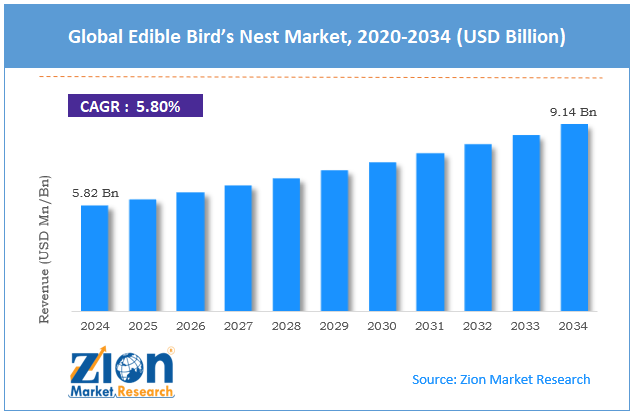
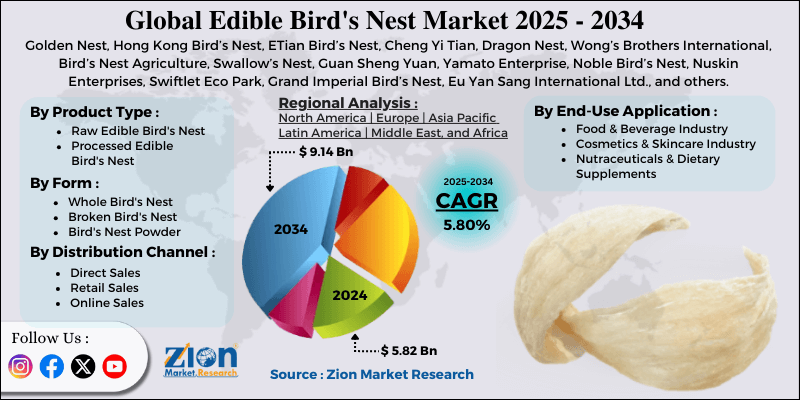
The global edible bird’s nest market size was worth around USD 5.82 billion in 2024 and is predicted to grow to around USD 9.14 billion by 2034, with a compound annual growth rate (CAGR) of roughly 5.80% between 2025 and 2034.
Key Insights:
- As per the analysis shared by our research analyst, the global edible bird’s nest market is estimated to grow annually at a CAGR of around 5.80% over the forecast period (2025-2034)
- In terms of revenue, the global edible bird’s nest market size was valued at around USD 5.82 billion in 2024 and is projected to reach USD 9.14 billion by 2034.
- The edible bird’s nest market is projected to grow significantly, driven by rising disposable incomes, an aging population seeking functional foods, and the premiumization trend in food products.
- Based on product type, the processed edible bird's nest segment is expected to lead the market, while the raw edible bird's nest segment is expected to grow considerably.
- Based on form, the whole bird's nest segment is the dominating segment, while the bird's nest powder segment is projected to witness sizeable revenue over the forecast period.
- Based on distribution channel, the retail sales segment leads the market, while the online sales segment is expected to grow considerably.
- Based on end-use application, the food & beverage industry segment is expected to lead the market, followed by the nutraceuticals & dietary supplements segment.
- By region, Asia Pacific is projected to dominate the global market during the forecast period, followed by the Middle East & Africa.
Edible Bird’s Nest Market: Overview
Edible bird’s nest, aka swiftlet nest, is a delicacy made of hardened saliva of certain swiftlet species. Highly prized in traditional Chinese medicine and cuisine, it is prominent for its rich nutritional content, comprising glycoproteins, minerals, and amino acids. It is primarily used in desserts and soups and is believed to boost immunity, promote skin health, and aid respiratory health. The global edible bird’s nest market is likely to expand rapidly, driven by rising disposable incomes, premiumization, health and wellness trends, and cultural and traditional consumption. Higher income levels in Asia and other regions have increased spending on luxury foods such as edible bird's nest. Consumers are ready to pay for high-quality and premium products. This fuels consistent industry growth in affluent segments.
Moreover, EBN offers anti-aging, respiratory, and immunity-boosting benefits. The worldwide move towards natural and functional foods has elevated its appeal. Health-conscious individuals are steadily including it in their diets. Furthermore, strong cultural ties in cuisine and Chinese medicine maintain a steady demand. Festivals, traditional rituals, and gifting consistently fuel purchases. Cultural relevance sustains long-term market stability.
Despite the growth, the global market is impeded by factors such as high price and, affordability barriers, and quality and safety concerns. EBN is high-priced, restricting access to affluent consumers. Price sensitive prevents broader adoption, thus limiting speedy industry expansion. Similarly, contamination, inconsistent grading, and adulteration undermine trust. Consumers are wary of unsafe products. Stringent safety measures are a must for industry growth.
Nonetheless, the global edible bird’s nest industry stands to benefit from several key opportunities, including scientific research and clinical validation, product diversification, and innovation. Research confirming EBN’s therapeutic and nutritional benefits improves credibility. Clinical evidence can support marketing claims. Stronger validation increases consumer trust. Introducing soups, drinks, gummies, and age-specific packs attracts a varied group. Convenience and flavor innovations boost engagement. Product variety stimulates repeat purchases.
Edible Bird’s Nest Market: Dynamics
Growth Drivers
How is strong cultural and traditional significance in Asia fueling the edible bird’s nest market?
In Southeast Asian, edible bird’s nest is a symbol of luxury, healthy, and status, mainly in Malaysia, Indonesia, and China. Traditionally used in desserts, soups, and as gifts, it enjoys consistent demand across generations. Its association with vitality and longevity keeps consumption stable, even during economic fluctuations. Cultural importance hence supports regional exports and domestic sales.
How do product innovation and diversification drive the edible bird’s nest market?
The edible bird’s nest market is advancing with convenient products like instant soups, bottled drinks, and beauty blends. These appeal to younger, urban consumers who seek quick, functional nutrition. Improved packaging, traceability, and safety enhance premium and trust. EBN is expanding beyond food into wellness and nutraceutical applications. Innovation keeps the market relevant and fuels long-term growth.
Restraints
Risk of adulteration and quality concerns hamper the market progress
The market faces ongoing issues with low-quality or fake bird’s nests, including mislabeling and chemical bleaching. Such cases damage consumer trust and can restrict industry growth in new regions. Stringent regulatory requirements are needed to guarantee safety, which increases operational costs for exporters and producers. Consumers may hesitate to adopt products if verification processes are inconsistent or unclear, and quality assurance challenges remain a persistent industry restraint.
Opportunities
How does the development of functional and ready-to-consume products offer advantageous conditions for the edible bird’s nest market development?
There is a strong scope to innovate beyond traditional soups with bottle drinks, beauty drinks, supplements, and fortified health products. Convenience-oriented products attract young consumers with hectic lifestyles. This diversification increases consumption frequency and appeals to urban buyers. Integrating EBN into wellness foods and nutraceuticals improves its market relevance. Product innovation is a strategic opportunity for long-term growth that impacts the global edible bird’s nest industry.
Challenges
Vulnerability to environmental changes restricts the market growth
Swiftlets are sensitive to changes in habitat, pollution, and climate variation. Urban development or natural disasters can remarkably reduce nest availability. These environmental dependencies make the supply chain unpredictable. Producers should invest in habitat conservation or controlled farming. Environmental fragility is a persistent operational challenge.
Edible Bird’s Nest Market: Report Scope
| Report Attributes | Report Details |
|---|---|
| Report Name | Edible Bird’s Nest Market |
| Market Size in 2024 | USD 5.82 Billion |
| Market Forecast in 2034 | USD 9.14 Billion |
| Growth Rate | CAGR of 5.80% |
| Number of Pages | 212 |
| Key Companies Covered | Golden Nest, Hong Kong Bird’s Nest, ETian Bird’s Nest, Cheng Yi Tian, Dragon Nest, Wong’s Brothers International, Bird’s Nest Agriculture, Swallow’s Nest, Guan Sheng Yuan, Yamato Enterprise, Noble Bird’s Nest, Nuskin Enterprises, Swiftlet Eco Park, Grand Imperial Bird’s Nest, Eu Yan Sang International Ltd., and others. |
| Segments Covered | By Product Type, By Form, By Distribution Channel, By End-Use Application, and By Region |
| Regions Covered | North America, Europe, Asia Pacific (APAC), Latin America, Middle East, and Africa (MEA) |
| Base Year | 2024 |
| Historical Year | 2019 to 2023 |
| Forecast Year | 2025 - 2034 |
| Customization Scope | Avail customized purchase options to meet your exact research needs. Request For Customization |
Edible bird’s nest market: Segmentation
The global edible bird’s nest market is segmented based on product type, form, distribution channel, end-use application, and region.
Based on product type, the global edible bird’s nest industry is divided into raw and processed edible bird's nest. The processed edible bird’s nest segment registers a leading 70% market share. They are ready-to-use, convenient, and safer for consumers, and are widely used in beverages, soups, and supplements, which increases demand.
On the other hand, the raw edible bird’s nest segment ranks second, with 30% market share. They are less familiar since they need extensive cleaning and preparation. They are mainly purchased by traditional users or specialty markets.
Based on form, the global market is segmented into whole bird's nest, broken bird's nest, and bird's nest powder. The whole bird’s nest segment captured 55% of the total market because it is the most sought-after, because they retain premium appearance, nutritional value, and quality. They are largely preferred for high-end culinary, gifting, and luxury consumption.
Conversely, the bird’s nest powder segment is the second-largest, accounting for 30% of the market. Powdered form is gaining popularity due to its versatility and convenience in supplements, drinks, and ready-to-eat products. It is easier for us than whole nests for modern consumers.
Based on distribution channel, the global edible bird’s nest market is segmented into direct sales, retail sales, and online sales. The retail sales segment leads with 50% of the market share. It comprises supermarkets, specialty stores, and health food shops. Consumers trust physical stores for authenticity, instant purchase, and quality verification.
Nonetheless, the online sales segment holds a second position with 35% of the overall market share. E-commerce is growing rapidly due to broader product variety, convenience, access to international brands, and home delivery. Tech-savvy and younger consumers are largely preferring online channels.
Based on end-use application, the global market is segmented into the food & beverage, cosmetics & skincare, and nutraceuticals & dietary supplements industries. The food & beverage industry dominates with a 60% market share. The majority of EBN is consumed in drinks, soups, desserts, and other culinary preparations. Its cultural and traditional values keep food and beverage consumption as the dominant segment.
However, the nutraceuticals & dietary supplements segment holds 30% of the total market share. Growing trends in functional food and health awareness are fueling the use of EBN in wellness products and supplements. This segment is speedily expanding but is still smaller than the food and beverage segment.
Edible Bird’s Nest Market: Regional Analysis
Why is Asia Pacific outperforming other regions in the global edible bird’s nest market?
Asia Pacific is anticipated to retain its leading role with a 5.3% CAGR in the global edible bird’s nest market, driven by cultural and traditional consumption dominance, strong regional market share and demand, and a strong production base in Southeast Asia. Edible bird’s nest has been a key part of medicinal and cultural traditions in Asia for centuries, particularly in countries such as Malaysia, Indonesia, and China. It is widely used in health tonics, soups, and desserts, making it a staple at festive occasions and in luxury diets. This strong cultural connection ensures consistent demand and ranks the region as the world's leading consumer of bird’s nest.
Moreover, APAC registers for a majority of the worldwide edible bird’s nest consumption, accounting for more than 70% of the market share. Large populations with developed culinary habits maintain revenue growth and steady volume year after year. The concentrated demand in this region keeps it firmly in a higher position in the worldwide market.
Furthermore, Southeast Asian nations such as Thailand, Malaysia, and Indonesia are the leading producers of edible bird’s nests. Being both a consumption and production hub offers APAC a strategic advantage in pricing, supply, and trade. This local production capacity promises that the region can meet both international and domestic demand effectively.
The Middle East & Africa rank second in the global edible bird’s nest industry, with a 4.9% CAGR, driven by growing health and wellness awareness, rising disposable income, and the affordability of premium products and cultural and expatriate experiences. Consumers in the Middle East and Africa are steadily focusing on immunity, health, and natural supplements. Edible bird’s nest is gaining attention for its perceived benefits in improving skin health, boosting immunity, and enhancing overall wellness. This growing health-conscious behavior is steadily expanding demand in the region. Economic growth in nations like Saudi Arabia, the UAE, and South Africa has created a population segment that can spend on luxury foods. As disposable income rises, more individuals are spending on high-value products, such as bird’s nests, for gifting or personal consumption. This trend supports steady industry growth despite the region being smaller than APAC.
Additionally, large expatriate communities from Asia, especially the Chinese and Southeast Asian populations, have brought a strong preference for EBN to the region. These communities continue to fuel demand for traditional culinary and wellness consumers. Their consumption habits have helped establish niche markets and retail channels in major cities.
Edible Bird’s Nest Market: Competitive Analysis
The leading players in the global edible bird’s nest market are:
- Golden Nest
- Hong Kong Bird’s Nest
- ETian Bird’s Nest
- Cheng Yi Tian
- Dragon Nest
- Wong’s Brothers International
- Bird’s Nest Agriculture
- Swallow’s Nest
- Guan Sheng Yuan
- Yamato Enterprise
- Noble Bird’s Nest
- Nuskin Enterprises
- Swiftlet Eco Park
- Grand Imperial Bird’s Nest
- Eu Yan Sang International Ltd.
Edible Bird’s Nest Market: Key Market Trends
Technological innovation & quality authentication:
Adoption of digital traceability tools such as blockchain and QR codes, advanced packaging technologies, and AI-assisted grading is growing to enhance quality assurance and combat counterfeiting. These solutions boost consumer confidence by verifying purity, origin, and processing standards. Improved authentication also backs premium pricing and smoother export compliance.
Sustainable packaging & eco‑friendly practices:
Sustainability has become a major differentiator as brands adopt recyclable or biodegradable packaging and promote ethical harvesting standards. Environmental concerns are impacting both product marketing and design, attracting eco-conscious users. This trend supports EBN as wider food and wellness market trends move toward responsible consumption.
The global edible bird’s nest market is segmented as follows:
By Product Type
- Raw Edible Bird's Nest
- Processed Edible Bird's Nest
By Form
- Whole Bird's Nest
- Broken Bird's Nest
- Bird's Nest Powder
By Distribution Channel
- Direct Sales
- Retail Sales
- Online Sales
By End-Use Application
- Food & Beverage Industry
- Cosmetics & Skincare Industry
- Nutraceuticals & Dietary Supplements
By Region
- North America
- The U.S.
- Canada
- Europe
- France
- The UK
- Spain
- Germany
- Italy
- Rest of Europe
- Asia Pacific
- China
- Japan
- India
- South Korea
- Southeast Asia
- Rest of Asia Pacific
- Latin America
- Brazil
- Mexico
- Rest of Latin America
- Middle East & Africa
- GCC
- South Africa
- Rest of Middle East & Africa
Table Of Content
Methodology
FrequentlyAsked Questions

List of Contents
Edible Birds NestIndustry Perspective:Key Insights:Edible Birds Nest OverviewEdible Birds Nest DynamicsEdible Birds Nest Report ScopeEdible birds nest market: SegmentationEdible Birds Nest Regional AnalysisEdible Birds Nest Competitive AnalysisEdible Birds Nest Key Market TrendsThe global edible birds nest market is segmented as follows:HappyClients

