
Global Digital Pathology Market Size, Share, Growth Analysis Report - Forecast 2034

Digital Pathology Market By Product (Scanners, Software, Communication Systems, and Storage Systems), By Type (Human Pathology and Veterinary Pathology), By Application (Drug Discovery, Disease Diagnosis, Teleconsultation, and Training & Education), By End User (Pharmaceutical & Biotechnology Companies, Hospitals and Reference Laboratories, and Academic & Research Institutes), and By Region - Global and Regional Industry Overview, Market Intelligence, Comprehensive Analysis, Historical Data, and Forecasts 2025 - 2034
| Market Size in 2024 | Market Forecast in 2034 | CAGR (in %) | Base Year |
|---|---|---|---|
| USD 1286.6 Million | USD 2765.96 Million | 8.1% | 2024 |
Digital Pathology Market: Industry Perspective
What will be the global digital pathology market size during the forecast period?
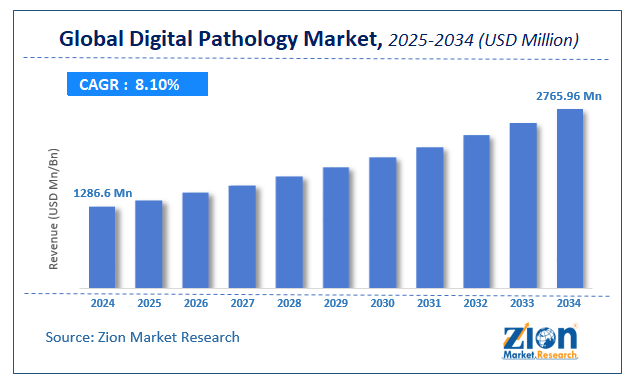
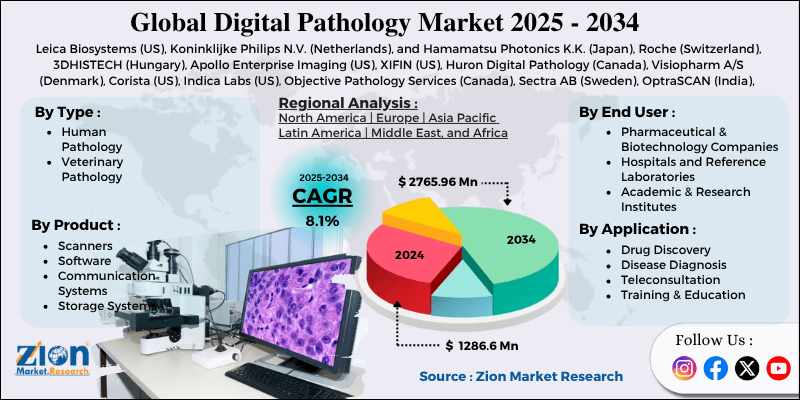
The global digital pathology market size was worth around USD 1286.6 million in 2024 and is predicted to reach around USD 2765.96 million by 2034, with a compound annual growth rate (CAGR) of roughly 8.1% between 2025 and 2034.
This report provides a comprehensive analysis of the growth drivers, restraints, and challenges shaping demand across the global digital pathology market throughout the forecast period, while highlighting high-potential emerging opportunities within the industry.
Key Insights
- As per the analysis shared by our research analyst, the global digital pathology market is estimated to grow annually at a CAGR of around 8.1% over the forecast period (2025-2034).
- Regarding revenue, the global digital pathology market size was valued at around USD 1286.6 Million in 2024 and is projected to reach USD 2765.96 Million by 2034.
- The digital pathology market is projected to grow at a significant rate due to increased adoption of AI-based diagnostic tools and telepathology.
- By product, the Scanners segment is expected to lead the global market.
- By Type, the Human Pathology segment is growing at a high rate and will continue to dominate the global market.
- By Application, the Drug Discovery segment is projected to swipe the largest market share.
- By End User, the Pharmaceutical & Biotechnology Companies segment is expected to dominate the global market.
- Based on region, North America is predicted to dominate the global market during the forecast period.
Digital Pathology Market: Overview
Digital Pathology enables laboratories to provide test results and diagnoses digitally and is gaining popularity as advancements in healthcare technology are transforming healthcare infrastructure worldwide. The approach supports remote access to images and data, collaboration, and more efficient laboratory workflows.
Digital Pathology Market: Growth Drivers
What factors are primarily accelerating demand in the digital pathology market?
Technological proliferation has increased in all aspects of life, including labs; digital pathology helps cut costs and boost efficiency and productivity. Faster pathology results can enable better diagnostics and treatment options, which in turn drives demand for the Digital Pathology market through the forecast period. The COVID-19 pandemic further bolstered demand for Digital Pathology, as it was deployed to contain infection spread among healthcare professionals under lockdown restrictions.
Digital Pathology Market: Restraints
What factors are limiting the expansion of the digital pathology market?
Digital Pathology solutions are costly, which is a major factor restraining adoption across healthcare infrastructure globally. This factor will drag down growth in emerging economies like India and China, where spending potential is lower, and will slow overall growth of the Digital Pathology market over the forecast period. In addition, a lack of trained personnel to operate these advanced systems will also restrain the Digital Pathology market.
Digital Pathology Market: Opportunities
Where do significant growth opportunities lie for the digital pathology market?
Rising research and development activity for new pharmaceuticals supports strong use of digital pathology in drug discovery. Collaboration between technology and life-science firms on AI-driven pathology software opens further avenues for product development and clinical adoption.
Expansion of teleconsultation, disease diagnosis, and training and education applications, as well as broader digitization of laboratory workflows, creates additional growth opportunities across pharmaceutical, hospital, and academic settings.
Digital Pathology Market: Challenges
What key challenges confront participants in the digital pathology market?
Managing high capital and implementation costs remains a central challenge for healthcare providers and laboratories. Effective use of scanners, software, and related systems requires adequate training and access to skilled operators.
Integration with existing laboratory information systems and clear demonstration of efficiency and diagnostic benefits remain ongoing requirements for sustained adoption.
Digital Pathology Market: Report Scope
| Report Attributes | Report Details |
|---|---|
| Report Name | Digital Pathology Market |
| Market Size in 2024 | USD 1286.6 Million |
| Market Forecast in 2034 | USD 2765.96 Million |
| Growth Rate | CAGR of 8.1% |
| Number of Pages | 227 |
| Key Companies Covered | Leica Biosystems, Koninklijke Philips N.V., and Hamamatsu Photonics K.K., Roche, 3DHISTECH, Apollo Enterprise Imaging, XIFIN, Huron Digital Pathology, Visiopharm A/S, Corista, Indica Labs, Objective Pathology Services, Sectra AB, OptraSCAN, Glencoe Software, Konfoong Biotech International Co. Ltd., Inspirata Inc., Mikroscan Technologies, Proscia Inc., Kanteron Systems, and others. |
| Segments Covered | By Product, By Type, By Application, By End User, and By Region |
| Regions Covered | North America, Europe, Asia Pacific (APAC), Latin America, The Middle East and Africa (MEA) |
| Base Year | 2024 |
| Historical Year | 2020 - 2023 |
| Forecast Year | 2025 - 2034 |
| Customization Scope | Avail customized purchase options to meet your exact research needs. Request For Customization |
Global Digital Pathology Market: Segmentation
The digital pathology market is segmented by product, type, application, end user, and region. All the segments of the digital pathology market have been analyzed based on present and future trends and the market is estimated from 2025 to 2034.
By Product, the market is divided into Scanners, Software, Communication Systems, and Storage Systems. The scanners segment is expected to be the most lucrative over the forecast period. These devices are expensive and essential in digital pathology; hence their value share is high in the global Digital Pathology marketplace, and this stance will be maintained over the forecast period as well.
By Type, the global digital pathology market is bifurcated into Human Pathology and Veterinary Pathology. The human pathology segment is growing rapidly and will continue to dominate the global market because of the scale of clinical diagnostics, pharmaceutical research, and hospital and laboratory demand. This dominance supports market expansion by concentrating adoption in human healthcare and research settings, while veterinary pathology contributes additional specialized demand.
By Application, the Digital Pathology market is segmented into Drug Discovery, Disease Diagnosis, Teleconsultation, and Training & Education. The drug discovery segment is expected to dominate the forecast period. Rising demand for drugs and increasing global research and development activity for new pharmaceuticals are expected to be key drivers of demand for this segment through 2034.
By End User, the global digital pathology market is categorized into Pharmaceutical & Biotechnology Companies, Hospitals and Reference Laboratories, and Academic & Research Institutes. The pharmaceutical and biotechnology companies segment is expected to dominate the global market because of intensive use in drug discovery and development. This focus drives demand for scanners, software, and related systems, while hospitals, reference laboratories, and academic institutes sustain clinical and research adoption.
Digital Pathology Market: Regional Analysis
Why will North America continue to dominate the global market during the projection period?
With a developed healthcare infrastructure, the Digital Pathology market in North America is expected to remain dominant over the forecast period. Increasing spending on research and development activities in this region is expected to be a prominent driver through 2034. Rising government support, increasing adoption of healthcare technology, favorable reimbursement policies, and growing demand for better diagnostics and treatment are other factors that will drive Digital Pathology market growth over the forecast period.
Recent Developments
- In September 2021, Visiopharm, a firm based in Denmark, and Agilent Technologies, Inc., based in the United States, announced a collaboration to develop an AI-driven precision pathology software to advance the Digital Pathology market. This collaboration aimed to advance both companies' pathology portfolios.
-
In November 2023, Koninklijke Philips N.V. partnered with an enterprise cloud computing provider to deploy scalable, cloud-hosted digital pathology image management platforms, facilitating seamless remote teleconsultation and collaborative diagnostic reviews across multi-site hospital networks.
Digital Pathology Market: Competitive Analysis
The global digital pathology market is dominated by players like:
- Leica Biosystems
- Koninklijke Philips N.V.
- Hamamatsu Photonics K.K.
- Roche
- 3DHISTECH
- Apollo Enterprise Imaging
- XIFIN
- Huron Digital Pathology
- Visiopharm A/S
- Corista
- Indica Labs
- Objective Pathology Services
- Sectra AB
- OptraSCAN
- Glencoe Software
- Konfoong Biotech International Co. Ltd.
- Inspirata Inc.
- Mikroscan Technologies
- Proscia Inc.
- Kanteron Systems
Digital Pathology Market: Key Trends
What are the key trends in the digital pathology market?
Scanners and drug discovery leading product and application demand
Scanners are expected to lead the product segment as essential, high-value tools for whole-slide imaging, while drug discovery is projected to hold the largest application share through rising pharmaceutical research and development activity.
AI-based diagnostics and telepathology adoption
Increased adoption of AI-based diagnostic tools and telepathology is improving efficiency, remote collaboration, and diagnostic support, reinforcing demand for integrated digital pathology systems across pharmaceutical, hospital, and research settings.
Segments Covered
The global digital pathology market is segmented as follows;
By Product
- Scanners
- Software
- Communication Systems
- Storage Systems
By Type
- Human Pathology
- Veterinary Pathology
By Application
- Drug Discovery
- Disease Diagnosis
- Teleconsultation
- Training & Education
By End User
- Pharmaceutical & Biotechnology Companies
- Hospitals and Reference Laboratories
- Academic & Research Institutes
By Region
- North America
- The U.S.
- Canada
- Mexico
- Europe
- France
- The UK
- Spain
- Germany
- Italy
- Rest of Europe
- Asia Pacific
- China
- Japan
- India
- Australia
- South Korea
- Rest of Asia Pacific
- The Middle East & Africa
- Saudi Arabia
- UAE
- Egypt
- Kuwait
- South Africa
- Rest of the Middle East & Africa
- Latin America
- Brazil
- Argentina
- Rest of Latin America
Table Of Content
Methodology
FrequentlyAsked Questions
Digital Pathology enables laboratories to deliver test results and diagnoses digitally and is gaining popularity as advancements in healthcare technology reshape healthcare infrastructure worldwide.
The global digital pathology market is expected to grow due to rising adoption of ai-driven diagnostics, increasing demand for remote pathology services, and advancements in imaging technologies.
According to a study, the global digital pathology market size was worth around USD 1286.6 Million in 2024 and is expected to reach USD 2765.96 Million by 2034.
The global digital pathology market is expected to grow at a CAGR of 8.1% during the forecast period.
North America is expected to dominate the digital pathology market over the forecast period.
Leica Biosystems, Koninklijke Philips N.V., and Hamamatsu Photonics K.K., Roche, 3DHISTECH, Apollo Enterprise Imaging, XIFIN, Huron Digital Pathology, Visiopharm A/S, Corista, Indica Labs, Objective Pathology Services, Sectra AB, OptraSCAN, Glencoe Software, Konfoong Biotech International Co. Ltd., Inspirata Inc., Mikroscan Technologies, Proscia Inc., Kanteron Systems, and others.
The report explores crucial aspects of the digital pathology market, including a detailed discussion of existing growth factors and restraints, while also examining future growth opportunities and challenges that impact the market.

HappyClients

