
Global Data Center Support Infrastructure Market Size, Share, Trends, and Forecast 2032

Data Center Support Infrastructure Market: By Type of Infrastructure (Power, Cooling, Security, and Monitoring & Measurement), Type of Service (Consulting, Professional, and System Integration), Industry Verticals (IT & Telecom, Retail, Healthcare, Government & Defense, Manufacturing & Energy, BFSI, Research & Academic, and Others), and End-User (Cloud Provider, Enterprise, and Co-Location Provider), And By Region: Global Industry Perspective, Comprehensive Analysis and Forecast, 2024 - 2032
| Market Size in 2023 | Market Forecast in 2032 | CAGR (in %) | Base Year |
|---|---|---|---|
| USD 66.95 Billion | USD 168.38 Billion | 10.79% | 2023 |
Data Center Support Infrastructure Industry Perspective
What will be the global data center support infrastructure market size during the forecast period?
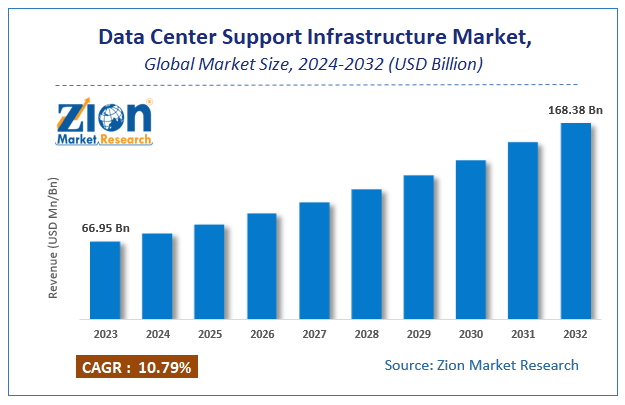
The global data center support infrastructure market size was valued at USD 66.95 billion in 2023 and is projected to reach around USD 168.38 billion by the end of 2032, expanding at a CAGR of approximately 10.79% from the forecast period 2024 to 2032.
The report examines the primary drivers, challenges, and restraints shaping global demand for the data center support infrastructure market throughout the forecast period and identifies high-growth opportunities across the industry.
Key Insights
- As per the analysis shared by our research analyst, the global data center support infrastructure market is estimated to grow at a CAGR of 10.79% during the forecast period (2024-2032).
- In terms of revenue, the global data center support infrastructure market size was valued at around USD 66.95 billion in 2023 and is projected to reach USD 168.38 billion by 2032.
- The market is driven by increasing demand for reliable data storage and efficient processing, growing awareness of the benefits of robust support systems, and favorable cost factors related to materials, maintenance, labor, and transportation.
- Based on the type of infrastructure, the power and cooling systems segment dominated the market with approximately 55% combined share because these systems are essential for ensuring optimal equipment performance, longevity, and handling rising data traffic and hardware density in modern facilities.
- Based on the type of service, the system integration segment dominated the market with approximately 40% share as organizations increasingly require professional expertise to set up and integrate complex, customized support infrastructure with minimal downtime and optimized performance.
- Based on the industry verticals, the IT & telecom segment dominated the market with approximately 32% share due to massive data consumption, the need for high uptime, and continuous expansion of cloud services and mobile networks that demand robust support systems.
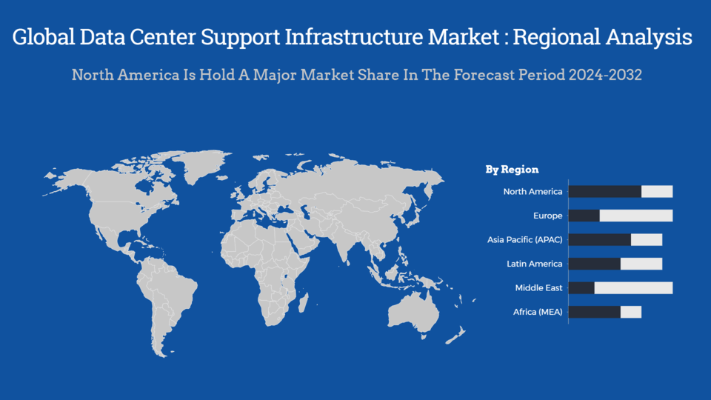
- Based on the region, North America dominated the market with approximately 35% share owing to the presence of major technology firms, mature IT infrastructure, and significant investments in hyperscale data centers, particularly in the United States.
Data Center Support Infrastructure Market: Overview
A data center support infrastructure is nothing but a digitalized infrastructure utilized for promoting data consumption and sharing. Like other infrastructures, it is developed to meet the demand of society and industry for a data economy to function. Data center support infrastructure indicates the crucial operational systems of a particular data center related to a firm, which is needed in its processing operations and data storage. Most of the data center support infrastructures consist of cooling, power, measurement and monitoring systems, and security, which assist in maintaining the data center’s sole operations of data processing and storage.
Data Center Support Infrastructure Market: Growth Drivers
What factors are primarily propelling the expansion of the data center support infrastructure market?
Increasing demand for reliable data storage and efficient processing capabilities forms a core driver as organizations generate and manage ever-larger volumes of information. Growing awareness among industries and enterprises regarding the operational benefits of robust power, cooling, security, and monitoring systems has significantly accelerated market development.
Favorable cost dynamics, including relatively low expenses for raw materials, maintenance, labor, and transportation, further stimulate investment. These elements collectively support the expansion of data centers and the corresponding need for advanced support infrastructure that ensures uptime, performance, and scalability.
Data Center Support Infrastructure Market: Restraints
What challenges are limiting the growth of the data center support infrastructure market?
High complexity associated with designing and implementing integrated support systems can slow deployment timelines and increase project costs. Energy consumption and related efficiency requirements also present constraints as facilities scale to handle denser computing loads.
These factors may limit rapid adoption in certain regions or among organizations with constrained budgets, necessitating careful planning and prioritization of critical infrastructure components to maintain operational continuity.
Data Center Support Infrastructure Market: Opportunities
What emerging prospects exist for stakeholders in the data center support infrastructure market?
The rapid growth of cloud services, hyperscale data centers, and artificial intelligence workloads creates substantial demand for advanced power and cooling solutions. Expansion into emerging markets and the adoption of modular, software-defined infrastructure management open additional avenues for providers.
Collaborations focused on energy-efficient designs, liquid cooling technologies, and integrated monitoring systems further enhance opportunities to deliver differentiated, high-performance solutions across diverse industry verticals.
Data Center Support Infrastructure Market: Challenges
What obstacles must the data center support infrastructure market overcome to achieve sustained growth?
Compliance with evolving energy efficiency mandates, carbon emission reporting requirements, and regional power grid capacity limitations poses ongoing challenges. Ensuring seamless integration of increasingly sophisticated systems while minimizing downtime remains critical.
Addressing these issues requires continuous innovation in modular construction, high-efficiency cooling methods, and digital management platforms to support reliable and sustainable data center operations.
Global Data Center Support Infrastructure Market: Report Scope
| Report Attributes | Report Details |
|---|---|
| Report Name | Data Center Support Infrastructure Market |
| Market Size in 2023 | USD 66.95 Billion |
| Market Forecast in 2032 | USD 168.38 Billion |
| Growth Rate | CAGR of 10.79% |
| Number of Pages | 250 |
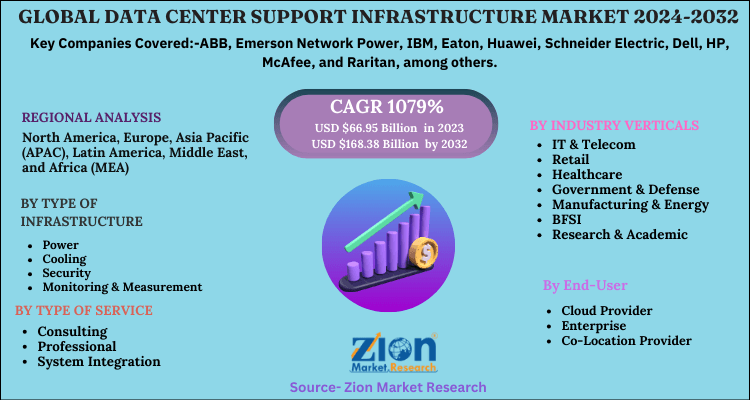
| Key Companies Covered | ABB, Emerson Network Power, IBM, Eaton, Huawei, Schneider Electric, Dell, HP, McAfee, and Raritan, among others |
| Segments Covered | By Type of Infrastructure, By Type of Service, By Industry Verticals, By End-User, and By Region |
| Regions Covered | North America, Europe, Asia Pacific (APAC), Latin America, Middle East, and Africa (MEA) |
| Base Year | 2023 |
| Historical Year | 2018 - 2022 |
| Forecast Year | 2024 - 2032 |
| Customization Scope | Avail customized purchase options to meet your exact research needs. Request For Customization |
Global Data Center Support Infrastructure Market: Segmentation
The data center support infrastructure market is segmented by type of infrastructure, type of service, industry verticals, and region. All the segments of the data center support infrastructure market have been analyzed based on present and future trends and the market is estimated from 2024 to 2032.
Based on Type of Infrastructure, the data center support infrastructure market is divided into power, cooling, security, and monitoring & measurement. The power and cooling systems hold the dominant position as they are indispensable for maintaining optimal equipment performance and longevity amid rising data traffic and higher hardware densities. Reliable power delivery combined with efficient thermal management prevents failures, supports continuous operations, and drives substantial investment, thereby fueling overall market growth through their foundational role in facility reliability. Security and monitoring & measurement systems rank as the next key focus areas, providing essential protection and real-time visibility that complement core power and cooling capabilities.
Based on Type of Service, the data center support infrastructure market is divided into consulting, professional, and system integration. The system integration segment currently leads because organizations increasingly depend on specialized expertise to install and interconnect complex, customized support systems with minimal disruption and maximum performance optimization. This dominance accelerates market expansion by enabling efficient deployment of advanced infrastructure and reducing operational risks for end users. Consulting and professional services follow closely, supporting planning, design, and ongoing management needs that enhance long-term system effectiveness.
Based on Industry Verticals, the data center support infrastructure market is divided into IT & telecom, retail, healthcare, government & defense, manufacturing & energy, BFSI, research & academic, and others. The IT & telecom segment dominates due to the enormous and continuously growing volumes of data traffic, stringent uptime requirements, and ongoing expansion of cloud platforms and mobile networks. These factors generate sustained demand for robust support infrastructure, driving market growth through large-scale investments aimed at maintaining service continuity and performance standards. Other verticals such as healthcare, BFSI, and government & defense contribute steadily as digitalization and data security needs expand across sectors.
Based on End-user, the global data center support infrastructure market is divided into cloud provider, enterprise, and co-location provider.
Data Center Support Infrastructure Market: Regional Analysis
Why will North America continue to dominate the global market during the projection period?
North America sustains its leadership through the concentration of major technology companies, a highly mature IT infrastructure base, and substantial ongoing investments in hyperscale data centers. The United States, in particular, hosts many of the world’s largest facilities and consistently drives innovation in power, cooling, and monitoring solutions. This regional strength propels overall market growth by setting high standards for reliability, scalability, and efficiency that influence global design practices and technology adoption. Continuous upgrades and expansion of cloud and enterprise facilities further reinforce North America’s pivotal role in industry trends and development.
Asia Pacific is the fastest-growing region, supported by rapid technology adoption in countries such as China and India that are expanding digital infrastructure and data center capacity. Europe maintains steady progress through established markets in Germany and other nations focused on energy-efficient and sustainable solutions. Latin America and the Middle East and Africa are advancing as digital transformation initiatives and data economy requirements increase demand for reliable support systems.
Data Center Support Infrastructure Market: Competitive Players
Some main participants of the Data Center Support Infrastructure market are:
- ABB
- Emerson Network Power
- IBM
- Eaton
- Huawei
- Schneider Electric
- Dell
- HP
- McAfee
- Raritan
Segments Covered
The global data center support infrastructure market is segmented as follows:
By Type of Infrastructure
- Power
- Cooling
- Security
- Monitoring & Measurement
By Type of Service
- Consulting
- Professional
- System Integration
By Industry Verticals
- IT & Telecom
- Retail
- Healthcare
- Government & Defense
- Manufacturing & Energy
- BFSI
- Research & Academic
- Others
By End-User
- Cloud Provider
- Enterprise
- Co-Location Provider
By Region
- North America
- The U.S.
- Canada
- Mexico
- Europe
- France
- The UK
- Spain
- Germany
- Italy
- Rest of Europe
- Asia Pacific
- China
- Japan
- India
- Australia
- South Korea
- Rest of Asia Pacific
- The Middle East & Africa
- Saudi Arabia
- UAE
- Egypt
- Kuwait
- South Africa
- Rest of the Middle East & Africa
- Latin America
- Brazil
- Argentina
- Rest of Latin America
Table Of Content
Methodology
FrequentlyAsked Questions
Data center support infrastructure consists of the critical operational systems such as power, cooling, security, and monitoring—required for a data center’s data processing and storage functions, enabling reliable data consumption and sharing within the digital economy.
Key growth drivers include rising demand for efficient data storage and processing, increasing awareness of the benefits of robust support systems, and favorable costs related to materials, maintenance, labor, and transportation.
The global data center support infrastructure market size was worth around USD 66.95 billion in 2023 and is expected to reach USD 168.38 billion by 2032.
The global data center support infrastructure market is expected to grow at a compound annual growth rate (CAGR) of 10.79% during the forecast period from 2024 to 2032.
Major challenges include system design complexity, energy efficiency requirements, carbon emission reporting obligations, and regional power grid capacity constraints.
Emerging trends include the shift toward software-defined management (DCIM), modular plug-and-play construction, and high-efficiency liquid immersion cooling technologies.
The value chain spans from raw component suppliers and equipment manufacturers to system integrators, facility operators, and enterprise end-users.
North America is expected to dominate and contribute notably toward market value over the forecast period.
Major players include ABB, Emerson Network Power, IBM, Eaton, Huawei, Schneider Electric, Dell, HP, McAfee, and Raritan, among others.
The report explores crucial aspects of the market, including a detailed discussion of existing growth factors and restraints, while also examining future growth opportunities and challenges that impact the market.

HappyClients

