
Critical Care Equipment Market Growth, Size, Share, Trends, and Forecast 2032

Critical Care Equipment Market By Products (eeding tubes, hemodialysis machines, CRRT machines, multiparameter monitoring devices, ECG devices, ventilators, and infusion pumps), By Applications (neurology, cardiology, renal care, and others), By End-use (specialty clinics, ambulatory surgical centers, hospitals, and others) And By Region: - Global and Regional Industry Overview, Market Intelligence, Comprehensive Analysis, Historical Data, and Forecasts, 2024-2032
| Market Size in 2023 | Market Forecast in 2032 | Growth Rate (in %) | Base Year |
|---|---|---|---|
| USD 31.60 Billion | USD 79.63 Billion | CAGR at 10.82% | 2023 |
Description
How big is the Critical Care Equipment Market?
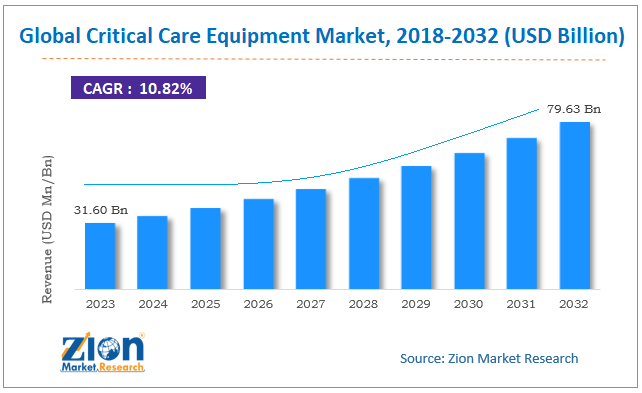
According to the report published by Zion Market Research, the global Critical Care Equipment Market size was valued at USD 31.60 Billion in 2023 and is predicted to reach USD 79.63 Billion by the end of 2032. The market is expected to grow with a CAGR of 10.82% during the forecast period. The report analyzes the global Critical Care Equipment Market’s growth drivers, restraints, and impact on demand during the forecast period. It will also help navigate and explore the arising opportunities in the Critical Care Equipment Market industry.
Global Critical Care Equipment Market: Overview
Critical care is also called intensive care. It is a vital medical practice used to treat and cure various life threatening diseases. In the critical care unit, professional medical practitioners treat and monitor the patient under controlled conditions with help of critical care equipment. Critical care equipment facilitates professionals to generate accurate information about the health of the patient. This equipment aids the patient in providing life-supporting post major surgeries. Critical care is a kind of specialized care that needs constant monitoring and comprehensive care.
Global Critical Care Equipment Market: Growth Factors
Innovation and developments in critical care devices utilized in the intensive care unit and surgical procedure facilitate improved patient care. Moreover, the advanced critical care devices that are being developed aid in easier and faster access to patient health status. The surging prevalence of kidney failure is boosting the growth of the global critical care equipment market. Thus the demand for CRRT machines is constantly increasing. However, surging cases of the renal failure is also contributing significantly toward the growth of the global market. The rising investments in research and development of critical care devices further propel the global market. The integration of the advancing technology with the critical care devices led to the monitoring of the health status of the patients at frequent intervals also boost market growth.
The growing geriatric population is one of the major factors driving the global critical care equipment market. The significant spike in coronary heart-related cases in recent years increased the demand for the critical care devices which in turn propelled the market growth vigorously. The growing support of the governments in the healthcare sector is anticipated to sustain the growth of the global market. The technological advancements across the globe are positively shaping the trajectory of the global critical care equipment market.
The emergence of the COVID-19 has supported the global market and the prominent market players are constantly launching new products with distinct features to easily penetrate the market and thus help in the expansion of the global market.
Global Critical Care Equipment Market: Segmentation
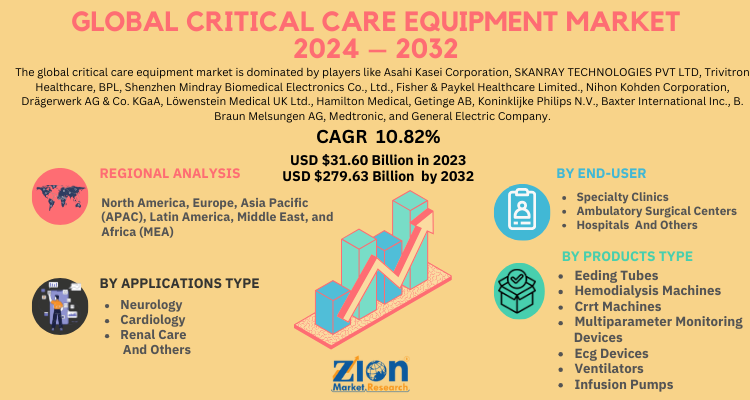
The global critical care equipment market can be segmented into products, applications, end-use, and region.
By products, the market can be segmented into feeding tubes, hemodialysis machines, CRRT machines, multiparameter monitoring devices, ECG devices, ventilators, and infusion pumps.The ventilator product dominates the market owing to the soaring number of critical patients.
By application field, the market can be segmented into neurology, cardiology, renal care, and others. The neurology segment holds hegemony over others owing to the growing number of neurology patients. The surging incidences of serious neurological disorders such as stroke, chronic low back pain (CLBP), multiple sclerosis (MS), migraine headache, spinal cord injury boost the growth of the segment.
By end-use, the market can be segmented into specialty clinics, ambulatory surgical centers, hospitals, and others. The hospital segment holds the largest share in the global critical care equipment market due to the surging number of cases requiring critical care in the hospital coupled with improved healthcare infrastructure.
Critical Care Equipment Market : Report Scope
| Report Attributes | Report Details |
|---|---|
| Report Name | Critical Care Equipment Market Research Report |
| Market Size in 2023 | USD 31.60 Billion |
| Market Forecast in 2032 | USD 79.63 Billion |
| Growth Rate | CAGR of 10.82% |
| Number of Pages | 196 |
| Key Companies Covered | Asahi Kasei Corporation, SKANRAY TECHNOLOGIES PVT LTD, Trivitron Healthcare, BPL, Shenzhen Mindray Biomedical Electronics Co., Ltd., Fisher & Paykel Healthcare Limited., Nihon Kohden Corporation, Drägerwerk AG & Co. KGaA, Löwenstein Medical UK Ltd., Hamilton Medical, Getinge AB, Koninklijke Philips N.V., Baxter International Inc., B. Braun Melsungen AG, Medtronic, and General Electric Company. |
| Segments Covered | By Products, By Applications, By End-use and By Region |
| Regions Covered | North America, Europe, Asia Pacific (APAC), Latin America, Middle East, and Africa (MEA) |
| Base Year | 2023 |
| Historical Year | 2018 to 2022 |
| Forecast Year | 2024 - 2032 |
| Customization Scope | Avail customized purchase options to meet your exact research needs. Request For Customization |
Global Critical Care Equipment Market: Regional analysis
North America holds the largest share in the global critical care equipment market due to the increasing support from the government to promote the healthcare sector specifically the critical care unit. The surging number of geriatric population and the growing prevalence of chronic diseases also contribute to the regional growth. Moreover, the presence of prominent players in the region also boosts regional market growth.
Asia Pacific is anticipated to witness huge growth due to the surging number of multi-specialty & super-specialty hospitals and the increasing number of chronic disease cases in the region.
Europe is growing fastly in the global critical care equipment market due to the growing technological advancements and proliferation of the healthcare sector in the region.
Global Critical Care Equipment Market: Competitive Players
Some of the significant players in the global critical care equipment market are:
- Asahi Kasei Corporation
- SKANRAY TECHNOLOGIES PVT LTD
- Trivitron Healthcare
- BPL
- Shenzhen Mindray Biomedical Electronics Co., Ltd.
- Fisher & Paykel Healthcare Limited.
- Nihon Kohden Corporation
- Drägerwerk AG & Co. KGaA
- Löwenstein Medical UK Ltd.
- Hamilton Medical
- Getinge AB
- Koninklijke Philips N.V.
- Baxter International Inc.
- B. Braun Melsungen AG
- Medtronic
- General Electric Company.
The Global Critical Care Equipment Market is segmented as follows:
By Products
- eeding tubes
- hemodialysis machines
- CRRT machines
- multiparameter monitoring devices
- ECG devices
- ventilators
- infusion pumps
By Applications
- neurology
- cardiology
- renal care
- and others
By End-use
- specialty clinics
- ambulatory surgical centers
- hospitals
- and others
By Region
- North America
- The U.S.
- Canada
- Mexico
- Europe
- France
- The UK
- Spain
- Germany
- Italy
- Rest of Europe
- Asia Pacific
- China
- Japan
- India
- Australia
- South Korea
- Rest of Asia Pacific
- The Middle East & Africa
- Saudi Arabia
- UAE
- Egypt
- Kuwait
- South Africa
- Rest of the Middle East & Africa
- Latin America
- Brazil
- Argentina
- Rest of Latin America
What Reports Provides
- Full in-depth analysis of the parent market
- Important changes in market dynamics
- Segmentation details of the market
- Former, on-going, and projected market analysis in terms of volume and value
- Assessment of niche industry developments
- Market share analysis
- Key strategies of major players
- Emerging segments and regional markets
- Testimonials to companies in order to fortify their foothold in the market.
Table Of Content

FrequentlyAsked Questions
Critical care equipment includes medical devices used to treat patients with life-threatening conditions. Examples include ventilators, monitors, and infusion pumps.
The global Critical Care Equipment market is expected to be driven by the Driven by growing ICU admissions, aging populations, and rising chronic disease burden. Increasing hospital investments and innovation in monitoring, ventilators, and infusion systems support demand.
According to study, the global Critical Care Equipment market size was worth around USD 31.60 Billion in 2023 and is predicted to grow to around USD 79.63 Billion By 2032.
The global Critical Care Equipment market is expected to grow at a Compound Annual Growth Rate (CAGR) of around CAGR 10.82% during the forecast period from 2024-2032.
The global Critical Care Equipment industry is projected to be challenged by High cost and long procurement cycles; stringent regulatory and quality requirements; maintenance, training, and interoperability challenges in ICUs.
The Rising ICU demand from aging populations and chronic disease; growth in home/step-down monitoring solutions; smart, connected devices improve outcomes and workflow will offer significant growth opportunities in the Critical Care Equipment market.
Connected ICU devices for centralized monitoring; automation/AI decision support for alarms and workflows; compact portable systems for surge capacity are the emerging trends and innovations impacting the Critical Care Equipment market.
The global Critical Care Equipment market is expected to be led by North America during the forecast period.
Some of the prominent players operating in the global Critical Care Equipment market are; Asahi Kasei Corporation, SKANRAY TECHNOLOGIES PVT LTD, Trivitron Healthcare, BPL, Shenzhen Mindray Biomedical Electronics Co., Ltd., Fisher & Paykel Healthcare Limited., Nihon Kohden Corporation, Drägerwerk AG & Co. KGaA, Löwenstein Medical UK Ltd., Hamilton Medical, Getinge AB, Koninklijke Philips N.V., Baxter International Inc., B. Braun Melsungen AG, Medtronic, and General Electric Company. and others.
The report explores crucial aspects of the Critical Care Equipment market, including a detailed discussion of existing growth factors and restraints, while also browsing future growth opportunities and challenges that impact the market.
HappyClients

