
Global Cosmetic Laser Market Size, Growth Trends, Share Analysis, and Forecast 2032

Cosmetic Laser Market By Type (Standalone Laser Devices and Multiplatform Laser Devices), By Modality (Carbon Dioxide Lasers, Erbium YAG Lasers, Diode Lasers, Pulsed Dye Lasers, ND: YAG Lasers, Alexandrite Lasers, and Others), By Applications (Vascular Lesions, Acne & Scars, Pigmented Lesions & Tattoos Removal, Hair Removal, Skin Rejuvenation, Leg & Varicose Veins, Body & Face Contouring, and Others), By End User (Hospital, Private Clinics, and Medical Spas), By Region: Global and Regional Industry Overview, Market Intelligence, Comprehensive Analysis, Historical Data, and Forecasts 2024 - 2032
| Market Size in 2023 | Market Forecast in 2032 | CAGR (in %) | Base Year |
|---|---|---|---|
| USD 2964.71 Million | USD 7019.28 Million | 10.05% | 2023 |
Cosmetic Laser Industry Perspective
What will be the global Cosmetic Laser market size during the forecast period?
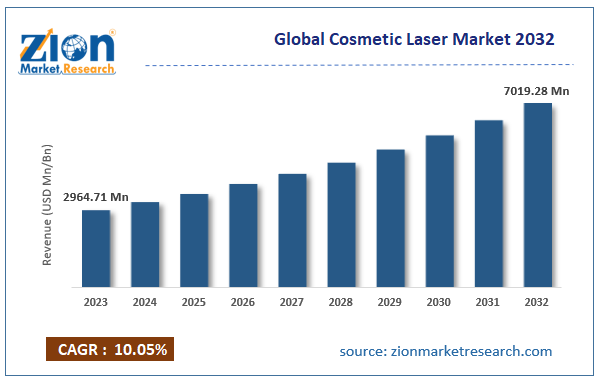
The global cosmetic laser market size was worth around USD 2964.71 million in 2023 and is predicted to grow to around USD 7019.28 million by 2032, with a compound annual growth rate (CAGR) of roughly 10.05% between 2024 and 2032.
This report provides an in-depth analysis of the drivers, market restraints, and demand-side factors governing the global cosmetic laser industry, uncovering critical emerging opportunities for stakeholders during the forecast period.
Key Insights
- As per the analysis shared by our research analyst, the cosmetic Laser market is anticipated to grow at a CAGR of 10.05% during the forecast period (2024-2032).
- The global cosmetic Laser market was estimated to be worth approximately USD 2964.71 million in 2023 and is projected to reach a value of USD 7019.28 million by 2032.
- The growth of the cosmetic Laser market is being driven by increasing demand for non-invasive and minimally invasive aesthetic treatments.
- Based on the type, the standalone laser devices segment is growing at a high rate and is projected to dominate the market.
- On the basis of modality, the carbon dioxide lasers segment is projected to capture the largest market share.
- In terms of application, the vascular lesions, acne, and scars segment is expected to dominate the market.
- Based on the sales channels, the hospital segment is expected to dominate the market.
- By region, North America is expected to dominate the global market during the forecast period.
Cosmetic Laser Market: Overview
Cosmetic lasers are medical devices that utilize the principle of light amplification by stimulated emission of radiation to deliver concentrated, short, and pulsating beams of light for aesthetic treatments. These systems enable precise targeting of skin irregularities, wrinkles, pigmented lesions, hair follicles, vascular structures, and other aesthetic concerns through selective photothermolysis, allowing layer-by-layer skin resurfacing or tissue interaction with minimal invasiveness and relatively cost-effective outcomes compared with traditional surgical approaches.
Cosmetic Laser Market: Growth Drivers
What factors are primarily accelerating demand for cosmetic lasers?
The growing beauty consciousness and aesthetic concepts among people are the major factors that are driving the growth of the global cosmetic laser market. The old cosmetic surgery techniques and solutions were time-consuming and not feasible; thus, consumers prefer laser treatment, which is cost-effective as well as gives a permanent solution, contributing to global market growth.
Factors such as an increase in disposable income, the rapid development of laser technology, and high adoption of aesthetic procedures are some of the factors driving the market growth. Also, the rapid increase in the number of accidents and burns, the increase in the obese population, and the melanin-deficient population are also expected to fuel the growth of the global cosmetic laser market.
Cosmetic Laser Market: Restraints
What challenges could limit the expansion of the cosmetic laser market?
The shortage of professionally trained personnel capable of safely operating advanced laser systems restricts broader adoption, particularly in emerging markets and smaller clinics. Limited reimbursement coverage for elective aesthetic procedures places the full cost burden on patients, which can slow uptake among price-sensitive consumers.
Regulatory requirements for device clearance and practitioner training also add complexity and cost for manufacturers and providers, potentially delaying market entry of new technologies in certain regions.
Cosmetic Laser Market: Report Scope
| Report Attributes | Report Details |
|---|---|
| Report Name | Cosmetic Laser Market |
| Market Size in 2023 | USD 2964.71 Million |
| Market Forecast in 2032 | USD 7019.28 Million |
| Growth Rate | CAGR of 10.05% |
| Number of Pages | 210 |
| Key Companies Covered | Solta Medical Cutera, Inc., Aerolase, Cynosure, Inc., Lutronic, Alma Lasers, Ltd., Lumenis Ltd., Sciton, Inc., Syneron Medical Inc., SharpLight Technologies, and others. |
| Segments Covered | By Type, By Modality, By Application, By Sales Channels, and By Region |
| Regions Covered | North America, Europe, Asia Pacific (APAC), Latin America, The Middle East and Africa (MEA) |
| Base Year | 2023 |
| Historical Year | 2018 - 2022 |
| Forecast Year | 2024 - 2032 |
| Customization Scope | Avail customized purchase options to meet your exact research needs. Request For Customization |
Cosmetic Laser Market: Segmentation
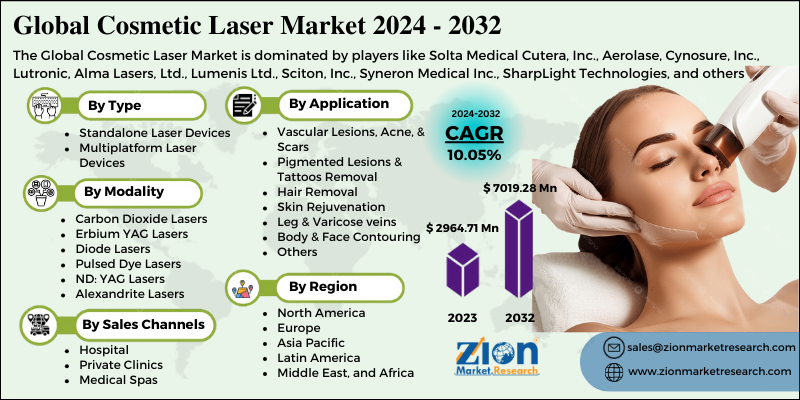
The Cosmetic Laser market is segmented by type, modality, application, sales channels, and region.
Based on Type Segment, the Cosmetic Laser market is divided into Standalone Laser Devices and Multiplatform Laser Devices. Standalone laser devices represent the most dominant sub-segment and are projected to continue leading the market. These systems deliver specialized, high-performance results for dedicated indications and are widely trusted in clinical environments for their reliability and optimized parameters. Their focused design supports strong adoption by hospitals and specialized practices that prioritize clinical excellence for specific procedures, thereby driving overall market value through consistent utilization and proven outcomes.
Based on Modality Segment, the Cosmetic Laser market is divided into Carbon Dioxide Lasers, Erbium YAG Lasers, Diode Lasers, Pulsed Dye Lasers, ND: YAG Lasers, Alexandrite Lasers, and Others. Carbon dioxide lasers hold the largest market share due to their established efficacy in precise ablative and fractional skin resurfacing, scar revision, and treatment of various dermatological conditions. Their ability to deliver controlled tissue interaction with good clinical results has made them a cornerstone modality in aesthetic practices, supporting high procedure volumes and market leadership.
Based on Application Segment, the Cosmetic Laser market is divided into Vascular Lesions, Acne, and Scars, Pigmented Lesions & Tattoo Removal, Hair Removal, Skin Rejuvenation, Leg & Varicose Veins, Body & Face Contouring, and Others. Vascular lesions, acne, and scars constitute the dominant application segment because of the high prevalence of these concerns and the proven ability of lasers to deliver targeted, effective, and lasting improvements with relatively low downtime. Strong patient demand for solutions in these areas drives significant procedure volumes and anchors a substantial portion of market revenue.
Based on Sales Channels Segment, the Cosmetic Laser market is divided into Hospital, Private Clinics, and Medical Spas. The hospital segment is expected to dominate due to its advanced infrastructure, access to highly trained specialists, and ability to manage a wide spectrum of complex aesthetic and reconstructive laser procedures. Hospitals often serve as referral centers and early adopters of new technologies, supporting both volume and value growth.
Cosmetic Laser Market: Regional Analysis
Why will North America continue to dominate the global market during the projection period?
North America is expected to dominate the global cosmetic laser market throughout the forecast period. The region benefits from high consumer awareness of aesthetic procedures, substantial disposable incomes, and a well-developed network of hospitals, private clinics, and medical spas equipped with advanced laser systems. The United States, in particular, drives regional leadership through strong demand for non-invasive treatments, a large base of trained practitioners, and continuous introduction of innovative technologies. Favorable regulatory pathways for device clearance and a culture that values appearance-enhancing procedures further reinforce market strength and set trends that influence global adoption patterns.
Europe maintains a significant share, supported by advanced healthcare systems, high standards of aesthetic care, and growing demand for minimally invasive treatments in countries such as Germany, the United Kingdom, and France.
Recent Development
- In September 2025, Apollo Biowellness, Inc. announced that it had signed a Letter of Intent with Revive Regenerative, Inc., a leading provider of aesthetic laser and energy devices for plastic surgeons, dermatologists, med spas, and wellness centers.
- In March 2025, Alma Lasers introduced the Alma Harmony platform, equipped with advanced energy capabilities and five integrated technologies, such as Q-Switch Laser, IPL, and Green Diode Laser. Designed to deliver personalized, multi-wavelength treatments for applications including skin rejuvenation, acne therapy, hair removal, and more, the platform enhances efficiency, ease of use, and overall patient outcomes.
- In March 2025, Lumenis extended its FoLix fractional laser treatment for hair loss to the Canadian market. The treatment utilizes non-ablative fractional laser technology to stimulate hair follicles and promote tissue regeneration, providing a non-surgical solution with minimal downtime.
Cosmetic Laser Market: Competitive Analysis
The global cosmetic laser market is led by players like:
- Solta Medical Cutera, Inc.
- Aerolase
- Cynosure, Inc.
- Lutronic
- Alma Lasers, Ltd.
- Lumenis Ltd.
- Sciton, Inc.
- Syneron Medical Inc.
- SharpLight Technologies
This report segments the global cosmetic laser market as follows:
By Type
- Standalone Laser Devices
- Multiplatform Laser Devices
By Modality
- Carbon Dioxide Lasers
- Erbium YAG Lasers
- Diode Lasers
- Pulsed Dye Lasers
- ND: YAG Lasers
- Alexandrite Lasers
- Others
By Application
- Vascular Lesions, Acne, and Scars
- Pigmented Lesions & Tattoo Removal
- Hair Removal
- Skin Rejuvenation
- Leg & Varicose Veins
- Body & Face Contouring
- Others
By Sales Channels
- Hospital
- Private Clinics
- Medical Spas
By Region
- North America
- The U.S.
- Canada
- Mexico
- Europe
- France
- The UK
- Spain
- Germany
- Italy
- Rest of Europe
- Asia Pacific
- China
- Japan
- India
- Australia
- South Korea
- Rest of Asia Pacific
- The Middle East & Africa
- Saudi Arabia
- UAE
- Egypt
- Kuwait
- South Africa
- Rest of the Middle East & Africa
- Latin America
- Brazil
- Argentina
- Rest of Latin America
Table Of Content
Methodology
FrequentlyAsked Questions
Cosmetic lasers are devices that use concentrated beams of light based on the principle of selective photothermolysis to treat aesthetic skin concerns. They precisely target irregularities such as wrinkles, scars, pigmented lesions, vascular structures, and hair follicles, enabling layer-by-layer resurfacing or controlled tissue interaction with minimal invasiveness.
Key growth drivers include increasing demand for non-invasive and minimally invasive aesthetic treatments, rising beauty consciousness, higher disposable incomes, rapid technological advancements in laser systems, and growing adoption of aesthetic procedures for conditions related to scars, pigmentation, hair removal, and skin rejuvenation.
According to a study, the global cosmetic laser market size was worth around USD 2964.71 million in 2023 and is predicted to grow to around USD 7019.28 million by 2032.
The CAGR value of the cosmetic laser market is expected to be around 10.05% during 2024-2032.
North America is expected to dominate the cosmetic laser market over the forecast period.
The global cosmetic laser market is led by players like Solta Medical Cutera, Inc., Aerolase, Cynosure, Inc., Lutronic, Alma Lasers, Ltd., Lumenis Ltd., Sciton, Inc., Syneron Medical Inc., and SharpLight Technologies, among others.

HappyClients

