
Cleaning Robot Market Size, Share, Trends and Forecast, 2032

Cleaning Robot Market By Vertical (Commercial, Healthcare, Residential, Industrial, And Others), By Product (Lawn Robot, Pool Robot, Floor Robot, Window Robot, And Others), By Region - Global And Regional Industry Overview, market Intelligence, Comprehensive Analysis, Historical Data, And Forecasts 2024-2032
| Market Size in 2023 | Market Forecast in 2032 | CAGR (in %) | Base Year |
|---|---|---|---|
| USD 5.20 Billion | USD 33.03 Billion | 22.8% | 2023 |
Description
What is the projected value for the Cleaning Robot Market during 2024 to 2032?
The global cleaning robot market size was worth around USD 5.20 billion in 2023 and is predicted to grow to around USD 33.03 billion by 2032 with a compound annual growth rate (CAGR) of roughly 22.8% between 2024 and 2032.
The study provides historical data from 2018 to 2022 along with a forecast from 2024 to 2032 based on revenue (USD billion). The report covers a forecast and an analysis of the Cleaning Robot market on a global and regional level.
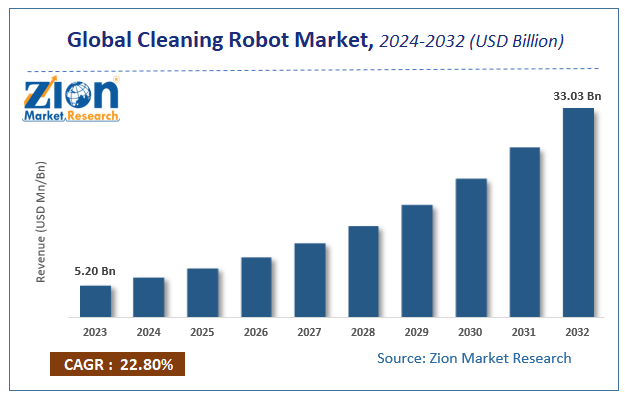
Global Cleaning Robot Market: Overview
Cleaning is one of the basic needs of a household that has to be done on a regular basis and consumes time as well as energy. Cleaning robot is a self-sufficient robot that is designed to clean lawns, windows, floor, and others. It is also employed in UV sterilization, mopping, and other functions in the household and industrial applications. It reduces human efforts and also saves time and electricity. People having disabilities can use these cleaning robots as a substitute for costly housekeeping services. Technological improvements have made robots more intellectual and they are capable of the detecting different quantity of dirt at various locations.
Global Cleaning Robot Market: Growth Factors
One of the main reasons for the boost in the market is its capability to fit in limited space and smaller size in comparison with the traditional robots. The cleaning robots also have a potential to clean places with dangerous surroundings and where the human entrance could be lethal. These robots save time and labor cost as a single robot is designed to perform the task of several laborers in less time, which further drives the market for cleaning robots. Additionally, the technological improvements, specifically in sensing and visualization equipment are anticipated to fuel the market. The inception of futuristic robotics is encouraging the development of smaller size, low-cost, and technologically enhanced cleaning robots. However, the low durability and battery life problems are few factors that may impede the growth of the market for cleaning robots.
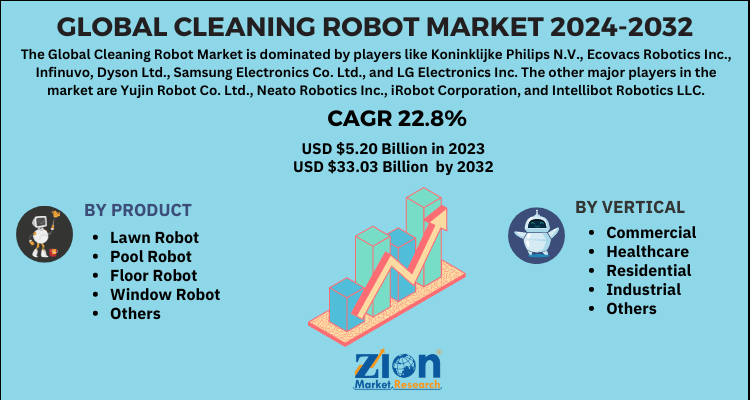
Global Cleaning Robot Market: Segmentation
The global cleaning robot market can be segmented based on vertical, product, and region.
The vertical segment of the market is categorized into commercial, healthcare, residential, industrial, and others.
The product segment of the market is diversified into lawn robot, pool robot, floor robot, window robot, and others.
Recent Development
- In November 2025, Dreame launched the Aqua10 Ultra Roller Complete in Israel, a next-generation scrubbing robotic vacuum designed for advanced autonomous home cleaning. The device combines high suction power with an automated, self-cleaning washing system, offering an enhanced, efficient cleaning experience.
- In February 2025, Nilfisk launched its next-generation vacuum cleaners, including the VP300 and VP400 compact canister vacuums and the VU200 cordless stick vacuum. Engineered for high performance, intuitive controls, and easy maneuverability, these professional-use vacuums feature enhanced filtration systems and user-friendly designs, forming part of Nilfisk’s expanded lineup of next-generation solutions being introduced throughout 2025.
- In January 2025, Ecovacs Robotics, Inc. showcased its latest innovations at CES 2025, including the DEEBOT X8 PRO OMNI with advanced self-washing mopping technology and the GOAT A3000 LiDAR robotic lawn mower with multi-technology navigation. The company also expanded its WINBOT series for improved window cleaning. The DEEBOT X8 PRO OMNI and T50 MAX PRO models were officially launched in February 2025.
- In January 2025, Roborock, a Chinese consumer goods company, unveiled the Saros Z70 at CES 2025 in Las Vegas. Marketed as the world’s first mass-produced robot vacuum with an intelligent, foldable robotic arm (OmniGrip), the device combines advanced cleaning capabilities with multitasking functionality, representing a significant innovation in consumer robotics.
- In December 2024, Skyline Robotics partnered with Alimak Group to automate building maintenance by combining Alimak’s access solutions with Skyline’s robotics technology. The collaboration focuses on autonomous window cleaning using Skyline’s Ozmo robot, aiming to enhance operational efficiency and sustainability while addressing labor shortages in the construction industry. As part of the initiative, Alimak Group also invested in Skyline to support this partnership.
Cleaning Robot Market: Report Scope
| Report Attributes | Report Details |
|---|---|
| Report Name | Cleaning Robot Market |
| Market Size in 2023 | USD 5.20 Billion |
| Market Forecast in 2032 | USD 33.03 Billion |
| Growth Rate | CAGR of 22.8% |
| Number of Pages | 215 |
| Key Companies Covered | Koninklijke Philips N.V., Ecovacs Robotics Inc., Infinuvo, Dyson Ltd., Samsung Electronics Co. Ltd., and LG Electronics Inc. The other major players in the market are Yujin Robot Co. Ltd., Neato Robotics Inc., iRobot Corporation, and Intellibot Robotics LLC |
| Segments Covered | By vertical, By product and By Region |
| Regions Covered | North America, Europe, Asia Pacific (APAC), Latin America, Middle East, and Africa (MEA) |
| Base Year | 2023 |
| Historical Year | 2018 to 2022 |
| Forecast Year | 2024 - 2032 |
| Customization Scope | Avail customized purchase options to meet your exact research needs. Request For Customization |
Global Cleaning Robot Market: Regional Analysis
Geographically, the cleaning robot market is grouped into Europe, North America, Asia-Pacific, Latin America, and the Middle East & Africa. North America is expected to rule the market for cleaning robots in the near future owing to the higher utilization of cleaning products among the households in the developed economies. Asia Pacific region is also anticipated to grow at a significant pace in the market owing to the rapidly increasing acceptance of such products by the middle-class families, as a result of the growing expendable income and the transforming lifestyle in developing economies.
Global Cleaning Robot Market: Competitive Players
The prominent players in the global cleaning robot market include:
- Koninklijke Philips N.V.
- Ecovacs Robotics Inc.
- Infinuvo
- Dyson Ltd.
- Samsung Electronics Co. Ltd.
- LG Electronics Inc.
- Yujin Robot Co. Ltd.
- Neato Robotics Inc.
- iRobot Corporation
- Intellibot Robotics LLC.
The Global Cleaning Robot Market is segmented as follows:
By Vertical
- Commercial
- Healthcare
- Residential
- Industrial
- Others
By Product
- Lawn Robot
- Pool Robot
- Floor Robot
- Window Robot
- Others
By Region
- North America
- The U.S.
- Canada
- Mexico
- Europe
- France
- The UK
- Spain
- Germany
- Italy
- Rest of Europe
- Asia Pacific
- China
- Japan
- India
- Australia
- South Korea
- Rest of Asia Pacific
- The Middle East & Africa
- Saudi Arabia
- UAE
- Egypt
- Kuwait
- South Africa
- Rest of the Middle East & Africa
- Latin America
- Brazil
- Argentina
- Rest of Latin America
What Report Provides
- Full in-depth analysis of the parent market
- Important changes in market dynamics
- Segmentation details of the market
- Former, on-going, and projected market analysis in terms of volume and value
- Assessment of niche industry developments
- Market share analysis
- Key strategies of major players
- Emerging segments and regional markets
- Testimonials to companies in order to fortify their foothold in the market.
Table Of Content

FrequentlyAsked Questions
A cleaning robot is an automated device designed to clean floors or surfaces with minimal human effort. It uses sensors and software to navigate and perform cleaning tasks.
The global Cleaning Robot market is expected to be driven by the Driven by labor shortages in commercial cleaning, rising demand for automated hygiene solutions, and growth in smart facilities. Better navigation, lower costs, and increasing adoption in homes, hospitals, and retail accelerate growth.
According to study, the global Cleaning Robot market size was worth around USD 5.20 Billion in 2023 and is predicted to grow to around USD 33.03 Billion By 2032.
The global Cleaning Robot market is expected to grow at a Compound Annual Growth Rate (CAGR) of around CAGR 22.8% during the forecast period from 2024-2032.
The global Cleaning Robot industry is projected to be challenged by Challenges include navigation limits in cluttered spaces, battery/runtime constraints, and pricing competition from low-cost brands.
The Opportunities include growing demand for home automation, commercial floor-cleaning adoption, and improved AI mapping, self-emptying, and IoT connectivity features will offer significant growth opportunities in the Cleaning Robot market.
Improved navigation with SLAM + vision and obstacle avoidance; self-emptying/self-cleaning docks for autonomy; fleet management for commercial facilities are the emerging trends and innovations impacting the Cleaning Robot market.
The global Cleaning Robot market is expected to be led by APAC during the forecast period.
Some of the prominent players operating in the global Cleaning Robot market are; Koninklijke Philips N.V., Ecovacs Robotics Inc., Infinuvo, Dyson Ltd., Samsung Electronics Co. Ltd., and LG Electronics Inc. The other major players in the market are Yujin Robot Co. Ltd., Neato Robotics Inc., iRobot Corporation, and Intellibot Robotics LLC and others.
The report explores crucial aspects of the Cleaning Robot market, including a detailed discussion of existing growth factors and restraints, while also browsing future growth opportunities and challenges that impact the market.
HappyClients

