
Global Chronic Hemodialysis Catheter Market Size, Share, Analysis, Trends, Forecasts 2032

Chronic Hemodialysis Catheter Market By End-user ( the home and in-center dialysis), By Type of tip (symmetric tip catheters, tip without side holes, tip with side holes, split type, and step tip), By Material (polyurethane and silicone) And By Region: - Global and Regional Industry Overview, Market Intelligence, Comprehensive Analysis, Historical Data, and Forecasts, 2024-2032
| Market Size in 2023 | Market Forecast in 2032 | Growth Rate (in %) | Base Year |
|---|---|---|---|
| USD 405.68 Million | USD 550.55 Million | CAGR at 3.43% | 2023 |
Description
What is the Chronic Hemodialysis Catheter Market Size?
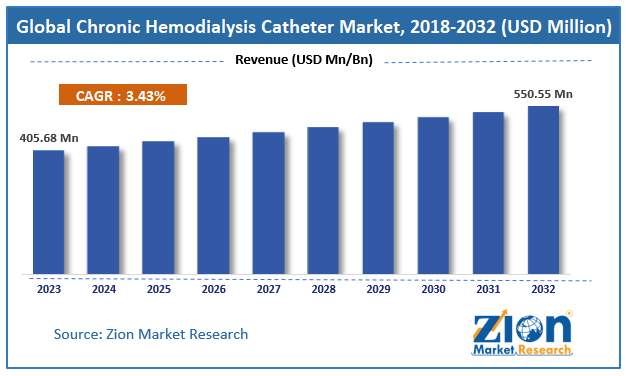
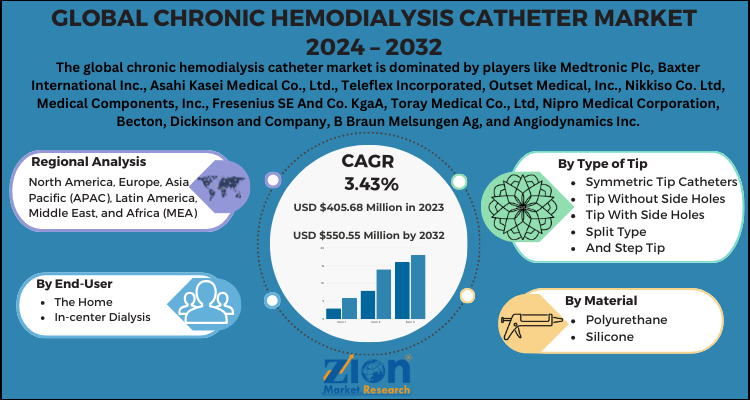
According to the report published by Zion Market Research, the global Chronic Hemodialysis Catheter Market size was valued at USD 405.68 Million in 2023 and is predicted to reach USD 550.55 Million by the end of 2032. The market is expected to grow with a CAGR of 3.43% during the forecast period. The report analyzes the global Chronic Hemodialysis Catheter Market’s growth drivers, restraints, and impact on demand during the forecast period. It will also help navigate and explore the arising opportunities in the Chronic Hemodialysis Catheter Market industry.
North America Chronic Hemodialysis Catheter Market Sales and Revenue: North America held a leading share of the global chronic hemodialysis catheter market, with a market size of USD 156.15 million in 2023. The market is projected to grow at a CAGR of 3.47% from 2024 to 2032, reaching approximately USD 211.66 million by 2032.
Europe Chronic Hemodialysis Catheter Market Sales and Revenue: Europe accounted for a significant portion of the global market, valued at USD 116.08 million in 2023. The region is expected to expand at a CAGR of 2.68% from 2024 to 2032, reaching nearly USD 147.50 million by 2032.
Asia Pacific Chronic Hemodialysis Catheter Market Sales and Revenue: Asia Pacific represented a steadily growing regional market with a size of USD 98.77 million in 2023. The region is anticipated to register the fastest growth at a CAGR of 4.83% from 2024 to 2032, reaching about USD 150.56 million by 2032.
Latin America Chronic Hemodialysis Catheter Market Sales and Revenue: Latin America was valued at USD 16.65 million in 2023. The market is forecasted to grow at a CAGR of 1.64% from 2024 to 2032, reaching approximately USD 19.62 million by 2032.
Middle East Chronic Hemodialysis Catheter Market Sales and Revenue: The Middle East market stood at USD 10.98 million in 2023 and is projected to grow at a CAGR of 1.04% from 2024 to 2032, reaching around USD 11.97 million by 2032.
Africa Chronic Hemodialysis Catheter Market Sales and Revenue: Africa accounted for a market size of USD 7.05 million in 2023. The market is expected to grow at a CAGR of 0.84% from 2024 to 2032, reaching nearly USD 8.23 million by 2032.
Global Chronic Hemodialysis Catheter Market: Overview
Hemodialysis is a blood filtration process that helps patients suffering from kidney failures. The process is carried out with the help of a dialysis machine where the patient is connected to the machine using the catheter as a linking tube. There are two types of lumens catheters used for the exchange of blood. One is in red color while the other is in blue for the easy identification of them during the dialysis process. The red color lumen catheter withdraws the blood from the body of the patient and transfers it to the dialysis filtration machine. While the blue-colored lumen catheter restores the blood in the body of the patient after the filtration process from the dialysis machine. However, when a patient needs long-term hemodialysis therapy, then a chronic hemodialysis catheter is used in the dialysis process. Several types of chronic hemodialysis catheters are available in the market.
Key Insights:
- As per the analysis shared by our research analyst, the chronic hemodialysis catheter market is anticipated to grow at a CAGR of 3.43% during the forecast period (2024-2032).
- The global chronic hemodialysis catheter market was estimated to be worth approximately USD 405.68 million in 2023 and is projected to reach a value of USD 550.55 million by 2032.
- The growth of the chronic hemodialysis catheter market is being driven by growing prevalence of end-stage renal diseases will promulgate.
- Based on the end-user, the home segment is growing at a high rate and is projected to dominate the market.
- On the basis of type of tip, the symmetric tip catheters segment is projected to swipe the largest market share.
- In terms of material, the polyurethane segment is expected to dominate the market.
- By region, North America is expected to dominate the global market during the forecast period.
Chronic Hemodialysis Catheter Market Dynamics:
Key growth drivers
The Chronic Hemodialysis Catheter Market is primarily driven by the rising global prevalence of chronic kidney diseases (CKD) and end-stage renal disease (ESRD). Conditions such as diabetes and hypertension are leading causes of CKD, and with the global aging population and a rise in lifestyle-related diseases, the patient pool requiring long-term dialysis is expanding. This creates a sustained demand for chronic hemodialysis catheters, which are essential for providing vascular access for patients who have exhausted other options like arteriovenous fistulas or grafts. Furthermore, advancements in catheter design, including antimicrobial coatings and improved materials, are enhancing patient safety, reducing complications, and increasing the lifespan of the devices, which further fuels market adoption.
Restraints
Despite the strong growth drivers, the market faces several key restraints. A major concern is the high risk of complications associated with chronic catheters, most notably catheter-related bloodstream infections and thrombosis. These complications can lead to hospitalization, increased healthcare costs, and, in severe cases, be life-threatening. The high cost of advanced catheters and the specialized procedures required for their insertion can be a financial barrier for some healthcare systems and patients, particularly in developing economies. Additionally, the lack of standardized clinical guidelines for their use and a shortage of skilled medical professionals to manage and maintain them properly can hinder widespread adoption and lead to suboptimal patient outcomes.
Opportunities
The market presents significant opportunities for innovation and expansion. The growing trend of home-based hemodialysis offers a major opportunity for chronic catheters, as patients require reliable, long-term access solutions for self-administration. The development of next-generation catheters with superior biocompatibility and anti-thrombogenic properties can address current complication rates, providing a safer and more effective option for patients. There is also a substantial opportunity in emerging markets, such as in the Asia-Pacific region, where improving healthcare infrastructure and a growing patient base with CKD are creating a strong demand for these medical devices. Collaborations between manufacturers and healthcare providers to develop comprehensive care protocols and training programs can also create new avenues for market growth.
Challenges
The Chronic Hemodialysis Catheter market is also confronted with several challenges. The fierce competition among manufacturers necessitates continuous research and development to create superior products, which requires significant financial investment. Gaining and maintaining regulatory approval for new devices is a complex and time-consuming process that can act as a barrier to market entry. Furthermore, the market faces competition from alternative vascular access methods, such as arteriovenous fistulas and grafts, which are often considered the gold standard for long-term dialysis. Educating both patients and healthcare providers on the benefits and proper management of chronic catheters is an ongoing challenge to ensure their appropriate and effective use.
Chronic Hemodialysis Catheter Market : Report Scope
| Report Attributes | Report Details |
|---|---|
| Report Name | Chronic Hemodialysis Catheter Market Research Report |
| Market Size in 2023 | USD 405.68 Million |
| Market Forecast in 2032 | USD 550.55 Million |
| Growth Rate | CAGR of 3.43% |
| Number of Pages | 196 |
| Key Companies Covered | Medtronic Plc, Baxter International Inc., Asahi Kasei Medical Co., Ltd., Teleflex Incorporated, Outset Medical, Inc., Nikkiso Co. Ltd, Medical Components, Inc., Fresenius SE And Co. KgaA, Toray Medical Co., Ltd, Nipro Medical Corporation, Becton, Dickinson and Company, B Braun Melsungen Ag, and Angiodynamics Inc. |
| Segments Covered | By End-user, By Type of tip, By Material and By Region |
| Regions Covered | North America, Europe, Asia Pacific (APAC), Latin America, Middle East, and Africa (MEA) |
| Base Year | 2023 |
| Historical Year | 2018 - 2022 |
| Forecast Year | 2024 - 2032 |
| Customization Scope | Avail customized purchase options to meet your exact research needs. Request For Customization |
Global Chronic Hemodialysis Catheter Market: Segmentation
The global chronic hemodialysis catheter market is classified on the basis of end-user, type of tip, material, and region. All the segments have been analyzed based on present and future trends and the market is estimated from 2024 to 2032.
On the basis of End-User, the market can be segmented into the home and in-center dialysis. The in-center dialysis segment accounts for the largest share in the global chronic hemodialysis catheter market due to the growing number of in-center dialysis clinics all across the globe along with the availability of high-end facilities.
On the basis of the Type of the tip, the market can be segmented into symmetric tip catheters, tip without side holes, tip with side holes, split type, and step tip. The step tip segment dominates the global market due to the growing incidences of chronic kidney disorders all across the globe.
On the basis of Material, the market can be segmented into polyurethane and silicone. The polyurethane segment holds hegemony over others due to the several advantages offered by it including a large diameter of the tube facilitating relatively a higher volume of blood flow. Also, the growing requirements of double-lumen long-term polyurethane hemodialysis catheters will fuel the growth of the segment vigorously during the forecast period.
The Regional, this segment includes the current and forecast demand for North America, Europe, Asia Pacific, Latin America,and the Middle East and Africa.
Recent Developments
- In June 2023, Merit Medical acquired AngioDynamics' dialysis catheter portfolio and the BioSentry biopsy tract sealant system, thereby consolidating a substantial set of dialysis products.
- In November 2023, the FDA granted approval to CorMedix for DefenCath, an antimicrobial catheter lock solution designed to lower the risk of catheter-related bloodstream infections (CRBSIs) in adult patients undergoing chronic hemodialysis via central venous catheters. This marks a significant advancement in infection prevention strategies.
- In August 2023, Teleflex introduced the “Arrow ErgoPack Complete Kits,” which combine hemodialysis and large-bore catheter lines in various sizes.
Chronic Hemodialysis Catheter Market: Regional analysis
Asia Pacific accounts for the largest share in the global chronic hemodialysis catheter market due to the high prevalence of several chronic diseases in the region. Also, the probable risk of kidney failures associated with several other diseases like hypertension, cardiovascular diseases, and diabetes will augment the growth of the regional market significantly during the forecast period due to the high prevalence of such diseases in the region.
Chronic Hemodialysis Catheter Market: Competitive Players
Some of the significant players in the global chronic hemodialysis catheter market are:
- Medtronic Plc
- Baxter International Inc.
- Asahi Kasei Medical Co., Ltd.
- Teleflex Incorporated
- Outset Medical, Inc.
- Nikkiso Co. Ltd
- Medical Components, Inc.
- Fresenius SE And Co. KgaA
- Toray Medical Co., Ltd
- Nipro Medical Corporation
- Becton
- Dickinson and Company
- B Braun Melsungen Ag
- Angiodynamics Inc.
The Global Chronic Hemodialysis Catheter Market is segmented as follows:
By End-user
- The home
- In-center dialysis
By Type of tip
- Symmetric tip catheters
- Tip without side holes
- Tip with side holes
- Split type
- Step tip
By Material
- Polyurethane
- Silicone
By Region
- North America
- The U.S.
- Canada
- Mexico
- Europe
- France
- The UK
- Spain
- Germany
- Italy
- Rest of Europe
- Asia Pacific
- China
- Japan
- India
- Australia
- South Korea
- Rest of Asia Pacific
- The Middle East & Africa
- Saudi Arabia
- UAE
- Egypt
- Kuwait
- South Africa
- Rest of the Middle East & Africa
- Latin America
- Brazil
- Argentina
- Rest of Latin America
What Reports Provides
- Full in-depth analysis of the parent market
- Important changes in market dynamics
- Segmentation details of the market
- Former, on-going, and projected market analysis in terms of volume and value
- Assessment of niche industry developments
- Market share analysis
- Key strategies of major players
- Emerging segments and regional markets
- Testimonials to companies in order to fortify their foothold in the market.
Table Of Content

FrequentlyAsked Questions
A chronic hemodialysis catheter is a long-term medical tube placed in a large vein for dialysis treatment. It allows continuous blood access for patients with kidney failure.
The global Chronic Hemodialysis Catheter market is expected to be driven by the Driven by rising chronic kidney disease and ESRD cases, growing dialysis patient pool, and increasing access to dialysis centers. Demand for improved catheter safety, infection control, and long-term vascular access fuels growth.
According to study, the global Chronic Hemodialysis Catheter market size was worth around USD 405.68 Million in 2023 and is predicted to grow to around USD 550.55 Million By 2032.
The global Chronic Hemodialysis Catheter market is expected to grow at a Compound Annual Growth Rate (CAGR) of around CAGR 3.43% during the forecast period from 2024-2032.
The global Chronic Hemodialysis Catheter industry is projected to be challenged by Challenges include infection and thrombosis risks, catheter longevity concerns, and strict quality and sterility requirements.
The Opportunities include rising ESRD prevalence, growing dialysis patient base, innovation in antimicrobial coatings, and increased home and outpatient dialysis expansion will offer significant growth opportunities in the Chronic Hemodialysis Catheter market.
Antimicrobial/antithrombogenic coatings to reduce infection and clotting; improved tip designs for better flow; ultrasound-guided placement kits and monitoring protocols are the emerging trends and innovations impacting the Chronic Hemodialysis Catheter market.
The global Chronic Hemodialysis Catheter market is expected to be led by North America during the forecast period.
Some of the prominent players operating in the global Chronic Hemodialysis Catheter market are; Medtronic Plc, Baxter International Inc., Asahi Kasei Medical Co., Ltd., Teleflex Incorporated, Outset Medical, Inc., Nikkiso Co. Ltd, Medical Components, Inc., Fresenius SE And Co. KgaA, Toray Medical Co., Ltd, Nipro Medical Corporation, Becton, Dickinson and Company, B Braun Melsungen Ag, and Angiodynamics Inc. and others.
The report explores crucial aspects of the Chronic Hemodialysis Catheter market, including a detailed discussion of existing growth factors and restraints, while also browsing future growth opportunities and challenges that impact the market.
HappyClients

