
Building Thermal Insulation Market Size, Share, Analysis, Trends, Growth, Forecasts, 2032

Building Thermal Insulation Market - By Building Type (Non-Residential Building And Residential Building), By Material Type (Plastic Foam, Glass Wool, And Stone Wool), By Application (Wall Insulation, Floor Insulation, And Roof Insulation), And By Region - Global Industry Perspective, Comprehensive Analysis, And Forecast, 2024 - 2032
| Market Size in 2023 | Market Forecast in 2032 | CAGR (in %) | Base Year |
|---|---|---|---|
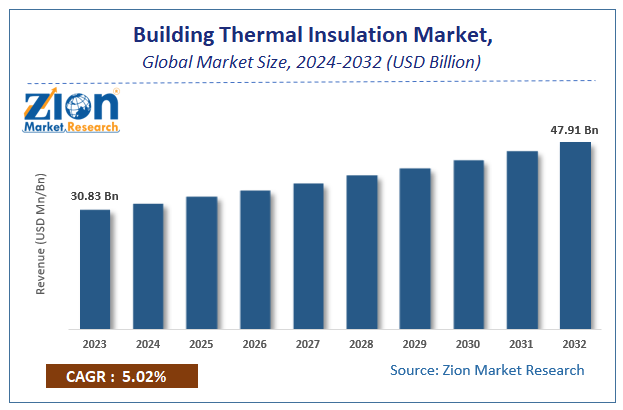
| USD 30.83 Billion | USD 47.91 Billion | 5.02% | 2023 |
Building Thermal Insulation Industry Perspective
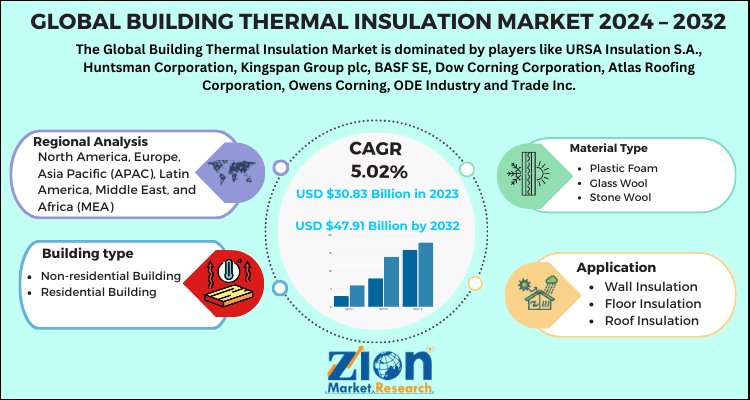
Zion Market Research has published a report on the global Building Thermal Insulation Market, estimating its value at USD 30.83 Billion in 2023, with projections indicating that it will reach USD 47.91 Billion by 2032. The market is expected to expand at a compound annual growth rate (CAGR) of 5.02% over the forecast period 2024-2032. The report explores the factors fueling market growth, the hitches that could hamper this expansion, and the opportunities that may arise in the Building Thermal Insulation industry. Additionally, it offers a detailed analysis of how these elements will affect market demand dynamics and market performance throughout the forecast period.
Building Thermal Insulation Market: Overview
The Building Thermal Insulation Market focuses on the production and application of materials that reduce heat transfer in buildings, improving energy efficiency and occupant comfort. Thermal insulation is widely used in residential, commercial, and industrial structures to minimize heating and cooling demands, thereby reducing energy consumption and greenhouse gas emissions. The market is driven by stringent building codes, increasing awareness of energy efficiency, and growing demand for sustainable construction materials. With advancements in insulation technologies and rising urbanization, particularly in emerging economies, the market is expected to grow significantly, supported by government incentives promoting energy-efficient buildings.
Thermal insulation is one of the known phenomenon in construction activities and is utilized for transferring heat among the adjacent environments. It plays a major part in retaining ambient climatic conditions indoors without using additional energy. In the recent times, thermal insulation is utilized in buildings for reducing the carbon footprints and restricting the thermal conduction to external environment.
What are the Market Dynamics of Building Thermal Insulation Market?
Growth Drivers
Stringent government regulations worldwide are pushing for energy-efficient buildings, compelling builders and homeowners to adopt thermal insulation to meet codes like the International Energy Conservation Code and EU directives on energy performance. This regulatory pressure fosters innovation in insulation materials, such as low-global-warming-potential foams, and accelerates market adoption in both new constructions and retrofits. Additionally, rising energy costs motivate consumers and industries to invest in insulation that reduces long-term heating and cooling expenses, creating a ripple effect across residential and commercial sectors.
Restraints
High initial costs of advanced insulation materials, such as aerogels and vacuum-insulated panels, deter widespread adoption, particularly in price-sensitive developing markets where budget constraints prioritize basic construction over premium efficiency solutions. Fluctuations in raw material prices, including petrochemicals for plastic foams, further exacerbate affordability issues, leading to project delays or substitutions with less effective alternatives. Moreover, limited awareness in some regions about the long-term benefits of quality insulation hinders market penetration.
Opportunities
The surge in green building certifications, like LEED and BREEAM, opens avenues for eco-friendly insulation products made from recycled or bio-based materials, appealing to environmentally conscious developers and governments offering incentives. Retrofitting older buildings in mature markets presents a vast untapped potential, as aging infrastructure requires upgrades to comply with modern energy standards. Emerging technologies, such as smart insulation integrated with IoT for real-time performance monitoring, could revolutionize the market by enhancing efficiency and attracting tech-savvy consumers.
Challenges
Installation complexities and the need for skilled labor pose significant hurdles, as improper application can compromise insulation effectiveness and lead to issues like moisture buildup or reduced durability. Environmental concerns over non-biodegradable materials, such as certain plastic foams, face scrutiny from regulators and activists, potentially leading to bans or increased compliance costs. Supply chain disruptions, including shortages of key raw materials due to geopolitical tensions, add volatility to production and pricing, challenging manufacturers to maintain consistent quality and availability.
Building Thermal Insulation Market: Segmentation
The global building thermal insulation market report divides the market into multiple segments on the basis of building type, material type, applications, and geography. All the segments have been analyzed based on present and future trends and the market is estimated from 2026 to 2035.
Based on the building type, the market is segmented into non-residential buildings and residential buildings.
By material type, the market is categorized into plastic foam, glass wool, and stone wool.
By application, the global market is bifurcated into wall insulation, floor insulation, and roof insulation.
The Regional, this segment includes the current and forecast demand for North America, Europe, Asia Pacific, Latin America,and the Middle East and Africa.
Beneficial laws due to growing focus on reducing the total power usage will steer the expansion of building thermal insulation industry over the estimated timespan. Thermal insulation assists in minimizing the dependence on heat, ventilation, and air conditioning and thus lowers the total power usage, thereby prompting the growth of building thermal insulation market. Escalating demand for the product across residential as well as commercial sectors in emerging nations is speculated to enlarge the scope of the market over the forecasting years.
Building Thermal Insulation Market: Report Scope
| Report Attributes | Report Details |
|---|---|
| Report Name | Building Thermal Insulation Market |
| Market Size in 2023 | USD 30.83 Billion |
| Market Forecast in 2032 | USD 47.91 Billion |
| Growth Rate | CAGR of 5.02% |
| Number of Pages | 110 |
| Key Companies Covered | URSA Insulation S.A., Huntsman Corporation, Kingspan Group plc, BASF SE, Dow Corning Corporation, Atlas Roofing Corporation, Owens Corning, ODE Industry and Trade Inc., Beijing New Building Material (Group) Co. Ltd., Paroc Group Oy, Trocellen GmbH, Knauf Insulation, Inc., Cabot Corporation, GAF Materials Corporation, Firestone Building Products Company, Lapolla Industries Inc., KCC Corporation, Saint-Gobain S.A., Rockwool International A/S, Covestro AG, Fletcher Building Limited, Recticel SA, NICHIAS Corporation, Johns Manville Corporation, and Aspen Aerogels, Inc |
| Segments Covered | By Building Type, By Material Type, By Application And By Region |
| Regions Covered | North America, Europe, Asia Pacific (APAC), Latin America, Middle East, and Africa (MEA) |
| Base Year | 2023 |
| Historical Year | 2018 to 2022 |
| Forecast Year | 2024 - 2032 |
| Customization Scope | Avail customized purchase options to meet your exact research needs. Request For Customization |
What is the Regional Analysis of Building Thermal Insulation Market?
Asia Pacific to dominate the global market.
Asia Pacific holds a commanding position in the building thermal insulation market, driven by explosive urbanization and massive infrastructure investments in countries like China and India. China, as the dominant country, leads with its aggressive push for energy-efficient skyscrapers and housing developments under national sustainability plans, accounting for a significant portion of regional demand through large-scale projects and policy incentives.
North America follows as a key player, with robust growth fueled by retrofitting initiatives and strict energy codes in the U.S. and Canada. The United States dominates this region, where federal programs like tax credits for insulation upgrades and the Bipartisan Infrastructure Law propel adoption in residential and commercial sectors, emphasizing high-performance materials for climate resilience.
Europe maintains a strong market presence through its focus on green building standards and renovation waves. Germany stands out as the dominant country, leveraging EU directives on energy performance to drive insulation in historic building retrofits and new constructions, prioritizing sustainable materials to achieve carbon neutrality goals.
Latin America experiences steady expansion, supported by emerging urbanization and climate adaptation needs in Brazil and Mexico. Brazil dominates, with government-backed affordable housing programs incorporating insulation to combat extreme weather, fostering market growth amid economic recovery.
The Middle East and Africa show promising potential, with increasing awareness of energy conservation in the UAE and South Africa. The UAE leads as the dominant country, integrating advanced insulation in iconic high-rises and sustainable cities like Dubai, driven by vision plans for reduced energy dependence.
What are the Market Trends in Building Thermal Insulation Market?
- Increasing adoption of sustainable and bio-based insulation materials to reduce environmental impact.
- Rise in demand for aerogels and vacuum-insulated panels for superior thermal performance in compact spaces.
- Growth in retrofitting projects for older buildings to meet modern energy efficiency standards.
- Integration of smart insulation technologies with IoT for real-time monitoring and optimization.
- Expansion of DIY insulation products for residential applications, driven by consumer awareness.
Building Thermal Insulation Market: Regional Insights
North America To Account For Major Market Share Over 2024–2032
The growth of the market in North America over the forecast timespan is due to presence of large number of end-users in the countries like the U.S. and Canada. In addition to this, strict execution of government rules pertaining to house insulation will crop up the growth of the market in the forthcoming years.
Building Thermal Insulation Market: Competitive Space
Key players included in the report are:
- URSA Insulation S.A.
- Huntsman Corporation
- Kingspan Group plc
- BASF SE
- Dow Corning Corporation
- Atlas Roofing Corporation
- Owens Corning
- ODE Industry and Trade Inc.
- Beijing New Building Material (Group) Co. Ltd.
- Paroc Group Oy
- Trocellen GmbH
- Knauf Insulation. Inc.
- Cabot Corporation
- GAF Materials Corporation
- Firestone Building Products Company
- Lapolla Industries Inc.
- KCC Corporation
- Saint-Gobain S.A.
- Rockwool International A/S
- Covestro AG
- Fletcher Building Limited
- Recticel SA
- NICHIAS Corporation
- Johns Manville Corporation
- Aspen Aerogels. Inc.
The market report categorizes the global building thermal insulation market based on:
Building type:
- Non-residential Building
- Residential Building
Material Type:
- Plastic Foam
- Glass Wool
- Stone Wool
Application:
- Wall Insulation
- Floor Insulation
- Roof Insulation
By Region
- North America
- The U.S.
- Canada
- Europe
- France
- The UK
- Spain
- Germany
- Italy
- Rest of Europe
- Asia Pacific
- China
- Japan
- India
- South Korea
- Southeast Asia
- Rest of Asia Pacific
- Latin America
- Brazil
- Mexico
- Rest of Latin America
- Middle East & Africa
- GCC
- South Africa
- Rest of Middle East & Africa
Table Of Content
Methodology
FrequentlyAsked Questions
Beneficial laws due to growing focus on reducing the total power usage will steer the expansion of building thermal insulation industry over the estimated timespan.
The CAGR of the industry is expected to be nearly 4.95% during the forecast timeline.
North America will contribute remarkably towards the global market share over the estimated timeline.
The key market players include Huntsman Corporation, BASF SE, Dow Corning Corporation, Atlas Roofing Corporation, Owens Corning, Beijing New Building Material (Group) Co. Ltd., Trocellen GmbH, Knauf Insulation, Inc, Firestone Building Products Company, URSA Insulation S.A., Lapolla Industries Inc., ODE Industry and Trade Inc., KCC Corporation, Saint-Gobain S.A., Rockwool International A/S, Covestro AG, GAF Materials Corporation, Fletcher Building Limited, Recticel SA, NICHIAS Corporation, Cabot Corporation, Johns Manville Corporation, Paroc Group Oy, Kingspan Group plc, and Aspen Aerogels, Inc.

List of Contents
Industry PerspectiveMarket:OverviewWhat are the Market Dynamics of Market?SegmentationReport ScopeWhat is the Regional Analysis of Market?What are the Market Trends in Market?Market:Regional InsightsMarket:Competitive SpaceThe market report categorizes the global building thermal insulation market based on:HappyClients

