
Global Bleaching Clay Market Trend, Share, Growth, Size, Analysis and Forecast 2030

Bleaching Clay Market By Type(Activated Bauxite, Activated Clays, Fuller's Earth), By Application(Industrial Oil, Mineral Oil and Waxes and Vegetable Oil, Animal Fats), By End-user Industry(Food and Beverage, Cosmetics and Personal Care, Chemicals, Other End-user Industries), and By Region: Global Industry Analysis, Size, Share, Growth, Trends, and Forecast, 2023-2030
| Market Size in 2022 | Market Forecast in 2030 | CAGR (in %) | Base Year |
|---|---|---|---|
| USD 1,025.87 million | USD 1,950.22 million | 8.36% | 2022 |
Description
What is Global Bleaching Clay Market Size?
The global bleaching clay market size was worth around USD 1,025.87 million in 2022 and is predicted to grow to around USD 1,950.22 million by 2030 with a compound annual growth rate (CAGR) of roughly 8.36% between 2023 and 2030.
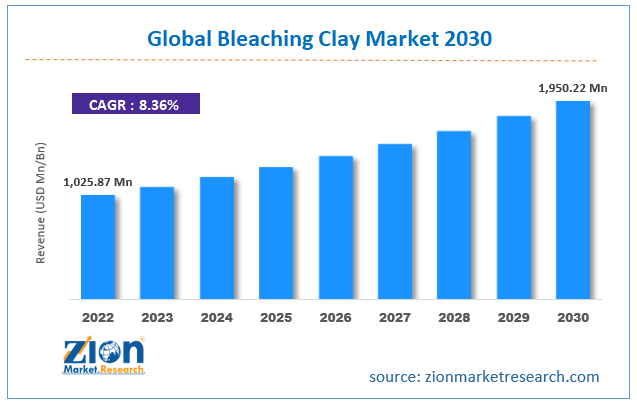
Global Bleaching Clay Market: Overview
Bleaching clay is an adsorbent clay or an activated clay that is been used to remove the coloring matter from the liquids such as oils. It is used in the refining of animal fats and vegetable oils for human consumption. The absorbent capacity of the bleaching clay removes the unwanted matter and impurities, such as proteins, soaps, coloring substances (carotenoids), and others found in fats and oils.
Global Bleaching Clay Market: Growth Factors
The global bleaching clay market is growing at a rapid rate. Growing demand for mineral oils owing to its wide applications in grease, lubricants & cosmetics, increase in consumption of refined edible oils, and rise in use of bleaching clay in chemical processes are some of the crucial factors that are fueling the growth of the global market. Further, the awareness of environmental concerns, fluctuating oil prices, and fossil oil depletion has strengthened the search for alternate fuels. Animal fats and vegetable oil are found to be the best candidates as an alternate energy source. However, their direct use is limited due to low volatility and high viscosity.
To overcome such restrictions and to produce fatty acid methyl ester (FAME) or known as biodiesel, animal fats or vegetable oil are reacted with simple alcohol. Biodiesel is counted among the best alternate for petro-diesel fuel owing to its comparable calorific value as well as numerous other advantages such as environmentally acceptance fuel, carbon-neutral, excellent lubricity, higher flash point, low toxic emission, and biodegradable. Bleaching clays can also be efficiently used for the removal of metals from biodiesel obtained via renewable, eco-friendly technologies.
Thus, with the rise in the use of biodiesel, there is a growing demand for bleaching clay thereby spurring the growth of the global bleaching clay market. Moreover, the increase in demand for cosmetics & skincare products, rise in the use of natural bleaching clays in numerous industries including wastewater treatment & paints are also some of the key features that are fostering the growth of the global market. Furthermore, technological advancement in optimization of the yield of oilseeds may create plenty of opportunities for the growth of the global bleaching clay market during the forecast period. However, the presence of stringent safety regulations may hinder the growth of the global bleaching clay market.
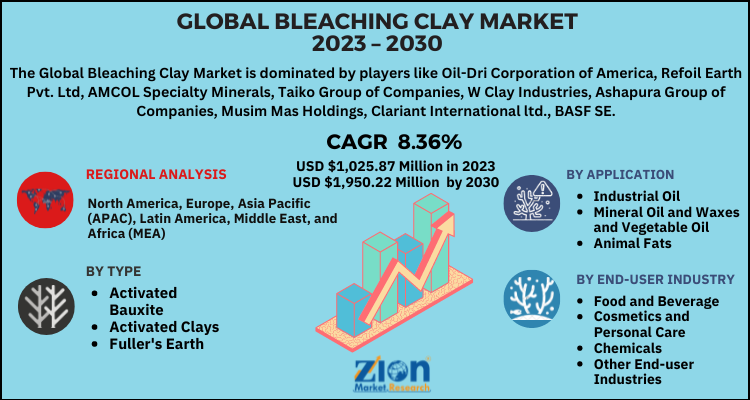
Bleaching Clay Market: Report Scope
| Report Attributes | Report Details |
|---|---|
| Report Name | Bleaching Clay Market |
| Market Size in 2022 | USD 1,025.87 Million |
| Market Forecast in 2030 | USD 1,950.22 Million |
| Growth Rate | CAGR of 8.36% |
| Number of Pages | 212 |
| Key Companies Covered | Oil-Dri Corporation of America, Refoil Earth Pvt. Ltd, AMCOL Specialty Minerals, Taiko Group of Companies, W Clay Industries, Ashapura Group of Companies, Musim Mas Holdings, Clariant International ltd., BASF SE, and Korvi Activated Earth among others. |
| Segments Covered | By Type, By Application, By End-user and By Region |
| Regions Covered | North America, Europe, Asia Pacific (APAC), Latin America, Middle East, and Africa (MEA) |
| Base Year | 2022 |
| Historical Year | 2017 - 2021 |
| Forecast Year | 2023 - 2030 |
| Customization Scope | Avail customized purchase options to meet your exact research needs. Request For Customization |
Global Bleaching Clay Market: Segmentation
The global bleaching clay market is classified based on type, application, end-user, and region.
Based on the type, the global bleaching clay market is fragmented into fuller's earth, activated clays, and activated bauxite.
The application segment of the global market consists of refining of mineral oils & lubricants, refining of vegetable oils & fats, and refining of biofuels.
Based on the end-user, the global market is divided into cosmetics & personal care, chemical processing, food & beverage, and others.
Global Bleaching Clay Market: Regional Analysis
Geographically, Asia Pacific is projected to contribute to the maximum share in the global bleaching clay market over the forecast period. Growing consumption & demand for vegetable oil, the presence of a large cosmetic market in countries like China & Japan, and an increase in crop yield are some of the major factors that are driving the growth of the market in this region. North America is estimated to hold the second most position in the market owing to the growing demand for edible oil from the food & beverages industry, the presence of global & domestic key players, and increase in the use of industrial oils.
Global Bleaching Clay Market: Competitive Players
Some of the major players that are operating in the global bleaching clay market are
- Oil-Dri Corporation of America
- Refoil Earth Pvt. Ltd
- AMCOL Specialty Minerals
- Taiko Group of Companies
- W Clay Industries
- Ashapura Group of Companies
- Musim Mas Holdings
- Clariant International ltd.
- BASF SE
- and Korvi Activated Earth among others.
Segment Coverage
By Type
- Activated Bauxite
- Activated Clays
- Fuller's Earth
By Application
- Industrial Oil
- Mineral Oil and Waxes and Vegetable Oil
- Animal Fats
By End-user Industry
- Food and Beverage
- Cosmetics and Personal Care
- Chemicals
- Other End-user Industries
By Region
- North America
- The U.S.
- Canada
- Mexico
- Europe
- France
- The UK
- Spain
- Germany
- Italy
- Rest of Europe
- Asia Pacific
- China
- Japan
- India
- Australia
- South Korea
- Rest of Asia Pacific
- The Middle East & Africa
- Saudi Arabia
- UAE
- Egypt
- Kuwait
- South Africa
- Rest of the Middle East & Africa
- Latin America
- Brazil
- Argentina
- Rest of Latin America
What Reports Provides
- Full in-depth analysis of the parent market
- Important changes in market dynamics
- Segmentation details of the market
- Former, on-going, and projected market analysis in terms of volume and value
- Assessment of niche industry developments
- Market share analysis
- Key strategies of major players
- Emerging segments and regional markets
- Testimonials to companies in order to fortify their foothold in the market.
Table Of Content

FrequentlyAsked Questions
Bleaching clay is used to purify edible oils. It removes color and impurities during refining
The global Bleaching Clay market is expected to be driven by the edible oil refining and food processing demand. Growth in cooking oil consumption supports expansion.
According to study, the global Bleaching Clay market size was worth around USD 1,025.87 Million in 2022 and is predicted to grow to around USD 1,950.22 Million by 2030.
The global Bleaching Clay market is expected to grow at a Compound Annual Growth Rate (CAGR) of around CAGR 8.36% during the forecast period from 2023-2030.
The global Bleaching Clay industry is projected to be challenged by Challenges include raw material quality variability and disposal concerns.
The Opportunities include edible oil refining demand, food processing growth, and expansion in vegetable oil consumption will offer significant growth opportunities in the Bleaching Clay market.
Improved adsorption efficiency; demand from edible oil refining; sustainable mining and processing practices are the emerging trends and innovations impacting the Bleaching Clay market.
The global Bleaching Clay market is expected to be led by APAC during the forecast period.
Some of the prominent players operating in the global Bleaching Clay market are; Oil-Dri Corporation of America, Refoil Earth Pvt. Ltd, AMCOL Specialty Minerals, Taiko Group of Companies, W Clay Industries, Ashapura Group of Companies, Musim Mas Holdings, Clariant International ltd., BASF SE, and Korvi Activated Earth among others. and others.
The report explores crucial aspects of the Bleaching Clay market, including a detailed discussion of existing growth factors and restraints, while also browsing future growth opportunities and challenges that impact the market.
HappyClients

