Global Autotransfusion Systems Market Size, Share, Trends, Growth and Forecast 2032

Autotransfusion Systems Market By Type (Autotransfusion Types and Autotransfusion Accessories), By Application (Cardiac Surgeries, Orthopedic Surgeries, Organ Transplantation, Trauma Procedures, and Other Procedures), and By Region - Global and Regional Industry Overview, Market Intelligence, Comprehensive Analysis, Historical Data, and Forecasts 2024 - 2032
| Market Size in 2023 | Market Forecast in 2032 | CAGR (in %) | Base Year |
|---|---|---|---|
| USD 475.37 Million | USD 743.8 Million | 5.10% | 2023 |
Autotransfusion Systems Market: Industry Perspective
What will be the global autotransfusion systems market size during the forecast period?
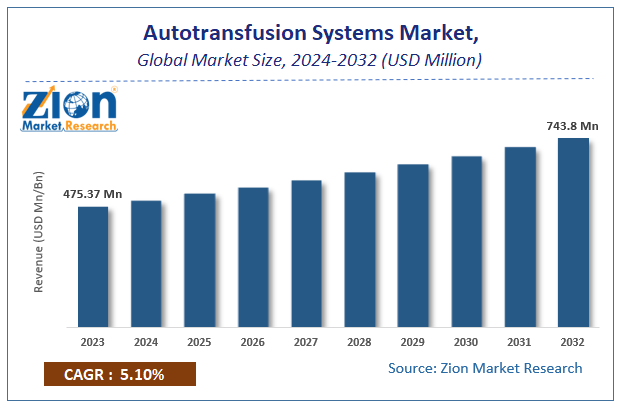
The global autotransfusion systems market size was valued at USD 475.37 million in 2023 and is predicted to reach USD 743.8 million by the end of 2032. The market is expected to grow with a CAGR of 5.10% during the forecast period.
This report provides a comprehensive analysis of the growth drivers, restraints, and challenges shaping demand across the global autotransfusion systems market throughout the forecast period, while highlighting high-potential emerging opportunities within the industry.
Key Insights
- As per the analysis shared by our research analyst, the global autotransfusion systems market is estimated to grow at a CAGR of approximately 5.10% during the forecast period from 2024 to 2032.
- In terms of revenue, the global autotransfusion systems market size was valued at around USD 475.37 million in 2023 and is projected to reach USD 743.8 million by 2032.
- The market is driven by rising surgical procedures, growing blood conservation needs, and increasing demand to reduce reliance on donor blood in hospitals.
- Based on the type, autotransfusion types (including intraoperative, postoperative, and dual-mode systems) segment lead the market as core equipment platforms that enable blood recovery and reinfusion during and after surgery, while accessories support recurring demand.
- Based on the application, cardiac surgeries segment represents a major application area due to the high volume of procedures involving significant blood loss where autologous blood recovery is particularly valuable.
- Regionally, North America is expected to lead the global market during the forecast period, supported by high surgical volumes, established clinical protocols, and strong presence of leading medical technology companies.
Autotransfusion Systems Market Overview
Autotransfusion systems are medical devices designed to collect, process, and reinfuse a patient’s own blood during or after surgery. These systems reduce the need for allogeneic (donor) blood transfusions, thereby lowering associated risks such as transfusion reactions, infection transmission, and immunological complications. They are used across a range of surgical specialties where blood loss is significant and blood conservation is a clinical priority.
Autotransfusion Systems Market: Dynamics
Growth Drivers
Why is demand for autotransfusion systems increasing in surgical settings?
The rising number of surgical procedures, particularly those involving substantial blood loss such as cardiac, orthopedic, and trauma operations, is a primary driver of market growth. Autotransfusion systems enable the recovery and reinfusion of a patient’s own blood, supporting blood conservation goals and reducing dependence on limited donor blood supplies. Hospitals are increasingly prioritizing patient blood management programs that emphasize autologous transfusion as a safer and more cost-effective approach.
Growing awareness of the risks associated with allogeneic transfusions, including immunological reactions and infection transmission, further encourages adoption. Clinical guidelines and hospital initiatives focused on improving patient outcomes and controlling blood product costs continue to reinforce demand for reliable autotransfusion technologies across major surgical specialties.
Restraints
What factors are constraining broader adoption of autotransfusion systems?
High equipment costs represent a significant barrier, particularly for smaller hospitals and surgical centers with limited capital budgets. The initial investment in systems, along with ongoing expenses for consumables and maintenance, can delay or restrict implementation outside high-volume facilities.
Stringent safety and regulatory requirements, combined with the need for trained operating staff, add further complexity. Limited use outside major surgical centers restricts broader market penetration, as many facilities lack the infrastructure, expertise, or procedure volume to justify dedicated autotransfusion capabilities.
Opportunities
Where do the most promising growth opportunities lie for autotransfusion system providers?
Expanding applications in trauma procedures, orthopedic surgeries, and organ transplantation present meaningful growth avenues. These areas involve significant blood loss and benefit from rapid autologous blood recovery, supporting both clinical outcomes and cost control objectives.
Hospital initiatives focused on patient safety, blood conservation, and reduced reliance on donor blood create favorable conditions for wider adoption. Technological improvements that enhance ease of use, processing speed, and blood quality further support market expansion by making systems more accessible and clinically effective across diverse surgical environments.
Challenges
What operational and clinical hurdles must the industry address?
Ensuring consistent blood product quality and safety across different patient conditions and procedure types remains a technical and operational challenge. Systems must reliably remove contaminants while preserving red blood cell integrity under varying clinical circumstances.
The requirement for specialized training and the limited availability of skilled personnel in some settings can slow adoption. Integrating autotransfusion into existing surgical workflows without disrupting efficiency demands careful process design and ongoing education, presenting continuous challenges for both manufacturers and healthcare providers.
Autotransfusion Systems Market: Report Scope
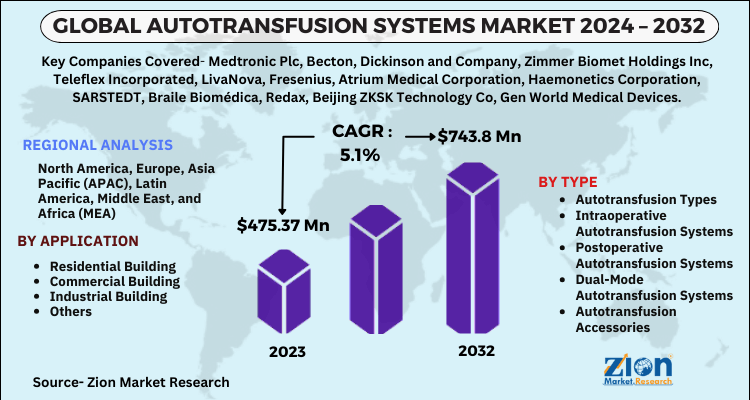
| Report Attributes | Report Details |
|---|---|
| Report Name | Autotransfusion Systems Market |
| Market Size in 2023 | USD 475.37 Million |
| Market Forecast in 2032 | USD 743.8 Million |
| Growth Rate | CAGR of 5.10% |
| Number of Pages | 255 |
| Key Companies Covered | Medtronic Plc, Becton, Dickinson and Company, Zimmer Biomet Holdings Inc, Teleflex Incorporated, LivaNova, Fresenius, Atrium Medical Corporation, Haemonetics Corporation, SARSTEDT, Braile Biomédica, Redax, Beijing ZKSK Technology Co, Gen World Medical Devices |
| Segments Covered | By Type, By Application, and By Region |
| Regions Covered | North America, Europe, Asia Pacific (APAC), Latin America, Middle East, and Africa (MEA) |
| Base Year | 2023 |
| Historical Year | 2018 - 2022 |
| Forecast Year | 2024 - 2032 |
| Customization Scope | Avail customized purchase options to meet your exact research needs. Request For Customization |
Autotransfusion Systems Market: Segmentation Analysis
The autotransfusion systems market is segmented by type, application, and region. All the segments of the autotransfusion systems market have been analyzed based on present and future trends and the market is estimated from 2024 to 2032.
Based on Type, the autotransfusion systems market is divided into autotransfusion types and autotransfusion accessories. Autotransfusion types, encompassing intraoperative autotransfusion systems, postoperative autotransfusion systems, and dual-mode autotransfusion systems, form the core equipment category that enables blood collection, processing, and reinfusion during and after surgical procedures. These systems are essential for active blood recovery in high-blood-loss operations and drive primary equipment demand. Autotransfusion accessories, including consumables and related components, support recurring revenue through single-use kits and disposables required for each procedure. The combination of durable systems and ongoing accessory demand underpins market stability and growth.
Based on Application, the autotransfusion systems market is divided into cardiac surgeries, orthopedic surgeries, organ transplantation, trauma procedures, and other procedures. Cardiac surgeries represent a leading application area because these procedures frequently involve significant blood loss where autologous recovery is clinically valuable and well established. Orthopedic surgeries and trauma procedures also generate substantial demand due to the potential for major hemorrhage and the benefits of rapid blood salvage. Organ transplantation and other surgical applications further contribute to diversified use, collectively supporting market expansion as blood conservation practices become more widely integrated into surgical protocols.
Autotransfusion Systems Market: Regional Analysis
Why will North America continue to dominate the global market during the projection period?
North America is expected to lead the global autotransfusion systems market during the forecast period. The region benefits from high volumes of complex surgical procedures, well-established clinical protocols for patient blood management, and a strong presence of leading medical technology companies. Advanced hospital infrastructure, reimbursement frameworks that support blood conservation initiatives, and continuous investment in surgical safety and efficiency reinforce adoption. The United States in particular drives regional performance through extensive cardiac, orthopedic, and trauma surgery activity combined with institutional emphasis on reducing allogeneic transfusion rates. These factors enable North America to set clinical standards, accelerate technology uptake, and influence global practices in autologous blood recovery.
Europe follows with solid demand supported by standardized surgical practices and stringent infection control protocols. Asia Pacific is expected to exhibit notable growth as surgical volumes rise, healthcare infrastructure expands, and awareness of blood conservation strategies increases in major markets. Latin America and the Middle East & Africa represent emerging opportunities where gradual improvements in surgical capacity and blood management practices are expected to support incremental adoption over time.
Autotransfusion Systems Market: Competitive Analysis
Some of the major players in the global autotransfusion systems market include;
- Medtronic Plc
- Becton
- Dickinson and Company
- Zimmer Biomet Holdings Inc
- Teleflex Incorporated
- LivaNova
- Fresenius
- Atrium Medical Corporation
- Haemonetics Corporation
- SARSTEDT
- Braile Biomédica
- Redax
- Beijing ZKSK Technology Co
- Gen World Medical Devices
Segments Covered
The report segments the global autotransfusion systems market as follows:
By Type
- Autotransfusion Types
- Intraoperative Autotransfusion Systems
- Postoperative Autotransfusion Systems
- Dual-Mode Autotransfusion Systems
- Autotransfusion Accessories
By Application
- Cardiac Surgeries
- Orthopedic Surgeries
- Organ Transplantation
- Trauma Procedures
- Other Procedures
By Region
- North America
- The U.S.
- Canada
- Mexico
- Europe
- France
- The UK
- Spain
- Germany
- Italy
- Rest of Europe
- Asia Pacific
- China
- Japan
- India
- Australia
- South Korea
- Rest of Asia Pacific
- The Middle East & Africa
- Saudi Arabia
- UAE
- Egypt
- Kuwait
- South Africa
- Rest of the Middle East & Africa
- Latin America
- Brazil
- Argentina
- Rest of Latin America
Table Of Content
Methodology
FrequentlyAsked Questions
Autotransfusion systems collect and reuse a patient’s own blood during surgery. They reduce the need for donor blood and lower transfusion-related risks by enabling autologous blood recovery and reinfusion.
The global autotransfusion systems market is driven by rising surgical procedures, growing blood conservation needs, and increasing demand to reduce reliance on donor blood in hospitals, supported by patient safety and cost-control initiatives.
The global autotransfusion systems market size was valued at approximately USD 475.37 million in 2023 and is expected to reach around USD 743.8 million by 2032.
The global autotransfusion systems market is expected to grow at a compound annual growth rate (CAGR) of approximately 5.10% during the forecast period from 2024 to 2032.
Major challenges include high equipment costs, stringent safety and regulatory requirements, the need for trained operating staff, and limited use outside major surgical centers that restricts broader adoption.
North America is expected to contribute notably and lead the global autotransfusion systems market during the forecast period, supported by high surgical volumes and established blood management protocols.
Some of the major players leveraging the autotransfusion systems market growth are Medtronic Plc, Becton, Dickinson and Company, Zimmer Biomet Holdings Inc, Teleflex Incorporated, LivaNova, Fresenius, Atrium Medical Corporation, Haemonetics Corporation, SARSTEDT, Braile Biomédica, Redax, Beijing ZKSK Technology Co, and Gen World Medical Devices.
The report provides a detailed examination of growth drivers, restraints, opportunities, and challenges, along with comprehensive segmentation analysis, regional insights, competitive landscape, and forward-looking forecasts that enable stakeholders to make informed strategic decisions.

HappyClients