
Global Automatic Fare Collection System Market Size, Share, Growth Trends, 2032

Automatic Fare Collection System Market By Component (Hardware and Software), By Application (Bus, Toll, Train, and Car Rental), By Technology Platform (Smart Card, NFC, Optical Character Recognition, Magnetic Strips, and Barcodes), and By Region - Global and Regional Industry Overview, Market Intelligence, Comprehensive Analysis, Historical Data, and Forecasts 2024 - 2032
| Market Size in 2023 | Market Forecast in 2032 | CAGR (in %) | Base Year |
|---|---|---|---|
| USD 9.17 Billion | USD 23.65 Billion | 11.1% | 2023 |
Automatic Fare Collection System Industry Perspective
What will be the global automatic fare collection system market size during the forecast period?
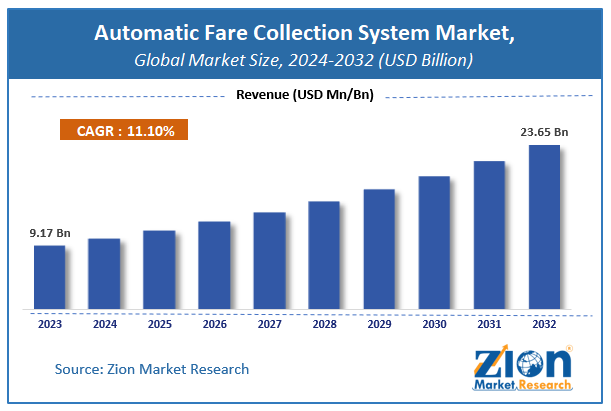
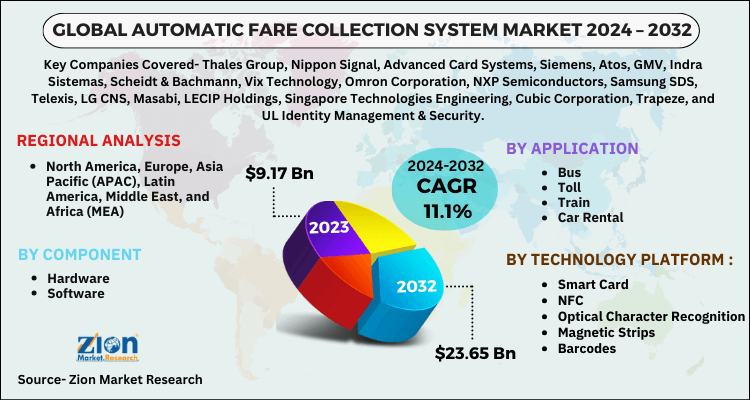
The global automatic fare collection system market size was valued at around USD 9.17 billion in 2023 and is projected to reach about USD 23.65 billion by 2032, with a compound annual growth rate (CAGR) of roughly 11.1% between 2024 and 2032.
This report provides a comprehensive analysis of the growth drivers, restraints, and challenges shaping demand across the global automatic fare collection system market throughout the forecast period, while highlighting high-potential emerging opportunities within the industry.
Key Insights
- As per the analysis shared by our research analyst, the global automatic fare collection system market is estimated to grow at a CAGR of approximately 11.1% during the forecast period from 2024 to 2032.
- In terms of revenue, the global automatic fare collection system market size was valued at around USD 9.17 billion in 2023 and is projected to reach USD 23.65 billion by 2032.
- The market is driven by the ability to enable faster transactions, support for affordable operations, improved user experience, smart city projects, public transport modernization, and rising demand for contactless and digital ticketing solutions.
- Based on the component, hardware forms a core part of deployments as gates, validators, ticket vending machines, and related devices enable physical access control and payment acceptance across transit networks.
- Based on the application, train segments represent major demand areas as metro, rail, and urban bus networks modernize fare collection to improve efficiency and passenger convenience.
- Based on the technology platform, smart card technology remains widely adopted due to its established reliability, interoperability potential, and extensive installed base across public transport systems worldwide.
- Regionally, Asia Pacific is expected to lead the automatic fare collection system market during the forecast period, supported by rising investments in transportation, metro projects, highway expansion, railway infrastructure development, and growth in digital payment systems in countries such as China and India.
Automatic Fare Collection System Market: Overview
Automatic fare collection systems are modern, automated alternatives to manual or traditional fare collection methods. They consist of integrated hardware and software components that automate the ticketing process for public transportation systems, including buses, metro trains, and related modes. These systems manage fare payment, validation, and access control at entry and exit points, reducing reliance on cash handling and manual ticket inspection while improving operational efficiency and passenger convenience.
Automatic Fare Collection System Market: Dynamics
Growth Drivers
What factors are accelerating the expansion of the automatic fare collection system market?
The ability to complete transactions more quickly is a primary growth driver. Automated systems reduce queues, speed boarding, and improve the overall passenger experience compared with manual ticketing. Support for affordable operations further encourages adoption, as transport operators seek to lower cash-handling costs, reduce fraud, and improve revenue protection across large networks.
Smart city projects and public transport modernization initiatives increase demand for contactless and digital ticketing solutions. Governments and operators invest in systems that integrate with broader mobility platforms, support multimodal travel, and deliver data that can improve planning and service quality. These factors collectively drive sustained investment in automatic fare collection infrastructure and software.
Restraints
What factors are limiting the growth of the automatic fare collection system market?
Technical errors and the potential for machines to fall out of order can limit system reliability and passenger satisfaction. High infrastructure costs associated with gates, validators, back-office systems, and network upgrades remain a barrier, particularly for smaller operators or regions with constrained budgets. System integration complexity adds further difficulty when connecting new solutions with legacy equipment and diverse payment methods.
Cybersecurity risks and long government procurement cycles can slow deployments. Ensuring secure handling of payment data and maintaining system integrity across large, distributed networks require ongoing investment and expertise, which can extend project timelines and increase total cost of ownership.
Opportunities
What emerging opportunities exist in the automatic fare collection system market?
Contactless payments, smart transit integration, and multimodal ticketing present significant growth opportunities. Urban transport expansion and the shift toward account-based and mobile ticketing increase demand for flexible, interoperable systems. Data-driven fare management enables operators to optimize pricing, capacity, and service design based on actual ridership patterns.
Integration with smart city infrastructure and mobility-as-a-service platforms further expands the addressable market. Vendors that deliver secure, scalable, and passenger-friendly solutions are well positioned to support both greenfield projects and upgrades of existing networks.
Challenges
What challenges does the automatic fare collection system market face?
Maintaining high availability and reliability across extensive device fleets is an ongoing operational challenge. Integrating new technologies such as NFC, mobile wallets, and account-based ticketing with established smart card and magnetic systems requires careful planning and phased migration. Balancing security, convenience, and cost while meeting diverse regulatory and accessibility requirements continues to demand coordinated effort among vendors, operators, and public authorities.
Automatic Fare Collection System Market: Report Scope
| Report Attributes | Report Details |
|---|---|
| Report Name | Automatic Fare Collection System Market |
| Market Size in 2023 | USD 9.17 Billion |
| Market Forecast in 2032 | USD 23.65 Billion |
| Growth Rate | CAGR of 11.1% |
| Number of Pages | 285 |
| Key Companies Covered | Thales Group, Nippon Signal, Advanced Card Systems, Siemens, Atos, GMV, Indra Sistemas, Scheidt & Bachmann, Vix Technology, Omron Corporation, NXP Semiconductors, Samsung SDS, Telexis, LG CNS, Masabi, LECIP Holdings, Singapore Technologies Engineering, Cubic Corporation, Trapeze, and UL Identity Management & Security |
| Segments Covered | By Component, By Application, By Technology Platform, and By Region |
| Regions Covered | North America, Europe, Asia Pacific (APAC), Latin America, Middle East, and Africa (MEA) |
| Base Year | 2023 |
| Historical Year | 2018 - 2022 |
| Forecast Year | 2024 - 2032 |
| Customization Scope | Avail customized purchase options to meet your exact research needs. Request For Customization |
Automatic Fare Collection System Market: Segment Analysis
The automatic fare collection system market is segmented by component, application, technology platform, and region. All the segments of the automatic fare collection system market have been analyzed based on present and future trends and the market is estimated from 2024 to 2032.
Based on Component, the automatic fare collection system market is divided into hardware and software. Hardware forms a foundational part of deployments because gates, validators, ticket vending machines, readers, and related devices enable physical access control and payment acceptance at stations and on vehicles. Reliable hardware underpins passenger trust and operational continuity. Software provides the intelligence for fare calculation, account management, reporting, and system integration, and its importance continues to grow as operators adopt cloud-based platforms, real-time analytics, and multimodal ticketing capabilities that extend beyond traditional closed systems.
Based on Application, the market is divided into bus, toll, train, and car rental. Train applications, including metro and rail networks, represent a major demand area because high passenger volumes and controlled access environments benefit strongly from automated gates and validators. Bus systems are equally important as urban operators modernize boarding processes and introduce contactless payment to improve speed and convenience. Toll applications support road infrastructure revenue collection, while car rental and related mobility services contribute additional demand for flexible, automated payment and access solutions.
Based on Technology Platform, the automatic fare collection system market is divided into smart card, NFC, optical character recognition, magnetic strips, and barcodes. Smart card technology remains widely adopted due to its proven reliability, large installed base, and ability to support secure, reusable fare media across transit networks. NFC is gaining strong momentum as contactless bank cards and mobile wallets become preferred payment methods for many passengers. Optical character recognition, magnetic strips, and barcodes continue to serve specific use cases and legacy environments, while overall industry direction favors open, contactless, and account-based approaches that improve convenience and interoperability.
Automatic Fare Collection System Market: Regional Analysis
Why will Asia Pacific continue to dominate the global market during the projection period?
Asia Pacific is expected to lead the automatic fare collection system market during the forecast period. The region benefits from the presence of major developing economies such as China and India, where substantial investments in the transportation sector support metro projects, highway network expansion, and railway infrastructure modernization. Growth in digital payment systems further accelerates demand for automated fare collection solutions that improve efficiency and passenger experience. These dynamics enable Asia Pacific to drive global market expansion, technology adoption, and large-scale deployment of contactless and smart transit systems.
North America maintains significant demand supported by ongoing transit modernization, smart city initiatives, and the replacement or upgrade of legacy fare systems. Europe continues to invest in interoperable and multimodal ticketing as part of broader mobility and sustainability strategies. Latin America and the Middle East and Africa represent emerging opportunities where urban transport development and digital payment adoption are expected to support gradual increases in automatic fare collection deployments over the forecast period.
Automatic Fare Collection System Market: Competitive Analysis
Some of the major players in the global automatic fare collection system market include;
- Thales Group
- Nippon Signal
- Advanced Card Systems
- Siemens
- Atos
- GMV
- Indra Sistemas
- Scheidt & Bachmann
- Vix Technology
- Omron Corporation
- NXP Semiconductors
- Samsung SDS
- Telexis
- LG CNS
- Masabi
- LECIP Holdings
- Singapore Technologies Engineering
- Cubic Corporation
- Trapeze
- UL Identity Management & Security
Segments Covered
The global automatic fare collection system market is segmented as follows:
By Component
- Hardware
- Software
By Application
- Bus
- Toll
- Train
- Car Rental
By Technology Platform
- Smart Card
- NFC
- Optical Character Recognition
- Magnetic Strips
- Barcodes
By Region
- North America
- The U.S.
- Canada
- Mexico
- Europe
- France
- The UK
- Spain
- Germany
- Italy
- Rest of Europe
- Asia Pacific
- China
- Japan
- India
- Australia
- South Korea
- Rest of Asia Pacific
- The Middle East & Africa
- Saudi Arabia
- UAE
- Egypt
- Kuwait
- South Africa
- Rest of the Middle East & Africa
- Latin America
- Brazil
- Argentina
- Rest of Latin America
Table Of Content
Methodology
FrequentlyAsked Questions
An automatic fare collection system enables electronic payment and automated ticketing in public transport. It improves efficiency, reduces manual ticketing and cash handling, and supports faster, more convenient passenger access across buses, trains, tolls, and related mobility services.
The global automatic fare collection system market is driven by faster transaction capability, support for affordable operations, improved user experience, smart city projects, public transport modernization, and rising demand for contactless and digital ticketing solutions.
According to study, the global automatic fare collection system market size was worth around USD 9.17 Billion in 2023 and is predicted to grow to around USD 23.65 Billion By 2032.
The global automatic fare collection system market is expected to grow at a compound annual growth rate (CAGR) of approximately 11.1% during the forecast period from 2024 to 2032.
What are the major challenges restraining the growth of the automatic fare collection system market?
The global automatic fare collection system industry is projected to be challenged by Major challenges include high infrastructure costs, system integration complexity, and cybersecurity risks. Long government procurement cycles slow deployments.
Emerging trends include contactless and mobile-based ticketing, AI-driven passenger analytics, and integration with smart city and multimodal mobility platforms that support seamless journeys and data-driven fare management.
The value chain typically includes hardware and software providers, system integrators, payment technology partners, transport operators and government agencies, and the passengers who use automated ticketing and access systems across public transport networks.
Asia Pacific is expected to lead and contribute notably to the global automatic fare collection system market, supported by transportation investments, metro and railway projects, and growth in digital payments in countries such as China and India.
Some of the major players leveraging the automatic fare collection system market growth are Thales Group, Nippon Signal, Advanced Card Systems, Siemens, Atos, GMV, Indra Sistemas, Scheidt & Bachmann, Vix Technology, Omron Corporation, NXP Semiconductors, Samsung SDS, Telexis, LG CNS, Masabi, LECIP Holdings, Singapore Technologies Engineering, Cubic Corporation, Trapeze, and UL Identity Management & Security.
The report explores crucial aspects of the automatic fare collection system market, including a detailed discussion of existing growth factors and restraints, while also browsing future growth opportunities and challenges that impact the market.

HappyClients

