
Autoinjector Market Size, Share, Growth, and Forecast to 2032

Autoinjector Market By distribution channel (hospital pharmacies, retail pharmacies, and others.), By therapeutic application (diabetes, multiple sclerosis, rheumatoid arthritis, anaphylaxis, and others.), By design (standardized and customized.), By product type (reusable and disposable.) And By Others: - Global Industry Analysis, Size, Share, Growth, Trends, and Forecast, 2024-2032
| Market Size in 2023 | Market Forecast in 2032 | CAGR (in %) | Base Year |
|---|---|---|---|
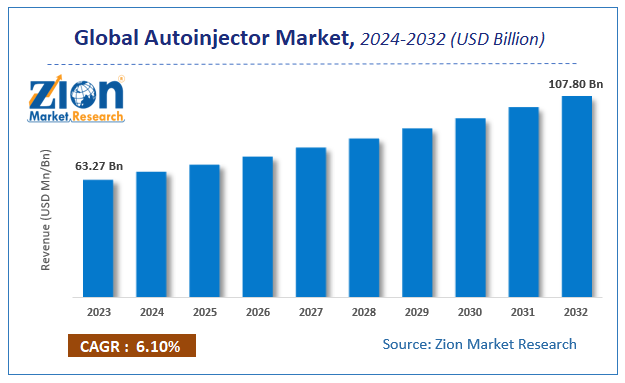
| USD 63.27 Billion | USD 107.80 Billion | 6.1% | 2023 |
Description
What is the Market size of the Autoinjector Industry?
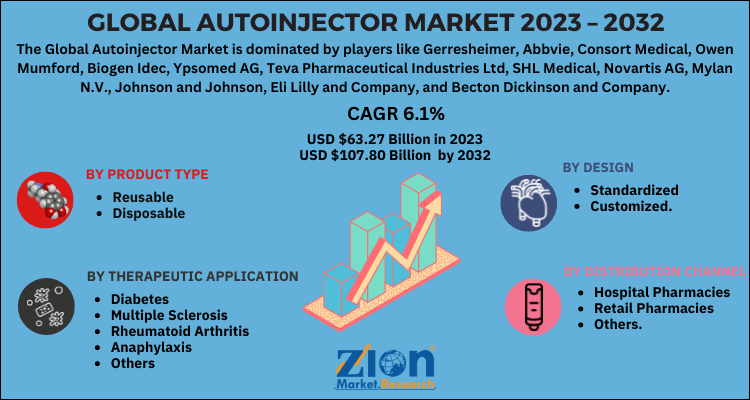
According to the report published by Zion Market Research, the global Autoinjector Market size was valued at USD 63.27 Billion in 2023 and is predicted to reach USD 107.80 Billion by the end of 2032. The market is expected to grow with a CAGR of 6.1% during the forecast period. The report analyzes the global Autoinjector Market's growth drivers, restraints, and impact on demand during the forecast period. It will also help navigate and explore the arising opportunities in the Autoinjector industry.
Global Autoinjector Market: Overview
An autoinjector is an effective mode of administration for intramuscular drugs. Typically, it is a syringe with a pre-charged dosage of drugs with a spring-charged needle. It triggers and delivers a measured drug dose into the body with the sliding motion. These autoinjectors are massively utilized for medical & emergency treatment, epinephrine self-administration, and by migraine sufferers. Autoinjectors offer several advantages like enhancing effectiveness, assuring dosage quality continuity, lowering the needle stuck accident cases, and also lowering the syringe-associated phobia disorder. Autoinjectors are known to maintain the high accuracy of drug dosage when compared to other options.
Global Autoinjector Market: Growth Factors
The global autoinjector market is likely to project subsequent growth with a healthy CAGR of 17.4 2% during the forecast period, largely due to the massive use of anaphylaxis, food allergens, adrenaline, and epinephrine injectors. Autoinjector holds a lot of benefits for both healthcare professionals and patients. These factors have improved compliance & safety and lowered anxiety while also simplifying self-administration. Almost all the present-day diseases have treatment therapies which are administered majorly through injections.
Additionally, injections have always been scary to a huge patient population which is the primary reason for the non-adherence to the treatment. As a result, these autoinjectors have effectively addressed the issues by manufacturing syringes with accurate depth while offering tolerability of administration and comfort when compared to the other manual syringes. The growing innovations in device function and material of autoinjectors will further scale up the growth of the global autoinjector market.
Furthermore, the demand and production of biologics coupled with the constantly aging population globally will also expand the scope of autoinjectors. The ongoing research activities for acute diseases like rheumatoid arthritis, multiple sclerosis, and others are paving the way for the positive trajectory of the global market. The Covid-19 pandemic has significantly impacted the growth of the global market.
Most of the in-hospital therapies and nonessential procedures were halted in the first half of the Covid-19 to contain the spread of the virus. But the overall effect of a pandemic is likely to have a positive impact on the global autoinjector market as the demand for effective remote monitoring and home care devices has scaled up the need for autoinjectors for patients to easily manage chronic illness.
Global Autoinjector Market: Segmentation
The global market can be segmented into the distribution channel, therapeutic application, design, product type, and region.
By distribution channel, the market can be segmented into hospital pharmacies, retail pharmacies, and others.
By therapeutic application, the market can be segmented into diabetes, multiple sclerosis, rheumatoid arthritis, anaphylaxis, and others. The rheumatoid arthritis segment accounts for the largest share in the global autoinjector market due to its growing cases globally.
By design, the market can be segmented into standardized and customized.
By product type, the market can be segmented into reusable and disposable.
Disposable autoinjectors account for the largest share in the global autoinjector market due to the growing awareness among people regarding proper hygiene and infection transfer cases. Furthermore, the ease of use and patient friendliness with autoinjectors will also contribute towards the growth of the segment significantly.
Recent Developments:
- In December 2025, Sempresto, Inc. acquired Alerje’s mobile device-integrated autoinjector platform, including its intellectual property and related physical assets. The acquisition adds nearly a decade of award-winning innovation and product development, strengthening Sempresto’s smartphone-integrated rescue drug delivery portfolio.
- In April 2025, Ypsomed agreed to fully exit its diabetes care business by transferring its insulin pump development unit and remaining subsidiaries to Swiss medtech TecMed in a deal valued at up to CHF 420 million (approximately USD 512 million). Following the carve-out, Ypsomed will focus on subcutaneous self-injector systems, including GLP-1 therapies, and deepen partnerships with biopharmaceutical companies.
- In April 2025, SHL Medical inaugurated a new state-of-the-art manufacturing facility in North Charleston, South Carolina. The expansion strengthens the Swiss-based company’s global production footprint and supports rising worldwide demand for autoinjectors, particularly in the cardiometabolic segment.
Autoinjector Market: Report Scope
| Report Attributes | Report Details |
|---|---|
| Report Name | Autoinjector Market |
| Market Size in 2023 | USD 63.27 Billion |
| Market Forecast in 2032 | USD 107.80 Billion |
| Growth Rate | CAGR of 6.1% |
| Number of Pages | 202 |
| Key Companies Covered | Gerresheimer, Abbvie, Consort Medical, Owen Mumford, Biogen Idec, Ypsomed AG, Teva Pharmaceutical Industries Ltd, SHL Medical, Novartis AG, Mylan N.V., Johnson and Johnson, Eli Lilly and Company, and Becton Dickinson and Company |
| Segments Covered | By distribution channel, By therapeutic application, By design, By product type and By Region |
| Regions Covered | North America, Europe, Asia Pacific (APAC), Latin America, Middle East, and Africa (MEA) |
| Base Year | 2023 |
| Historical Year | 2018 - 2022 |
| Forecast Year | 2024 - 2032 |
| Customization Scope | Avail customized purchase options to meet your exact research needs. Request For Customization |
Global Autoinjector Market: Regional analysis
North America accounts for the largest share in the global autoinjector market due to the growing awareness among people regarding the benefits offered by autoinjectors. Also, growing cases of rheumatoid arthritis in the region are further likely to strengthen the demand.
Asia Pacific is another leading region in the global market due to the growing disposable income of people in the region.
Global Autoinjector Market: Competitive Players
Some of the significant players in the global autoinjector market include
- Gerresheimer, Abbvie
- Consort Medical
- Owen Mumford
- Biogen Idec
- Ypsomed AG
- Teva Pharmaceutical Industries Ltd
- SHL Medical
- Novartis AG
- Mylan N.V.
- Johnson and Johnson
- Eli Lilly
- Company
- Becton Dickinson
- Company.
The Global Autoinjector Market segments are as follows:
By distribution channe
- hospital pharmacies
- retail pharmacies
- others.
By therapeutic application
- diabetes
- multiple sclerosis
- rheumatoid arthritis
- anaphylaxis
- others.
By design
- standardized
- customized.
By product type
- reusable
- disposable.
By Region
- North America
- The U.S.
- Canada
- Mexico
- Europe
- France
- The UK
- Spain
- Germany
- Italy
- Rest of Europe
- Asia Pacific
- China
- Japan
- India
- Australia
- South Korea
- Rest of Asia Pacific
- The Middle East & Africa
- Saudi Arabia
- UAE
- Egypt
- Kuwait
- South Africa
- Rest of the Middle East & Africa
- Latin America
- Brazil
- Argentina
- Rest of Latin America
What Reports Provides
- Testimonials to companies in order to fortify their foothold in the market.
- Emerging segments and regional markets
- Key strategies of major players
- Market share analysis
- Assessment of niche industry developments
- Former, on-going, and projected market analysis in terms of volume and value
- Segmentation details of the market
- Important changes in market dynamics
- Full in-depth analysis of the parent market
Table Of Content

FrequentlyAsked Questions
An autoinjector is a medical device used to automatically deliver a preset dose of medication. It is commonly used for emergency treatments such as allergies or chronic condition management.
The global Autoinjector market is expected to be driven by the Growth is driven by rising prevalence of allergies and chronic diseases, increasing home-based self-administration, and demand for patient-friendly drug delivery. Innovation in needle safety and connected autoinjectors supports expansion.
According to study, the global Autoinjector market size was worth around USD 63.27 Billion in 2023 and is predicted to grow to around USD 107.80 Billion By 2032.
The global Autoinjector market is expected to grow at a Compound Annual Growth Rate (CAGR) of around CAGR 6.1% during the forecast period from 2024-2032.
The global Autoinjector industry is projected to be challenged by High device + biologic combination costs and strict regulatory requirements; usability and device reliability issues can trigger recalls; reimbursement variability limits uptake in some regions.
The Rising prevalence of allergies, autoimmune diseases, and homecare adoption; growth of self-administration biologics and biosimilars; innovation in smart/autoinjectors and needle-safety features will offer significant growth opportunities in the Autoinjector market.
Connected autoinjectors with adherence tracking; needle-safety and reduced injection force designs; wider use with biologics and self-administration therapies are the emerging trends and innovations impacting the Autoinjector market.
The global Autoinjector market is expected to be led by North America during the forecast period.
Some of the prominent players operating in the global Autoinjector market are; Gerresheimer, Abbvie, Consort Medical, Owen Mumford, Biogen Idec, Ypsomed AG, Teva Pharmaceutical Industries Ltd, SHL Medical, Novartis AG, Mylan N.V., Johnson and Johnson, Eli Lilly and Company, and Becton Dickinson and Company and others.
The report explores crucial aspects of the Autoinjector market, including a detailed discussion of existing growth factors and restraints, while also browsing future growth opportunities and challenges that impact the market.
HappyClients

