
5G MVNO Market Size, Share, Trends, Growth & Forecast 2034

5G MVNO Market By Type (Full MVNO, Light MVNO, and Branded Reseller), By Operational Model (Infrastructure-Based and Infrastructure-Light), By Subscriber Type (Consumer, Enterprise, and Internet of Things), By Industry Vertical (Retail and E-commerce, Healthcare, Manufacturing, Transportation and Logistics, Media and Entertainment, Financial Services, and Others), By Service Type (Voice Services, Data Services, Messaging Services, and Value-Added Services), By Business Model (Prepaid and Postpaid), and By Region - Global and Regional Industry Overview, Market Intelligence, Comprehensive Analysis, Historical Data, and Forecasts 2025 - 2034
| Market Size in 2024 | Market Forecast in 2034 | CAGR (in %) | Base Year |
|---|---|---|---|
| USD 8.80 Billion | USD 13.73 Billion | 7.70% | 2024 |
5G MVNO Industry Perspective:
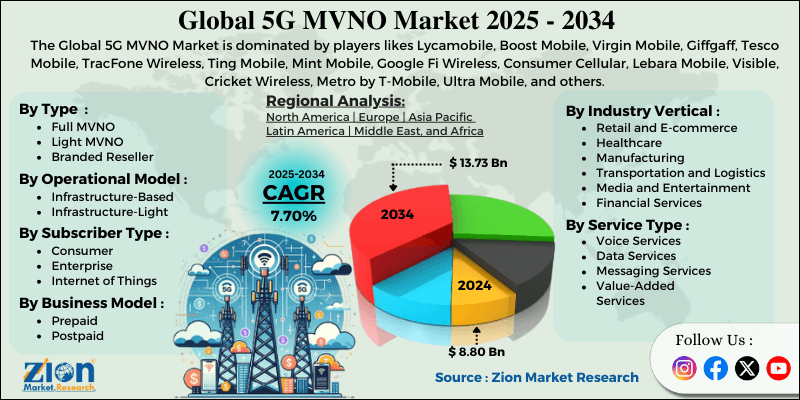
The global 5G MVNO market size was worth approximately USD 8.80 billion in 2024 and is projected to grow to around USD 13.73 billion by 2034, with a compound annual growth rate (CAGR) of roughly 7.70% between 2025 and 2034.

Key Insights:
- As per the analysis shared by our research analyst, the global 5G MVNO market is estimated to grow annually at a CAGR of around 7.70% over the forecast period (2025-2034).
- In terms of revenue, the global 5G MVNO market size was valued at approximately USD 8.80 billion in 2024 and is projected to reach USD 13.73 billion by 2034.
- The 5G MVNO market is projected to grow significantly due to expanding 5G network coverage, increasing demand for specialized connectivity solutions, growing enterprise adoption of private networks, rising Internet of Things device deployments, competitive pressure on traditional carriers, and increasing consumer preference for flexible service plans.
- Based on type, the light MVNO segment is expected to lead the 5G MVNO market, while the full MVNO segment is anticipated to experience significant growth.
- Based on the operational model, the infrastructure-light segment is expected to lead the market compared to the infrastructure-based segment.
- Based on subscriber type, the consumer segment is the dominating segment, while the enterprise segment is projected to witness sizeable revenue over the forecast period.
- Based on industry vertical, the retail and e-commerce segment is expected to lead the market during the forecast period.
- Based on service type, the data services segment is expected to dominate compared to the voice services segment.
- Based on the business model, the prepaid segment is expected to lead the market during the estimated period.
- Based on region, Asia Pacific is projected to dominate the global 5G MVNO market during the estimated period, followed by North America.
5G MVNO Market: Overview
A 5G MVNO, or fifth-generation mobile virtual network operator, is a wireless communication service provider that delivers cellular services to customers without owning physical network infrastructure. It purchases wholesale access to network capacity from traditional mobile network operators and then packages and sells mobile services under its own brand name. Unlike conventional carriers that build and maintain cell towers, spectrum licenses, and core network equipment, a 5G MVNO focuses on marketing, customer service, billing, and the development of specialized service offerings for specific customer segments. The introduction of 5G technology provides MVNOs with enhanced capabilities, including very high data speeds, reduced latency, large-scale device connectivity, and network slicing features that enable customized virtual networks for different applications. It can design tailored solutions for industries such as healthcare, manufacturing, logistics, and entertainment because these sectors benefit from advanced 5G performance.
A 5G MVNO usually targets niche markets underserved by major carriers, offers competitive pricing structures, provides flexible contract terms, and delivers personalized customer experiences. A 5G MVNO aggregates customers, negotiates bulk pricing with host operators, adds value through specialized service features, and competes by concentrating on specific demographics, geographic areas, or industry verticals where it can offer stronger value propositions.
The increasing demand for specialized mobile services and the growing deployment of 5G networks are expected to drive growth in the 5G MVNO market throughout the forecast period.
5G MVNO Market Dynamics
Growth Drivers
How are specialized enterprise solutions and industry-specific services driving the 5G MVNO market expansion?
The 5G MVNO industry is growing quickly as businesses across various industries seek simple, customized connectivity solutions. Manufacturing companies use private 5G networks for factory automation, robotics coordination, and real-time production monitoring. Healthcare providers depend on secure, reliable connections for telemedicine, remote patient monitoring, and connected medical devices. Logistics and transportation firms use 5G systems for fleet tracking, warehouse automation, and improved supply chain visibility.
Retail businesses are adopting 5G services for enhanced augmented reality shopping experiences, improved inventory management systems, and seamless point-of-sale connectivity. Smart city programs rely on large sensor networks and real-time data processing supported by 5G MVNO services. Agriculture operations deploy connected sensors for precision farming, automated equipment, and continuous crop monitoring. Entertainment and media firms deliver high-definition content and enable enhanced virtual reality experiences.
Growing Internet of Things adoption and machine-to-machine communications
The global 5G MVNO market is growing strongly as Internet of Things deployments expand across many applications requiring reliable and scalable connectivity. Connected vehicles use constant communication for navigation, safety functions, entertainment systems, and vehicle-to-everything technologies. Smart home devices, including security systems, appliances, thermostats, and lighting controls, require continuous and dependable connectivity. Wearable devices for fitness tracking, health monitoring, and personal safety generate steady data streams across various environments. Industrial Internet of Things systems monitor equipment health, optimize processes, and predict essential maintenance needs.
Utility companies deploy advanced smart meters for consumption monitoring and efficient grid management operations. Environmental monitoring networks track air quality, water conditions, and important weather patterns reliably. Asset tracking applications enable the real-time location of equipment, vehicles, and inventory across diverse locations. MVNOs specializing in Internet of Things connectivity offer pricing models suited to machine communication patterns. They support many device types, provide global coverage, and offer platforms for managing large device fleets.
Restraints
How are network quality concerns and dependency on host operators creating key restraints for the 5G MVNO market?
The 5G MVNO market faces significant challenges due to its dependence on host operators for access to essential infrastructure. MVNOs have limited control over network capacity, coverage areas, upgrade schedules, and overall performance quality. During network congestion periods, MVNO customers may receive lower priority compared to primary carrier subscribers. Service issues created by host networks often damage MVNO reputations when customers assign responsibility in frustration.
Wholesale pricing discussions with host operators strongly influence MVNO profitability, competitive strategy, and long-term sustainability. Host carriers may limit access because they consider MVNO offerings competitive compared to their retail services. Technical integration between MVNO platforms and host systems requires cooperation, which may not always occur. New features, including slicing and edge computing, depend on host capabilities and willingness to support sharing. Strict contractual conditions can restrict MVNO pricing options, service design choices, and targeted market segments.
Opportunities
Expanding opportunities in private networks and enterprise connectivity
The 5G MVNO industry is gaining strong opportunities by offering private network solutions to enterprises needing dedicated connectivity infrastructure. Manufacturing plants use isolated networks for operational technology systems, keeping them separate from corporate information technology environments. Ports and airports require wide coverage across large areas with strict security and reliability expectations. Hospitals deploy private networks to ensure patient data protection, prioritize medical devices, and maintain uninterrupted operational processes.
Universities create campus networks supporting research activities, educational programs, and essential administrative functions efficiently. Sports venues use private networks supporting fan experiences, stadium operations, and essential broadcast infrastructure during major events. Military and defense applications require secure, controlled communication systems designed for sensitive operational needs. Financial trading floors use ultra-low latency connections, providing essential advantages during high-speed transactions. Data centers employ private 5G for inter-facility connections and advanced edge computing support. Distribution warehouses optimize operations using private networks supporting robotics, automation, and safety systems.
Challenges
How are regulatory complexity and spectrum access issues challenging the 5G MVNO market?
The 5G MVNO market faces many challenges while operating across diverse regulatory environments in different global regions. Telecommunications regulations vary significantly in terms of licensing rules, operational limits, and essential consumer protection requirements. Some countries require MVNOs to secure specific licenses, while others permit operation under host carrier agreements. Number portability rules influence customer acquisition efforts and long-term retention strategies for competitive markets. Roaming arrangements demand compliance with international standards supported through complex bilateral agreements.
Data privacy regulations, such as the GDPR, impose strict conditions for managing and protecting customer information. Emergency service obligations require defined technical capabilities supported through certified systems and infrastructure. Network security rules mandate strong protections against cyber threats and critical infrastructure vulnerabilities. Spectrum licensing policies may either restrict or enable MVNO access to essential operating frequencies. Universal service obligations may require coverage commitments in unprofitable rural areas. Interconnection rules govern relationships with carriers and essential third-party service providers.
5G MVNO Market: Report Scope
| Report Attributes | Report Details |
|---|---|
| Report Name | 5G MVNO Market |
| Market Size in 2024 | USD 8.80 Billion |
| Market Forecast in 2034 | USD 13.73 Billion |
| Growth Rate | CAGR of 7.70% |
| Number of Pages | 217 |
| Key Companies Covered | Lycamobile, Boost Mobile, Virgin Mobile, Giffgaff, Tesco Mobile, TracFone Wireless, Ting Mobile, Mint Mobile, Google Fi Wireless, Consumer Cellular, Lebara Mobile, Visible, Cricket Wireless, Metro by T-Mobile, Ultra Mobile, and others. |
| Segments Covered | By Type, By Operational Model, By Subscriber Type, By Industry Vertical, By Service Type, By Business Model, and By Region |
| Regions Covered | North America, Europe, Asia Pacific (APAC), Latin America, Middle East, and Africa (MEA) |
| Base Year | 2024 |
| Historical Year | 2019 to 2023 |
| Forecast Year | 2025 - 2034 |
| Customization Scope | Avail customized purchase options to meet your exact research needs. Request For Customization |
5G MVNO Market: Segmentation
The global 5G MVNO market is segmented based on type, operational model, subscriber type, industry vertical, service type, business model, and region.
Based on type, the global 5G MVNO industry is segregated into full MVNO, light MVNO, and branded reseller. Light MVNOs lead the market due to lower infrastructure investment requirements, faster market entry capabilities, operational simplicity, and flexibility to focus on customer acquisition and service innovation without heavy technical obligations.
Based on the operational model, the industry is segmented into infrastructure-based and infrastructure-light. Infrastructure-light models hold the largest market share due to lower capital requirements, reduced operational complexity, faster scalability, and the ability to leverage host operator investments in network infrastructure while focusing on customer-facing differentiation.
Based on subscriber type, the global 5G MVNO market is divided into consumer, enterprise, and Internet of Things. Consumer subscribers are expected to lead the market during the forecast period due to large addressable populations, growing smartphone adoption, increasing data consumption, and opportunities to serve underserved demographic segments with specialized offerings.
Based on industry vertical, the global market is classified into retail and e-commerce, healthcare, manufacturing, transportation and logistics, media and entertainment, financial services, and others. Retail and e-commerce hold the largest market share due to high mobile commerce adoption, the need for employee connectivity across distributed locations, point-of-sale systems requiring reliable connections, and customer engagement applications driving data consumption.
Based on service type, the global market is segmented into voice services, data services, messaging services, and value-added services. Data services hold the largest market share due to the explosive growth in mobile data consumption, the popularity of streaming media, social media usage, cloud application adoption, and 5G's primary value proposition, which centers on enhanced data capabilities.
Based on the business model, the global market is categorized into prepaid and postpaid. Prepaid services are expected to lead the market as they attract cost-conscious consumers, provide flexible spending control, require no credit checks, suit temporary or variable usage patterns, and dominate in emerging markets with large unbanked populations.
5G MVNO Market: Regional Analysis
Asia Pacific leads due to its massive population and rapid 5G deployment.
Asia Pacific holds a leading position in the 5G MVNO market due to large populations, rapid 5G expansion, rising smartphone usage, and varied opportunities across many development stages. China leads regional deployment with the world’s largest subscriber base supported by extensive nationwide 5G coverage. India’s huge population includes many new mobile users actively seeking affordable and dependable connectivity options. Japan and South Korea demonstrate advanced 5G applications supported by a strong readiness to adopt innovative digital services.
Digital payment ecosystems across the region increase demand for dependable mobile connectivity supporting daily consumer transactions. E-commerce platforms require reliable connectivity solutions supporting merchants, delivery workers, and logistics operations. Manufacturing hubs need strong industrial connectivity supporting large-scale smart factory automation initiatives. Competitive telecommunication markets with many carriers generate wholesale capacity suitable for MVNO operations. Regulatory environments in several countries actively encourage MVNO entry through supportive policies.
Price-sensitive consumers respond quickly to MVNO offerings presenting competitive pricing advantages. Dense urban environments allow efficient network deployment and high customer concentration across major cities. Mobile-first internet usage patterns across the region prioritize continuous connectivity over fixed broadband access. Remittance flows and migrant workers create a strong demand for dependable international roaming services. Digital inclusion programs implemented by governments expand mobile connectivity access across underserved populations. A strong regional technology industry presence promotes innovation in advanced mobile applications and services.
What is driving North America's strong growth in the 5G MVNO market?
North America exhibits strong growth in the 5G MVNO market due to mature telecommunications infrastructure, high smartphone usage, and advanced enterprise needs, creating supportive conditions. The United States maintains extensive 5G coverage from multiple carriers supplying essential wholesale capacity for MVNO operations. Consumer interest in alternatives to traditional carriers helps MVNOs gain market share across many demographic groups. Competition involving unlimited data plans creates opportunities for MVNOs to differentiate through service quality or targeted offerings. Enterprise focus on digital transformation increases demand for specialized connectivity supporting modern business operations. Internet of Things adoption across industries, from agriculture to healthcare, requires dedicated connectivity providers with strong reliability. Online-only business models reduce operational overhead, allowing highly competitive pricing strategies. Technology-savvy consumers compare options carefully and favor providers offering transparent plans and flexible choices.
Regulatory frameworks support competition and require carriers to offer mandated wholesale access. Customer dissatisfaction with carrier service and pricing creates consistent switching opportunities for MVNO providers. Wireless-first households, who are moving away from fixed broadband, increase overall mobile data consumption. Streaming entertainment and remote work behaviors drive continuous growth in mobile data demand. Partner ecosystems, including retailers and online platforms, create efficient customer acquisition channels. Brand loyalty continues declining as consumers prioritize strong value over long-term carrier identity. Innovation in billing flexibility and service customization attracts diverse customer groups across the region.
Recent Market Developments:
- In July 2025, T‑Mobile U.S. entered a multi-year exclusive agreement with Charter Communications and Comcast Corporation to support their business customers via MVNO arrangements using T-Mobile’s 5G network infrastructure.
- In August 2025, Maxis Berhad and China Mobile International Limited signed a deal to launch a new MVNO offering in Malaysia that will run on Maxis’s 4G/5G network and expand China Mobile International’s global MVNO footprint.
5G MVNO Market: Competitive Analysis
The leading players in the global 5G MVNO market are:
- Lycamobile
- Boost Mobile
- Virgin Mobile
- Giffgaff
- Tesco Mobile
- TracFone Wireless
- Ting Mobile
- Mint Mobile
- Google Fi Wireless
- Consumer Cellular
- Lebara Mobile
- Visible
- Cricket Wireless
- Metro by T-Mobile
- Ultra Mobile
The global 5G MVNO market is segmented as follows:
By Type
- Full MVNO
- Light MVNO
- Branded Reseller
By Operational Model
- Infrastructure-Based
- Infrastructure-Light
By Subscriber Type
- Consumer
- Enterprise
- Internet of Things
By Industry Vertical
- Retail and E-commerce
- Healthcare
- Manufacturing
- Transportation and Logistics
- Media and Entertainment
- Financial Services
- Others
By Service Type
- Voice Services
- Data Services
- Messaging Services
- Value-Added Services
By Business Model
- Prepaid
- Postpaid
By Region
- North America
- The U.S.
- Canada
- Europe
- France
- The UK
- Spain
- Germany
- Italy
- Rest of Europe
- Asia Pacific
- China
- Japan
- India
- South Korea
- Southeast Asia
- Rest of Asia Pacific
- Latin America
- Brazil
- Mexico
- Rest of Latin America
- Middle East & Africa
- GCC
- South Africa
- Rest of Middle East & Africa
Table Of Content
Methodology
FrequentlyAsked Questions

HappyClients

