
3D Micro Battery Market Size, Share, Trends, Growth Report 2034

3D Micro Battery Market By Type (3D Concentric MB and 3D Interlaced MB), By Product (Thin-Film Zinc-Based Micro Batteries, Thin-Film Lithium Polymer Micro Batteries, Thin-Film Lithium-Ion Micro Batteries, and Others), By Application (Smart Dust, Medical Implantable Devices, Smart Cards, MEMS, CMOS Memories, Drug Delivery System, and Others), and By Region - Global and Regional Industry Overview, Market Intelligence, Comprehensive Analysis, Historical Data, and Forecasts 2025 - 2034
| Market Size in 2024 | Market Forecast in 2034 | CAGR (in %) | Base Year |
|---|---|---|---|
| USD 366.05 Million | USD 1044.00 Million | 12.35% | 2024 |
3D Micro Battery Industry Perspective:
What is the anticipated CAGR for the 3D micro battery market during the forecast period?
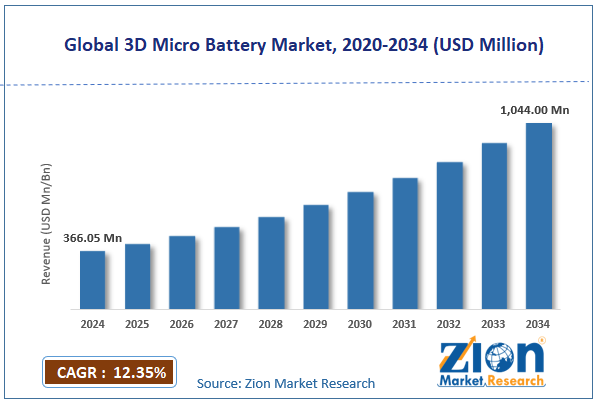
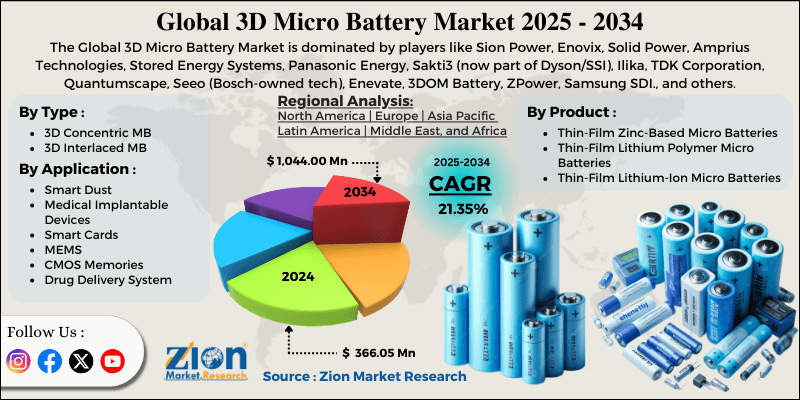
The global 3D micro battery market size was worth around USD 366.05 million in 2024 and is predicted to grow to around USD 1,044.00 million by 2034, with a compound annual growth rate (CAGR) of roughly 12.35% between 2025 and 2034.
Key Insights:
- As per the analysis shared by our research analyst, the global 3D micro battery market is estimated to grow annually at a CAGR of around 12.35% over the forecast period (2025-2034)
- In terms of revenue, the global 3D micro battery market size was valued at around USD 366.05 million in 2024 and is projected to reach USD 1,044.00 million by 2034.
- The 3D micro battery market is projected to grow at a significant rate due to the rising demand for wearables worldwide
- Based on the type, the 3D interlaced MB segment is growing at a high rate and will continue to dominate the global market, as per industry projections
- Based on the product, the thin-film lithium-ion micro battery segment is anticipated to command the largest market share
- Based on the application, the MEMS segment is projected to shape the market growth trends
- Based on region, North America is projected to dominate the global market during the forecast period
3D Micro Battery Market: Overview
3 dimension (3D microbatteries (MB) are next-generation energy storage systems revolutionizing how small devices are powered. 3D microbatteries are compact energy sources facilitating advancements in medical implants, wearables, and Internet-of-Things (IoT) sensors. 3D microbatteries offer a 3-dimensional architecture as opposed to conventionally used 2D batteries. These solutions are constructed using flat electrodes stacked on top of one another, thereby increasing the surface area and improving overall performance. Some of the most prominent advantages of 3D microbatteries are improved energy density and higher safety. 3D microbatteries have shown extensive applications in micro-robotics, wearable electronics, and microelectronics sectors. Global demand for 3D microbatteries is projected to grow as small, high-performance battery storage systems power miniaturized electronic devices.
Additionally, the rising number of wearable users across the globe and the surge in IoT applications may open extended avenues for further growth. The industry players may face growth limitations due to high production costs and competition from conventional battery solutions.
3D Micro Battery Market: Dynamics
Growth Drivers
Why will the growing demand for wearables influence improved growth in the 3D micro battery market?
The global 3D micro battery market is expected to be driven by the rising demand for wearables worldwide. One of the most prominent applications of 3D microbatteries is the development of compact wearables such as fitness trackers and smartwatches. The general population is increasingly becoming more health-conscious due to the rising rate of common and serious medical conditions reported across the globe. In addition, the growing rate of the geriatric population has further influenced the increased demand for highly effective wearables.
According to official projections, the global wearables industry reported a year-on-year increase of 9.61% in Q2 2025 as compared to Q2 2024. Industry analysis suggests that wearables powered by 3D microbatteries have higher energy density in small form factors. They are lightweight and deliver exceptional operational life as compared to traditional wearables.
Expansion of IoT applications to influence industry revenue during the projection period
3D microbatteries have registered wider applications in Internet of Things (IoT)-based ecosystems, especially used in commercial and industrial settings. In recent years, IoT applications across industries have experienced accelerated growth, driven by the advantages these solutions offer.
For instance, IoT sensors are integral components of smart factories, warehouses, and manufacturing units. In addition, they are applied in modern-age environmental monitoring systems as well as packaging solutions. The amplified use of IoT systems globally is expected to promote revenue in the global 3D microbattery market during the projection period.
Restraints
Why will cost constraints limit the expansion of the 3D micro battery market?
The global 3D microbattery industry is expected to be restricted due to the cost barriers in the market. 3D microbatteries are a part of next-generation technologies that do not enjoy the benefits of a well-established and mature market. In addition, the development and production of 3D microbatteries requires advanced fabrication technologies with precision manufacturing. The high cost of raw materials for 3D microbatteries further increases the overall cost of the technology, thereby limiting the number of market participants.
Opportunities
Emergence of microrobotics to deliver renewed growth opportunities to the industry players
The global 3D microbattery market is anticipated to generate growth opportunities due to the emergence of microrobotics. The industry deals with the production of small robots capable of conducting micro-scale tasks with high precision. Microrobotics is gaining momentum among robotics companies due to the versatility and wider applications of compact robots. These machines are powered by small energy-storage devices, such as 3D microbatteries. Expansion of microrobotics will ultimately work in favor of the 3D microbattery market during the projection period.
How are solid-state 3D microbatteries expected to influence growth in the 3D micro battery market?
Solid-state 3D microbatteries are developed using a solid electrolyte as opposed to traditionally used liquid counterparts. As per industry analysis, solid-state 3D microbatteries have higher energy density and greater safety. In addition, they can be directly integrated with micro-electro-mechanical systems (MEMS), a highly significant advantage that creates new investment opportunities for market players.
Challenges
Scaling concerns and competition from alternative technologies challenge market expansion
The global 3D microbattery industry is expected to face significant challenges in scaling production due to technical complexities, limited standardization, raw material shortages, and a shortage of skilled labor. In addition, competition from alternative solutions, such as supercapacitors and conventional thin-film batteries, may affect market expansion trends in the future.
3D Micro Battery Market: Report Scope
| Report Attributes | Report Details |
|---|---|
| Report Name | 3D Micro Battery Market |
| Market Size in 2024 | USD 366.05 Million |
| Market Forecast in 2034 | USD 1,044.00 Mllion |
| Growth Rate | CAGR of 21.35% |
| Number of Pages | 230 |
| Key Companies Covered | Sion Power, Enovix, Solid Power, Amprius Technologies, Stored Energy Systems, Panasonic Energy, Sakti3 (now part of Dyson/SSI), Ilika, TDK Corporation, Quantumscape, Seeo (Bosch-owned tech), Enevate, 3DOM Battery, ZPower, Samsung SDI., and others. |
| Segments Covered | By Type, By Product, By Application, and By Region |
| Regions Covered | North America, Europe, Asia Pacific (APAC), Latin America, Middle East, and Africa (MEA) |
| Base Year | 2024 |
| Historical Year | 2019 to 2023 |
| Forecast Year | 2025 - 2034 |
| Customization Scope | Avail customized purchase options to meet your exact research needs. Request For Customization |
3D Micro Battery Market: Segmentation
The global 3D micro battery market is segmented based on type, product, application, and region.
Why will 3D interlaced MB dominate the 3D micro battery market during the forecast period?
Based on type, the global market segments are 3D concentric MB and 3D interlaced MB. Around 60.05% of global revenue in 2024 was listed in the 3D interlaced MB segment and is expected to continue dominating the market in the coming years. The segment is projected to deliver a CAGR of more than 10% during the forecast period, owing to the design offers improved stability and overall applications across industries.
What is the expected CAGR for thin-film lithium-ion micro batteries industry in the 3D micro battery in the coming years?
Based on product, the global 3D micro battery industry is divided into thin-film zinc-based micro batteries, thin-film lithium polymer micro batteries, thin-film lithium-ion micro batteries, and others. The highest market share was held by the thin-film lithium-ion micro batteries segment in 2024, accounting for over 43% of total revenue. The segment is anticipated to generate a CAGR of 9.89% during the projection period, led by increased applications of the product in the production of wearables and compact electronic devices.
Which area holds the leading position in the application segment of the 3D micro battery market?
Based on application, the global market segments are smart dust, medical implantable devices, smart cards, MEMS, CMOS memories, drug delivery systems, and others. The MEMS segment was the dominant application in 2024, contributing up to 29% of the final revenue. It is expected to continue leading the market during the forecast period with a CAGR of 11% due to higher use of 3D microbatteries in the production of microsensors.
3D Micro Battery Market: Regional Analysis
Which factors contribute to North America’s dominance in the 3D micro battery market?
The global 3D micro battery market is expected to be led by North America during the projection period. The region accounted for 36% of global revenue in 2024 and is expected to deliver a CAGR of 13% over the coming years. The regional market growth trends are attributable to a strong, technologically advanced engineering infrastructure that facilitates research & development (R&D) in emerging technologies such as 3D microbatteries. In addition, the rapidly growing regional investments in domestic fabrication facilities may create new growth opportunities for the players across North America.
What is the expected CAGR for Asia-Pacific in the 3D micro battery industry during the forecast period?
Asia-Pacific is anticipated to emerge as the fastest-growing region in the 3D micro battery market, with a CAGR of 15% during the projection period. China, India, and South Korea are anticipated to emerge as leading players due to the strong presence of advanced semiconductor manufacturing sectors in these prominent nations.
In addition, rising demand for modern wearables, increased production of technology-embedded medical devices, and accelerating IoT applications may further aid improved revenue across the Asia-Pacific.
3D Micro Battery Market: Competitive Analysis
The global 3D micro battery market is led by players like:
- Sion Power
- Enovix
- Solid Power
- Amprius Technologies
- Stored Energy Systems
- Panasonic Energy
- Sakti3 (now part of Dyson/SSI)
- Ilika
- TDK Corporation
- Quantumscape
- Seeo (Bosch-owned tech)
- Enevate
- 3DOM Battery
- ZPower
- Samsung SDI.
What are the key trends in the 3D Micro Battery Market?
Flexible 3D microbatteries
A promising trend in the 3D micro battery industry is the growing work on the development of flexible batteries that can be integrated into stretchable materials, such as smart textiles.
Miniaturization of medical devices
Miniaturization of medical devices such as insulin pumps, implantable pacemakers, and continuous glucose monitoring systems. The growing demand for minimally invasive medical procedures is further driving demand for 3D microbatteries
The global 3D micro battery market is segmented as follows:
By Type
- 3D Concentric MB
- 3D Interlaced MB
By Product
- Thin-Film Zinc-Based Micro Batteries
- Thin-Film Lithium Polymer Micro Batteries
- Thin-Film Lithium-Ion Micro Batteries
- Others
By Application
- Smart Dust
- Medical Implantable Devices
- Smart Cards
- MEMS
- CMOS Memories
- Drug Delivery System
- Others
By Region
- North America
- The U.S.
- Canada
- Europe
- France
- The UK
- Spain
- Germany
- Italy
- Rest of Europe
- Asia Pacific
- China
- Japan
- India
- South Korea
- Southeast Asia
- Rest of Asia Pacific
- Latin America
- Brazil
- Mexico
- Rest of Latin America
- Middle East & Africa
- GCC
- South Africa
- Rest of Middle East & Africa
Table Of Content
Methodology
FrequentlyAsked Questions

HappyClients

