

Zero-Emission Trucks Market is expected to grow with a CAGR of 28.6% during the forecast period.
12-Jan-2026 | Zion Market Research
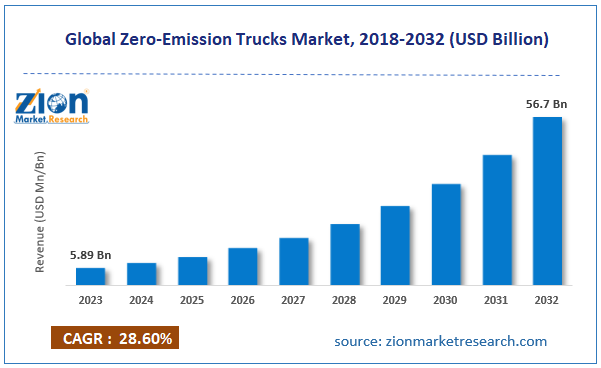
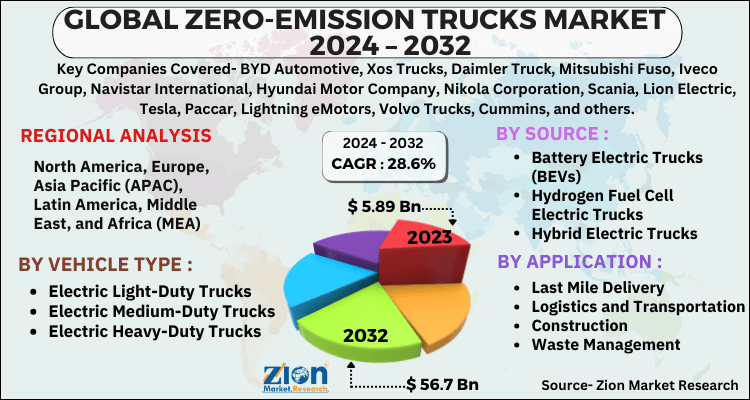
The global zero-emission trucks market size was worth around USD 5.89 billion in 2023 and is predicted to grow to around USD 56.7 billion by 2032 with a compound annual growth rate (CAGR) of roughly 28.6% between 2024 and 2032.
Zero-emission trucks are commercial vehicles using electric batteries or hydrogen fuel cells to operate without producing exhaust emissions during daily transport operations. Battery electric trucks store energy in large lithium-ion batteries, powering electric motors, with charging completed at depots or public fast-charging stations. Hydrogen fuel cell trucks create electricity on board by combining hydrogen with oxygen, releasing only water vapor and supporting a longer driving range. Both zero-emission truck technologies reduce air pollution, cut greenhouse gas emissions, and operate with much lower noise than diesel trucks. Available models range from light-duty delivery vehicles to heavy-duty trucks, offering varied payload capacity, driving range, and energy refill time. Fleet operators assess total ownership cost, including vehicle price, energy savings, maintenance reduction, and available government incentives. Growing sustainability goals and clean-transport regulations continue to accelerate the adoption of zero-emission trucks across global logistics and freight markets.
Browse the full “Zero-Emission Trucks Market By Vehicle Type (Electric Light-Duty Trucks, Electric Medium-Duty Trucks, and Electric Heavy-Duty Trucks), By Source (Battery Electric Trucks (BEVs), Hydrogen Fuel Cell Electric Trucks, and Hybrid Electric Trucks), By Application (Last Mile Delivery, Logistics and Transportation, Construction, and Waste Management), and By Region - Global and Regional Industry Overview, Market Intelligence, Comprehensive Analysis, Historical Data, and Forecasts 2024 - 2032" Report at https://www.zionmarketresearch.com/report/zero-emission-trucks-market
The growth of the global zero-emission trucks industry is primarily driven by government emissions regulations mandating clean-vehicle adoption, falling battery costs that improve economic viability, and corporate sustainability commitments that are pushing major logistics companies toward fleet electrification.
Market Growth Factors
Several factors are propelling the expansion of the zero-emission trucks market.
- Air quality improvement mandates: Cities introduce zero-emission zones limiting diesel truck entry, pushing logistics companies to adopt electric or hydrogen trucks for urban deliveries under stricter environmental regulations.
- Charging infrastructure investment: Governments and private firms build high-power charging stations at depots, ports, and highways, reducing range anxiety and supporting wider zero-emission truck operations.
- Fleet operator cost analysis: Lower electricity costs and reduced maintenance needs improve total ownership value for zero-emission trucks, helping fleets justify higher upfront vehicle prices.
Restraints
- Range limitation concerns: Current battery limits restrict driving distance for heavy trucks, creating challenges for long-haul routes where diesel trucks travel much farther daily.
- Charging time requirements: Long battery charging times reduce vehicle availability, forcing fleet operators to adjust schedules or invest in additional trucks to meet delivery demands.
| Report Attributes | Report Details |
|---|---|
| Report Name | Zero-Emission Trucks Market |
| Market Size in 2023 | USD 5.89 Billion |
| Market Forecast in 2032 | USD 56.7 Billion |
| Growth Rate | CAGR of 28.6% |
| Number of Pages | 201 |
| Key Companies Covered | BYD Automotive, Xos Trucks, Daimler Truck, Mitsubishi Fuso, Iveco Group, Navistar International, Hyundai Motor Company, Nikola Corporation, Scania, Lion Electric, Tesla, Paccar, Lightning eMotors, Volvo Trucks, Cummins, and others. |
| Segments Covered | By Vehicle Type, By Source, By Application, and By Region |
| Regions Covered | North America, Europe, Asia Pacific (APAC), Latin America, Middle East, and Africa (MEA) |
| Base Year | 2023 |
| Historical Year | 2018 to 2022 |
| Forecast Year | 2024 - 2032 |
| Customization Scope | Avail customized purchase options to meet your exact research needs. Request For Customization |
Market Segmentation
The zero-emission trucks market can be segmented by propulsion type, vehicle weight class, application, end-user, and region.
Based on propulsion type, the market is divided into battery-electric trucks, hydrogen fuel cell trucks, and hybrid combinations using both technologies. Battery-electric trucks are expected to maintain a significant market share during the forecast period due to established charging infrastructure and lower technology costs compared with hydrogen systems.
Based on vehicle weight class, the zero-emission trucks industry is classified into light-duty trucks under 6,000 pounds, medium-duty trucks between 6,000 and 26,000 pounds, and heavy-duty trucks above 26,000 pounds. Medium-duty trucks are expected to lead the market during the forecast period due to their suitability for urban delivery operations and balanced range requirements.
Based on application, the zero-emission trucks market is segmented into last-mile delivery, port drayage, regional hauling, refuse collection, and construction operations. Last-mile delivery leads the market due to short routes, predictable schedules, and overnight charging opportunities that align well with current zero-emission truck capabilities.
Based on end-user, the market is segregated into logistics companies, retail chains with private fleets, municipal governments, waste management companies, and construction firms. Logistics companies lead the market as the largest commercial truck operators, facing pressure to reduce emissions and environmental impacts.
Europe leads the global zero-emission trucks market due to strict emission regulations targeting commercial vehicles and clear timelines for reducing diesel truck usage. Many European countries are introducing zero-emission zones in cities, prompting fleet operators to adopt electric and hydrogen-powered trucks. The European Union offers strong subsidies for zero-emission truck purchases and charging or hydrogen refueling infrastructure development. High environmental awareness among businesses and consumers increases demand for sustainable freight and clean logistics solutions. Advanced power grids and robust renewable energy capacity enable low-emission charging from wind and solar. European truck manufacturers invest heavily in electric trucks and hydrogen fuel cell technology to remain globally competitive. Shorter urban delivery distances across Europe align with current battery-electric truck range and charging requirements. Regional coordination on charging standards and hydrogen networks supports smooth cross-border zero-emission truck operations across European transport corridors.
Key Market Players
Leading companies operating in the global zero-emission trucks market include:
- BYD Automotive
- Xos Trucks
- Daimler Truck
- Mitsubishi Fuso
- Iveco Group
- Navistar International
- Hyundai Motor Company
- Nikola Corporation
- Scania
- Lion Electric
- Tesla
- Paccar
- Lightning eMotors
- Volvo Trucks
- Cummins
Recent Developments
- In October 2025, Hyundai Motor Company and PlusAI received recognition in TIME’s “Best Inventions of 2025” list for their autonomous XCIENT Fuel Cell Class 8 hydrogen truck, showcasing innovation in zero-emission long-haul commercial transport technology.
The global zero-emission trucks market is segmented as follows:
By Vehicle Type
- Electric Light-Duty Trucks
- Electric Medium-Duty Trucks
- Electric Heavy-Duty Trucks
By Source
- Battery Electric Trucks (BEVs)
- Hydrogen Fuel Cell Electric Trucks
- Hybrid Electric Trucks
By Application
- Last Mile Delivery
- Logistics and Transportation
- Construction
- Waste Management
By Region
- North America
- The U.S.
- Canada
- Europe
- France
- The UK
- Spain
- Germany
- Italy
- Rest of Europe
- Asia Pacific
- China
- Japan
- India
- South Korea
- Southeast Asia
- Rest of Asia Pacific
- Latin America
- Brazil
- Mexico
- Rest of Latin America
- Middle East & Africa
- GCC
- South Africa
- Rest of Middle East & Africa
About Us:
Zion Market Research is an obligated company. We create futuristic, cutting-edge, informative reports ranging from industry reports, company reports to country reports. We provide our clients not only with market statistics unveiled by avowed private publishers and public organizations but also with vogue and newest industry reports along with pre-eminent and niche company profiles. Our database of market research reports comprises a wide variety of reports from cardinal industries. Our database is been updated constantly in order to fulfill our clients with prompt and direct online access to our database. Keeping in mind the client’s needs, we have included expert insights on global industries, products, and market trends in this database. Last but not the least, we make it our duty to ensure the success of clients connected to us—after all—if you do well, a little of the light shines on us.
Contact Us:
Zion Market Research
244 Fifth Avenue, Suite N202
New York, 10001, United States
Tel: +49-322 210 92714
USA/Canada Toll-Free No.1-855-465-4651
Email: sales@zionmarketresearch.com
Website: https://www.zionmarketresearch.com