

Global Wearable Medical Devices Market Worth $159.56 Billion By 2032
10-Dec-2024 | Zion Market Research
With the presence of a large pool of participants, the global wearable medical devices market is displaying a highly competitive business landscape, finds a new research report by Zion Market Research (ZMR).
This review is based on a report by Zion Market Research, titled “Wearable Medical Devices Market - By Device Type (Diagnostic & Monitoring Devices and Therapeutic Devices), By Application (Sports & Fitness, Home Healthcare, and Remote Patient Monitoring), By Type (Activity Monitors, Smart Clothing, Patches, and Smartwatches), By Distribution Channel (Pharmacies, Hypermarkets, and Online Channel), and By Region: Global Industry Perspective, Comprehensive Analysis, and Forecast, 2024–2032."
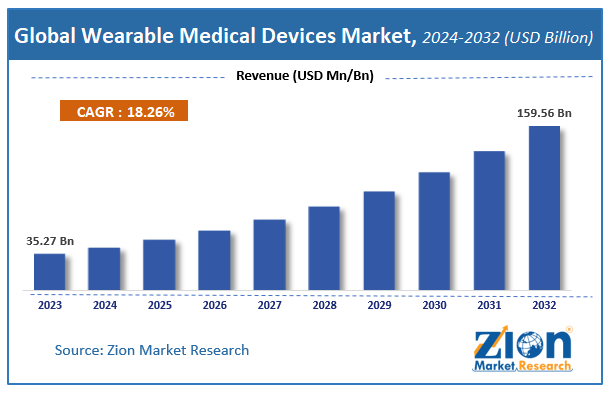
Browse the full “Wearable Medical Devices Market - By Device Type (Diagnostic & Monitoring Devices and Therapeutic Devices), By Application (Sports & Fitness, Home Healthcare, and Remote Patient Monitoring), By Type (Activity Monitors, Smart Clothing, Patches, and Smartwatches), By Distribution Channel (Pharmacies, Hypermarkets, and Online Channel), and By Region: Global Industry Perspective, Comprehensive Analysis, and Forecast, 2024–2032” Report at https://www.zionmarketresearch.com/report/wearable-medical-devices-market
The growth of the wearable devices market over the forecast period is due to the ability of these products in monitoring blood pressure, electrophysiology, body temperature, heart rate, and myriad sweating biomarkers. Apart from this, wearable medical devices can also be placed on skin epidermis and inserted via the skin for determining biochemical signals along with delivering medicines to the user.
According to Forbes, wearable technology is likely to witness a prominent surge over the coming two decades and this is likely to boost the cost savings for the healthcare industry in the foreseeable future. Moreover, the cost-savings is the result of accurate prediction ability of wearable devices. This, in turn, will embellish the growth of wearable medical devices industry over the forecast period.
Furthermore, wearable technologies functioning in integration with artificial intelligence can help in accurately determining the symptoms of severe diseases such as heart and diabetes. This will assist the patients in seeking effective medical treatment with better prognosis and prevent long & expensive modes of treatment. Precisely, the growing wearable artificial intelligence (AI) market trends will further prompt the growth of wearable medical devices market over the forthcoming years.
Sports & Fitness Segment To Dominate Application Landscape By 2032
The segmental growth over the forecast period is credited to growing awareness about maintaining good health among youth as well as elderly persons. Apart from this, need to measure the levels of physical fitness after exercises in gym or after outdoor activities with the help of wearable medical devices will boost the segmental growth.
North America To Dominate Overall Market Growth During 2024-2032
The growth of the regional market over the forecast period is credited to presence of robust healthcare infrastructure facility, highlight on technological enhancements, and easy access to advanced healthcare apps & compatible equipment. Availability of national health insurance policies including Medicaid and Medicare in the countries like the U.S. will further expedite the regional market growth over 2024-2032.
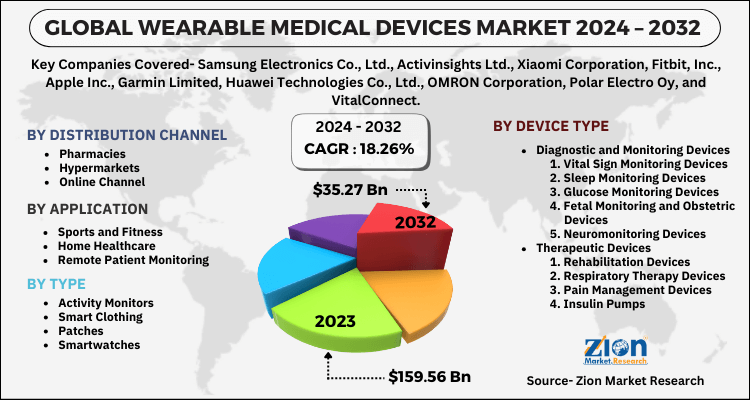
Key players involved in the wearable medical devices market include Samsung Electronics Co., Ltd., Activinsights Ltd., Xiaomi Corporation, Fitbit, Inc., Apple Inc., Garmin Limited, Huawei Technologies Co., Ltd., OMRON Corporation, Polar Electro Oy, and VitalConnect.
The global wearable medical devices market is segmented as follows:
By Device Type
- Diagnostic and Monitoring Devices
- Vital Sign Monitoring Devices
- Sleep Monitoring Devices
- Glucose Monitoring Devices
- Fetal Monitoring and Obstetric Devices
- Neuromonitoring Devices
- Therapeutic Devices
- Rehabilitation Devices
- Respiratory Therapy Devices
- Pain Management Devices
- Insulin Pumps
By Application
- Sports and Fitness
- Home Healthcare
- Remote Patient Monitoring
By Type
- Activity Monitors
- Smart Clothing
- Patches
- Smartwatches
By Distribution Channel
- Pharmacies
- Hypermarkets
- Online Channel
By Region
- North America
- The U.S.
- Canada
- Europe
- France
- The UK
- Spain
- Germany
- Italy
- Rest of Europe
- Asia Pacific
- China
- Japan
- India
- South Korea
- Southeast Asia
- Rest of Asia Pacific
- Latin America
- Brazil
- Mexico
- Rest of Latin America
- Middle East & Africa
- GCC
- South Africa
- Rest of Middle East & Africa
About Us:
Zion Market Research is an obligated company. We create futuristic, cutting-edge, informative reports ranging from industry reports, the company reports to country reports. We provide our clients not only with market statistics unveiled by avowed private publishers and public organizations but also with vogue and newest industry reports along with pre-eminent and niche company profiles. Our database of market research reports comprises a wide variety of reports from cardinal industries. Our database is been updated constantly in order to fulfill our clients with prompt and direct online access to our database. Keeping in mind the client’s needs, we have included expert insights on global industries, products, and market trends in this database. Last but not the least, we make it our duty to ensure the success of clients connected to us—after all—if you do well, a little of the light shines on us.
Contact Us:
Zion Market Research
244 Fifth Avenue, Suite N202
New York, 10001, United States
Tel: +49-322 210 92714
USA/Canada Toll-Free No.1-855-465-4651
Email: sales@zionmarketresearch.com
Website: https://www.zionmarketresearch.com