

Subsea Production and Processing Systems Market is estimated to reach USD 37 billion by the end of 2032
17-Jul-2026 | Zion Market Research
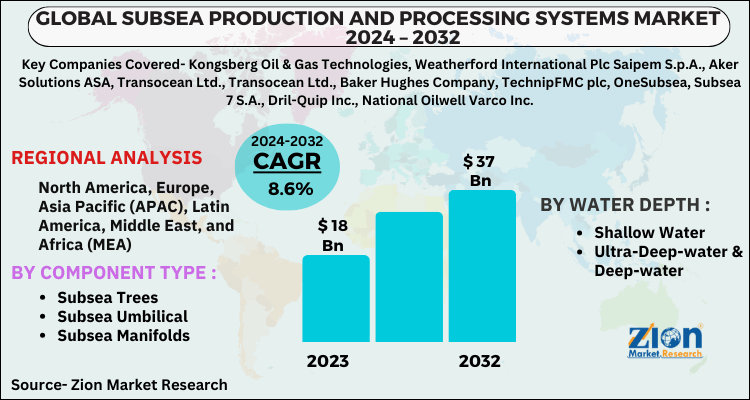
The global subsea production and processing systems market size was evaluated at $18 billion in 2023 and is slated to hit $37 billion by the end of 2032, with a CAGR of nearly 8.6% between 2024 and 2032.
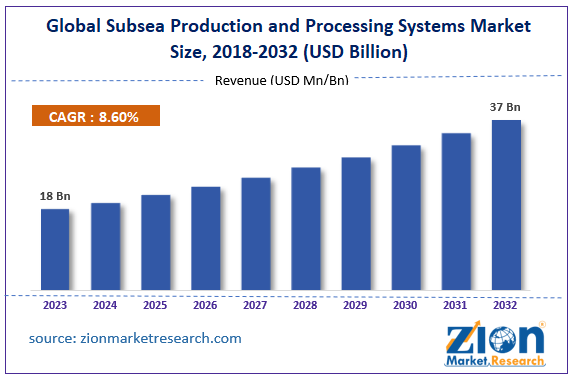
Subsea production and processing systems are advanced underwater systems used to safely and efficiently extract, process, and transport oil and natural gas from offshore fields. These systems are installed on the seabed and perform critical tasks, such as separating oil and gas, increasing pressure, and transporting hydrocarbons to offshore platforms or onshore facilities. Unlike traditional offshore platforms that rely on large surface equipment, subsea systems operate directly on the ocean floor. They can remain operational for many years in deep, harsh underwater environments with minimal maintenance. The main components include subsea trees, manifolds, control systems, umbilicals, and boosting units, each playing a specific role in the production process. These systems are widely used in deep-water and ultra-deep-water oil and gas fields, mature offshore basins, and long-distance subsea projects to access energy reserves that are difficult to reach. Growing offshore oil and gas exploration, rising global energy demand, and continuous improvements in subsea technology are driving the increasing adoption of subsea production and processing systems worldwide.
The subsea production and processing systems industry is growing due to rising offshore exploration, increasing deep-water developments, and wider adoption of advanced subsea technologies.
Browse the full “Subsea Production and Processing Systems Market By Component Type (Subsea Trees, Subsea Umbilical, Subsea Manifolds, Subsea Pumps & Compressors, Subsea Pipelines, and Subsea Control Systems), By Water Depth (Shallow Water and Ultra-Deep-water & Deep-water), and By Region - Global and Regional Industry Overview, Market Intelligence, Comprehensive Analysis, Historical Data, and Forecasts 2024 - 2032” Report at https://www.zionmarketresearch.com/report/subsea-production-and-processing-systems-market
Market Growth Factors
Several factors are pushing growth in the subsea production and processing systems market.
- Rising deep- and ultra-deep-water exploration: Depletion of shallow-water reserves is pushing operators toward deeper offshore basins that require advanced subsea equipment.
- Increasing global demand for oil and natural gas: Continued reliance on hydrocarbons for energy and industrial use is supporting steady investment in offshore production infrastructure.
- Growing focus on cost-efficient field development: Operators are adopting standardized and modular subsea designs to shorten project timelines and reduce topside infrastructure costs.
Restraints
- High capital investment requirements: Subsea projects demand substantial upfront spending on equipment, installation, and specialized vessels, which can limit participation to larger operators.
- Complex project execution and supply chain risks: Harsh underwater conditions and long project timelines can lead to delays and cost overruns during installation and maintenance.
Subsea Production and Processing Systems Market: Report Scope
| Report Attributes | Report Details |
|---|---|
| Report Name | Subsea Production and Processing Systems Market |
| Market Size in 2023 | USD 18 Billion |
| Market Forecast in 2032 | USD 37 Billion |
| Growth Rate | CAGR of 8.6% |
| Number of Pages | 224 |
| Key Companies Covered | Kongsberg Oil & Gas Technologies, Weatherford International Plc Saipem S.p.A., Aker Solutions ASA, Transocean Ltd., Transocean Ltd., Baker Hughes Company, TechnipFMC plc, OneSubsea, Subsea 7 S.A., Dril-Quip Inc., National Oilwell Varco Inc., Schlumberger, Halliburton Company, GE Oil & Gas, Saipem, DOF Subsea AS, Oceaneering International Inc., and others. |
| Segments Covered | By Component Type, By Water Depth, and By Region |
| Regions Covered | North America, Europe, Asia Pacific (APAC), Latin America, Middle East, and Africa (MEA) |
| Base Year | 2023 |
| Historical Year | 2018 to 2022 |
| Forecast Year | 2024 - 2032 |
| Customization Scope | Avail customized purchase options to meet your exact research needs. Request For Customization |
Market Segmentation
The subsea production and processing systems market can be segmented by type, component, processing technology, water depth, and region.
Based on type, the subsea production and processing systems market is classified into subsea production systems and subsea processing systems. Subsea production systems hold the largest share because they form the core equipment used across nearly every offshore field development project worldwide.
Based on component, the market is segregated into subsea trees, manifolds, control systems, and umbilicals. Subsea trees lead the market due to their essential role in regulating the flow of oil and gas from the wellhead to the processing and transport networks.
Based on processing technology, the subsea production and processing systems industry is divided into subsea boosting, subsea separation, and subsea compression. Subsea boosting accounts for the largest share of processing technology because it increases flow efficiency and extends the productive life of mature offshore fields.
Based on water depth, the market is categorized into shallow water and deep-water and ultra-deep-water. Deep-water and ultra-deep-water lead the market, as operators increasingly target these zones to access reserves that shallow water fields can no longer supply.
North America leads the global subsea production and processing systems market due to its strong offshore oil and gas industry, advanced exploration technologies, and significant investments in deep-water energy projects. The United States is the largest market in the region, supported by extensive offshore activities in the Gulf of Mexico and continuous development of new subsea oil and gas fields. Major energy companies are investing in advanced subsea production systems to improve operational efficiency, reduce costs, and increase production from existing offshore reserves. Canada also contributes to regional growth through offshore exploration projects and investments in modern subsea infrastructure. Rising global energy demand and the need to maximize production from mature offshore fields are encouraging greater adoption of subsea processing technologies. The presence of leading oilfield service providers, advanced engineering expertise, and strong research and development capabilities further strengthens the regional market.
Key Market Players
Leading companies in the global subsea production and processing systems market include:
- Kongsberg Oil & Gas Technologies
- Weatherford International Plc Saipem S.p.A.
- Aker Solutions ASA
- Transocean Ltd.
- Transocean Ltd.
- Baker Hughes Company
- TechnipFMC plc
- OneSubsea
- Subsea 7 S.A.
- Dril-Quip Inc.
- National Oilwell Varco Inc.
- Schlumberger
- Halliburton Company
- GE Oil & Gas
- Saipem
- DOF Subsea AS
- Oceaneering International Inc.
Recent Developments
- In June 2026, SLB OneSubsea secured a contract from bp to deliver a standardized subsea boosting system for the Thunder Horse project in the Gulf of America, supporting improved production efficiency and faster project execution.
The global subsea production and processing systems market is segmented as follows:
By Component Type
- Subsea Trees
- Subsea Umbilical
- Subsea Manifolds
- Subsea Pumps & Compressors
- Subsea Pipelines
- Subsea Control Systems
By Water Depth
- Shallow Water
- Ultra-Deep-water & Deep-water
By Region
- North America
- The U.S.
- Canada
- Mexico
- Europe
- France
- The UK
- Spain
- Germany
- Italy
- Rest of Europe
- Asia Pacific
- China
- Japan
- India
- Australia
- South Korea
- Rest of Asia Pacific
- The Middle East & Africa
- Saudi Arabia
- UAE
- Egypt
- Kuwait
- South Africa
- Rest of the Middle East & Africa
- Latin America
- Brazil
- Argentina
- Rest of Latin America
About Us:
Zion Market Research is an obligated company. We create futuristic, cutting-edge, informative reports ranging from industry reports, the company reports to country reports. We provide our clients not only with market statistics unveiled by avowed private publishers and public organizations but also with vogue and newest industry reports along with pre-eminent and niche company profiles. Our database of market research reports comprises a wide variety of reports from cardinal industries. Our database is been updated constantly in order to fulfill our clients with prompt and direct online access to our database. Keeping in mind the client's needs, we have included expert insights on global industries, products, and market trends in this database. Last but not the least, we make it our duty to ensure the success of clients connected to us-after all-if you do well, a little of the light shines on us.
Contact Us:
Zion Market Research
244 Fifth Avenue, Suite N202
New York, 10001, United States
US OFFICE NO: +1 (302) 444-0166
USA/Canada Toll-Free No: 1-855-465-4651
APAC: +91 7768 006 007, +91 7768 006 008
Email: sales@zionmarketresearch.com
Website: https://www.zionmarketresearch.com