

Global Stem Cell Therapy Market To Expand Tremendously at USD 663.82 Million By 2032 | CAGR of 10.27%
15-Nov-2024 | Zion Market Research
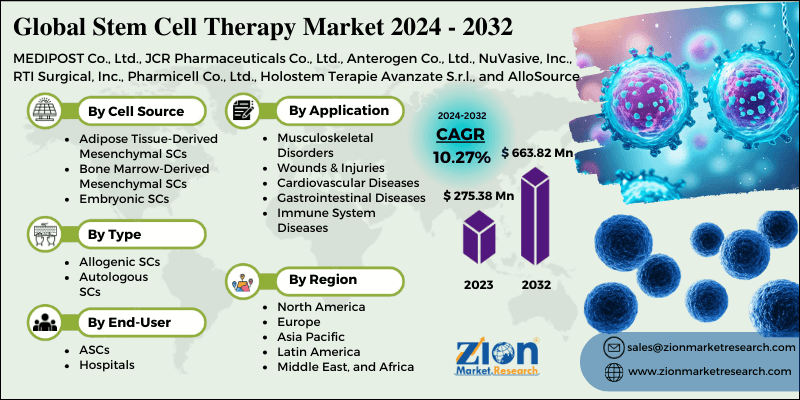
As per study of Zion Market Research, Stem Cell Therapy Market amassed proceeds worth nearly US$ 275.38 Million in 2023 and is anticipated to accrue returns of approximately US$ 663.82 Million by 2032. Moreover, Stem Cell Therapy market is prognosis to record CAGR of almost 10.27% in 2024 - 2032.
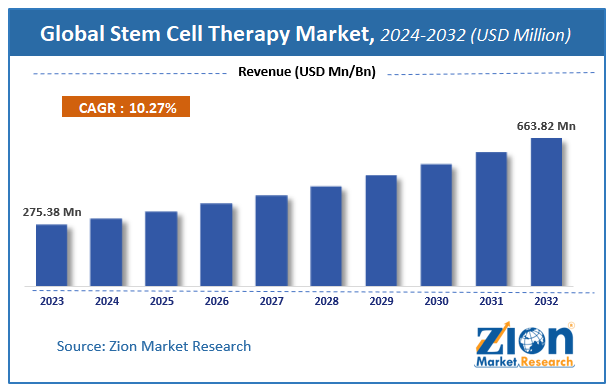
Furthermore, expansion of stem cell therapy market over assessment period is due to huge therapeutic potential possessed by stem cells. For instance, embryonic stem cells can develop into nearly 200 cell types in human body, thereby possessing huge therapeutic application potential.
Reportedly, adult stem cells have potential to provide autologous stem cell donation. Citing an instance, during autologous transplantations, beneficiaries get their own stem cells and thus avert risk of getting rejected by immune system of human body. Apart from this, adult stem cells are widely considered for stem cell treatment research. According to NIH researchers, induced pluripotent stem cells are adult stem cell tissues that are genetically reprogrammed to embryonic stem cells and thus can differentiate into any cell type in human body. Such moves can create lucrative growth avenues for stem cell therapy market.
Furthermore, stem cell therapies help in research on various kinds of diseases and new drug development, thereby driving market trends. Ability of embryonic stem cells in differentiating and self-replicating has made it a key source for treating degenerative disorders. Additionally, they can also be used for replacing damaged tissues of skin as well as other parts of human body. All these aforementioned aspects are likely to sketch a profitable landscape for stem cell therapy industry over upcoming years. However, social issues as well as ethical problems related to utilization of embryonic stem tissues and countries such as the U.S. banning use of these tissues for research has posed a threat to growth of stem cell therapy market. Moreover, though induced pluripotent stem cells provide new avenues for emergence of new cell-based treatments, they also create ethical issues pertaining to use of embryos for purpose of extracting stem cells. This will further put brakes on stem cell research activities, thereby hindering market expansion.
Allogenic stem cells To Dominate Type Segment Over 2024 – 2032
With risk of rejecting stems cells such as mesenchymal stem (or stromal) cells by human immune system being lesser in allogenic form, the segment is likely to gain traction over forthcoming years. Furthermore, clinical trials performed by NIH researchers on mice with type 2 diabetes revealed that injecting of allogenic epidermal stem cells into wounds resulted into reduction in healing period. Furthermore, clinical tests have proved that injecting of allogenic hUCB- mesenchymal stem (or stromal) cells in patients suffering from severe atropic dermatitis & psoriasis derived huge benefits and demonstrated clinical improvement without having severe side effects. As per NIH researchers, injecting of allogenic bone marrow derived stem cells for RDEB patients resulted in phenotypic improvement in health with exhibited massive reduction in tissue fragility and blistering. Moreover, these same children suffering from RDEB demonstrated improvement in wound healing, reduction in skin redness, high tolerance, and enhancement in quality of life after being treated with bone marrow derived MSCs.
North American Market To Register Massive Growth Over Forecast Period
Growth of stem cell therapy market in North America over assessment timespan is subject to increase in allocation of funds for stem cell research and huge research grants offered by government for same purpose. In addition to this, rise in number of clinical trials conducted by firms with a view to make effective use of stem cell therapy for treating incurable diseases is likely to proliferate size of stem cell therapy market in region. Presence of key players in countries such as the U.S. will translate into mammoth growth of industry in North America over coming years. Growing awareness among people about therapeutic potential of stem cell therapy is likely to translate into massive expansion of industry in sub-continent.
Moreover, ongoing research on stem cell treatment in various countries across globe projected to unleash new opportunities of growth for both biotechnology, pharmaceutical, and healthcare sectors. Apart from this, key players of industry are trying to focus more on conducting large number of clinical trials on patients and trying to find efficacy of stem cells in treating chronic as well as incurable diseases including cancer, diabetes, and skin disorders. This has opened new gateways for medical treatment domain, particularly regenerative medical treatment, cell therapies, new drug discovery & treatment, and personalized medical treatment.
Stem Cell Therapy Market: Report Scope
| Report Attributes | Report Details |
|---|---|
| Report Name | Stem Cell Therapy Market |
| Market Size in 2023 | USD 275.38 Million |
| Market Forecast in 2032 | USD 663.82 Million |
| Growth Rate | CAGR of 10.27% |
| Number of Pages | 110 |
| Key Companies Covered | MEDIPOST Co., Ltd., JCR Pharmaceuticals Co., Ltd., Anterogen Co., Ltd., NuVasive, Inc., RTI Surgical, Inc., Pharmicell Co., Ltd., Holostem Terapie Avanzate S.r.l., and AlloSource. |
| Segments Covered | By Cell Source, By Type, By End-User, By Therapeutic Application and By Region |
| Regions Covered | North America, Europe, Asia Pacific (APAC), Latin America, Middle East, and Africa (MEA) |
| Base Year | 2023 |
| Historical Year | 2018 - 2022 |
| Forecast Year | 2024 - 2032 |
| Customization Scope | Avail customized purchase options to meet your exact research needs. Request For Customization |
We have profiled some of these key players in our market research report including MEDIPOST Co., Ltd., Holostem Terapie Avanzate S.r.l., JCR Pharmaceuticals Co., Ltd., Anterogen Co., Ltd., Pharmicell Co., Ltd., NuVasive, Inc., RTI Surgical, Inc., and AlloSource.
Browse the full “Stem Cell Therapy Market- By Cell Source (Adipose Tissue-Derived Mesenchymal SCs, Bone Marrow-Derived Mesenchymal SCs, And Embryonic SCs), By Type (Allogenic SCs And Autologous SCs), By End-User (ASCs And Hospitals), And By Therapeutic Application (Musculoskeletal Disorders, Wounds & Injuries, Cardiovascular Diseases, Gastrointestinal Diseases, And Immune System Diseases): Global Industry Perspective, Comprehensive Analysis, And Forecast, 2024 – 2032.” Report at https://www.zionmarketresearch.com/report/stem-cell-therapy-market
The global Stem Cell Therapy Market is segmented as follows:
By Cell Source
- Adipose Tissue-Derived Mesenchymal SCs
- Bone Marrow-Derived Mesenchymal SCs
- Embryonic SCs
By Type
- Allogenic SCs
- Autologous SCs
By End-User
- ASCs
- Hospitals
By Therapeutic Application
- Musculoskeletal Disorders
- Wounds & Injuries
- Cardiovascular Diseases
- Gastrointestinal Diseases
- Immune System Diseases
By Region
- North America
- The U.S.
- Canada
- Europe
- France
- The UK
- Spain
- Germany
- Italy
- Rest of Europe
- Asia Pacific
- China
- Japan
- India
- South Korea
- Southeast Asia
- Rest of Asia Pacific
- Latin America
- Brazil
- Mexico
- Rest of Latin America
- Middle East & Africa
- GCC
- South Africa
- Rest of Middle East & Africa
About Us:
Zion Market Research is an obligated company. We create futuristic, cutting-edge, informative reports ranging from industry reports, the company reports to country reports. We provide our clients not only with market statistics unveiled by avowed private publishers and public organizations but also with vogue and newest industry reports along with pre-eminent and niche company profiles. Our database of market research reports comprises a wide variety of reports from cardinal industries. Our database is been updated constantly in order to fulfill our clients with prompt and direct online access to our database. Keeping in mind the client’s needs, we have included expert insights on global industries, products, and market trends in this database. Last but not the least, we make it our duty to ensure the success of clients connected to us—after all—if you do well, a little of the light shines on us.
Contact Us:
Zion Market Research
244 Fifth Avenue, Suite N202
New York, 10001, United States
Tel: +49-322 210 92714
USA/Canada Toll-Free No.1-855-465-4651
Email: sales@zionmarketresearch.com
Website: https://www.zionmarketresearch.com