

Advanced Air Mobility Market is projected to grow due to rising urban congestion and investment in electric aviation technologies
17-Mar-2026 | Zion Market Research
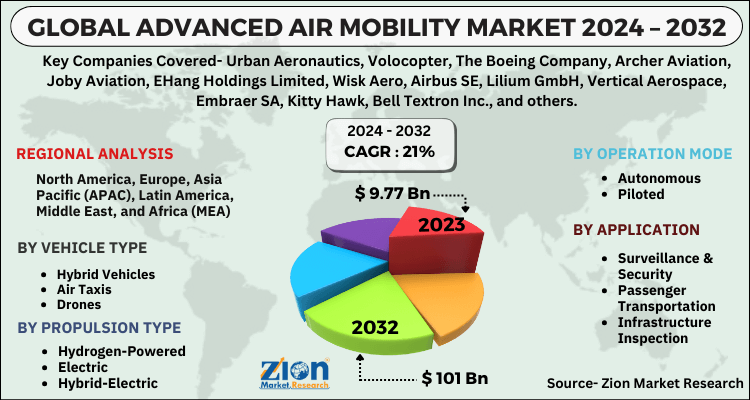
The global advanced air mobility market size was evaluated at $9.77 billion in 2023 and is slated to hit $101 billion by the end of 2032, with a CAGR of nearly 21% between 2024 and 2032.
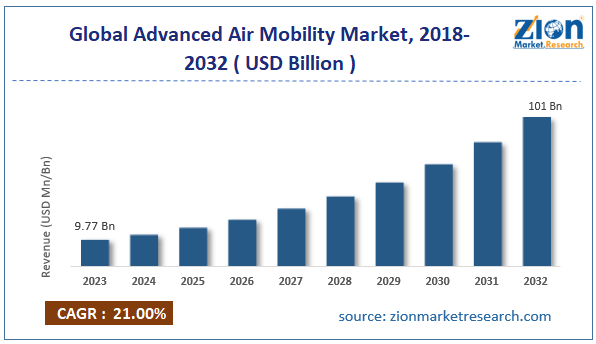
Advanced air mobility is a new form of transportation that uses small electric aircraft to move people and cargo over short- and medium-distance routes. These aircraft are usually electric or hybrid-electric and can take off and land vertically, so they do not need long airport runways. They can operate from small landing areas called vertiports, which can be installed on rooftops, in parking areas, or at dedicated city locations. Many of these aircraft are electric vertical takeoff and landing vehicles designed for safe and efficient urban travel. They use several small electric motors and rotors distributed around the aircraft instead of a single large engine. This design improves safety and helps control the aircraft during flight. The vehicles are powered by advanced batteries or, in some cases, hydrogen fuel cells. Smart flight software controls the motors and keeps the aircraft stable in the air. Advanced air mobility aims to provide air taxi services between city centers, airports, suburbs, and nearby towns. It can also support cargo delivery, medical transport, and emergency response services.
The growth of the global advanced air mobility industry is primarily driven by growing urban congestion, demand for faster transportation, advancements in electric aviation technology, and increasing investment in sustainable urban mobility solutions.
Browse the full “Advanced Air Mobility Market By Vehicle Type (Hybrid Vehicles, Air Taxis, and Drones), By Operation Mode (Autonomous and Piloted), By Propulsion Type (Hydrogen-Powered, Electric, and Hybrid-Electric), By Application (Surveillance & Security, Passenger Transportation, Infrastructure Inspection, and Cargo Delivery), and By Region - Global and Regional Industry Overview, Market Intelligence, Comprehensive Analysis, Historical Data, and Forecasts 2024 - 2032” Report at https://www.zionmarketresearch.com/report/advanced-air-mobility-market
Market Growth Factors
Several important factors are accelerating development and investment in the advanced air mobility market.
- Urban traffic growth: Rapidly growing cities face heavy road traffic, increasing interest in air taxis that can move passengers faster across urban areas.
- Electric aviation progress: Improvements in batteries, electric motors, and power electronics are making electric vertical takeoff aircraft more practical for short-distance passenger travel.
- Strong industry investment: Aerospace companies, venture investors, and governments are investing heavily in air mobility aircraft, vertiports, and supporting infrastructure.
Restraints
- Regulatory approval delays: Certifying new electric vertical takeoff aircraft under aviation safety regulations is complex and time-consuming.
- Battery limits: Current battery technology still limits the flight range and passenger capacity of many electric air mobility vehicles.
Advanced Air Mobility Market: Report Scope
| Report Attributes | Report Details |
|---|---|
| Report Name | Advanced Air Mobility Market |
| Market Size in 2023 | USD 9.77 Billion |
| Market Forecast in 2032 | USD 101 Billion |
| Growth Rate | CAGR of 21% |
| Number of Pages | 221 |
| Key Companies Covered | Urban Aeronautics, Volocopter, The Boeing Company, Archer Aviation, Joby Aviation, EHang Holdings Limited, Wisk Aero, Airbus SE, Lilium GmbH, Vertical Aerospace, Embraer SA, Kitty Hawk, Bell Textron Inc., and others. |
| Segments Covered | By Vehicle Type, By Operation Mode, By Propulsion Type, By Application, and By Region |
| Regions Covered | North America, Europe, Asia Pacific (APAC), Latin America, Middle East, and Africa (MEA) |
| Base Year | 2023 |
| Historical Year | 2018 to 2022 |
| Forecast Year | 2024 - 2032 |
| Customization Scope | Avail customized purchase options to meet your exact research needs. Request For Customization |
Market Segmentation
The advanced air mobility market can be segmented by platform type, operation mode, application, infrastructure type, and region.
Based on platform type, the advanced air mobility industry is segregated into electric vertical takeoff and landing aircraft, short takeoff and landing aircraft, and unmanned aerial vehicles for cargo. Electric vertical takeoff and landing aircraft are expected to dominate the market as they represent the core vehicle category attracting the greatest investment and regulatory attention from aviation authorities developing commercial air taxi certification pathways.
Based on operation mode, the advanced air mobility market is classified into piloted and autonomous operations. Piloted operations are expected to lead in the near term because aviation regulations in most major markets require certified pilots aboard commercial air taxi vehicles during the initial phases of market development, with autonomous operations expected to grow gradually as regulatory frameworks and public trust develop over time.
Based on application, the market is segmented into urban air taxi services, regional air mobility, cargo and logistics delivery, and emergency medical services. Urban air taxi services are expected to generate the largest revenue share as the primary commercial use case driving vehicle development, vertiport construction, and route planning by advanced air mobility companies and airline partners.
Based on infrastructure type, the market is divided into vertiports, charging infrastructure, air traffic management systems, and maintenance facilities. Vertiports are expected to play a critical role in market development, as dedicated landing and takeoff hubs that support passenger boarding, battery charging, and flight coordination for urban air mobility networks.
North America leads the global advanced air mobility market due to strong aerospace technology development, significant private investment, and supportive aviation regulations. The United States plays the most important role, with several leading companies developing electric vertical takeoff and landing aircraft for future urban air taxi services. Companies such as Joby Aviation, Archer Aviation, and Wisk Aero are actively testing aircraft prototypes and working toward commercial certification. Major airlines and transportation companies in the region are also partnering with air mobility developers to prepare future air taxi networks. The Federal Aviation Administration is developing regulatory frameworks to certify new aircraft types and ensure their safe integration into the national airspace system. Strong venture capital funding and government research support have accelerated innovation in electric propulsion systems, flight control software, and advanced aviation technologies. Several cities across North America are exploring vertiport development and planning for urban air mobility infrastructure. Growing interest in sustainable transportation and faster urban travel continues to strengthen the region’s leadership in the development of advanced air mobility.
Key Market Players
Leading companies operating in the global advanced air mobility market include:
- Urban Aeronautics
- Volocopter
- The Boeing Company
- Archer Aviation
- Joby Aviation
- EHang Holdings Limited
- Wisk Aero
- Airbus SE
- Lilium GmbH
- Vertical Aerospace
- Embraer SA
- Kitty Hawk
- Bell Textron Inc.
Recent Developments
- In January 2026, Archer Aviation advanced testing of its Midnight eVTOL aircraft, aiming to achieve FAA certification and support future urban air taxi networks in partnership with airlines and mobility providers.
- In March 2026, Joby Aviation began flight testing its first production-model electric air taxi in California, marking a major step toward regulatory approval and large-scale manufacturing of eVTOL aircraft for commercial operations.
The global advanced air mobility market is segmented as follows:
By Vehicle Type
- Hybrid Vehicles
- Air Taxis
- Drones
By Operation Mode
- Autonomous
- Piloted
By Propulsion Type
- Hydrogen-Powered
- Electric
- Hybrid-Electric
By Application
- Surveillance & Security
- Passenger Transportation
- Infrastructure Inspection
- Cargo Delivery
[Global]
[AboutUs]
[ContactUs]