

6G Market is projected to reach USD 57.54 billion during the forecast period
16-Mar-2026 | Zion Market Research
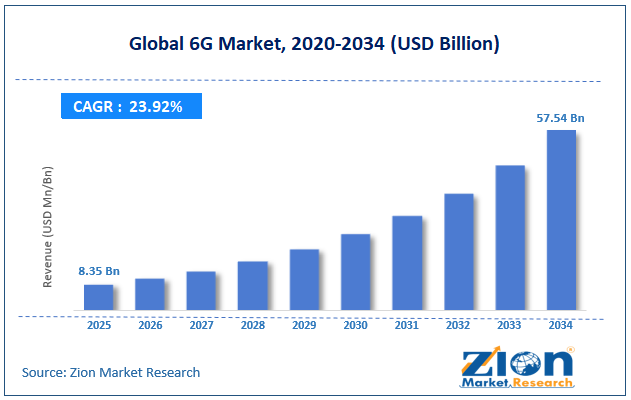
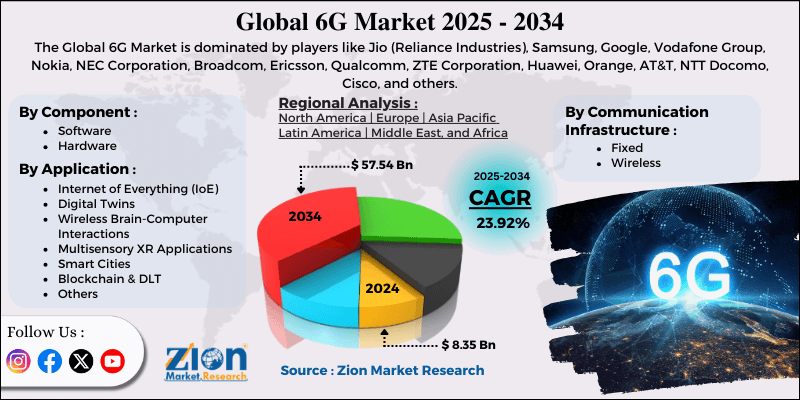
The global 6G market size was approximately USD 8.35 billion in 2025 and is projected to reach USD 57.54 billion by 2034, with a compound annual growth rate (CAGR) of approximately 23.92% between 2026 and 2034.
6G is the sixth generation of wireless communication technology designed to provide much faster internet speeds, extremely low delay, and smarter network performance than current mobile networks. It will follow 5G and is expected to greatly improve how devices, machines, and digital systems connect and communicate. Although 5G networks are still expanding across many countries, research organizations and technology companies are already developing 6G technology and global standards. 6G networks may support data speeds reaching nearly 1 terabit per second, which could be around one hundred times faster than existing 5G networks. These advanced networks will also work closely with artificial intelligence systems that can manage network traffic, improve connection quality, and respond automatically to changing user needs. 6G technology may use terahertz radio frequencies, advanced antenna systems, and new network designs to provide reliable connectivity in cities, rural regions, and remote locations.
The growth of the global 6G industry is primarily driven by the growing demand for ultra-fast wireless connectivity, the rapid expansion of connected devices, the increasing adoption of artificial intelligence and immersive technologies, and continuous investment in next-generation telecommunications infrastructure.
Browse the full “6G Market By Application (Internet of Everything (IoE), Digital Twins, Wireless Brain-Computer Interactions, Multisensory XR Applications, Smart Cities, Blockchain & DLT, and Others), By Component (Software and Hardware), By Communication Infrastructure (Fixed and Wireless), and By Region - Global and Regional Industry Overview, Market Intelligence, Comprehensive Analysis, Historical Data, and Forecasts 2026-2034” Report at https://www.zionmarketresearch.com/report/6g-market
Market Growth Factors
Several important factors are driving the development and commercialization of the 6G market.
- Increasing demand for ultra-fast connectivity: As digital services, cloud computing, and streaming applications continue to grow, networks require much higher speed and lower delay. This increases global demand for next-generation wireless technology to support future communication needs.
- Growing investment in artificial intelligence integration: 6G networks are being designed to work with artificial intelligence systems that can automatically manage network traffic and improve communication performance with minimal human control.
- Rising adoption of connected devices and smart infrastructure: The growing number of Internet of Things devices, smart cities, and autonomous systems requires stronger wireless networks than current technologies can provide.
Restraints
- Early stage of standardization and development: Global 6G standards are still being developed by technology groups and regulatory organizations, creating uncertainty about timelines, frequency of use, and final technical specifications.
- High infrastructure deployment costs: Building new wireless infrastructure capable of supporting terahertz frequencies requires large investments in base stations, advanced equipment, and spectrum licensing.
6G Market: Report Scope
| Report Attributes | Report Details |
|---|---|
| Report Name | 6G Market |
| Market Size in 2025 | USD 8.35 Billion |
| Market Forecast in 2034 | USD 57.54 Billion |
| Growth Rate | CAGR of 23.92% |
| Number of Pages | 221 |
| Key Companies Covered | Jio (Reliance Industries), Samsung, Google, Vodafone Group, Nokia, NEC Corporation, Broadcom, Ericsson, Qualcomm, ZTE Corporation, Huawei, Orange, AT&T, NTT Docomo, Cisco, and others. |
| Segments Covered | By Application, By Component, By Communication Infrastructure, and By Region |
| Regions Covered | North America, Europe, Asia Pacific (APAC), Latin America, the Middle East and Africa (MEA) |
| Base Year | 2025 |
| Historical Year | 2020 to 2024 |
| Forecast Year | 2026 - 2034 |
| Customization Scope | Avail customized purchase options to meet your exact research needs. Request For Customization |
Market Segmentation
The 6G market can be segmented by component, application, end user, and region.
Based on component, the market is divided into hardware, software, and services. Hardware components, including advanced antennas, base stations, and semiconductor chips, are expected to hold a dominant share, as physical infrastructure serves as the foundational layer on which all 6G network capabilities are built and delivered.
Based on application, the 6G market is categorized into enhanced mobile broadband, ultra-reliable low-latency communication, massive machine-type communication, and integrated sensing and communication. Ultra-reliable low-latency communication is projected to grow significantly as industries such as healthcare, automotive, and manufacturing depend on real-time data transfer for critical operations.
Based on end-user, the 6G industry is segmented into consumer electronics, healthcare, defense and government, automotive, and industrial automation. The defense and government segment is expected to hold a significant share, as national governments prioritize secure, advanced wireless communication networks for military, public safety, and strategic infrastructure applications.
North America leads the global 6G market because the region invests heavily in next-generation wireless research and advanced communication technologies. The United States plays the biggest role, as it hosts many of the world’s leading technology companies, research universities, and telecommunications firms working on early 6G development. Major companies such as Qualcomm, Intel, and other technology innovators are actively investing in new wireless technologies, artificial intelligence-driven networks, and advanced semiconductor development. Government organizations also support research through funding programs and national technology initiatives focused on future communication systems. This strong research and innovation ecosystem enables the region to develop new wireless technologies and early network prototypes more quickly. Canada also contributes through strong telecommunications research and partnerships between universities and technology companies. As a result, North America has become a major center for 6G research, wireless technology innovation, and next-generation communication infrastructure development.
Key Market Players
Leading companies operating in the global 6G market include:
- Jio (Reliance Industries)
- Samsung
- Vodafone Group
- Nokia
- NEC Corporation
- Broadcom
- Ericsson
- Qualcomm
- ZTE Corporation
- Huawei
- Orange
- AT&T
- NTT Docomo
- Cisco.
Recent Developments
- In March 2026, Ericsson and Türk Telekom announced a strategic research partnership to advance 6G standards and innovation, focusing on joint R&D projects and technology development to shape future telecom services.
- In March 2026, NVIDIA partnered with telecom companies, including Cisco, Ericsson, Nokia, Deutsche Telekom, SoftBank, SK Telecom, and T-Mobile, to develop AI-driven infrastructure platforms designed to support open and intelligent 6G network architectures.
The global 6G market is segmented as follows:
By Application
- Internet of Everything (IoE)
- Digital Twins
- Wireless Brain-Computer Interactions
- Multisensory XR Applications
- Smart Cities
- Blockchain & DLT
- Others
By Component
- Software
- Hardware
By Communication Infrastructure
- Fixed
- Wireless
[Global]
[AboutUs]
[ContactUs]